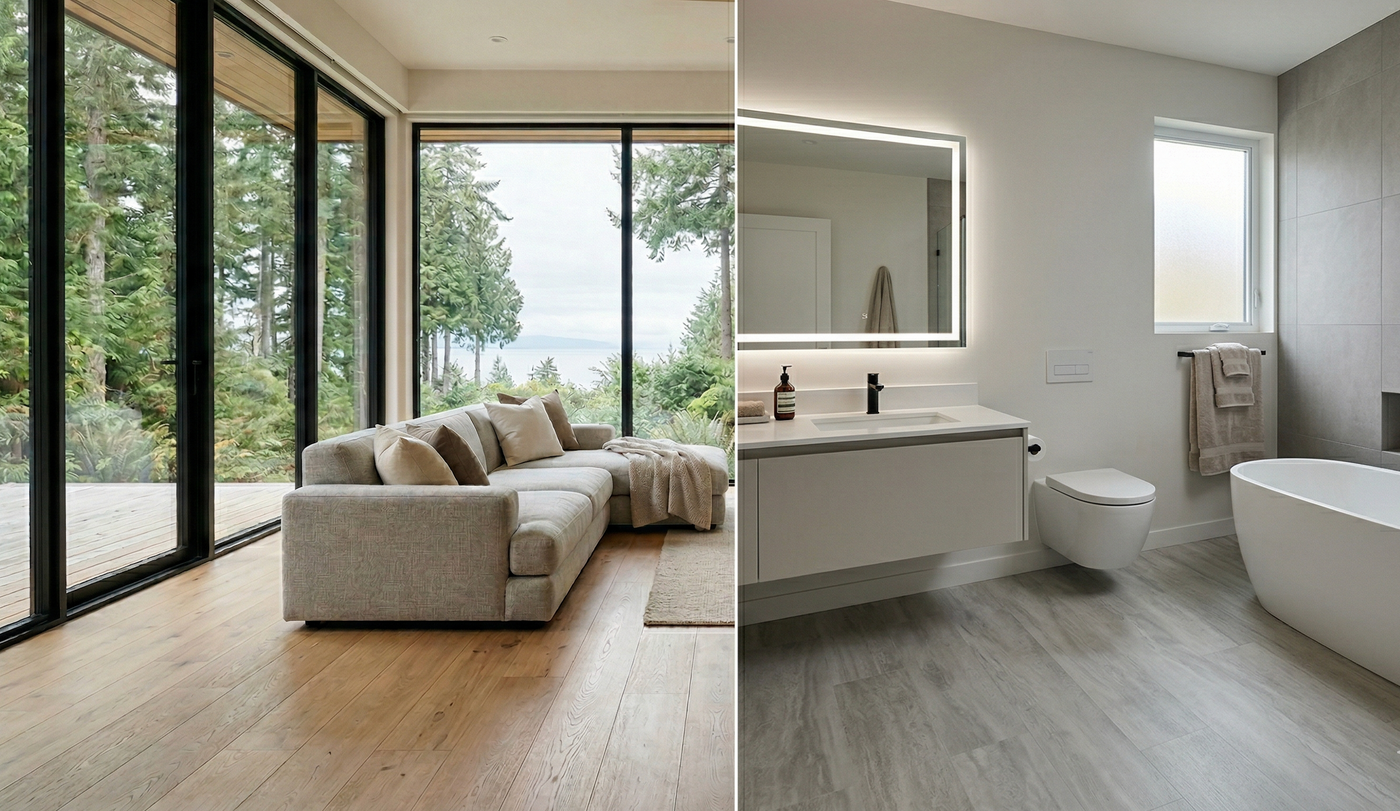
At a basic level, engineered hardwood is a real wood surface layered over a stable core, while vinyl flooring is a fully synthetic product designed for durability and water resistance.
That distinction matters, but not in the way most people think.
The real difference shows up after the floor is installed. Engineered hardwood is chosen for how a space feels. Vinyl flooring is chosen for how a space performs once people start living on it.
Those are not the same goal, and most bad decisions come from treating them like they are.
In Canada, flooring doesn’t live in controlled conditions. It deals with tracked-in snow, water that sits longer than it should, and constant swings between dry winters and more humid seasons. These aren’t edge cases. They’re normal.
Engineered hardwood is more stable than solid wood, but it is still a wood product. It reacts to its environment. Not always immediately, but gradually, and usually in the exact areas you use the most.
Vinyl flooring takes a different approach. It is designed to ignore those conditions. Water doesn’t affect it. Seasonal changes have minimal impact. It is built for consistency, not sensitivity.
That difference becomes more important over time.

What actually looks better?
Engineered hardwood has traditionally been the benchmark because it is real wood. It brings natural variation, depth, and a surface that changes subtly with light and use.
But that gap has narrowed significantly.
High-quality vinyl flooring, particularly wide plank WPC products with strong colour work and embossed-in-register surfaces, can now compete visually in a way that wasn’t true even a few years ago. In some spaces, especially more modern interiors, it can look just as good, and in certain cases, cleaner and more intentional.
Where engineered hardwood still has an edge is in natural inconsistency. Every board is slightly different, and that randomness creates a look that feels organic over time.
Vinyl is more controlled. That can work for or against it. In some homes, it reads as flat. In others, it feels refined.
At this level, the better-looking floor is no longer decided by category. It comes down to the specific product and the space you’re designing.

Where vinyl flooring quietly wins
This is where most decisions should actually be made.
Vinyl flooring doesn’t win because it looks better. It wins because it removes problems.
In real homes, floors take abuse. Dogs run across them every day. Chairs get dragged in and out without much thought. Water gets tracked in and doesn’t always get cleaned up immediately. Entryways take repeated impact, especially through the winter.
Engineered hardwood can handle some of this, but not all of it, and not consistently over time. What typically happens is the floor looks great early on, then slowly starts to show wear in the exact areas you use the most.
Most engineered hardwood failures aren’t product issues. They’re lifestyle mismatches.
Vinyl flooring is built for that reality. It doesn’t require you to change how you live. It simply holds up.
That’s the real trade-off.
You’re giving up some natural variation in exchange for a floor that you don’t have to think about once it’s installed.
Is engineered hardwood risky?
Not if it’s used in the right place.
The issue is not the product. The issue is where people install it.
Engineered hardwood works well in living rooms, bedrooms, and spaces where moisture is controlled. It becomes a risk when it’s pushed into kitchens with regular spills, entryways with wet boots, or basements with any moisture history.
The problem is that these issues don’t show up immediately. The floor can look perfect for months, even years, before wear starts to appear.
By that point, the decision is already locked in.
Vinyl flooring reduces that risk by design. It is far less sensitive to where it’s installed, which gives it a wider margin for error.
What about condos in Canada?
In many condos, vinyl flooring is simply the more practical choice.
It tends to meet sound requirements more easily, handles small leaks or spills without damage, and reduces long-term maintenance concerns.
Engineered hardwood can absolutely be used in condos, but it requires more discipline. Better installation, more care, and less margin for error.
For many condo owners, vinyl ends up being the safer decision.

Which one lasts longer?
Both can last a long time, but they fail in different ways.
Vinyl flooring resists wear and tends to look consistent over time. When it reaches the end of its life, it is replaced.
Engineered hardwood can show wear earlier, especially in high-traffic areas. The trade-off is that some products can be refinished, which can extend their lifespan.
The common assumption is that wood always lasts longer. In practice, that depends heavily on where it’s installed.
In many Canadian homes, vinyl flooring outlasts it simply because it is better matched to the conditions.
So what should you actually do?
The simplest way to get this right is to match the product to the space.
Use engineered hardwood where appearance is the priority and the environment is controlled.
Use vinyl flooring where performance, durability, and water resistance matter more, especially in areas that see daily use.
Most well-designed homes don’t choose one or the other. They use both, each in the areas where they make the most sense.
Trying to force one product across every room is where most problems start.
FAQ
Is engineered hardwood better than vinyl flooring?
It depends on the goal. Engineered hardwood offers a more natural look, while vinyl flooring performs better in high-moisture and high-traffic environments.
Can engineered hardwood be used in kitchens?
Yes, but it comes with trade-offs. Spills need to be cleaned quickly, and long-term wear should be expected.
Is vinyl flooring a lower-quality option?
No. High-quality vinyl flooring is designed to solve real-world problems. In many Canadian homes, it is the more practical choice.
Contact us for help choosing a floor