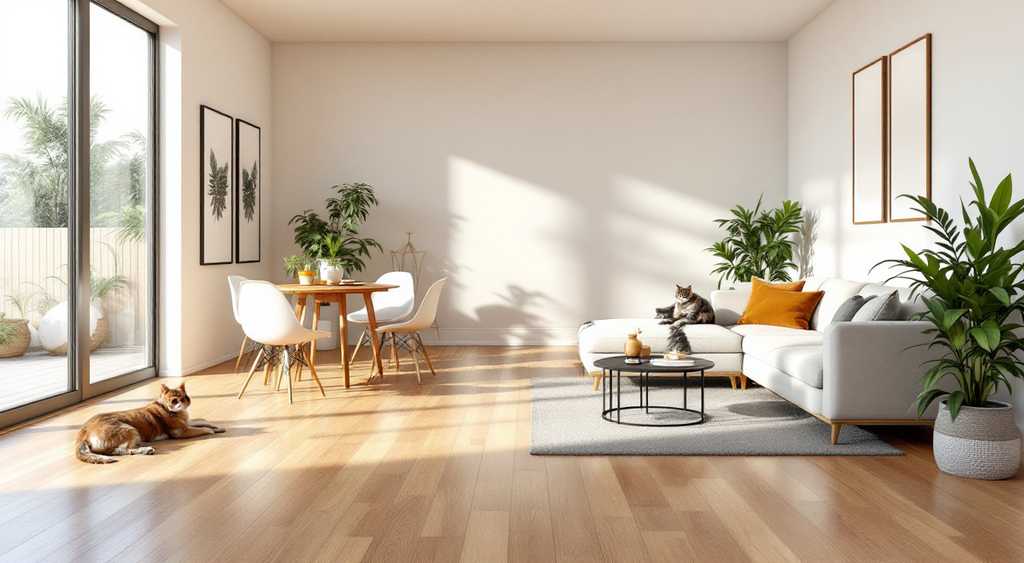
Engineered hardwood can work well in a home with pets, provided the owner accepts a few honest trade-offs around scratches, moisture, and upkeep. It is not the most damage-proof flooring option on the market, but with routine nail care and a few protective habits, most pet households find the real-wood surface holds up better than they expect.
Is Engineered Hardwood a Good Choice for Pet Owners?
Yes, for most pet households, with two caveats: claws will eventually leave fine surface marks on any hardwood, and the wood veneer reacts to standing moisture in a way a fully sealed surface does not. Engineered hardwood is not the toughest option against pet wear, but it offers something few alternatives do, a real wood surface that can be sanded and refinished later if the look starts to fade.
The honest answer depends on the pets in the home. A single, well-groomed indoor cat is a very different wear scenario than three large dogs that come in from the yard daily. The material can suit both, but the level of maintenance required is not the same.

How Do Pet Claws Actually Affect an Engineered Hardwood Floor?
Pet claws create fine surface scratches on any real wood floor over time. This is a normal characteristic of hardwood, engineered or solid, not a sign of a defective product or a poor finish.
No wear layer thickness, finish hardness, or veneer grade makes a wood floor immune to this. The only way to meaningfully reduce claw marking is physical prevention, not a product spec. Two habits matter more than anything else:
- Keep nails trimmed short and rounded on a regular schedule. Long or split nails are what actually gouge a wood surface, not normal paw contact.
- Place a low-pile rug or runner along the main paths pets use every day, particularly from an entry door to the rest of the home, and in front of food and water bowls.
These two steps are worth doing regardless of which flooring a home has. They are the difference between a floor that shows its age gracefully and one that looks worn within a year or two.

What Happens When Pets Track in Water, Mud, or Accidents?
Engineered hardwood's real wood surface is not water-resistant, and it should never be treated as if it were. Standing moisture from a knocked-over water bowl, muddy paws, or a housetraining accident can cause the wood surface to swell, cup, or discolour if it sits for any length of time.
The fix is simple and non-negotiable: wipe up any liquid promptly, and avoid placing water and food bowls directly on bare engineered hardwood without a mat or tray underneath to catch spills. A washable mat under the feeding station protects the floor and is easier to clean than the floor itself.
Homes with multiple large dogs, frequent accidents during housetraining, or a genuinely wet climate around entry points should weigh this limitation seriously. For those specific situations, waterproof flooring such as WPC vinyl flooring or tile removes the moisture risk entirely rather than managing around it. That is a fair trade to consider before committing to real wood in a high-moisture pet zone.
Engineered Hardwood vs WPC Vinyl Flooring for a Pet Household
The honest comparison below covers the two hard-surface options pet owners weigh most often. Neither wins outright. Each answers a different priority.
| Factor | Engineered Hardwood | WPC Vinyl Flooring |
|---|---|---|
| Surface material | Real wood veneer over an engineered core | Printed decorative layer under a clear protective wear layer |
| Visible claw marks over time | Fine scratches can show on the wood grain, more noticeable on dark or high-gloss finishes | Textured, embossed surfaces and matte finishes tend to hide light surface marks more easily |
| Water bowls, mud, and accidents | Standing moisture must be wiped up quickly; the wood surface can swell or discolour if neglected | A fully waterproof core tolerates spills and accidents without swelling, provided seams and edges stay sealed |
| Recovery from wear | Can typically be sanded and refinished, often more than once, to restore the surface | Cannot be sanded; a damaged plank is replaced rather than repaired |
| Underfoot feel | Warm, traditional wood feel and sound | A comfortable feel with an attached pad, generally quieter underfoot than hardwood |
Engineered hardwood wins on long-term recoverability and authentic wood character. WPC vinyl flooring wins on moisture tolerance and lower day-to-day risk. A household with one calm, well-trained pet and a dry climate may never notice the difference. A household with several active dogs and a muddy yard will feel it within the first year.
Does Wood Species or Finish Sheen Change How Scratches Show?
Yes, though the effect is mostly cosmetic rather than a true durability difference. Harder wood species such as oak or hickory generally resist denting a little better than softer species such as pine, cherry, or walnut, but hardness alone does not stop fine claw scratches from appearing on any of them.
Finish sheen matters more for how visible existing marks are than for whether they happen at all. A matte or low-sheen finish, and a wire-brushed or hand-scraped surface texture, both scatter light in a way that hides fine surface scratches far better than a high-gloss finish, which reflects light evenly and makes every mark stand out. Darker, more uniform stains also tend to show pale claw marks more readily than a lighter, more variegated colour with natural grain movement.
Can a Scratched or Dented Engineered Hardwood Floor Be Fixed?
In most cases, yes. This is engineered hardwood's real advantage over surface-printed alternatives: a worn or scratched floor can typically be sanded down and refinished, restoring an even surface, rather than requiring full replacement.
The National Wood Flooring Association's refinishing guidelines set a clear, flat threshold for this: if the remaining wear layer is less than 3/32 inch (2.5mm), the floor should not be sanded again. A typical refinishing pass removes about 1/32 inch (0.8mm) of material, rising to roughly 1/16 inch (1.6mm) for a heavier correction job addressing deeper scratches or unevenness. Premium engineered hardwood products commonly use a veneer of around 4mm, which clears that 2.5mm sanding threshold with meaningful margin, while some budget-tier products use veneers as thin as 1.5 to 2mm and may not tolerate even one full refinish. Checking the veneer thickness before buying is worth the five minutes it takes, specifically for households planning around pet wear.
Solid hardwood can typically be refinished more times over its life than engineered hardwood, since the entire board is real wood rather than a wear layer over a core. Engineered hardwood's usual one to two refinishing passes are still enough to meaningfully extend a pet-worn floor's life, which is more recovery potential than a printed vinyl or laminate surface offers.
How to Protect Engineered Hardwood in a Pet Household
None of these steps require replacing the floor. They are the practical difference between a floor that ages well and one that does not.
- Trim pet nails on a consistent schedule, and keep dewclaws trimmed as well since they are easy to miss.
- Use low-pile rugs or runners on main pet pathways and in front of feeding stations, with a washable mat or tray directly under water and food bowls.
- Wipe up spills, muddy tracking, and accidents as soon as they happen rather than letting moisture sit.
- Keep a felt furniture pad under any pet bed frame, crate, or heavy stand that stays in one spot for long periods.
- Choose a matte or low-sheen finish and a wood species or stain with some natural colour variation if scratch visibility is a top concern.

Frequently Asked Questions
These are the questions pet owners most often ask once they have decided engineered hardwood is otherwise the right style and budget fit for their home.
Do certain dog breeds damage engineered hardwood more than others?
Larger, heavier dogs and breeds that are harder to keep nails trimmed on tend to leave more visible wear over time, but nail care habits matter more than breed alone. A large, well-groomed dog with regularly trimmed nails is often gentler on a floor than a smaller dog whose nails are left long.
Is engineered hardwood better than solid hardwood for a home with pets?
For most pet households, yes, mainly because of stability rather than scratch resistance. Engineered hardwood's plywood or cross-laminated core is generally more dimensionally stable through humidity swings than solid hardwood, which matters in homes with water bowls, higher humidity, or a damp climate. The visible wood surface on both products is real wood, so claw-scratch behaviour is similar between them.
Does a matte finish really hide pet scratches better than a glossy one?
Yes. A matte or low-sheen finish scatters light unevenly, which makes fine surface scratches far less noticeable than they are under a high-gloss finish that reflects light evenly across the whole surface. This is a cosmetic effect, not a change in how easily the floor actually scratches.
Do I need a special flooring product for a multi-pet household?
Not a single special product, but a combination of the right material trade-offs and consistent protective habits. A home with several active pets should weigh moisture exposure and refinishing potential carefully before choosing between engineered hardwood and a fully waterproof alternative, since the right answer depends on the specific pets and their habits, not a one-size-fits-all product recommendation.
For more on managing wear across multiple pets, see our guide to flooring for multi-pet households and our honest look at what to expect from pet-friendly floors. For more on the recovery potential discussed above, see can engineered hardwood be refinished. For the fuller moisture picture, see is engineered hardwood waterproof, and for a broader material comparison, see engineered hardwood vs laminate. For a full overview of choosing engineered hardwood generally, see our engineered hardwood buyer's guide.
Contact us if you have questions about choosing the right floor for your household.
To find waterproof vinyl flooring, click here for a Caledon Floors dealer near you.