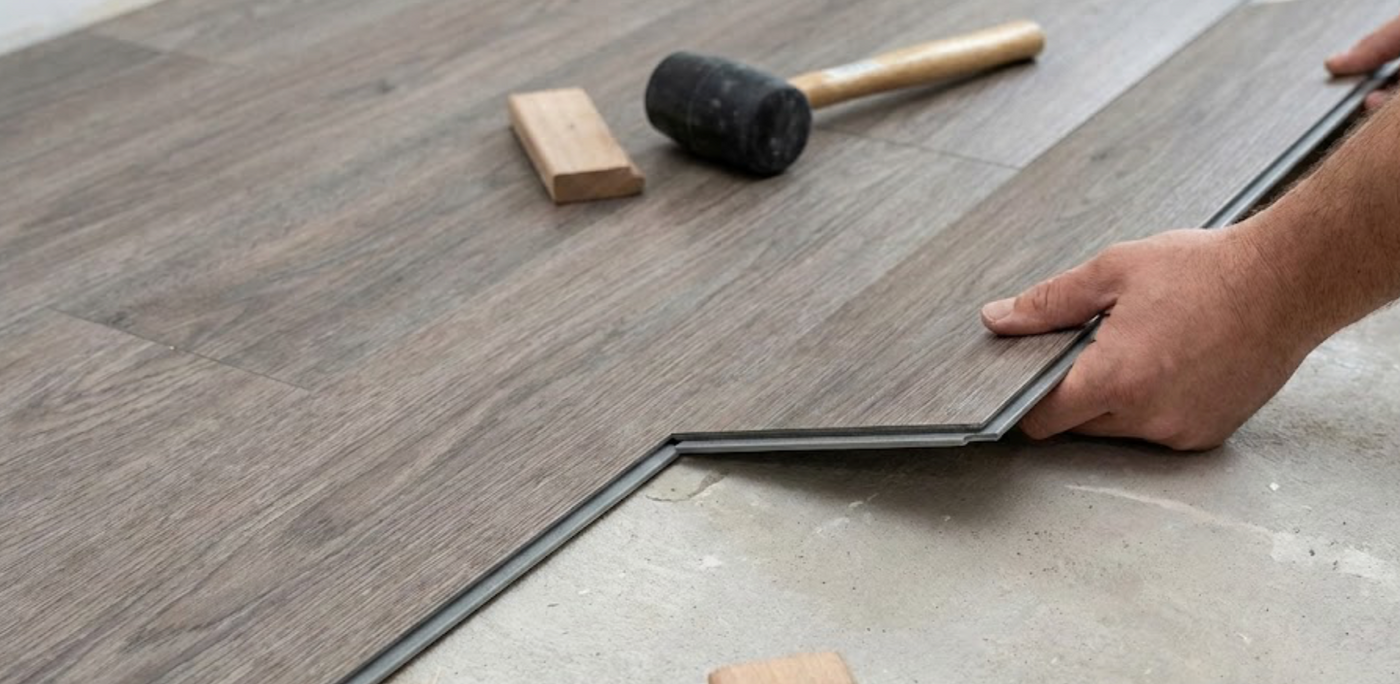
When shopping for vinyl flooring, two terms come up again and again: SPC and WPC vinyl flooring. Both are considered rigid core vinyl, both are often described as waterproof, and both are widely used in modern homes. Despite similar appearances, SPC and WPC behave differently once installed, and the difference that matters most depends on what a specific room actually demands.
Understanding those differences helps homeowners choose a floor that not only performs well on paper, but also feels right day to day.

What Do SPC and WPC Vinyl Flooring Mean?
SPC and WPC describe the core construction of rigid vinyl flooring, not the surface design.
SPC stands for stone plastic composite.
WPC is the other common rigid core type, built around a lighter foamed composite core.
Both flooring types typically include a wear layer, a printed design layer, a rigid core, and a backing or attached underlay. The core composition affects stability, comfort, sound, and how the floor responds to subfloor conditions.
What Is SPC Vinyl Flooring?
SPC vinyl flooring uses a dense, mineral-reinforced core designed for maximum dimensional stability. The rigidity of the core makes SPC resistant to expansion and contraction, which is why it is commonly used in environments where temperature variation and concrete subfloors are factors.
SPC vinyl flooring is often chosen for basements, condos, and installations directly over concrete slabs. It provides predictable performance and resists movement well, even in challenging conditions.
Because of its density, SPC tends to feel firm underfoot. While durable and stable, it does not offer much cushioning or warmth compared to other vinyl options.
What Is WPC Vinyl Flooring?
WPC vinyl flooring uses a lighter foamed composite core that creates a thicker plank with an attached pad. Both are rigid vinyl, but WPC behaves differently from SPC once installed, mainly in how it feels and sounds underfoot.
WPC flooring typically feels warmer and quieter underfoot than SPC. The thicker construction helps absorb sound and reduce foot fatigue, which is noticeable in living rooms, bedrooms, and family spaces.
WPC is often selected because it offers a more comfortable and residential feel compared to denser rigid core options.
SPC vs WPC Vinyl Flooring: Key Differences
| Feature | SPC Vinyl Flooring | WPC Vinyl Flooring |
|---|---|---|
| Core rigidity | Very rigid | Rigid |
| Underfoot feel | Firm | Warmer and quieter than SPC |
| Stability | Extremely high | High with proper prep |
| Performance over concrete | Excellent | Good if slab is well prepared |
| Sound absorption | Moderate | Generally better |
| Resistance to point-load denting | Stronger under a genuinely aggressive, sustained point load (see below) | Durable rigid core; only softer relative to SPC, and only relevant under the same sustained point-load scenarios (see below) |
| Typical thickness | Thinner | Thicker |
| Common use cases | Basements, condos, concrete slabs | Living areas, bedrooms, comfort-focused spaces |
The trade-offs behind each row, including denting resistance, are covered in the sections below.
How Do SPC and WPC Perform in Real Homes?
Homes place unique demands on flooring depending on climate and construction. Cold concrete slabs, seasonal temperature swings, multi-level construction, and a preference for barefoot living all influence how a floor feels and performs over time.
While both SPC and WPC can work well, these conditions often make comfort, sound absorption, and warmth more noticeable factors than raw rigidity.

Is SPC or WPC Better Over Concrete?
SPC vinyl flooring performs very well over concrete slabs, which is why it is frequently recommended for basements. Its rigidity and dimensional stability help it handle temperature variation and slab conditions predictably.
WPC vinyl flooring can also be used in basements, but it performs best when the slab is flat, dry, and properly prepared. Moisture evaluation and subfloor preparation are especially important when installing WPC below grade.
In most basements, SPC remains the more forgiving choice.
Is SPC or WPC Better for Living Areas and Upper Floors?
In above-grade living spaces, priorities often shift from maximum stability to comfort and sound.
WPC vinyl flooring offers a warmer feel underfoot and absorbs sound more effectively. These qualities make it popular for living rooms, bedrooms, and open-concept spaces where people spend long periods standing or walking.
SPC can still be used upstairs, but many homeowners notice the firmer feel, especially in rooms designed for comfort rather than durability alone.
Which Is Quieter and More Comfortable, SPC or WPC?
Sound transmission is a major concern in condos and multi-level homes. WPC flooring generally performs better acoustically due to its thicker construction and attached pad.
SPC flooring can meet sound requirements, but often relies more heavily on underlay systems and strict installation standards. In real-world residential use, WPC tends to feel quieter underfoot.
Why Thickness Often Matters More Than SPC vs WPC
Many homeowners focus on whether a floor is labelled SPC or WPC, but overall thickness and construction quality often have a greater impact on comfort and satisfaction.
A thick WPC vinyl floor typically provides better comfort, improved sound absorption, and a warmer feel over both concrete and framed subfloors. Thicker planks can also be more forgiving of minor subfloor imperfections.
Thin SPC floors, while stable, can feel hard and transmit sound more easily. In homes where cold floors and sound transfer are common concerns, these differences are noticeable.
At the same time, a thin WPC floor may not outperform a well-built SPC product. Core type should always be evaluated alongside thickness, wear layer, and subfloor conditions. For the full mil-by-mil breakdown of wear layer thickness, see how to choose the right wear layer for vinyl flooring.
Are SPC and WPC Vinyl Flooring Actually Waterproof?
Both SPC and WPC vinyl flooring are typically waterproof at the plank or tile level. This means the material itself does not absorb water or swell like wood-based products.
However, waterproof flooring does not prevent water from reaching the subfloor. Installation details around toilets, tubs, edges, and transitions still matter, as do leaks and standing water.
Good installation practices remain essential regardless of core type. For more on where marketing language about waterproof vinyl gets loose, see common myths about vinyl flooring, debunked.
How Long Do SPC and WPC Vinyl Flooring Last?
Neither SPC nor WPC vinyl flooring is automatically more durable than the other. Durability depends on wear layer thickness, locking system quality, subfloor preparation, and daily use patterns.
Both SPC and WPC vinyl flooring typically last between 15 and 30 years when properly selected and installed.
Does Core Type Affect Denting Under a Desk Chair or Heavy Furniture?
Yes, but only in one narrow scenario. WPC is a durable rigid core, and normal furniture and daily use are not a denting concern. Under an aggressive, sustained point load, such as an office chair's casters or feet bearing weight for hours every day, or a piano, SPC's denser core resists denting better, and even then the answer is protection with a chair mat or felt pads. WPC's advantage is comfort: it is warmer and quieter underfoot than the harder, colder SPC.
Neither core is universally better. A living room or bedroom with normal furniture and foot traffic rarely stresses this difference. A home office with a daily-use rolling desk chair, or any room with a heavy stationary object like a piano or a fixed barstool used for hours daily, is exactly the scenario where it matters, and it is a genuine case where SPC, not WPC, is the more durable answer.
Whichever core is chosen, a hard plastic chair mat under the full range of motion of a rolling chair is mandatory, not optional, and a felt furniture protector pad belongs under the legs of any stationary chair used for hours daily. No core thickness or wear layer spec is a substitute for that protection. It is not a matter of if, only a matter of when.
ASTM F3261, the specification covering modular resilient flooring with a rigid polymeric core, governs this category of construction, the rigid core shared by both SPC and WPC, and sets the material, manufacturing, and performance testing framework the category is built against. It does not certify that any single product resists a specific household's chair or furniture, which is why physical protection stays mandatory regardless of core type.
Is SPC or WPC Better for a Condo?
Condo bylaws often influence flooring choices. SPC is commonly used because it performs well over concrete and offers predictable stability.
WPC is often preferred where sound reduction and comfort are priorities, provided the subfloor is well prepared and building requirements are met.
Always confirm acoustic ratings, underlay requirements, and installation rules before purchasing flooring for a condo.
Is SPC or WPC Better for Homes With Pets?
Both SPC and WPC can perform well in homes with pets. Wear layer thickness, grit control, and furniture protection typically have more impact on appearance than core type alone.
SPC resists joint movement well in busy households. WPC improves comfort but does not eliminate the need for proper floor care.
Which Is Better: SPC or WPC Vinyl Flooring?
For most everyday living spaces, WPC vinyl flooring tends to be the more comfortable overall choice. Its thicker construction and attached pad absorb sound and feel warmer underfoot, which matters most in living rooms, bedrooms, and other rooms where people spend long stretches standing or walking.
That is not a universal answer. A room with a specific, ongoing demand, such as a home office with a daily-use rolling desk chair, a heavy stationary object, or a basement slab needing maximum dimensional stability, points toward SPC instead. SPC's denser, more rigid core resists concentrated point-load denting better and performs more predictably over concrete, even though it trades away some of WPC's comfort and sound absorption.
The honest answer depends on what a specific room actually demands, not on which core sounds more premium. Match the room's real traffic, moisture exposure, and point-load pattern to the core built to handle it, then evaluate thickness and wear layer within that choice.
Which Vinyl Core Should You Actually Buy? A Practical Hierarchy
For a general living space with no unusual point-load or moisture demand, many installers and homeowners view vinyl flooring options in this order for comfort and long-term satisfaction:
-
High-quality, thick WPC vinyl flooring
-
Well-built SPC vinyl flooring
-
Thin WPC vinyl flooring
-
Entry-level or thin SPC products
This ranks comfort and long-term satisfaction for a typical living space. It is not a ranking for durability under concentrated point loads or performance over concrete. A home office with a daily-use rolling chair, or a basement slab installation, should be evaluated against the sections above instead of this general list.
Final Thoughts
SPC and WPC vinyl flooring are not interchangeable products.
SPC excels where stability over concrete, temperature control, and resistance to concentrated point-load denting are critical. WPC, especially in thicker constructions, offers a warmer, quieter, more comfortable experience for everyday living spaces.
Match the core to the room's real demands rather than a general preference, and evaluate thickness and wear layer within whichever core fits. For the full vinyl plank flooring buyer's guide, covering wear layers, certifications, and cost alongside core type, see Vinyl Plank Flooring: The Complete Buyer's Guide. Want to learn more about vinyl flooring types, costs, and waterproofing specifically? Click here.
Frequently Asked Questions
These are the specific questions people ask most often when comparing SPC and WPC vinyl flooring. Each answer is short enough to stand alone.
Is WPC or SPC Vinyl Better?
Neither wins outright. WPC is a durable rigid core that is warmer and quieter underfoot, and normal furniture is not a denting concern. SPC's denser core resists denting better only under an aggressive, sustained point load such as a daily-use desk chair or a piano, though it feels harder and colder underfoot. The better choice depends on the room's actual traffic, moisture exposure, and point-load pattern, not which core sounds more premium.
Is SPC or WPC More Durable?
Durability depends more on wear layer thickness, locking system quality, subfloor preparation, and daily use patterns than on core type alone. Both SPC and WPC vinyl flooring typically last between 15 and 30 years when properly selected and installed. Where they differ is in what kind of stress each resists best: SPC resists concentrated point-load denting better, while WPC resists sound transmission and feels warmer underfoot.
Does SPC or WPC Resist Dents Better?
Only under an aggressive, sustained point load, such as an office chair's casters or a piano, does SPC's denser core resist denting better than WPC's rigid core. In normal residential use WPC is a durable rigid core and denting is not a concern. Neither core removes the need for a chair mat or furniture pad under daily, sustained contact.
Which Is Better for a Home Office or Heavy Furniture?
A room with a daily-use rolling desk chair or another heavy, stationary object is one of the few cases where SPC is the honest answer over WPC, because its rigid core resists concentrated point-load denting better. A hard plastic chair mat or a felt furniture protector pad is still required under sustained contact regardless of which core is chosen.
Is SPC or WPC Better Over Concrete?
SPC generally performs better directly over concrete slabs. Its rigid, dense core handles temperature variation and slab conditions more predictably, which is why it is frequently recommended for basements. WPC can also be installed over concrete, but it depends more on the slab being flat, dry, and properly prepared.
Is WPC or SPC Better for a Condo?
It depends on the priority. SPC is commonly used in condos because it performs well over concrete and offers predictable stability. WPC is often preferred where sound reduction and comfort matter most, provided the subfloor is well prepared and the building's requirements are met.
Contact us for help choosing a floor.
To find waterproof vinyl flooring, click here for a Caledon Floors dealer near you.