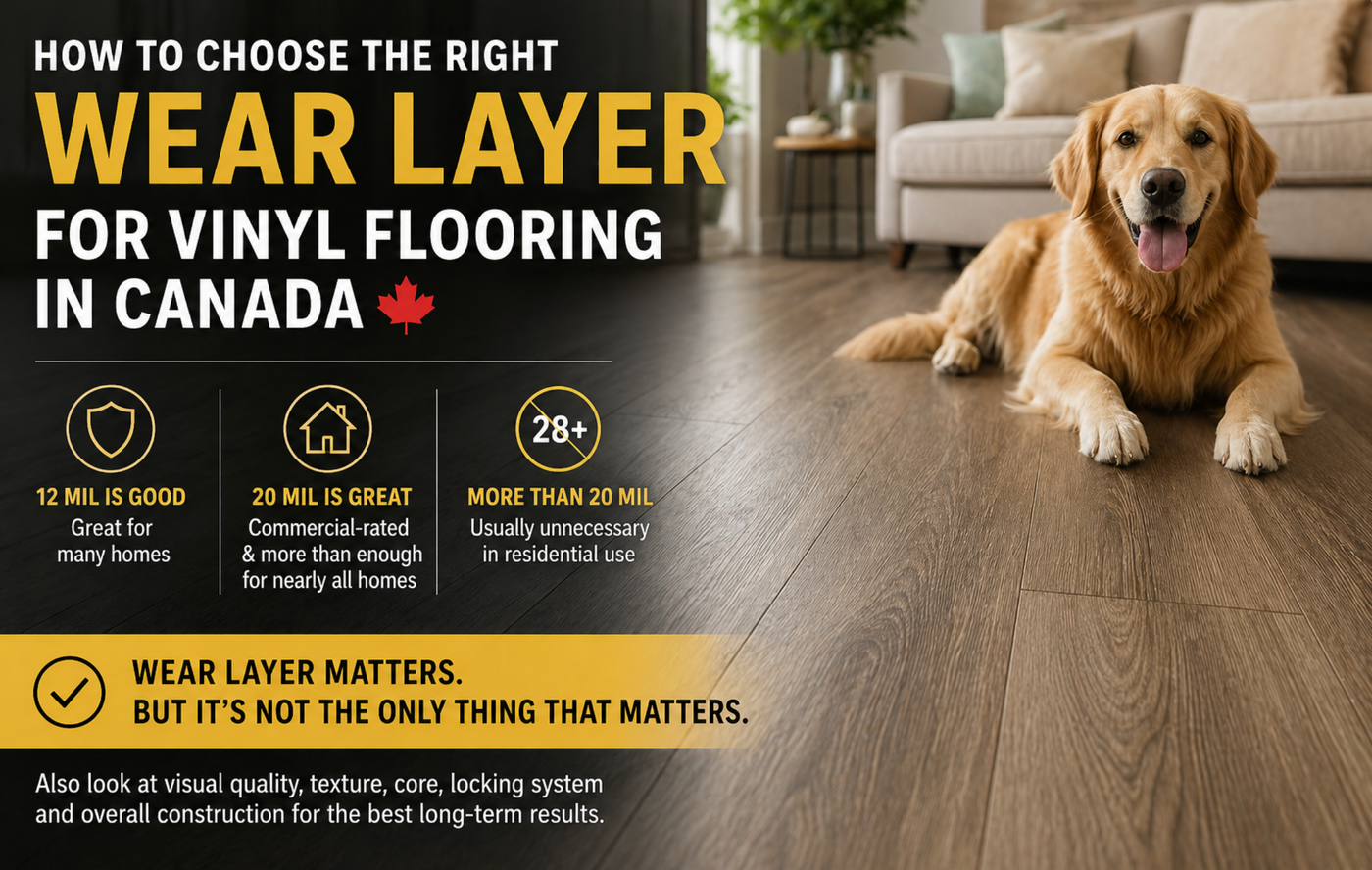
If you are shopping for vinyl flooring, one of the first specs you will see is the wear layer. It gets talked about constantly, and many buyers come away with one simple takeaway: bigger must be better.
That is not the right way to think about it. The better question is not, "What is the thickest wear layer I can find?" The better question is, "What wear layer is actually right for my home?" In most Canadian homes, 12 mil is already a good wear layer. A 20 mil wear layer is great. In fact, it is already commercial-rated and more than enough for nearly all residential use, even in very busy homes. Once you go above that, the number often sounds more impressive than it is useful.
That does not mean wear layer does not matter. It does. But homeowners often over-focus on the number and under-focus on the rest of the floor. A vinyl floor is not just a wear layer. Visual quality matters. Construction matters. Locking system matters. Core matters. Underfoot feel matters. The smartest buyer understands all of that and buys accordingly.
What a Wear Layer Actually Does
The wear layer is the clear top protective layer above the printed image of the floor. Its job is to help protect the floor from everyday wear, scuffs, and surface damage over time. That is why it matters.
A stronger wear layer generally gives the floor better surface protection, especially in homes with kids, dogs, heavier foot traffic, or more day-to-day abrasion. It is one of the reasons some vinyl floors hold up better than others over time.
But the wear layer is not the whole flooring story. It does not tell you how realistic the floor will look, how solid it will feel underfoot, or how good the locking system will be. A buyer who shops by wear layer alone can still end up with the wrong floor.

The Most Common Mistake Buyers Make
The biggest mistake is assuming that thicker always means smarter. That sounds logical, but it is not always true. A 28 mil wear layer might sound better than a 20 mil wear layer on paper, but that does not automatically make it the better choice for a home. In residential settings, the jump beyond 20 mil is often unnecessary. At that point, the buyer may be paying for a spec that matters far more in heavier commercial environments than it does in daily life at home.
That is where homeowners can get distracted by numbers instead of focusing on value. The smartest vinyl flooring buyers are not looking for the biggest wear-layer number. They are looking for the best-built floor that gives them the right level of protection, the right look, and the right overall quality for the room.
12 Mil vs 20 Mil: What Homeowners Actually Need to Know
This is the comparison that matters most for most Canadian buyers.
12 mil wear layer
A 12 mil wear layer is good. It is a legitimate residential wear layer and can be a smart choice in many homes. For standard bedrooms, secondary spaces, and many normal-use residential areas, 12 mil is often enough. That does not make it entry-level or weak. It simply means it sits in a solid residential-use range.
20 mil wear layer
A 20 mil wear layer is great. This is where many buyers can stop worrying about whether they are getting enough protection. A 20 mil wear layer is commercial-rated and is more than enough for nearly all homes, even busy ones with kids, dogs, frequent foot traffic, and everyday life happening on the floor. That is why 20 mil is often the best answer for serious residential buyers. It gives real confidence without drifting into unnecessary spec-chasing.
More than 20 mil
Once you go above 20 mil, the question becomes: why? For most homes, the answer is usually not very compelling. In residential use, a wear layer above 20 mil is often overkill. The buyer may be paying for a spec that sounds stronger but does not meaningfully improve day-to-day ownership. The practical guidance is simple: 12 mil is good, 20 mil is great, and more than 20 mil is usually unnecessary in a home.

Wear Layer Is Important, but It Is Not Everything
A vinyl floor can have a respectable wear layer and still feel average if the visuals are weak, the texture is flat, or the locking system is poor. On the other hand, a floor with a strong overall build, good visuals, good texture, and a 20 mil wear layer can be an excellent long-term residential product.
That is why buyers should think in terms of complete product quality, not isolated specs. If you are comparing vinyl flooring options in Canada, the wear layer should be one of the things you check, not the only thing you check.
Where 12 Mil Makes Sense
A 12 mil wear layer is a reasonable choice in many residential situations: bedrooms, lower-traffic areas, guest rooms, some condos, homes where the floor is not taking constant abuse, and projects where the buyer wants solid quality without paying for more protection than the room really needs. That does not mean 12 mil is only for light use. It means it is a good level for many normal residential applications. For some buyers, 12 mil is exactly the right answer because the room does not justify anything more.
Where 20 Mil Makes More Sense
A 20 mil wear layer is often the better answer when the buyer wants more confidence and more protection in daily life. It makes strong sense in busy family homes, homes with kids or dogs, main living areas, open-concept spaces, kitchens, entryways, and rental properties, anywhere the owner wants to stop second-guessing the wear-layer question.
This is one of the reasons 20 mil gets recommended so often. It is not because it is the biggest number on the market. It is because it is the point where the buyer is already getting a very strong level of wear protection for residential life.
Wear Layer Comparison
| Wear layer | General use case | Practical read |
|---|---|---|
| 6 mil | Lower-end product range | Usually too light for buyers looking for stronger long-term performance |
| 12 mil | Good residential use | Good choice for many homes and normal-use rooms |
| 20 mil | Strong residential and commercial-rated use | Great choice and more than enough for nearly all homes |
| 28 mil+ | Heavier commercial-oriented spec | Usually unnecessary for normal residential use |
Where Buyers Get Fooled
A big wear layer number can make a floor sound stronger than it really is. But if the visuals are weak, the texture is flat, the locking system is average, or the overall construction is poor, the floor can still disappoint.
Buyers also get fooled when they assume commercial-rated automatically means they need it in a home. They usually do not. A 20 mil wear layer already gets most serious homeowners into the range where the spec stops being a problem. And some buyers get fooled by focusing so heavily on wear layer that they ignore the room. A secondary bedroom does not need the same answer as a busy kitchen, and a rental property does not need the same answer as a design-led main floor.
Why Bigger Can Stop Meaning Better
At a certain point, more spec stops creating more value. Once a floor already has enough wear protection for the real use case, adding more does not automatically create a better ownership experience. It may not make the room look better, feel better, or perform better in any meaningful way.
That is why 20 mil is such an important number in this conversation. It is already enough. For most homes, it is more than enough. Above that, the buyer should be asking harder questions about whether the extra money is doing anything meaningful.
Vinyl Flooring Is a Wide Category
When people say "vinyl flooring," they can mean very different products. A cheap 2mm dryback product is not the same as a well-built SPC floor. A 5mm loose lay floor is not the same as a thicker waterproof product with a rigid core. A premium WPC vinyl flooring product is not the same as a low-cost landlord-grade vinyl plank.
That is why wear layer should always be read in context. A 20 mil wear layer on a poor overall product does not magically make it premium. A 12 mil wear layer on a strong, well-designed floor may still be a better decision than a heavier-spec product with weaker visuals or weaker overall quality. The category is wider than many buyers realize.

What Else You Should Check Besides Wear Layer
If you want to make a smart vinyl flooring decision, the wear layer is one checkpoint, not the whole checklist. You should also look at visual quality (how realistic does the floor look across a larger area?), surface texture (does it add realism or feel flat?), EIR where relevant (aligning texture with the print can make a noticeable difference in better products), locking system quality, core construction type, and how well the product actually fits the room it is going into.
What Buyers Get Wrong About "Commercial-Rated"
When a floor is commercial-rated, it does not mean every homeowner should automatically buy it. It means the floor is built to meet a higher use expectation. In the case of a 20 mil wear layer, that is exactly why it is such a strong residential answer. It already clears the point where most buyers need to stop worrying.
The mistake is thinking that if commercial-rated is good, then an even thicker wear layer must be much better. In a home, that usually does not follow. Commercial standards and residential value are not always the same thing.
Practical Guide by Buyer Type
| Buyer type | Good wear layer target | Better advice |
|---|---|---|
| Standard home | 12 mil | Often enough if the rest of the floor is strong |
| Busy family home | 20 mil | Stronger long-term choice |
| Rental property | 20 mil | Usually the smart answer |
| Buyer looking at 28 mil+ | Usually unnecessary | Focus on full product quality instead |
How to Choose the Right Wear Layer for Your Home
If you are buying for a normal home and want a good-quality floor, 12 mil can absolutely be enough. If you want stronger confidence, heavier-use protection, or a floor for a busy household, 20 mil is a very strong answer and will be more than enough for nearly all homes. If you are looking above 20 mil for a house, stop and ask whether the number is helping your real-life ownership experience or just making the spec sheet sound bigger. That question alone can save people from overspending.

FAQ: Wear Layer for Vinyl Flooring
Is 12 mil wear layer good for vinyl flooring?
Yes. A 12 mil wear layer is good for many homes and is a legitimate residential wear layer.
Is 20 mil better than 12 mil?
Yes, in the sense that it gives more surface protection. For many buyers, 20 mil is the stronger long-term choice, especially in busy homes.
Do homes need more than 20 mil wear layer?
Usually no. For nearly all homes, even busy ones, 20 mil is already more than enough.
Is the thickest wear layer always the best choice?
No. A thicker wear layer is not automatically a better floor. Buyers should still look at visuals, texture, construction, locking system, and overall product quality.
Does wear layer matter more than thickness?
Not always. Wear layer matters for surface protection, but total product construction still matters for feel, sound, and overall quality.
Final Verdict
If you are choosing vinyl flooring in Canada, the smartest approach is not to chase the biggest wear-layer number. It is to choose the right wear layer for the room and the right overall product for the home. For most buyers, 12 mil is good, 20 mil is great, and anything beyond 20 mil is usually unnecessary in residential use. A good vinyl floor is not just a wear layer. It is the full product. Buy enough protection, but do not get distracted by oversized specs that do not actually improve life in the home. Contact us for help choosing a floor, or find a dealer near you who can walk you through the right product for your room and budget.

Related Reading
These articles go deeper on vinyl flooring quality and construction: