Basements in Canada are different (article updated for 2026).
They’re not just another room in the house. They sit on concrete, deal with temperature swings, and are always closer to moisture than people think, even when they feel completely dry.
That’s why basement flooring decisions tend to go wrong in a predictable way. People choose based on appearance first, and performance second. It works at the beginning. Then the space gets used, and the floor slowly starts to show it.
The goal isn’t to find the “best looking” option.
It’s to choose something that will still look right after a year of real use.

Why basement flooring behaves differently
Even in well-finished homes, basements carry a few realities that don’t exist on upper floors.
Concrete subfloors hold cold. They can also carry slight moisture, even when there’s no visible issue. Seasonal changes matter more. Small shifts in humidity and temperature can affect how materials expand, contract, or settle over time.
Then there’s how the space is actually used.
Basements aren’t always controlled environments. They become playrooms, rental suites, gyms, or multi-use spaces where durability matters more than people expect at the start.
This combination (moisture, temperature, and usage) is what separates basement flooring from everything else in the home.
What actually works in Canadian basements
There isn’t a single “perfect” option, but there are materials that consistently perform better because they align with how basements behave.
Vinyl flooring, particularly WPC and SPC, stands out because it removes the biggest risk: moisture.
Water doesn’t affect it. Seasonal changes have minimal impact. That stability makes it one of the safest choices for basements across Canada.
Between the two, the difference is feel.
WPC tends to be warmer and slightly softer underfoot, which matters in a space that already runs cool. SPC is denser and more rigid, which makes it durable, but can feel harder and less forgiving.
Both work. The better choice depends on how you want the space to feel, not just how you want it to perform.
Laminate has improved, especially newer water-resistant versions.
In a dry, well-controlled basement, it can be a practical and cost-effective option. It looks good, installs easily, and holds up well under normal use. The limitation is moisture. It can handle some exposure, but not prolonged or repeated contact.
That’s where the risk comes in.
Tile is another option that performs well technically.
It’s fully waterproof and extremely durable. But in basements, comfort becomes the trade-off. Without in-floor heating, tile tends to feel cold and hard, which works for utility areas but is less appealing in living spaces.
Carpet tiles offer a different kind of solution.
They add warmth and comfort, and they’re easy to replace if damaged. But they don’t solve moisture; they absorb it. That means they work best in basements that are consistently dry and well-managed.

What tends to cause problems
Most flooring failures in basements aren’t dramatic. They don’t happen overnight.
They show up slowly.
Materials that are sensitive to moisture, like solid hardwood, can warp, swell, or shift over time. Even engineered wood, while more stable, still carries some risk if the environment isn’t well controlled.
Lower-quality products of any type also tend to struggle.
Thinner materials, weaker locking systems, or inconsistent cores may install fine but start to show movement, separation, or wear under real conditions.
In basements, small weaknesses get exposed faster.
That’s why product quality matters more here than in many other areas of the home.
The role of the subfloor
What sits under your flooring matters just as much as what sits on top.
Concrete isn’t always perfectly level. It can have minor imperfections that don’t seem important until flooring is installed over it.
Some products, like thicker vinyl or laminate, can help hide small inconsistencies. Others require more preparation to perform properly.
Moisture is also part of this layer.
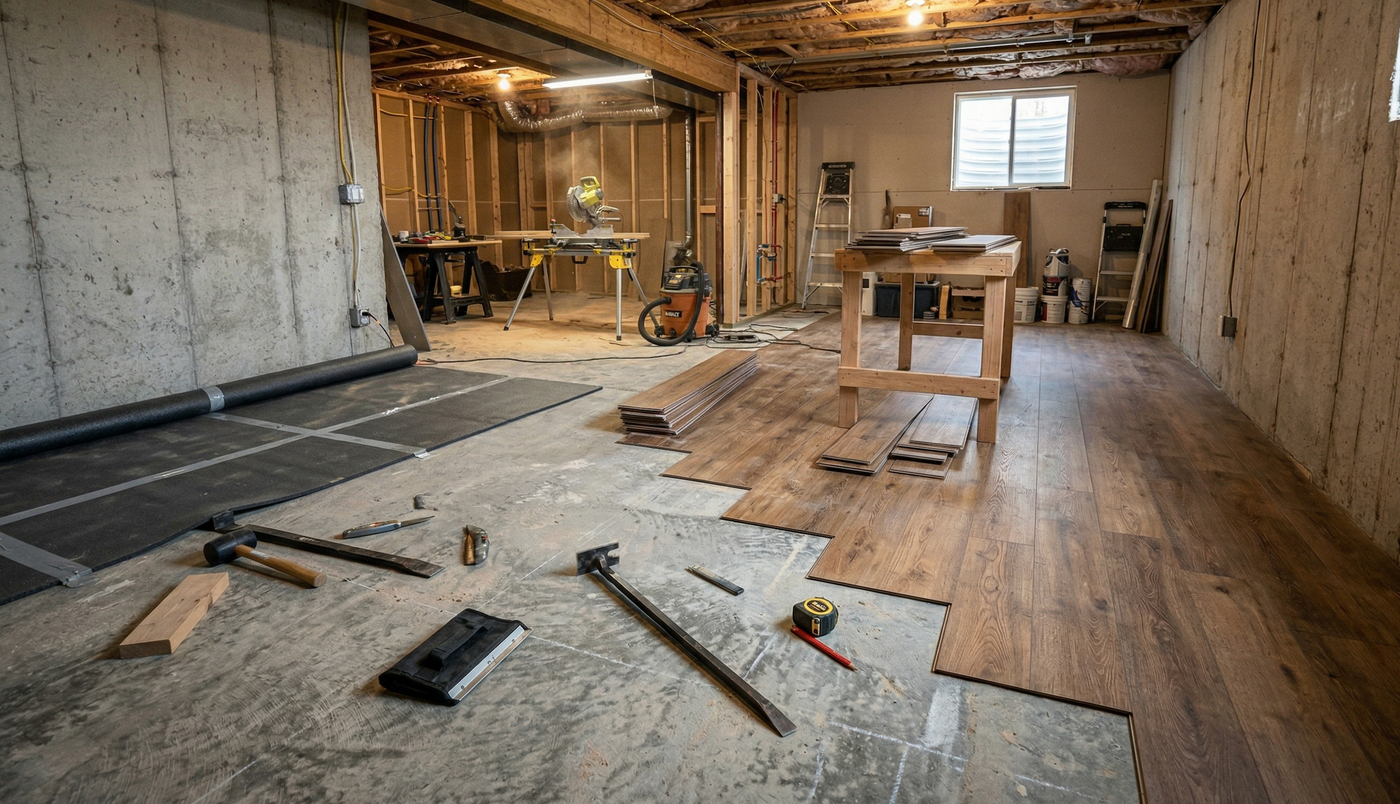
Even when a basement appears dry, vapour can move through concrete. That’s why vapour barriers, proper underlayments, and following installation guidelines matter.
Skipping these steps doesn’t always cause immediate problems.
But it often shows up later.
How to make the right decision
The simplest way to get this right is to match the flooring to how the space will actually be used.
If the basement is a high-traffic, multi-use area or a rental suite, durability and moisture resistance should lead the decision. Vinyl flooring is often the safest and most practical fit.
If the space is controlled, dry, and used more like a secondary living area, laminate or even carpet tiles can make sense, depending on the feel you want.
Tile fits where water exposure is consistent, like bathrooms or laundry areas, but is rarely the best choice for full basement coverage unless comfort is addressed.
The mistake is trying to force one solution across every type of basement.
The better approach is to choose based on real conditions, not ideal ones.

Final thought
Basement flooring in Canada isn’t about finding the “best” product.
It’s about avoiding the wrong one.
Once you understand how basements behave (moisture, temperature, and daily use) the right options become much clearer.
From there, it’s not a complicated decision.
It’s just a practical one.
Contact us for help choosing a floor
Content to help with flooring decisions in Canada:
Can you install Engineered Hardwood over Concrete? (like in a basement)
Engineered Hardwood in Canada what is the cost?
Vinyl flooring in Canada including waterproof information