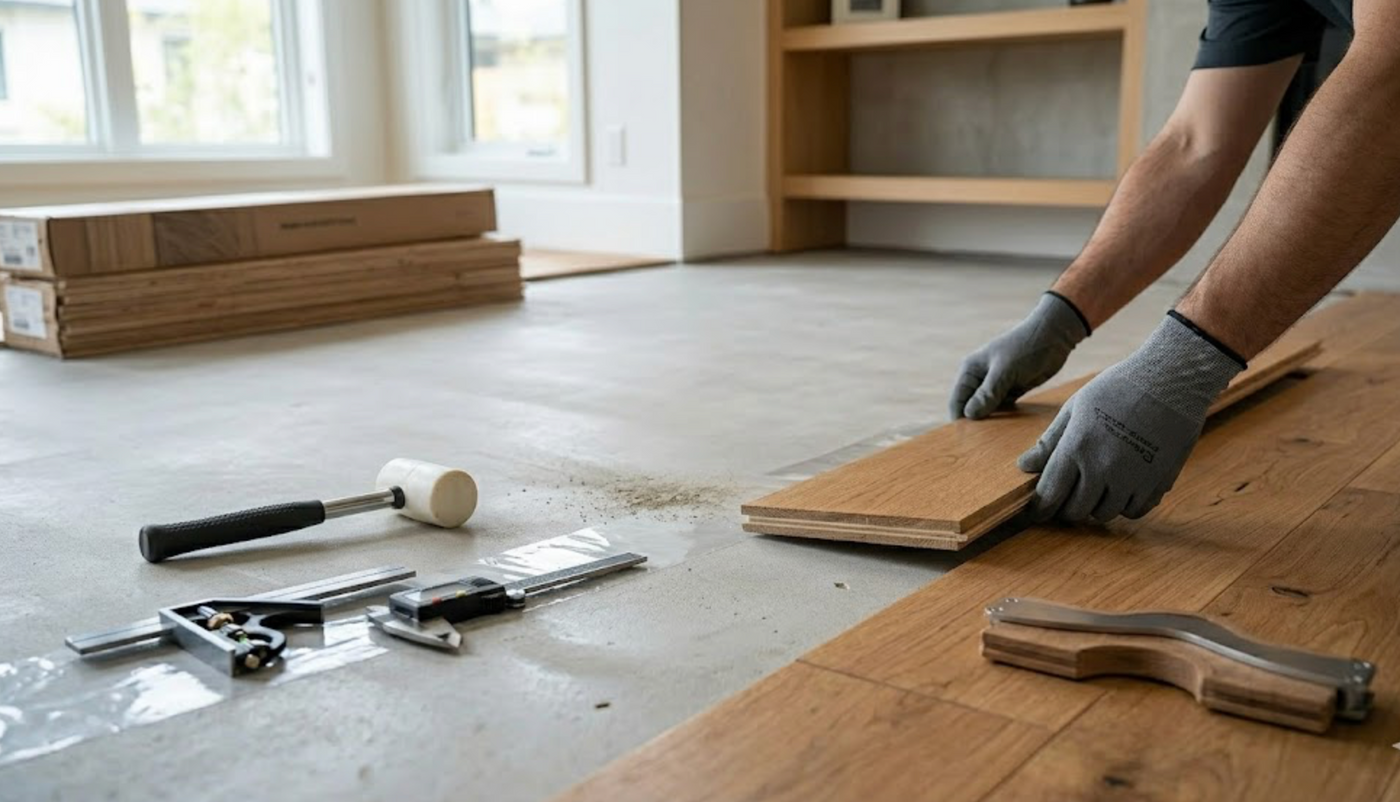
Yes, engineered hardwood can go over concrete.
That is one of the reasons it has become such an important flooring category. It gives homeowners a way to get real wood underfoot in places where solid hardwood is often the wrong bet. But that simple yes has caused plenty of bad decisions, because the real issue is not whether engineered hardwood can go over concrete. The real issue is whether the concrete is ready for it.
A slab can look dry and still hold enough moisture to create trouble later. It can seem flat enough until the boards are down. It can feel like a routine installation until the floor starts moving, gaps appear, or the adhesive fails. That is why this question deserves a better answer than “yes, no problem.”
If you want engineered hardwood over concrete, the project has to start with the slab: moisture testing, flatness, preparation, and the right installation method.

The Short Answer
Engineered hardwood can be installed over concrete when:
· the slab is properly moisture tested
· moisture conditions are acceptable
· the concrete is flat and prepared
· the flooring product is approved for that application
· the installation method is right for the site
So yes, it can absolutely be done. But it is not a casual installation, and it is not a shortcut job.
Why Engineered Hardwood Works Better Than Solid Hardwood Over Concrete
Concrete and solid wood have never been a particularly relaxed pairing.
Concrete handles moisture one way. Wood handles it another. Solid hardwood is more sensitive to that relationship, which is why it is usually a riskier choice directly over concrete, especially in lower-level or moisture-sensitive settings.
Engineered hardwood is different. Its layered construction gives it better dimensional stability, which is exactly why it is the more practical real-wood option for concrete installations. That does not make it invincible. It just makes it more realistic.
That distinction matters. A lot of homeowners hear “real wood” and think the categories behave the same way. They do not. If you want the appearance and feel of wood over concrete, engineered hardwood is usually the conversation worth having.
The Real Risk Is Moisture, Not Concrete Itself
Concrete is not automatically the problem. Unchecked moisture is.
This is where projects get into trouble. A slab may look perfectly fine and still carry enough moisture to create problems after the floor is installed. Once wood goes over top, that moisture has fewer places to go, and the consequences can show up in ugly ways:
· board movement
· cupping
· adhesive failure
· finish problems
· mould concerns
· long-term instability
That is why the question is never just, “Can I put engineered hardwood over concrete?” The better question is, “Has this slab been properly tested, and is it actually ready?”
If the answer to that is weak, the rest of the project is weak too.
Moisture Testing Comes First
Before style, before colour, before plank size, before price, there is the slab.
Concrete should be properly moisture tested before engineered hardwood goes over it. Not guessed at. Not assumed to be dry because the house is older. Not treated as safe because it feels dry to the touch. Tested.
That step is what allows the next decisions to make sense:
· whether the site is ready
· whether a moisture-control system is needed
· whether the product is appropriate
· whether floating or glue-down makes sense
· whether the project is smart to do at all
A premium engineered hardwood floor installed over an untested slab is still a gamble. Good flooring does not fix bad preparation.

Basements and Below-Grade Areas Deserve More Respect
This is where the answer becomes more conditional.
Yes, engineered hardwood can work over concrete in some basements and other below-grade settings. But those spaces deserve more honesty, not more optimism. Below grade is where moisture history, humidity swings, and slab conditions matter even more.
That does not mean engineered hardwood is automatically a bad basement floor. It means the project has to earn the answer.
A few questions matter immediately:
· Has the slab been properly tested?
· Is there any history of dampness or water issues?
· Is the product approved for that environment?
· Is the installation system designed for those conditions?
If those answers are strong, engineered hardwood can be a very good solution. If they are weak, the floor category will not rescue the project.
Flatness Matters More Than Most Buyers Expect
Moisture gets the headlines, but slab flatness causes its own quiet problems.
An uneven slab can affect:
· board fit
· locking performance
· feel underfoot
· hollow or inconsistent movement
· long-term stability
This is one of those issues homeowners rarely think about until something feels off after installation. And by then, the product gets blamed for a subfloor problem.
That is part of what makes concrete installations unforgiving. If the slab is not prepared properly, even a good engineered hardwood floor can end up looking like the weak link.

Installation Method Is Part of the Answer
There is no single universal version of engineered hardwood over concrete.
Depending on the product and the site, the floor may be:
· floated
· glued down
· installed over a moisture-control layer or approved underlayment system
That matters because the success of the installation depends on the full system, not just the board. A floor that performs well in one setup may be the wrong product in another.
This is also why broad advice can get homeowners in trouble. Not every engineered hardwood floor is interchangeable, and not every concrete slab is alike. Product approvals and installation instructions matter here. A lot.
Not All Engineered Hardwood Is Equally Good Over Concrete
This is where category-level advice stops being enough.
Some engineered hardwood products are much better suited to concrete than others. That can come down to:
· core construction
· total board thickness
· locking system
· product approvals
· installation method
· how much margin the product gives the installer
A better-built floor often feels more stable and more substantial over concrete. A cheaper product may still work, but with less forgiveness. That does not mean the most expensive option is always right. It means product quality still matters, especially when the subfloor is concrete.
Cheap flooring and concrete are not always a great combination. There is often less room for sloppiness on both sides of the equation.
When Engineered Hardwood Over Concrete Makes Sense
This kind of installation can make a lot of sense when:
· you want the warmth and look of real wood
· the slab has been tested properly
· moisture is under control
· the site is prepared correctly
· the product is approved for the application
· the installer is using the right system
In that situation, engineered hardwood can be an excellent choice. It gives homeowners real wood in spaces where solid hardwood would usually be a much shakier decision.
When WPC Vinyl May Be the Smarter Choice
Sometimes the better answer is not engineered hardwood at all.
If the slab carries elevated moisture risk, the basement history is uncertain, or the homeowner wants a more forgiving product category, WPC vinyl may be the smarter move. That is not an insult to engineered hardwood. It is just what honest product matching looks like.
This is what good flooring advice sounds like. Not loyalty to a category. Not pushing one answer every time. Just matching the right product to the right situation.
Questions to Ask Before Installing Engineered Hardwood Over Concrete
Before moving ahead, ask these questions:
Has the slab been properly moisture tested?
Not assumed. Not guessed. Actually tested.
Is the slab flat enough?
This gets overlooked constantly, and it matters.
Is the product approved for installation over concrete?
Do not assume the answer is yes just because it is engineered hardwood.
What installation method is being used?
Floating and glue-down are not interchangeable decisions.
Is this a room where engineered hardwood makes sense, or is WPC vinyl the smarter option?
In a high-moisture environment, WPC vinyl is often the safer call.
Frequently Asked Questions
Can you install engineered hardwood directly on concrete?
Sometimes, yes, but only when the slab is properly tested, properly prepared, and the product and installation method are approved for that application.
Is engineered hardwood better than solid hardwood over concrete?
In most cases, yes. Engineered hardwood is generally the more stable and realistic real-wood option over concrete.
Is engineered hardwood over concrete a good basement option?
It can be, but only when moisture conditions are under control and the product is right for the space. Basements deserve extra caution.
Final Thought
Yes, engineered hardwood can go over concrete.
But the success of the project depends far less on the sample board and far more on what is happening underneath it. The slab has to be tested. The moisture conditions have to be acceptable. The floor has to be right for the application. And the installation has to be done properly.
Get those things right, and engineered hardwood over concrete can be an excellent solution. Get them wrong, and the floor can turn into an expensive lesson.
If you want the look and feel of real wood over concrete, engineered hardwood is absolutely worth considering. Just make sure you are making the decision with the slab in mind, not just the showroom display in your hand.
Visit a Caledon dealer. Click here to find the closest dealer to you.
Related Reading
These articles go deeper on topics covered in this guide: