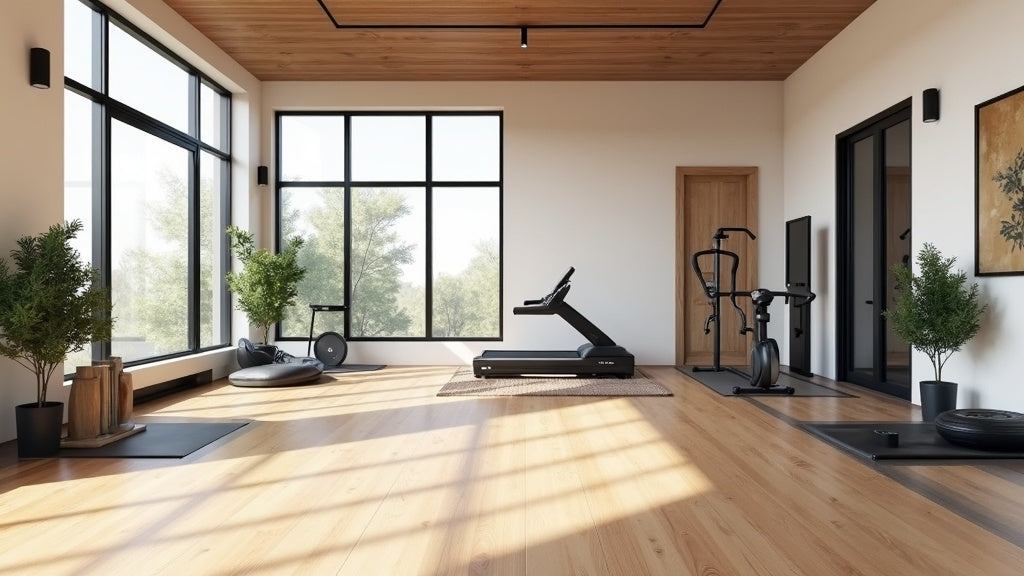
A home gym asks three things of a floor at once: it has to feel reasonable to stand and move on for an hour at a time, it has to absorb or at least soften the noise of the workout happening on it, and it has to tolerate sweat and humidity without reacting badly. Those three demands, comfort underfoot, sound, and moisture, are the honest starting point for choosing home gym flooring. What is already in the room, or what happens to be easiest to buy, is not.
Most home gyms are not one uniform surface problem either. A corner with a squat rack, a bench, or a heavy machine behaves completely differently than a stretching mat or a cardio zone a few feet away. The right flooring answer often changes by zone, not by the room as a whole.
What Does a Home Gym Actually Need From a Floor?
A home gym floor needs to manage sustained standing and movement, dampen the impact noise of a workout, and hold up to sweat and ambient humidity without warping, staining, or smelling. Everything else is secondary to these three.
Comfort Underfoot
Bodyweight training, standing cardio, and stretching are all easier on the joints with some give in the surface. A rigid, unforgiving floor is not dangerous, but it is noticeably harder on knees, ankles, and a lower back over a long session than a floor with some cushioning. A layer such as a thick mat or rug on top of an otherwise hard floor can add real cushioning too, the same logic covered in Area Rugs and Hard Floors: An Easy Way to Add Warmth, Colour, and Comfort.
Sound Dampening Perception
Weights get set down, sometimes dropped. Feet land. None of this needs to be silent, but a softer, denser surface measurably reduces how loud and sharp that impact sounds and feels, both in the room and in whatever space sits below or beside it.
Moisture From Sweat and Humidity
A hard workout puts real moisture onto a floor, session after session, and a closed-in gym space such as a basement, garage, or converted spare room often runs more humid than the rest of the house. The floor underneath needs to shed that moisture rather than absorb it.
No single residential flooring category is built to do all three at once in every part of the room, which is why the equipment zone and the rest of the gym are worth thinking about separately.

Why Heavy Equipment Changes the Flooring Question
A squat rack, a loaded barbell, a heavy bench, or a large fixed machine puts a sustained, concentrated point load onto one small footprint of floor, day after day. That is a fundamentally different kind of stress than foot traffic or furniture spread across a wide area. No wear-layer rating, no finish hardness, and no core specification on any flooring product makes it immune to this kind of repeated, concentrated contact.
This is not a matter of personal preference. A dedicated rubber gym mat, or a protective pad sized to the equipment's actual footprint, is mandatory practice under any heavy, stationary gym equipment, regardless of what flooring sits underneath it, whether that is tile, vinyl, engineered hardwood, or a bare concrete slab. A barbell coming down off a rack is not a controlled load, so the floor itself is never the only line of defence.
That protection also solves the noise and moisture questions for that specific footprint, since a dense rubber mat absorbs impact and tolerates sweat on its own. It does not, however, replace the decision of what the rest of the room's flooring should be.
The Honest Case for Dedicated Gym Flooring or Tile in the Equipment Zone
For the specific area under a squat rack, a bench, or fixed machines, dedicated rubber gym flooring, or a hard, non-porous tile, is usually the more realistic answer than a residential flooring product, including the categories built for comfort and waterproofing. This is a case where the honest answer for one part of a home gym points outside the categories most homes are floored in.
Rubber gym flooring, whether rolled rubber or interlocking tiles, is dense and largely non-porous, so it sheds sweat and routine moisture rather than absorbing it, and it resists denting, scuffing, and gouging from dropped plates in a way a softer residential surface is not built for. Its density also absorbs impact energy and cuts reverberation, so a dropped weight sounds and feels noticeably less sharp on rubber than on a hard surface. None of that makes it soundproof, and a heavy enough drop still transmits some impact through the subfloor, which matters most in a shared-floor situation like a condo or a room above a finished basement.
A hard, non-porous tile is the other realistic option for a heavy-use equipment zone. Tile does not absorb moisture the way a softer or wood-based surface can, and a dense tile resists surface denting from a static heavy load reasonably well. Tile is harder and less forgiving underfoot and dampens sound less than rubber, so it tends to make more sense where the floor plan already favours it, such as a converted mudroom or basement corner, rather than as a first choice purely for a gym. Vinyl Flooring vs Tile in Canada: Which Is Better for Kitchens, Bathrooms, and Everyday Living walks through this same tile-versus-vinyl trade-off for other high-moisture rooms.
Neither of these is a comfort-focused or wood-based residential flooring category, and that is the point: the equipment zone's actual physical demands, concentrated point loads plus sweat, point there first, ahead of whatever a general flooring aisle leads with.

Where WPC Vinyl Flooring Genuinely Fits in a Home Gym
WPC vinyl flooring is a legitimately strong choice for the parts of a home gym that do not carry heavy, stationary equipment: a stretching corner, a yoga or mat-work area, or an open cardio zone used for bodyweight training. Waterproof flooring built on a WPC core has a genuinely waterproof core construction, which is a real, verified property, not a stretch claim, and it is warmer underfoot than tile and comfortable thanks to its attached pad, which suits a room built around bare feet, socks, and mat work.
What WPC vinyl flooring is not built for is a fixed squat rack or a heavy machine sitting on it indefinitely without protection. WPC is a durable rigid core, but a fixed squat rack or heavy machine is exactly the aggressive, sustained point load where any residential floor benefits from protection. A mat under any fixed equipment resolves it, the same mandatory practice as on any other floor.
Readers weighing WPC against a denser, more rigid vinyl construction for a high-load room can get the fuller technical picture in SPC vs WPC Vinyl Flooring: What is the Difference and Which Is Better?, which covers how core rigidity changes point-load performance in more detail than a single gym-focused article can.
What About Engineered Hardwood?
Engineered hardwood is generally not the right call for a home gym, and it is worth saying honestly rather than working around it. Its surface is a real wood veneer, a natural material with the same vulnerability to concentrated point-load denting as any other wood surface, and a home gym is exactly the kind of room that puts sustained point loads on a floor. Engineered hardwood is also not a water-resistant product. The veneer reacts to sustained moisture exposure over time, and a room where sweat regularly lands on the floor, plus the humidity swings common in basements and garages, is not the environment that plays to its strengths.
Engineered hardwood's real strengths, authentic wood character, refinishing potential, and long-term visual warmth, belong in rooms built around those qualities, not a workout space. A gym that shares open floor space with a living area is a legitimate design conversation, but it should happen with eyes open about where the actual training takes place on that floor.
Comparing the Realistic Options
| Comfort underfoot | Sound dampening | Sweat and humidity | Heavy fixed equipment | |
|---|---|---|---|---|
| Rubber or high-density gym flooring | Good, purpose-built cushioning | Strong, dense and impact-absorbing | Strong, non-porous surface | Strong, the standard choice for equipment zones |
| Hard, non-porous tile | Firm, minimal give | Limited, hard surface reflects sound | Strong, does not absorb moisture | Good, resists denting from static loads |
| WPC vinyl flooring | Strong, cushioned attached pad | Moderate, softer than tile | Strong, waterproof core | Needs a mat under any fixed piece |
| Engineered hardwood | Moderate, some natural give | Moderate | Weak, real wood reacts to sustained moisture | Needs a mat under any fixed piece, and is not water-resistant |
This table is a qualitative comparison to guide zone-by-zone decisions, not a ranking of one universal winner. The equipment corner and the stretching corner of the same gym can reasonably end up with two different answers.
Does a Home Gym Need Sound Dampening Underlayment?
An underlayment can meaningfully help if the gym sits above a finished space or shares a floor with a condo unit below, since it targets impact noise transmission through the structure itself rather than just softening the surface underfoot. This is a separate question from the surface material, and it matters most where a dropped weight is not just the lifter's problem. Condo Flooring Sound and Underlayments in Canada: Rules, Ratings, and Best Flooring Choices covers acoustic ratings and underlayment choices for anyone training above a shared floor.
For a ground-level or basement gym without a unit below it, sound dampening is more about household comfort than a structural requirement, and the surface choice itself, rubber over tile, for instance, carries most of that job.

Frequently Asked Questions
A few questions come up repeatedly once the zone-by-zone approach makes sense, mostly about where the mandatory-protection rule ends and where the flooring choice actually matters.
Do I still need a mat under a squat rack if the floor is already rubber or tile?
Yes. A dedicated mat or pad under the equipment's footprint is mandatory practice regardless of what the surrounding floor is, because it protects both the floor and the equipment's stability, and because a dropped barbell is an uncontrolled load no floor spec is tested against.
Can carpet work anywhere in a home gym?
Carpet is a poor fit for the areas where sweat lands directly or where equipment is used, since it absorbs moisture rather than shedding it and offers no meaningful protection against point loads. It can be reasonable in an adjoining stretch or warm-up area that stays dry, but that is a narrow use case, not a gym-wide answer.
What is the best flooring for a basement home gym specifically?
The zone logic still applies below grade, with humidity as the added factor. A basement runs more consistently humid than upper floors, which strengthens the case for a waterproof or non-porous surface (WPC vinyl flooring in a comfort zone, rubber or tile under equipment) over anything wood-based.
Does rubber flooring make a home gym completely quiet?
No. Rubber flooring reduces impact noise and reverberation noticeably compared with a hard surface, but it does not eliminate sound, and a heavy enough drop still transmits some impact through the subfloor and building structure. Pairing rubber with a proper underlayment addresses the structural transmission side separately.
Have questions about the right flooring for your space? Get in touch with our team.
To find waterproof vinyl flooring, click here for a Caledon Floors dealer near you.