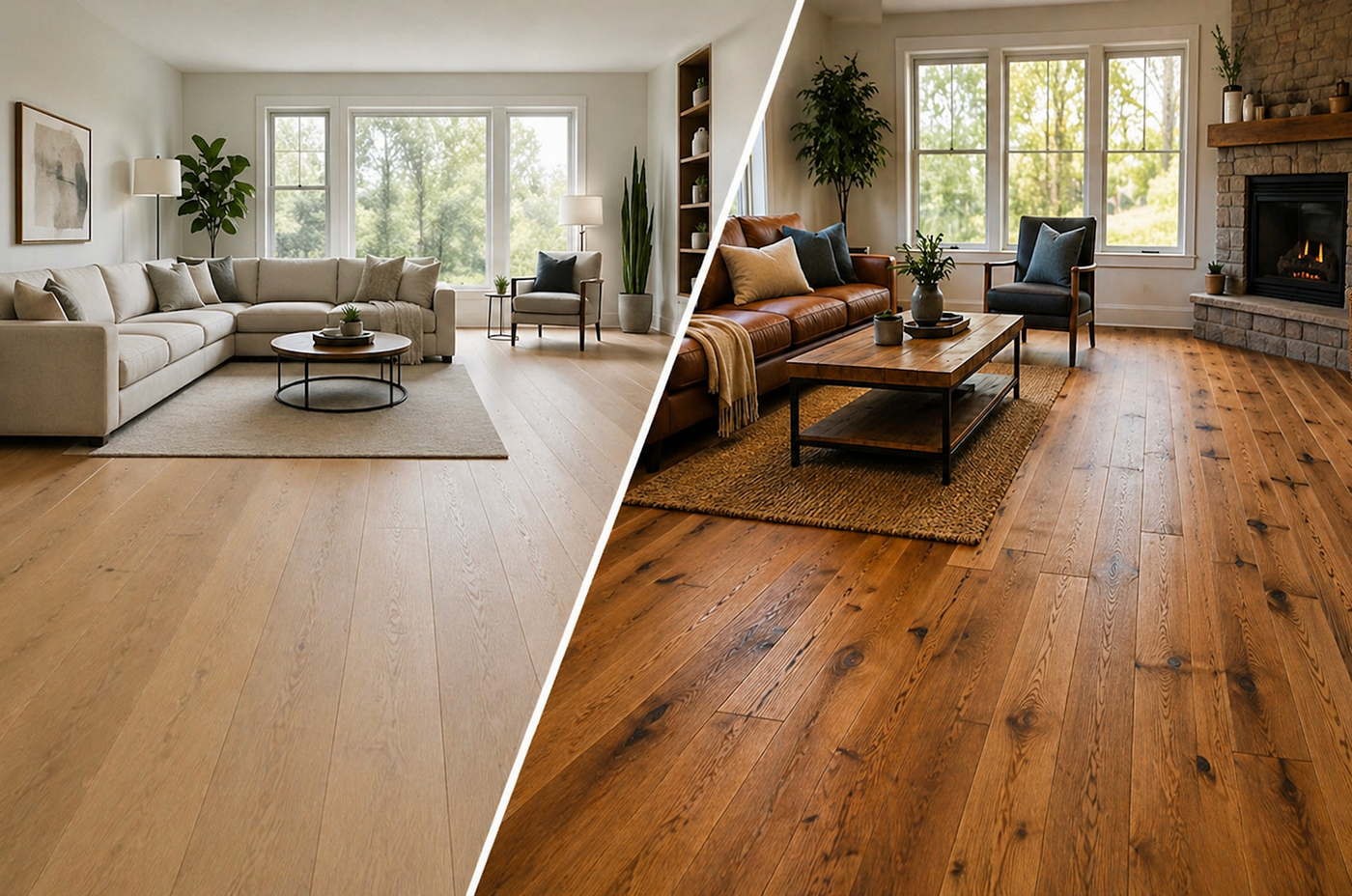
If two engineered hardwood floors are made from the same species and have a similar stain colour, they can still look very different once they are installed. One floor may look calm, clean, and refined. Another may look warmer, busier, and more natural. In many cases, the biggest reason is grade.
Grade is one of the main reasons one engineered hardwood floor looks more uniform while another shows more knots, more colour variation, more mineral streaks, more sapwood, and more visual movement. If homeowners do not understand grade before they buy, they can easily choose a floor that looks very different from what they expected once it is installed across a full room.
The short answer is this: engineered hardwood grade mainly affects the visual selection of the wood. Cleaner grades usually have fewer natural markings and a more consistent overall look. More character-driven grades usually show more knots, more colour movement, and a more natural, active appearance. Neither is automatically better. The right choice depends on the look the homeowner actually wants to live with.
What Engineered Hardwood Grade Actually Means
In engineered hardwood, grade mainly refers to the visual selection of the wood surface. Grade does not mean one floor is real wood and another is not. It also does not automatically mean one floor is good and another is bad. In most buyer-facing conversations, grade is about appearance: it affects how clean, consistent, varied, or character-heavy the floor looks after installation.
Grade can affect how many knots are visible and how noticeable they are, how much colour variation appears from board to board, how visible mineral streaks are, how much sapwood appears, and how calm or active the floor feels overall.
Grade names can vary by manufacturer, so homeowners should not rely only on labels. One company may use one grading term while another uses a different term for a similar visual range. The important question is not just what the grade is called: it is what the installed floor will actually look like.
Why Grade Matters More Than a Small Sample Shows
A single sample board rarely tells the whole story. That is one of the biggest issues with engineered hardwood shopping. A small sample may show one or two boards and may not show the full range of knots, colour variation, mineral streaking, or sapwood that can appear in the actual floor. Grade becomes much more obvious when many boards are installed together across a full room.
This is why homeowners can be surprised after installation. They may have liked the sample, but the full floor feels busier, more varied, or more rustic than they expected. In other cases, they may have wanted a natural, character-filled floor and end up choosing something that feels too clean or too quiet. The sample matters, but it is only a starting point. For engineered hardwood, buyers should always ask what the full installed range looks like.
Cleaner Grade vs Character Grade
This is the comparison most buyers are really trying to understand. A cleaner grade usually looks more controlled: fewer knots, less dramatic colour variation, and a more even visual flow across the room. Buyers who want a refined, quieter floor are often drawn to cleaner grades because the finished space feels calmer.
A character grade usually looks more natural and more active. It may show more knots, more colour swing, more visible natural markings, and more board-to-board variation. Buyers who want warmth, personality, and a less formal look may prefer a character grade for exactly that reason.
Neither look is automatically better: they are simply different. The mistake is choosing one while expecting the other. A homeowner who wants a calm, edited look may be disappointed by too much character. A homeowner who wants warmth and natural variation may find a cleaner grade too plain. The right grade is the one that matches the buyer's actual taste, not just the one that sounds better on paper.
What Buyers Actually See in Different Grades
Grade becomes easier to understand when you look at the features that change the floor visually.

Knots
Knots are one of the easiest grade differences to notice. Cleaner grades usually have fewer knots, smaller knots, or knots that are less visually dominant. Character grades usually show more knots, and those knots become part of the floor's personality. Some homeowners love knots because they make the floor feel natural and warm. Others find them too busy, especially in a modern or more refined interior.
Colour variation
Some engineered hardwood floors look relatively even from board to board. Others show stronger shifts between lighter and darker boards. That variation is not necessarily a flaw: it is often part of the intended grade and visual style. The key question is whether the homeowner wants that movement. In a full room, board-to-board variation becomes much more noticeable than it does on a small sample.
Mineral streaks
Mineral streaks are natural markings that can appear in wood. Some grades limit them more heavily. Others allow them to show as part of the floor's character. For some buyers, mineral streaks add authenticity. For others, they interrupt the cleaner look they were hoping for.
Sapwood
Sapwood can create lighter areas in the wood. Depending on the species, grade, and colour, it can be subtle or quite noticeable. Cleaner grades usually limit sapwood more. Character grades may allow more of it, which can increase the visual range of the floor.
Overall visual movement
Grade does not just affect one feature: it affects the entire feeling of the installed floor. Cleaner grades create less visual movement. Character grades create more. That overall movement is often what homeowners respond to emotionally, even if they do not know the technical reason.

Room Size and Lighting Make Grade More Obvious
Grade does not look the same in every room. In a small room with less natural light, variation may feel softer and less obvious. In a large open-concept space with big windows, the same grade can look much more active: more boards are visible at once, and natural light can highlight colour variation, knots, mineral streaks, and sapwood.
This matters because many engineered hardwood decisions are made from a small sample in a showroom or under artificial light. That is not the same as seeing the floor across a bright kitchen, living room, hallway, and dining area. If the floor is going into a large main living space, grade becomes more important. A cleaner grade can help create a calmer foundation. A character grade can add warmth and movement, but the buyer needs to want that look intentionally. Large rooms make grade harder to ignore.
Why Some Homeowners Love Character and Others Do Not
Some homeowners want a floor that feels calm, elegant, and visually controlled. They do not want the floor competing with cabinets, furniture, rugs, or other design elements. They want the wood to support the space, not dominate it. These buyers often prefer cleaner grades.
Other homeowners want the floor to feel more natural. They like seeing knots, colour variation, and visual movement because it reminds them that wood is a real material. They may find cleaner grades too plain or too formal. These buyers often prefer character grades.
Both preferences are valid. The important thing is knowing which buyer you are. Many flooring regrets happen when a homeowner chooses based on price, trend, or sample-board appeal instead of being honest about how much variation they actually want to see every day.

Which Homes and Design Styles Suit Each Grade
Cleaner grades often suit modern homes, refined interiors, transitional spaces, calmer colour palettes, open-concept main floors where the owner wants less visual noise, and rooms where cabinetry or architecture already add enough visual interest.
Character grades often suit warmer interiors, relaxed family spaces, rustic or organic design styles, homes where natural variation is part of the appeal, and rooms where the owner wants the floor to feel more expressive and lived-in.
This is not a strict rule. A modern home can use character grade if the design is intentional. A traditional home can use a cleaner grade if the owner wants a quieter look. The key is that the grade needs to support the design goal, not fight it.
When Paying More for a Cleaner Grade Is Worth It
Paying more for a cleaner grade is often worth it when the homeowner would be bothered by knots, strong colour variation, or a busier floor across a large area. That is the practical test.
Cleaner grade may be worth the upgrade in large open-concept spaces, main living areas, design-led renovations, homes with a quieter and more refined style, and any room where the buyer strongly dislikes knots or strong board-to-board variation. In those cases, the homeowner is not just paying for a label: they are paying for a different visual outcome. If the buyer wants a cleaner look, choosing a more character-heavy floor just to save money can become frustrating later.
When Character Grade Is the Better Buy
Character grade can be the better buy when the homeowner genuinely likes natural variation. That can make sense in relaxed family homes, rustic or organic interiors, spaces where warmth matters more than uniformity, and homes where a more active floor helps the room feel less formal.
Character grade is not automatically a compromise: for some buyers, it is the better-looking floor. It can also offer good value if the homeowner truly likes the look. The problem only starts when someone chooses a character grade mainly to save money but actually wants the appearance of a cleaner grade. That is when the floor may feel too busy after installation.

Cleaner Grade vs Character Grade: Visual Differences
| Buyer question | Cleaner grade | Character grade |
|---|---|---|
| What is the overall look? | Calmer and more uniform | More natural and more varied |
| How visible are knots? | Fewer and usually less dominant | More visible and more frequent |
| How much colour variation should I expect? | Lower | Higher |
| How visible are mineral streaks and sapwood? | Usually more limited | Often more visible |
| How much visual movement will the room have? | Lower and more controlled | Higher and more active |
| Where does it often work best? | Refined, calmer, design-led spaces | Warm, relaxed, natural interiors |
| What is the main benefit? | More consistency | More character |
| What is the main risk? | May feel too plain for buyers who want natural variation | May feel too busy for buyers who want a cleaner look |
| When is it worth paying more? | When the buyer wants a calmer floor and would notice variation | When the buyer genuinely likes visible character and movement |
What Buyers Get Wrong About Grade
The first mistake is thinking grade only affects price. It affects the appearance of the floor in a major way. The second mistake is assuming cleaner grade is always better: it is only better if the homeowner actually wants a cleaner, more uniform look. The third mistake is assuming character grade means poor quality. In many cases, it means more visible natural variation, not that the floor is bad. The fourth mistake is buying from a small sample without asking what the full installed range looks like. The fifth mistake is choosing a more character-heavy grade to save money when the buyer really wants a calmer floor. That last mistake is common, and avoidable.
How to Choose the Right Engineered Hardwood Grade
Start with the look you want, not the grade name. Ask yourself: Do I want the floor to feel calm or active? Do I like visible knots? Am I comfortable with board-to-board colour variation? Will this be installed in a large open room where variation will be more obvious? Do I want the floor to be a quiet background or a major design feature? Am I paying more for a cleaner grade because I truly want that look, or am I choosing character grade because I genuinely like it, rather than just because it costs less?
Those questions are more useful than asking which grade is best. The best grade is the one that creates the look the homeowner actually wants.
FAQ: Engineered Hardwood Grades
What does grade mean in engineered hardwood?
Grade mainly refers to the visual selection of the wood surface. It affects how many knots, colour changes, mineral streaks, sapwood, and natural markings may appear in the floor.
Is cleaner grade always better?
No. Cleaner grade is often more uniform, but it is only better if the homeowner wants a calmer and more refined look.
Does character grade mean lower quality?
Not necessarily. Character grade usually means more visible natural variation. It can be a beautiful choice when the buyer wants a warmer, more natural-looking floor.
Why does one engineered hardwood floor look calmer than another?
Often because of grade. Cleaner grades usually show fewer knots and less colour variation, which creates a calmer overall look.
Should I choose cleaner grade or character grade?
Choose cleaner grade if you want a more controlled and consistent look. Choose character grade if you like knots, variation, and more visible natural movement.

Final Verdict
Engineered hardwood grade changes the look of a floor more than many homeowners realize. It is one of the biggest reasons one floor looks calm and refined while another looks warmer, busier, or more natural. Cleaner grades usually suit buyers who want a more uniform result. Character grades usually suit buyers who want more visible natural variation and movement. Neither is automatically right: the right answer depends on the look you actually want to live with.
Before choosing engineered hardwood, do not just look at species, colour, and price. Look carefully at grade, and ask how much variation will appear across the full floor, not just the sample board. That is how you choose a floor that still looks right after it is installed. Contact us for help choosing a floor, or find a dealer near you who can show you the full installed range before you decide.
Related Reading
These articles go deeper on engineered hardwood and how to choose the right product: