If you are trying to decide between engineered hardwood and vinyl plank, the real question is usually not which one looks better on day one. The real question is which one will still feel like a smart decision 10 to 15 years from now.
At the start, both can look attractive. Both can work well in the right home. Both can be sold as durable, stylish, and practical. But over a 10 to 15 year period, the differences become more meaningful. Upfront cost, comfort underfoot, wear patterns, scratch visibility, moisture tolerance, replacement risk, resale feel, and long-term satisfaction all start to matter more than the showroom sample.
The short answer is this: good-quality vinyl plank is often the smarter practical and financial choice for many households over 10 to 15 years, especially in busy homes with kids, dogs, moisture risk, or a tighter budget. Engineered hardwood can still be worth it, but usually for homeowners who care deeply about the feel and visual character of a real wood floor, are willing to pay more upfront, and understand that they are choosing a more premium finish with less forgiveness in everyday life.
One important clarification: "vinyl plank" is a very broad category. It can mean a low-cost 2mm dryback product at one end of the market, or a much thicker and more premium WPC floor at the other. It can also include strong mid-range SPC and very good loose lay products in between. Those are not the same ownership decision. In this article, vinyl plank mainly refers to the kinds of products homeowners realistically compare with engineered hardwood in a full-home renovation: typically good-quality SPC and WPC, loose lay, and other solid mid-range to better vinyl plank options, not the cheapest price-point vinyl on the market.

That is the real dividing line. Good-quality vinyl plank usually wins on practicality. Engineered hardwood can still win on feel, character, and the kind of long-term satisfaction some homeowners simply value more.
What "Worth It" Really Means Over 10 to 15 Years
A lot of flooring comparisons fail because they only compare the purchase itself. If you are comparing engineered hardwood vs vinyl plank over 10 to 15 years, the better question is not just what each floor costs today. It is what each floor asks from you over time. How does it wear? How does it handle moisture? How does it feel after years of living with it? Does it still look good in the main traffic lanes? Does it still suit the home? Does it create regret, or does it continue to feel like money well spent?
That is what "worth it" really means. Some homeowners define worth by lowest overall cost and least maintenance stress. Others define worth by how the floor feels every morning when they walk across it. Others care about resale perception, or about whether the home still feels premium 12 years later. Those are not all the same thing, and that is why there is no one-size-fits-all answer.

Upfront Cost: Vinyl Usually Wins
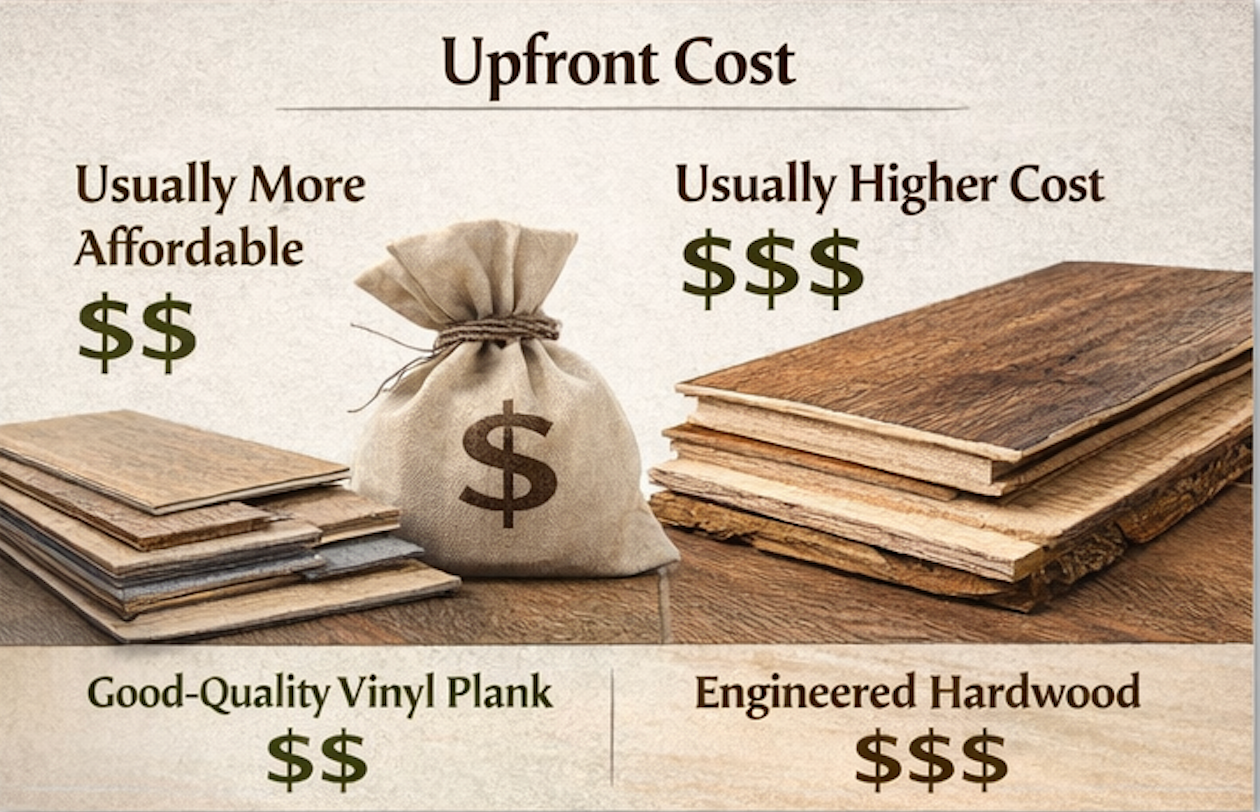
This is the easiest part of the comparison. Most SPC, loose lay, and many other good-quality vinyl plank options are usually more affordable upfront than engineered hardwood. In many real-world flooring decisions, that matters a lot. It gives homeowners a way to get a durable, attractive wood-look floor without stepping into the higher material cost that usually comes with engineered hardwood.
That lower entry price also changes the emotional relationship with the floor. Homeowners are often more relaxed with good-quality vinyl plank because they know they did not buy the most delicate or expensive finish in the store. In a busy family home, that can actually be a major quality-of-life benefit. You are less likely to panic over everyday living.
Engineered hardwood usually costs more because you are paying for a real wood wear surface and a product that carries a more premium design identity. That higher cost can absolutely be worth it for the right homeowner, but it needs to deliver something meaningful in return. If the owner does not actually value the things engineered hardwood does better, then the extra spend may not feel justified over time.

Feel Underfoot: Engineered Hardwood Usually Wins
This is where engineered hardwood starts to make a stronger case. A real wood floor has a different feel. It is hard to quantify perfectly, but most people can sense it. Engineered hardwood tends to feel warmer, richer, more natural, and more substantial in a way that many vinyl floors do not fully replicate. Even very good vinyl plank is still an imitation of wood. Sometimes a very convincing imitation, but still an imitation.
Over 10 to 15 years, this matters more than some people expect. A homeowner who truly loves the presence of real wood may continue appreciating engineered hardwood long after the memory of the higher price fades. In those cases, engineered hardwood can absolutely be worth it. Not because it is more practical, but because it delivers a different emotional and design experience.
Good-quality vinyl plank, especially mid-range SPC, good loose lay, or better WPC, can still perform very well. But it often feels more functional than soulful. That is not an insult. It is simply part of the category. Many homeowners are completely happy with that trade-off. But for others, it is exactly why engineered hardwood keeps its appeal.
Moisture, Family Life, and Everyday Forgiveness: Vinyl Usually Wins
This is one of the biggest long-term decision points. Over 10 to 15 years, most floors do not get judged in ideal conditions. They get judged in real life. Wet shoes. Dog bowls. Entryway mess. Kids. Chairs dragged across the floor. Small spills. Forgotten spills. Heavy traffic. Constant use.
That is where good-quality vinyl plank usually becomes the more forgiving option. It is generally a better fit for homes where everyday life is busy, messy, and unpredictable. It handles moisture risk more comfortably, usually asks less from the homeowner emotionally, and lets people live on the floor instead of worrying about the floor all the time.
Engineered hardwood is less forgiving. That does not mean it is fragile or unusable. It means homeowners need to accept that real wood has limits, especially in harder-use areas of the home. If someone chooses engineered hardwood in a high-abuse environment and expects it to age like a worry-free utility floor, they are often going to be disappointed.
That is why good-quality vinyl plank often wins in kitchens, basements, entryways, mudrooms, homes with kids, and homes with larger dogs. Over a 10 to 15 year horizon, that forgiveness matters.
Wear, Scratches, and Aging: Different Problems, Different Regrets
This is where the comparison becomes more nuanced. Vinyl plank and engineered hardwood do not usually age badly in the same way.
Good-quality vinyl plank, including strong SPC, WPC, and some loose lay products, often resists a lot of daily abuse well, especially in better constructions with strong wear layers. But once it looks tired, damaged, or dated, there is usually no meaningful way to restore it. It is more of a replacement-cycle product. If it wears out or the look starts feeling old, the answer is generally replacement, not renewal.
Engineered hardwood is different. Because it has a real wood surface, it can carry a richer, more authentic visual life over time. In some cases, light wear can even feel more natural on a wood floor than it does on a synthetic one. But wood also shows scratches, dents, and traffic wear more honestly. If it gets beat up badly, the homeowner notices.
So the real long-term question is not just which one wears better. It is what kind of aging the homeowner would rather live with. A good-quality vinyl plank floor may hold together better in a chaotic household, but once it reaches the end of its visual life, it often feels finished. Engineered hardwood may show real-life wear sooner in some conditions, but it can still carry a deeper sense of value and permanence if the homeowner accepts the imperfections that come with real wood.

Sound and Comfort in the Home
This is another area where homeowners often know the answer emotionally before they know it logically. A better engineered hardwood floor usually contributes to a home feeling more grounded and refined. The acoustics, the firmness, the tone of the space, and the psychological sense of real material can all add up over time.
Good-quality vinyl plank can still perform very well, especially with the right construction and the right installation, but it often feels more utilitarian. In some homes, that is exactly what is needed. In others, especially more design-conscious spaces, people start to feel the difference over years of living with it.
This does not automatically make engineered hardwood worth the premium. It simply means that over a long ownership horizon, the softer "feel of the home" factors can matter more than people expect when they first compare price tags.
Resale and Perception: Engineered Hardwood Usually Has the Edge
Resale conversations around flooring are often exaggerated, but perception still matters. A real engineered hardwood floor generally carries a more premium impression than vinyl plank. That does not mean a buyer will pay dollar for dollar more because of it. It does mean the home may feel more elevated, more intentional, and more architecturally aligned with what many buyers imagine as a higher-quality finish.
Vinyl plank has become widely accepted, and in many homes it is absolutely the right choice. But it rarely carries the same emotional weight as real wood. If the homeowner cares about long-term resale feel, or simply wants the home to feel a notch more premium over time, engineered hardwood usually has an edge here.
That said, resale value should not be used as a lazy argument for overspending. If the home is in a category, price point, or lifestyle pattern where good-quality vinyl plank makes more practical sense, buyers may actually appreciate the durability and low-maintenance logic more than a more delicate premium floor.
Which One Usually Makes More Sense Over 10 to 15 Years?
The honest answer depends on the homeowner.
Good-quality vinyl plank is usually worth it if:
- you want the smarter practical choice
- you have kids, dogs, moisture risk, or heavy everyday traffic
- you care about lower stress and lower upfront cost
- you would rather replace later than worry now
- you want strong performance without paying for a premium feel
Engineered hardwood is usually worth it if:
- you care deeply about the feel and character of real wood
- you are willing to pay more for a more premium experience
- your home and lifestyle are less punishing on the floor
- you want the home to feel warmer, richer, and more elevated over time
- you understand that real wood is not the most forgiving category and choose it anyway
That is the real dividing line. One is usually the better operating decision. The other can be the better emotional and design decision.

Engineered Hardwood vs Vinyl Plank Over 10 to 15 Years
| Factor | Good-quality vinyl plank | Engineered hardwood |
|---|---|---|
| Upfront cost | Usually lower | Usually higher |
| Moisture tolerance | Usually better | Usually less forgiving |
| Family and pet practicality | Usually stronger | More sensitive |
| Feel underfoot | Varies widely by product; often more functional than soulful | More natural and premium |
| Scratch and wear visibility | Often hides everyday life better at first | Shows real wear more honestly |
| Long-term visual character | Practical but usually more replacement-oriented | Richer and more authentic |
| Resale perception | Good in many homes, but less premium | Stronger premium impression |
| Typical best fit | Busy practical households choosing strong SPC, WPC, or loose lay options | Homeowners who truly value real wood |
What Homeowners Get Wrong
One common mistake is assuming engineered hardwood is always the better floor because it costs more. That is not true. Sometimes it is the wrong choice for the household, even if it is the more premium material.
Another common mistake is assuming vinyl plank is always the smartest choice because it is more practical. That is not true either. Some homeowners spend 10 or 15 years wishing they had chosen the floor that felt more real and more satisfying in the home, even if it cost more and required more respect.
The wrong question is "which one is best?" The right question is "which one fits the way I actually live, and what will I still be happy with in 10 to 15 years?" That is a much better test.
Best Choice by Homeowner Type
Best for busy family practicality
Good-quality vinyl plank usually wins. It is easier to live with, easier to worry less about, and often the lower-stress decision over time.
Best for design-led homeowners
Engineered hardwood usually has the edge. If the owner genuinely values real wood, that value often lasts longer than expected.
Best for moisture-risk homes
Good-quality vinyl plank is usually the safer answer. Basements, entryways, kitchens, and harder-use spaces often favour practicality.
Best for long-term emotional satisfaction
This is where engineered hardwood can make a very strong case. If the homeowner truly wants real wood and can afford it, that choice can continue feeling right long after the financial pain is forgotten.
FAQ: Engineered Hardwood vs Vinyl Plank
Is engineered hardwood worth the extra money over vinyl plank?
Sometimes. It is usually worth the extra money for homeowners who genuinely value the feel, character, and premium look of real wood and are willing to accept less forgiveness in everyday life.
Is vinyl plank better over 10 to 15 years?
For many households, good-quality vinyl plank is the smarter practical choice over 10 to 15 years because it usually handles family life, moisture risk, and everyday abuse with less stress. But "vinyl plank" is a wide category, so product quality matters a lot.
Does engineered hardwood last longer than vinyl plank?
Not automatically. Longevity depends heavily on product quality, installation, household use, and environment. Over 10 to 15 years, the bigger difference is often not lifespan alone, but how each floor ages and what kind of wear the homeowner is willing to accept.
Which has better resale appeal?
Engineered hardwood usually carries the stronger premium impression, but that does not always mean it is the smarter financial decision in every home.

Final Verdict
Over 10 to 15 years, good-quality vinyl plank is often the better practical and financial choice for many Canadian households. It is more forgiving, usually costs less upfront, and handles busy everyday life with less drama. Engineered hardwood can still be worth it, but usually for homeowners who truly care about the feel and visual character of real wood and are willing to pay more for that experience.
So if the question is "which one is smarter for most homes?", the answer is often good-quality vinyl plank. If the question is "which one can feel more rewarding for the right homeowner over 10 to 15 years?", the answer is often engineered hardwood. That is the honest comparison. Contact us for help choosing a floor, or find a dealer near you to talk through what makes sense for your home.
Related Reading
These articles go deeper on the products covered in this guide:
- Engineered Hardwood vs Vinyl Flooring in Canada: What Actually Works in Real Homes
- SPC vs WPC Vinyl Flooring: What Is the Difference and Which Is Better?
- WPC Vinyl or Engineered Hardwood Flooring: Which Is Right for Your Home?
- Why Some Engineered Hardwood Costs Twice as Much as Other Engineered Hardwood