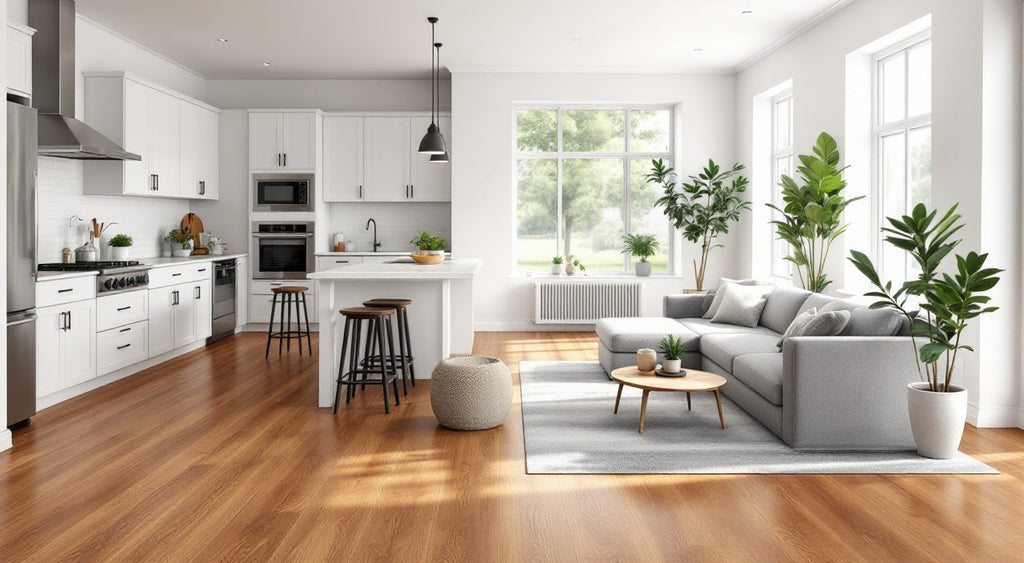
LVP, LVT, SPC, and WPC are not four competing flooring types you have to choose between. LVP and LVT describe the shape and marketing name of a vinyl plank or tile. SPC and WPC describe what is inside it, the core construction underneath the printed surface. A single product can carry both labels at once, which is exactly why the four terms get tangled together in product listings and buying guides. Once you separate "what shape is this" from "what is it made of," the whole naming system stops being confusing.
What Does LVP Stand For?
LVP stands for luxury vinyl plank. It is a format name: a long, narrow piece of vinyl flooring cut and printed to resemble a hardwood board, installed in rows the same way solid or engineered wood planks are.
LVP is not a construction type on its own. A plank sold as LVP can be built on a flexible vinyl core, a stone-based rigid core, or a composite WPC rigid core. The word "plank" only tells you the shape. It does not tell you what is underneath the printed layer, which is where SPC and WPC come in. For a fuller look at LVP's pros, cons, and typical costs, see What Is Vinyl Plank Flooring?
What Does LVT Stand For, and How Is It Different From LVP?
LVT stands for luxury vinyl tile. It is the same underlying vinyl flooring family as LVP, just cut into square or rectangular tiles instead of long planks, usually to imitate stone or ceramic tile rather than wood.
LVT and LVP are siblings, not competitors. Both are printed, wear-layer-protected vinyl flooring. The only real difference is the shape the manufacturer cuts it into and the look it is designed to imitate. A stone-look product is almost always sold as LVT; a wood-look product is almost always sold as LVP. The core underneath either one can still be flexible, SPC, or WPC.

What Does SPC Stand For?
SPC stands for stone plastic composite (also written stone polymer composite). It describes a rigid core built from limestone powder combined with PVC and stabilizers, compressed into a dense, hard layer.
That density is the whole point of SPC. Under a genuinely aggressive, sustained point load, day after day, a stone-based rigid core resists denting better than WPC's rigid core, holds its shape under temperature swings, and takes a floating click-lock installation well because the rigid core keeps individual planks flat and stable. The trade-off is underfoot feel: SPC is harder and colder underfoot, and can sound and feel slightly less comfortable to walk on than a WPC floor with an attached pad.
What Does WPC Stand For?
WPC stands for wood plastic composite. It is the industry label for a rigid vinyl core built from a composite of PVC and foaming or mineral agents, though formulations vary by manufacturer.
What WPC vinyl flooring construction does reliably deliver is a lighter rigid core, often manufactured with an attached underlayment pad. That combination gives WPC floors a warmer, quieter feel underfoot than the harder, colder SPC. Under an aggressive, sustained point load, such as an office chair's casters bearing weight in the same spot for hours every day, a dense stone-based core resists denting better, but WPC is a durable rigid core and normal furniture and daily use are not a denting concern. For a deeper walkthrough of WPC construction specifically, see What Is WPC Vinyl Flooring?

So How Do These Four Terms Actually Relate to Each Other?
LVP and LVT answer "what shape and look is this floor." SPC and WPC answer "what is the rigid core made of." They describe two different questions, not four points on the same scale, which is why a single product can honestly be labeled "WPC LVP" (a WPC rigid core, cut into planks) or "SPC LVT" (a stone-composite rigid core, cut into tiles).
Both SPC and WPC fall under the same rigid-core resilient flooring category, formal enough in North America to have its own industry specification: ASTM F3261, the standard covering dimensional and performance requirements for resilient flooring in modular format with a rigid polymeric core. That single standard applies to both SPC and WPC products, because structurally they are close cousins that differ mainly in what the rigid core is built from and how that changes the feel underfoot.
| LVP | LVT | SPC | WPC | |
|---|---|---|---|---|
| What it describes | Format: long plank shape | Format: tile or square shape | Core: stone-based rigid core | Core: composite rigid core |
| Full name | Luxury vinyl plank | Luxury vinyl tile | Stone plastic composite | Wood plastic composite |
| Typically imitates | Hardwood planks | Stone or ceramic tile | N/A (a core type, not a look) | N/A (a core type, not a look) |
| Core rigidity | Depends on core used | Depends on core used | Rigid, dense | Rigid |
| Underfoot feel | Depends on core used | Depends on core used | Firmer, harder | Warmer, quieter |
| Point-load dent resistance | Depends on core used | Depends on core used | Generally stronger | Generally weaker |
| Can combine with the others | Yes, with any core type | Yes, with any core type | Yes, cut as LVP or LVT | Yes, cut as LVP or LVT |

Which Core Should You Choose: SPC or WPC?
Neither core is universally better. The honest answer depends on what the room actually demands.
Choose an SPC rigid core where dimensional stability over concrete matters most, such as a basement or a condo slab, or where the room involves a genuinely aggressive, sustained point load in one spot, day after day: rolling office chairs, carts, or equipment used for hours every day, or a fixed heavy object like a piano. The dense stone-based core resists that specific kind of concentrated point-load denting better than WPC's rigid core does.
Choose a WPC rigid core where comfort underfoot is the higher priority: bedrooms, living rooms, entryways, kitchens, and other everyday living spaces. WPC is a durable rigid core in its own right, and normal furniture and daily use, including a busy entryway or a kitchen with typical appliances, is not a denting concern; the added warmth and quiet simply make a real difference to how the floor feels day to day.
One rule applies regardless of which core you pick: a desk chair used for hours every day, rolling or stationary, will damage any resilient floor over time without physical protection underneath it. This is not a personal preference question. A hard chair mat or a low-pile rug under the full range of the chair's motion is mandatory for any home office setup, on SPC or WPC alike. No core, wear layer, or finish makes a floor immune to sustained daily chair contact. For the full comparison, including where each core makes the most practical sense room by room, see SPC vs WPC Vinyl Flooring: What Is the Difference?
Is LVP the Same Thing as SPC or WPC?
No. LVP describes the plank shape and wood-look printed surface. SPC and WPC describe what is inside the plank. An LVP product can be built on a traditional flexible vinyl core, an SPC rigid core, or a WPC rigid core, so "LVP flooring" alone does not tell you which core you are getting. Always check the core construction separately from the format name when comparing products.
Both SPC and WPC cores are generally built with water-resistant, waterproof-rated capabilities, with that protection coming largely from the rigid core itself rather than a printed surface layer, which is why rigid-core LVP and LVT are commonly marketed together as waterproof flooring. A traditional flexible-core LVP or LVT, by contrast, does not carry the same water performance and should not be assumed waterproof without checking the specific product's core and its manufacturer documentation. For a full breakdown of what "waterproof" actually requires from a floor, see Waterproof Flooring: The Complete Guide
These four terms describe shape and core construction only. They say nothing about wear-layer thickness, which is a separate spec measured in mils and covered in What Is a Wear Layer, Really?. Two SPC products can carry the same core type and still differ meaningfully in wear-layer thickness, so check that spec separately from the LVP, LVT, SPC, or WPC label.

Frequently Asked Questions
A few quick, direct answers to the questions people ask most when these four terms show up in the same product listing.
What does WPC stand for in flooring?
WPC stands for wood plastic composite. It describes a rigid vinyl flooring core, typically manufactured with an attached underlayment pad, rather than a specific look or shape.
What is the difference between LVP and LVT?
LVP (luxury vinyl plank) is cut into long, narrow boards that imitate hardwood. LVT (luxury vinyl tile) is cut into squares or rectangles that imitate stone or ceramic tile. Both belong to the same vinyl flooring family and can be built on the same range of core types.
Is SPC or WPC more waterproof?
Both are generally built with waterproof-rated protection coming from the rigid core itself, not just a surface coating, though buyers should confirm the specific product's waterproof rating rather than assume it from the core type alone. Neither core type has an inherent water-resistance advantage over the other; the meaningful differences between them are underfoot feel and point-load dent resistance, not waterproofing.
Can LVP flooring have an SPC or WPC core?
Yes. LVP only describes the plank shape and wood-look surface. The core underneath can be SPC, WPC, or a traditional flexible vinyl core, so the same LVP product line can exist in more than one core version.
Which is better, SPC or WPC?
Neither wins outright. SPC's dense, stone-based core resists concentrated point-load denting better only under a genuinely aggressive, sustained load, such as a daily-use rolling office chair or a piano, and suits high-traffic or heavy-use spaces built around that kind of load. WPC is a durable rigid core in its own right and suits everyday living spaces, where its added warmth and quiet underfoot matter more than resisting that narrow, sustained point-load scenario. The right choice depends on the room, not a universal ranking.
To see the full Caledon Floors range, click here. To find a Caledon Floors dealer near you, click here.