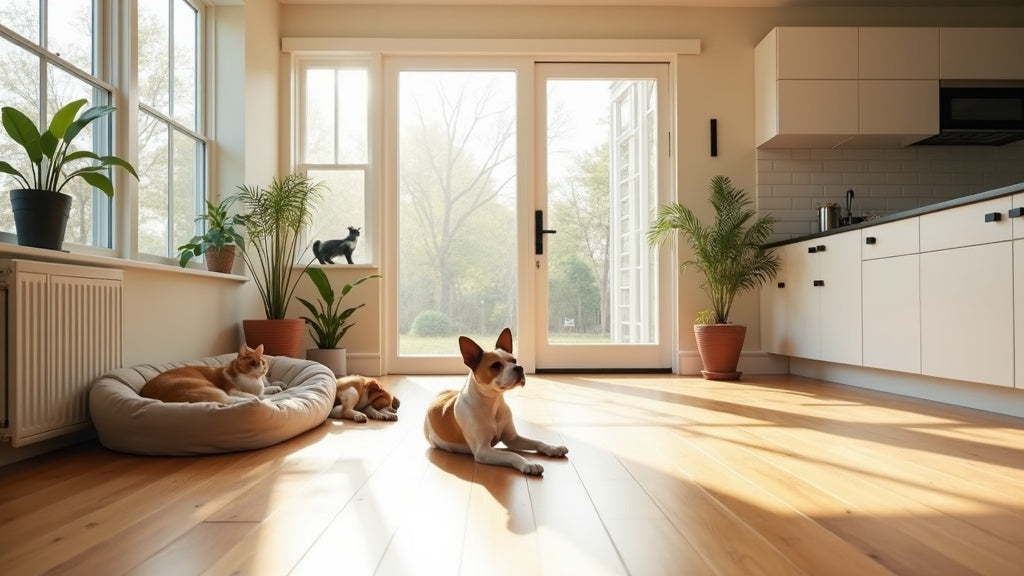
A home with two or more pets needs flooring that hides cumulative wear, manages moisture from several accident and feeding zones instead of one, and fits into a cleaning routine you can actually repeat every day. That is a different question than "is this floor pet-friendly," and it deserves a different answer. Multi-pet households do not just get more of the same wear a single pet produces. They get concentrated traffic on the same paths, more moisture sources spread through the home, and less margin for a floor that is high-maintenance by nature.
This guide looks at flooring the way a multi-pet household actually experiences it: by surface texture, by how moisture and accidents scale with more animals, and by which categories fit a repeatable care routine. It compares flooring types generally, not specific products, because the honest answer to what a multi-pet home needs points to the category first, not any one brand's catalog.

What Actually Changes When a Home Has More Than One Pet?
More pets means more repetition on the same stretch of floor, not just more total wear. A single dog wears a path from the door to the kitchen. Two dogs and a cat wear the same path twice as fast, plus a second path to the litter box and a third to a water bowl in another room.
Three things scale directly with pet count, regardless of species:
- Traffic concentration: multiple pets tend to use the same hallways, doorways, and stair landings, so wear shows up faster in fewer, more predictable spots rather than spread evenly across a room.
- Number of moisture zones: every additional pet usually means another water bowl, another litter tray, or another spot where wet paws come in from outside. A single-pet home might have one zone to think about. A three-pet home often has three or four.
- Cleaning frequency: more fur, more litter tracking, and more accidents mean the floor gets swept, vacuumed, and mopped more often. A floor that is only "fine if cleaned occasionally" becomes a daily chore in a multi-pet house.
None of this means a multi-pet home needs an exotic flooring category. It means texture, moisture handling, and maintenance fit deserve more weight in the decision than they would for a single calm cat in a quiet apartment.

Does Floor Texture Matter More With Multiple Pets?
Yes. A textured, matte, or embossed surface hides cumulative wear noticeably better than a smooth, glossy one, and multi-pet homes accumulate that wear faster. Glossy finishes reflect light directly off the surface, which makes every paw print, dust streak, and light claw mark visible. Matte and satin finishes scatter that light instead, so the same amount of wear reads as far less noticeable.
Texture also affects footing, and footing matters more when multiple pets are moving through the same space, sometimes chasing each other or navigating around one another near doorways and stairs. Smooth, glossy hard surfaces are more likely to feel slick underpaw, which is a bigger concern for older dogs, larger dogs, and any pet with mobility issues. A textured or embossed surface generally offers more secure footing than a smooth, high-gloss one.
None of this means a specific wear layer or finish spec will prevent scratching from claws. No flooring surface is claw-proof, and no product should be marketed that way. The realistic goal is a surface that disguises normal wear well and gives pets confident footing, achieved through texture and finish choice rather than a promise about durability under claws specifically. For a deeper look at what to realistically expect from claws and everyday accidents, see Pets, Claws, and Accidents: What to Really Expect from Pet-Friendly Floors.
How Should a Multi-Pet Home Handle Moisture at Scale?
The key shift is that moisture in a multi-pet home is rarely limited to one spot. With several animals, spilled water bowls, litter tray splashes, and wet paws from multiple dogs can show up in more rooms and more often than in a single-pet household. That changes how much moisture tolerance matters, and where.
A fully waterproof core, the kind used in WPC vinyl flooring, is not affected by standing water or spilled bowls reaching the surface, because the core itself does not absorb moisture. That is a construction fact worth stating plainly, not a promise about how a floor will hold up to claws or general wear. Waterproof flooring in this sense is about what happens when water sits on the surface, not about scratch resistance.
Real wood surfaces behave differently. Engineered hardwood's veneer is a natural material, and it reacts to sustained moisture with swelling, cupping, or discolouration more readily than a sealed composite or a modern water-resistant laminate. That does not rule engineered hardwood out of a multi-pet home. It means moisture zones, litter areas, and feeding stations are better placed away from it, or managed with a mat and prompt cleanup, if the household wants real wood underfoot.
How Do Different Flooring Types Generally Hold Up in Multi-Pet Homes?
The table below compares flooring categories on the qualities that matter most once wear and moisture are spread across several pets, not one. These are general category tendencies, not guarantees about any single product.
| Flooring type | How wear typically shows | How it manages moisture and accidents | Grip and footing | Fit with a multi-pet cleaning routine |
|---|---|---|---|---|
| WPC vinyl flooring | Textured, embossed surfaces disguise everyday wear well | Fully waterproof core is unaffected by standing water or spills reaching the surface | Textured finishes generally offer secure footing; smooth or glossy versions are more slip-prone | Wipes and mops easily; comfortable, cushioned surface for pets to lie on |
| SPC (rigid core) vinyl | Same wear-layer behaviour as WPC vinyl; a dense, rigid core is naturally firmer underfoot | Waterproof core, similar moisture behaviour to WPC vinyl | Comparable footing to WPC when textured; firmer, less cushioned surface | Same easy-clean surface as WPC vinyl; the firmer core also suits homes mixing heavy furniture with pets |
| Laminate | Wear resistance depends on the wear layer rating; matte and textured finishes hide marks well | Modern water-resistant laminate lines carry measurable swell-rate ratings and sealed edges, offering more predictable standing-water tolerance than a real wood surface, though the core is still wood fibre based | Textured laminate offers decent grip; smooth or high-gloss laminate can feel slick | Easy to sweep and mop; less forgiving than vinyl if water sits unattended for a long period |
| Engineered hardwood | Real wood grain and hand-scraped textures can camouflage light scratches; pale, uniform finishes show wear more | Real wood veneer reacts to sustained moisture with swelling or cupping more readily than the categories above; not a water-resistant surface | Satin or matte finishes offer better footing than high-gloss finishes | Requires more attentiveness around litter and feeding zones; refinishing is possible if surface wear accumulates over years |
| Tile | Very wear-resistant surface itself; grout lines are the visible aging point | Impervious surface is unaffected by spills and standing water, though porous grout can absorb odour and staining over time without regular sealing | Glazed tile is typically harder and slicker underpaw, a real consideration for older or larger dogs | Easy to wipe; grout maintenance scales up with more pets and more accidents |
| Carpet | Shows matting, staining, and traffic patterns fastest of any category here | Fibres and padding absorb moisture, odour, and dander in a way hard surfaces do not, so accidents are harder to fully clean | Softest, most secure footing of any category, an advantage for senior or anxious pets | Generally the highest-maintenance choice in a multi-pet home because more pets mean more absorbed moisture and odour sources |
What Maintenance Habits Matter More Than the Floor Itself?
No flooring category removes the need for a maintenance routine, and in a multi-pet home the routine matters more than the material. These habits apply regardless of which flooring type is already in the home or being considered:
- Trim or grind nails regularly: shorter nails reduce dragging and clicking across any hard surface and make less noticeable contact with the floor over time.
- Clean accidents promptly: the single biggest factor in how well moisture is managed on any floor is how quickly it is addressed, not the floor's rating.
- Use mats and rugs strategically: a washable mat under every water bowl and litter tray, plus a rug or runner along the main pet traffic path, reduces both moisture exposure and visible wear concentration.
- Scale cleaning frequency to pet count, not floor type: a three-pet home needs more frequent sweeping and vacuuming than a one-pet home on the exact same floor. Set the routine around the household, not the material.
- Choose rugs with non-slip backing in play areas: where multiple pets run or chase each other, a securely backed rug adds footing and protects the floor underneath at the same time.
These habits work with any flooring category and are worth building into the household routine before or alongside a flooring decision. For more on the difference vinyl construction can make for scratch expectations specifically, see Is Vinyl Flooring Really Scratch Resistant? For the trade-off between the two rigid-core vinyl categories mentioned in the table above, see SPC vs WPC Vinyl Flooring: What is the Difference and Which Is Better? And for a related look at how cumulative household traffic affects flooring decisions beyond pets, see Best Flooring for Busy Families with Kids.

FAQ: Flooring for Multi-Pet Households
A few questions come up specifically once a household has more than one pet, beyond the general pet-friendly flooring basics.
Is any flooring truly scratch-proof for a multi-pet home?
No. Every flooring category can show wear from claws over time. Matte, textured, or hand-scraped finishes make that wear far less visible than a smooth, glossy surface, but no finish or wear layer makes a floor claw-proof.
Do multiple cats change the flooring math differently than multiple dogs?
To some degree. Cats concentrate more of their scratching on furniture and scratching posts than on floors, but multiple cats usually mean more litter tray zones and more litter tracking to manage. Multiple dogs tend to concentrate more direct floor traffic and paw moisture along specific paths. A household with both benefits from thinking about footing and litter-zone moisture, not just claws.
Does adding more pets mean the whole flooring category should change?
Not necessarily. More pets mainly raises the volume and frequency of ordinary wear and moisture exposure. That usually changes how much weight texture, moisture handling, and cleaning cadence deserve in the decision, more than it changes which category is the right starting point.
Is carpet ever a reasonable choice in a multi-pet household?
It can be, in limited, low-accident areas like a quiet bedroom, for households that are diligent about cleaning. Carpet is generally the highest-maintenance category in a multi-pet home because its fibres and padding absorb moisture, odour, and dander in a way hard surfaces do not, and that compounds as pet count increases.
Choosing flooring for a multi-pet household comes down to fewer surprises, not a single perfect material: a surface that hides normal wear, tolerates moisture across more than one zone of the home, and fits into a cleaning routine the household will actually keep up with.
Contact us with any questions about your project.
To find waterproof vinyl flooring, click here for a Caledon Floors dealer near you.