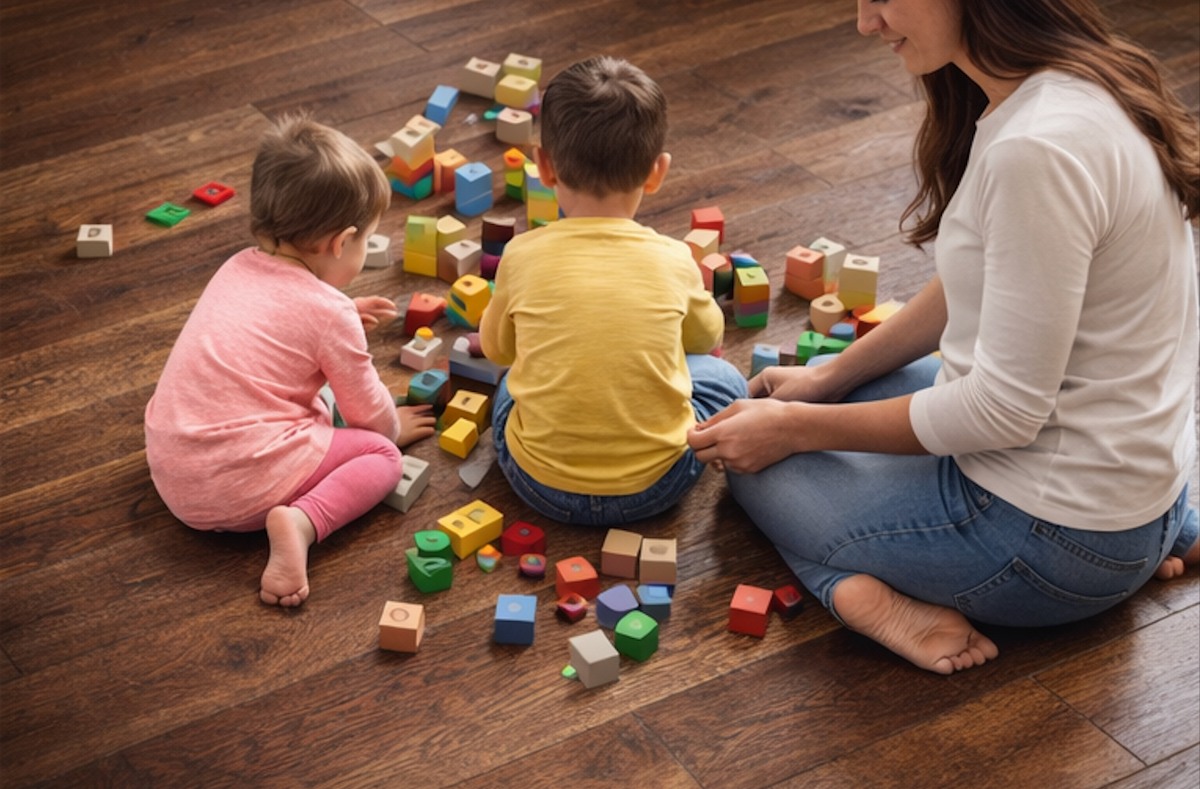
Choosing the right flooring for a family home with young kids is one of the most practical decisions a Canadian homeowner can make. The floor is the most used surface in the house: toys, spills, muddy boots, pet accidents, and daily foot traffic all land on it. Getting this right means fewer headaches and less money spent replacing a floor that wasn't built for real family life.

What Makes a Floor Good for Families with Kids?
For most Canadian families, the best flooring for kids comes down to five things: durability, waterproofing, ease of cleaning, comfort underfoot, and safety. Each matters differently depending on the room and your children's age.
Durability means resistance to scratches from toys, chair legs, and shoes. Waterproofing matters because spills and accidents happen, often at the same time. A floor that absorbs moisture or swells at the seams will not last. Comfort underfoot is easy to overlook until your kids are spending hours on the floor; hard, cold surfaces become tiring fast. Safety also means slip resistance in kitchens and entryways, and avoiding flooring that demands strict maintenance. Refinishing schedules or careful humidity controls are not compatible with real family life.
The Best Flooring Options for Canadian Family Homes
Not all flooring types perform equally in a busy Canadian household. Here is an honest look at your main options: what each does well and where each falls short.

WPC Vinyl Flooring: Top Pick for Most Families
WPC vinyl is the top pick for most Canadian families with kids. It is 100% waterproof, comfortable underfoot, scratch-resistant with a quality wear layer, and easy to clean with a damp mop. WPC is warmer and quieter underfoot than harder rigid cores like SPC, which is noticeable when kids spend extended time on the floor. It also absorbs sound better than most alternatives, which matters in open-concept or multi-storey homes.
Look for at least a 12 mil wear layer for standard residential use; 20 mil is worth the step up in a high-traffic family home. The wear layer is what stands between everyday abuse and the printed surface: it is the specification that matters most when comparing products.
No floor is scratch-proof. Sharp objects, dragged furniture, and grit tracked in from outside will leave marks over time on any product. Entry mats and felt pads under furniture legs go a long way regardless of what floor you choose.
SPC Vinyl Flooring: Best for Basements
SPC (stone plastic composite) is WPC's denser, harder cousin. Both are waterproof and visually similar, but SPC has a mineral-reinforced core that is more dimensionally stable, a real advantage in Canadian basements and below-grade installations over concrete where temperature and moisture fluctuate more than above grade.
The trade-off is comfort. SPC feels firmer underfoot and transmits sound more readily than WPC. In main living areas and bedrooms, most families find WPC the more liveable option day-to-day. For basement rec rooms and utility spaces, SPC's stability is often worth that trade-off.

Engineered Hardwood: A Good Option With Honest Caveats
Engineered hardwood offers the warmth and look of real wood with better dimensional stability than solid hardwood across Canada's seasonal humidity swings. For families who want authentic wood, it is a legitimate option in the right rooms: above grade, away from consistent moisture.
The caveats are real and worth understanding before you commit. Engineered hardwood is not waterproof. Sustained moisture (a spill left too long, a pet accident, or humidity issues in a basement) can cause swelling or delamination. Scratch resistance is also a concern: deep marks require professional refinishing, and not all engineered hardwood products can be refinished at all. That option depends entirely on how thick the wear layer is, with 4mm being the practical minimum.
Laminate: Worth Considering in the Right Rooms
Quality AC3 or AC4-rated laminate is genuinely durable and scratch-resistant, in some dry-room applications, more so than vinyl. It handles everyday foot traffic, toys, and furniture well. In living areas and bedrooms where moisture is not a concern, it is a strong budget-conscious option for Canadian families.
The limitation is moisture, and it is a hard one. Even water-resistant laminate cannot handle standing water or sustained dampness. Spills left overnight or pet accidents can cause the core to swell and planks to buckle permanently. Keep laminate out of basements, bathrooms, and any space with recurring moisture exposure. It also tends to feel hollow underfoot and transmit more noise than vinyl without a quality underlayment beneath it.
What to Avoid
Solid hardwood is not well-suited to most Canadian family homes with young children. It expands and contracts with seasonal humidity changes, is vulnerable to water damage, and cannot be installed below grade. The refinishing potential that makes it appealing long-term requires careful, consistent maintenance that is genuinely difficult during the young-kids phase of home life.
Avoid thin, entry-level vinyl under 4mm thick with a wear layer below 8 mil. The upfront savings do not offset early replacement costs: it is one of the most common flooring regrets among Canadian homeowners.
Which Rooms Need the Most Thought?
Not every room in a family home has the same demands. Choosing by room rather than trying to find one product that works everywhere will almost always give you a better result.
Living Room and Main Floor
The main floor is typically the highest-traffic area and where kids spend the most time. WPC vinyl with a 20 mil wear layer handles an open-concept layout well, combining waterproofing, comfort, and easy cleaning in a single product. Engineered hardwood is viable above grade if you are prepared for the maintenance requirements and honest about moisture exposure in your home.
Kids' Bedrooms
Bedrooms are lower-traffic and lower-moisture, which opens up more options. WPC vinyl remains a practical choice for consistency with the rest of the home. AC3 or AC4 laminate works well in rooms where moisture is genuinely minimal. Choose a product with enough thickness (7mm or more) and a quality underlayment. The difference in warmth and softness underfoot is real in a room where kids spend hours on the floor.
Basement Rec Room
Canadian basements require more care than almost any other room in the house. Concrete subfloors hold moisture and stay cold, and seasonal humidity swings are more pronounced below grade than above. Any flooring that is not waterproof is a real risk in this environment, and that risk compounds when the basement is used as a family rec room or play area.
WPC and SPC vinyl are the clear recommendations for finished basement spaces. SPC's stability over concrete is an advantage. WPC is warmer and more comfortable but requires a well-prepared, moisture-managed subfloor. Do not skip the vapour barrier in a Canadian basement.

Stairs
Stairs combine high-traffic wear with a genuine safety concern. Slip resistance is critical where kids run up and down constantly. Carpet provides the most grip and cushions falls, which is why many families keep carpet on stairs even when switching to hard flooring elsewhere in the home.
For hard flooring on stairs, choose a textured or matte finish and ensure stair nosings are properly flush. Protruding nosing lips that catch a foot are a real hazard. Stair installation also costs more than flat floor installation, and it is worth factoring into your budget upfront rather than being surprised later.
What Canadian Homeowners Should Know Before Buying
Canada's climate creates real flooring challenges that homeowners in warmer climates do not have to think about. Forced-air heating pulls moisture from the air in winter, causing wood-based flooring to contract. Summer humidity causes it to expand. Managed improperly, these seasonal cycles cause gapping, buckling, and creaking.
WPC and SPC vinyl handle Canadian climate swings without the expansion gaps and humidity management required for wood-based floors. For engineered hardwood and laminate, proper acclimation, expansion gaps, and vapour barriers are not optional: they are what prevent a good floor from failing in a Canadian home.
Subfloor preparation matters more than most homeowners expect and is underestimated almost universally. An uneven subfloor causes clicking, movement, and premature wear regardless of what product goes on top. Thicker planks are more forgiving of minor imperfections, but significant deviations need correcting before installation no matter what you choose.
If you are unsure about your subfloor conditions, room usage, or which product is right for your home, contact a local dealer before you buy. Getting advice based on your actual home (not a generic spec sheet) is the most valuable step you can take.
Frequently Asked Questions
Here are the questions Canadian homeowners ask most often when choosing flooring for a family home with young children.
What is the most waterproof flooring for families with kids?
WPC and SPC vinyl are fully waterproof at the plank level and are the right choice wherever moisture is a real concern: kitchens, bathrooms, basements, and any room where accidents happen. Engineered hardwood and laminate are water-resistant at best and are not substitutes for genuinely waterproof flooring in those areas.
What is the most scratch-resistant flooring for a family home?
AC4-rated laminate generally edges out vinyl for surface scratch resistance in dry rooms. Where waterproofing also matters, WPC vinyl with a 20 mil wear layer is the practical choice. No flooring is scratch-proof: felt pads under furniture and an entry mat at exterior doors reduce wear on any product.
Can I use the same flooring throughout the whole house?
WPC vinyl is the most suitable product for whole-home installation in a Canadian family home. For basements, SPC is often more dimensionally stable over concrete. Engineered hardwood and laminate are best limited to above-grade, lower-moisture rooms.
Does waterproof flooring mean I never have to worry about water?
Waterproof flooring means the planks will not absorb water or swell. It does not mean the subfloor is protected in a major leak or that every joint is sealed under sustained standing water. Clean up spills promptly: the waterproof rating applies to plank construction, not every possible scenario.
Is laminate a good choice for a family home in Canada?
Quality AC3 or AC4 laminate works well in above-grade living areas and bedrooms with low moisture exposure. Avoid it in basements, bathrooms, or rooms where spills and humidity are ongoing. In those spaces, waterproof vinyl is the better fit.
The Bottom Line
For most Canadian families with young children, WPC vinyl offers the best combination of waterproofing, comfort, durability, and low maintenance, without refinishing schedules, humidity management, or anxiety about every spill. SPC vinyl is the better choice for basements. Engineered hardwood earns a place above grade when chosen with a 4mm minimum wear layer and installed in the right rooms. Quality laminate is practical in bedrooms and living areas where budget matters and moisture is genuinely low.
Avoid solid hardwood and thin entry-level vinyl. The trade-offs do not work in a family home with young kids, and the regret tends to come fast.
Every home is different. Contact us for help choosing a floor, or find a dealer near you for advice based on your actual space.
Related Reading
These articles go deeper on topics covered in this guide: