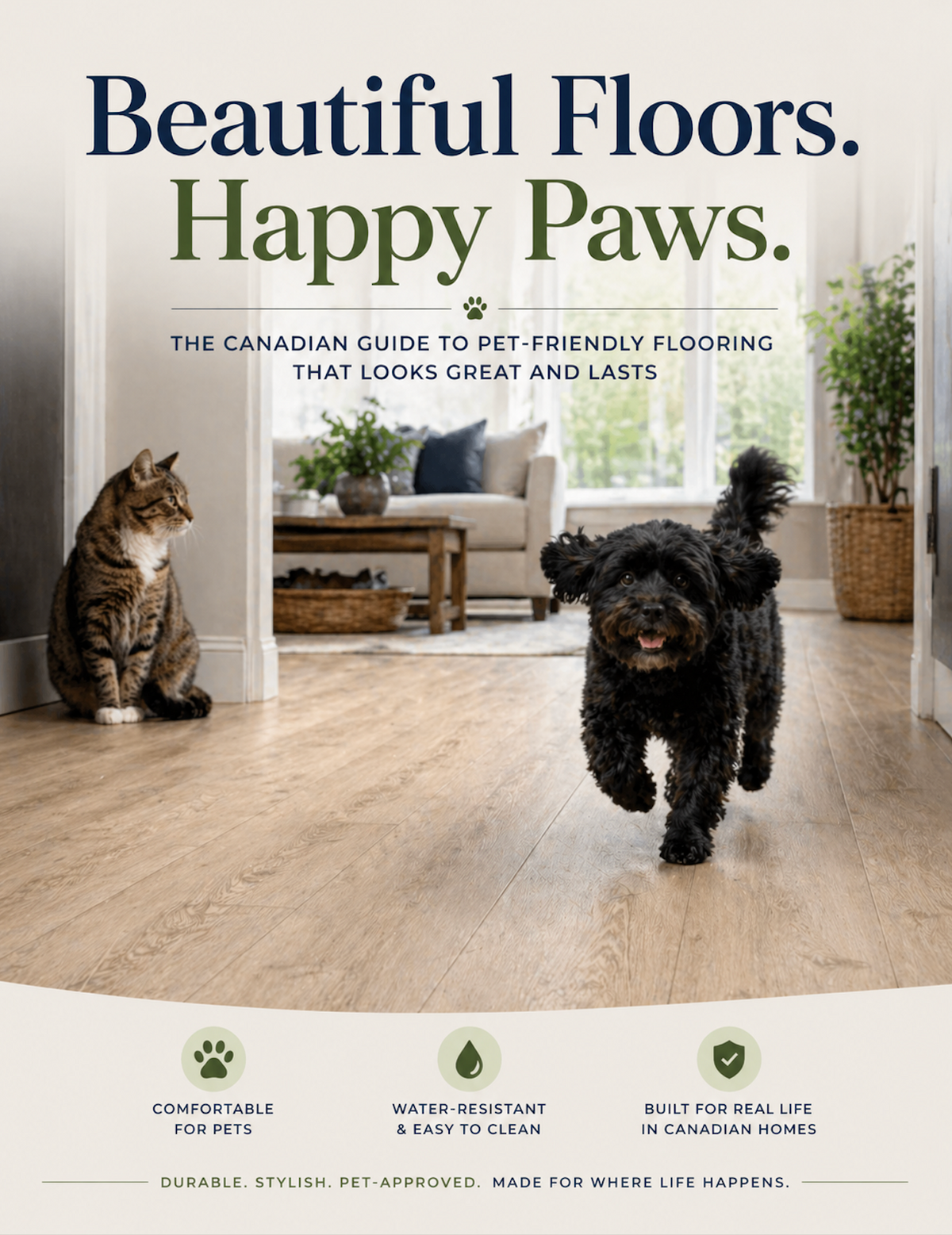
If you have pets, the right flooring question is not "What floor is perfect?" It is "What floor is likely to be easier to live with in my house?" That is the real question, because "pet-friendly" does not mean pet-proof. It does not mean scratch-proof. It does not mean worry-free. It usually means the floor may be more forgiving in some important ways, especially around cleanup, moisture, and everyday wear.
For most pet owners, the decision comes down to four things: how visible wear will be, how the floor handles bowls and wet paws and accidents, how slippery it feels for the pet, and how easy it is to keep clean. Those are the issues that matter most in daily life.

What Pet Owners Usually Want to Know
Most buyers with pets are really asking a version of one of these questions: What floor is easiest to live with? What floor is less stressful around claws and accidents? What floor is easiest to clean? What floor gives the best balance between practicality and appearance? Those are good questions, and they lead to better decisions than vague "pet-friendly" marketing language.
If Your Biggest Concern Is Claws
Then you need to be realistic. Any floor can show wear over time. No responsible advice should tell you otherwise. Bigger dogs, sharper nails, more activity, tighter turns, and dirt tracked in from outside all increase the chance of visible wear.
So the better question is not, "What floor will never scratch?" The better question is: which floors are usually more forgiving, which are easier to live with if wear happens, and which are more likely to hide everyday life better? That is a much more useful way to think about it. In many homes, practical hard-surface floors are part of this conversation because they can be easier to live with in a busy, active household, but expectations still need to stay realistic.

If Your Biggest Concern Is Accidents, Water Bowls, and Wet Paws
Then easier cleanup and better water tolerance should move up the priority list. For many pet homes, this is where practical hard-surface flooring becomes attractive. Water bowls get knocked, paws come in wet, and accidents happen. Some floors are simply easier to manage when that is part of normal life.
This does not mean waterproof or water-resistant should be treated like magic. Cleanup still matters. Installation still matters. But if daily moisture is a real concern, it makes sense to favour floors that are less stressful in that area. Waterproof flooring can help significantly in pet homes, as long as expectations stay grounded.
If Your Biggest Concern Is Traction
Then do not focus only on surface durability. This is one of the most overlooked parts of the discussion. A floor can be easy to clean and still feel too slick for some pets, especially older dogs, larger dogs, dogs with joint issues, dogs that run hard through the house, and homes with stairs.
If a dog does not feel stable on the floor, that matters. Grip matters. Confidence underfoot matters. This is one reason the best pet floor is not always the one with the strongest marketing language around wear.

If Your Biggest Concern Is Easiest Ownership
Then you are usually looking for a floor that is easier to clean, less stressful around moisture, and more forgiving in everyday use. That is why many pet owners start by looking at practical hard-surface floors, not because they are perfect, but because they often simplify daily life. This is the most useful way to frame the whole conversation: not perfect, not pet-proof, just easier to live with.
Vinyl Flooring in Pet Homes
Vinyl often enters the conversation early for a reason. If a homeowner's biggest priorities are easier cleanup, practical day-to-day use, and lower stress around moisture, vinyl is often one of the first categories considered. That does not mean all vinyl is equal: product quality still matters, construction still matters, and surface look still matters. But directionally, vinyl is often attractive in pet homes because it can be a more forgiving everyday choice for many households, especially when the buyer wants practicality first.
Laminate Flooring in Pet Homes
Laminate can also work in some pet homes, especially for buyers who want a hard surface with strong visual value. The key is to think beyond the sample. Moisture exposure matters. Traction matters. Room use matters. A good laminate floor may be a reasonable choice in one home and the wrong choice in another. This is a category where the room and the pet habits matter a lot; a buyer should not assume that because laminate works in one pet household, it is automatically the best answer in every pet household.
Engineered Hardwood in Pet Homes
Engineered hardwood is where expectations need to be clearest. A homeowner may still choose engineered hardwood in a pet home because they value real wood enough to accept the trade-offs, and that can be a reasonable decision. But it should be a conscious one.
Real wood is a more appearance-sensitive material than many practical hard-surface alternatives. That does not make it wrong. It means the owner should not expect it to behave like a low-stress utility floor. If the buyer wants the least stressful pet floor possible, engineered hardwood is usually a harder sell. If the buyer wants real wood and accepts the trade-offs, it can still be the right choice.
Which Floors Tend to Be More Forgiving?
Not best. Not perfect. More forgiving. For many pet owners: easier cleanup and moisture tolerance often push vinyl near the top of the conversation; laminate can work in some homes, but the moisture and traction side needs careful thought; and engineered hardwood is usually the more appearance-sensitive option, not the lower-stress one. That is a much more useful framework than pretending one floor solves everything.
Pet-Flooring Comparison
| Main concern | Most useful way to think about it | Floors often considered |
|---|---|---|
| Claws and daily wear | Focus on realistic scratch expectations and how visible wear may be | Practical hard-surface floors, especially better vinyl products |
| Accidents and bowls | Focus on easier cleanup and moisture tolerance | Vinyl, some laminate options, tile |
| Older dogs or mobility issues | Focus on traction, not just durability | Room-specific decision; avoid slick surfaces where possible |
| Premium visual finish | Focus on whether you accept a more appearance-sensitive material | Engineered hardwood if the trade-offs are acceptable |
Best Answer by Buyer Priority
If you want the easiest cleanup
Practical hard-surface floors usually enter the conversation first, and vinyl is often one of the most common choices in Canadian pet homes.
If you want the least stressful everyday ownership
A more forgiving hard-surface floor is usually easier to live with than a more appearance-sensitive one.
If you want real wood and accept the trade-offs
Engineered hardwood can still be the right choice, but it should be chosen with realistic expectations about how it will hold up to pet life.
If you have an older or larger dog
Do not ignore traction. A floor that feels too slick may be the wrong answer even if it checks other boxes.

What Pet Owners Often Get Wrong
The first mistake is taking "pet-friendly" too literally. The second is focusing only on claws and ignoring traction, water, and cleanup. The third is buying for the showroom sample instead of the real household: a floor that looks great in a display can still be the wrong fit for a home with large dogs, muddy paws, and constant daily use. The fourth is expecting one floor to remove every trade-off. That is not realistic.
FAQ: Pet-Friendly Floors
What does pet-friendly flooring actually mean?
Usually, it means the floor may be easier to live with in a home that has pets. It does not mean pet-proof.
Will pet-friendly floors scratch?
Any floor can show wear over time. The better question is whether the floor is more forgiving and whether wear will be easier to live with.
Is waterproof flooring better for pet homes?
It can be very helpful in homes where bowls, wet paws, or accidents are part of normal life, but it should not be treated like a cure-all.
Is engineered hardwood a bad choice for pet homes?
Not automatically. But it is usually the more appearance-sensitive choice, so buyers should go into it with realistic expectations.
What matters most in a pet home: scratches or traction?
Both matter, but many homeowners underestimate traction. For some dogs, especially older or larger ones, it can matter just as much as surface durability.
Final Verdict
If you have pets, the goal is not to find a perfect floor. The goal is to find a floor that is more practical for the way your household actually lives. That means keeping expectations realistic: no floor should be sold as scratch-proof, and no floor is right for every pet home. The right answer usually depends on the type of pet, the room, the level of activity, the amount of moisture, and what the homeowner values most. "Pet-friendly" should mean more forgiving, not perfect. Contact us for help choosing a floor, or find a dealer near you who can match the right product to your home and your pets.

Related Reading
These articles go deeper on topics covered in this guide: