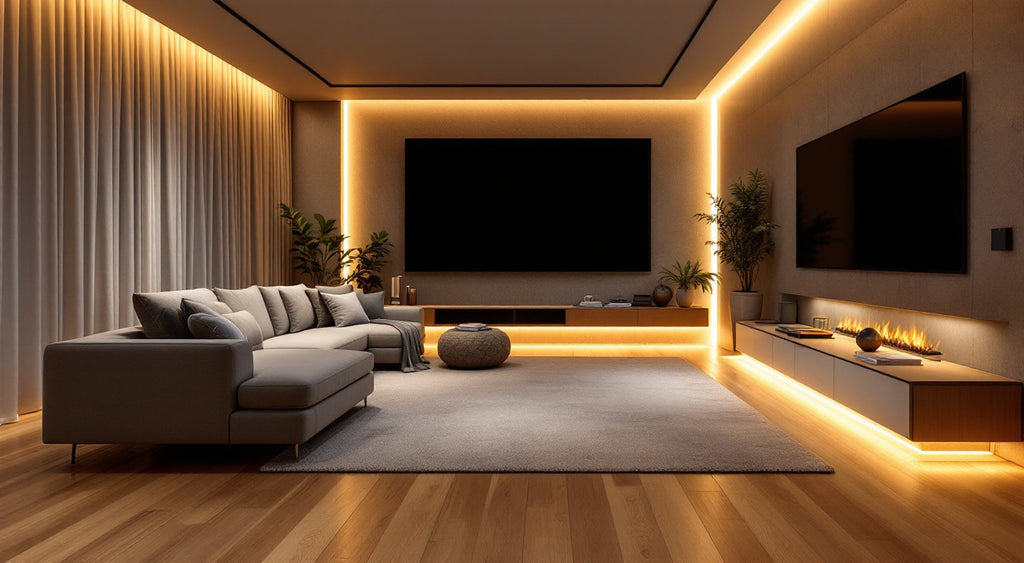
There is no single flooring material that solves every home theatre concern at once. The honest answer depends on four separate, practical factors: how much impact noise reaches the room below, how comfortable the floor feels for long barefoot lounging sessions, how much a glossy finish reflects light back at the screen, and, if the room is below grade, whether moisture is a real concern. Understanding these four factors separately, rather than chasing one "best" material, is what actually makes a media room comfortable and functional.
What Actually Matters When Choosing Flooring for a Home Theatre?
Four things matter, and they rarely point to the same single answer. Footstep and impact noise reaching a room below matters most in a condo, an apartment, or any multi-storey home. Underfoot comfort matters because people sit, recline, or sprawl on the floor for hours at a time, not just walk across it. Finish sheen matters because a dark, low-light room makes reflections far more noticeable than a sunlit living room does. Below-grade moisture matters only if the room happens to be in a basement, which a large share of home theatres are, simply because basements are the part of the house most homeowners are willing to dedicate to a dark, closed-off room.
None of these four factors is optional window dressing. Each one shows up as a real, everyday annoyance if it gets ignored during planning, and each has an honest answer that does not always point to the same flooring category.
Does Flooring Material Stop a Subwoofer's Bass From Shaking the Room Below?
No. This is one of the most common misconceptions homeowners bring into a media room project, and it is worth correcting directly. Low-frequency bass vibration travels through the physical structure of a building, the subfloor and framing, not primarily through the surface layer of flooring sitting on top of it. Swapping one flooring material for another does very little to stop that transfer.
The actual fix is mechanical decoupling: an isolation platform or a dense isolation pad placed directly under the subwoofer or speaker cabinet itself, breaking the physical connection between the unit and the floor so vibration has to fight through a compliant material before it reaches the structure. This applies regardless of what flooring is on the floor. Even a plush carpet, on its own, does not fully isolate a subwoofer from the floor beneath it; a proper isolation pad or platform under the speaker is still the right tool for that specific problem. Choosing a flooring material is a separate decision from managing bass vibration, and conflating the two leads to disappointment.

Which Flooring Options Actually Reduce Footstep and Impact Noise?
Cushioned, floating installations with an attached resilient pad, and soft surfaces like carpet, measurably reduce everyday impact noise such as footsteps and a dropped remote, compared with a hard, rigid, or glued-down surface. This is basic building acoustics: adding a compliant layer between a hard walking surface and the structural subfloor absorbs impact energy before it can transmit as sound to the room below.
| Flooring option | Impact noise behaviour | Underfoot comfort | Honest trade-off |
|---|---|---|---|
| Carpet | Best airborne and impact sound absorption of the group | Warmest, softest surface | Not part of every flooring line-up; can trap dust and needs more frequent deep cleaning |
| WPC vinyl flooring, floating with attached pad | Noticeably quieter underfoot than a rigid or glued surface, thanks to the cushioning layer | Warm and cushioned, comfortable for extended lounging | Still reflects airborne echo more than carpet or a rug; a fully waterproof core is a genuine plus in a below-grade room, though not the reason to choose it here |
| Engineered hardwood, floated over underlayment | Some impact reduction if floated, less if glued down | Warmer than tile, firmer than a padded vinyl floor | A glossy factory finish increases glare; a satin or matte finish is the better call for a dark room |
| SPC or rigid-core vinyl and quality laminate | Denser, harder core transmits more impact noise than a cushioned floating floor | Firmer, cooler underfoot, less forgiving for hours of lounging | A dense, rigid core generally holds up better against dents from heavy equipment racks or furniture legs than a softer, comfort-oriented core, though nothing is dent-proof under sustained concentrated weight |
| Tile | Loudest and coldest of the group for footstep noise and lounging comfort | Least comfortable for sitting or lying directly on the floor | Genuinely the safest, most moisture-tolerant choice for a below-grade room with real water risk |
None of these options eliminate impact noise entirely on their own. For the specific building-code ratings that govern how much impact and airborne sound a floor assembly must block in shared-wall or stacked housing, the exact rating mechanics are covered in more depth in the guide to condo flooring sound ratings and underlayments, which goes into the acoustic-rating detail this article intentionally does not repeat.

Is Carpet Actually the Best Choice for a Home Theatre's Acoustics?
Yes, for pure sound absorption, carpet is genuinely the strongest performer of any common flooring category. Its soft, fibrous surface absorbs both airborne echo and impact noise far more effectively than any hard surface, cushioned or not, which is exactly why professional screening rooms and commercial cinemas lean on carpet so heavily.
That is the honest answer, even though it points outside a hard-surface product line. The realistic trade-off is that carpet is harder to keep clean around spilled snacks and drinks, traps more dust and allergens, and does not offer the same durability or moisture tolerance as a hard surface. For homeowners who want a hard floor for cleaning and durability reasons, a large, thick area rug placed across the main seating and walking zone recreates a meaningful share of carpet's acoustic softening on top of any hard flooring choice, without covering the whole room. More detail on using area rugs to add warmth and comfort to a hard floor applies directly here.
What Makes a Home Theatre Floor Comfortable for Long Lounging Sessions?
Warmer, softer-underfoot surfaces make more sense in a room where people sit, recline, or lie on the floor for hours at a time, rather than simply walking through it. A cold, hard, rigid surface like tile or a dense composite core is a poor match for that use pattern, even if it wins on other measures like moisture resistance or dent resistance.
A cushioned floating floor with an attached pad, or a hard floor layered with a substantial area rug across the main seating zone, both address this directly. The physical reasons some floors feel warmer and softer than others, independent of the room they are in, are covered in more depth in why some floors feel warmer or softer underfoot than others.
Why Does Floor Finish Matter More in a Media Room Than Almost Any Other Room?
Because a glossy or highly reflective floor finish bounces ambient and screen light around a room that is specifically kept dark, and that reflected light is genuinely distracting during viewing in a way it simply is not in a brightly lit kitchen or living room. A high-sheen finish under a projector or a large screen can throw a visible glare pattern across the floor that pulls attention away from the screen itself.
A matte or low-sheen finish is the honest right call for this specific room, even though the same finish might read as less dramatic in a sunlit space. This is one of the few cases where finish sheen genuinely matters more for function than for looks. The trade-offs between finish levels, including how each one changes the way light behaves across a room, are covered in how floor finish sheen changes a room's feel.
Does a Basement or Below-Grade Home Theatre Need Waterproof Flooring?
Not because of anything about watching movies or listening to a subwoofer, but because a large share of home theatres are built in basements, and basement moisture is a real, separate concern that deserves an honest answer of its own. A below-grade room can see humidity swings, minor seepage, or a slow leak that a main-floor media room never has to plan for.
Where that risk is real, a fully waterproof flooring category is the honest recommendation, not because of the room's use as a theatre, but because of where the room physically sits in the house. WPC vinyl flooring's composite core is fully waterproof by construction, which is a genuine advantage in a below-grade space regardless of what else the room is used for. Engineered hardwood's real-wood veneer is more moisture-reactive and is not the safer choice for a basement with meaningful water risk, and tile remains the most moisture-tolerant hard surface of the group, at the cost of the comfort and warmth this room otherwise wants. For a fuller picture of how below-grade moisture actually behaves and what to plan for, see moisture and vapour barriers for below-grade rooms. For readers weighing WPC vinyl flooring more broadly for the rest of the room, the complete buyer's guide to vinyl plank flooring covers the category in full.

Frequently Asked Questions
These are the questions homeowners ask most often once they start planning flooring for a dedicated theatre or media room.
Does Carpet Actually Sound Better Than Hard Flooring in a Home Theatre?
Yes, for airborne echo and impact noise absorption specifically, carpet outperforms every hard flooring category. A large area rug over a hard floor recreates a meaningful share of that benefit across the main seating and walking zone without covering the whole room.
Will a Floating Vinyl or Engineered Hardwood Floor Stop a Subwoofer From Vibrating the Floor Below?
No. Bass vibration travels through the building's structure, not primarily through the surface flooring material. An isolation platform or pad placed directly under the subwoofer is the correct fix, and it matters regardless of which flooring material is chosen.
What Flooring Finish Reduces Screen Glare the Most?
A matte or low-sheen finish reflects the least ambient and screen light back into the room, which matters more in a deliberately dark media room than in almost any other room in the house.
Can I Add an Area Rug Over a Hard Floor in a Media Room?
Yes, and it is one of the most effective ways to add acoustic softening and underfoot warmth to a hard-surface floor without giving up the durability and easy cleaning that a hard floor offers over full carpet.
Does a Basement Media Room Need Waterproof Flooring?
Only because of the basement location, not the theatre use itself. Below-grade rooms carry real moisture risk that a main-floor room does not, and a fully waterproof flooring category is the honest answer where that risk is genuine.
A media room's flooring decision comes down to four separate, honest trade-offs rather than one universal winner: impact noise, underfoot comfort, finish sheen, and, for basement rooms specifically, moisture. Working through each one on its own terms gets a far more useful answer than searching for a single best material.
Have questions about flooring for a specific room, contact us and we can help.
To find waterproof vinyl flooring or engineered hardwood flooring, click here for a Caledon Floors dealer near you.