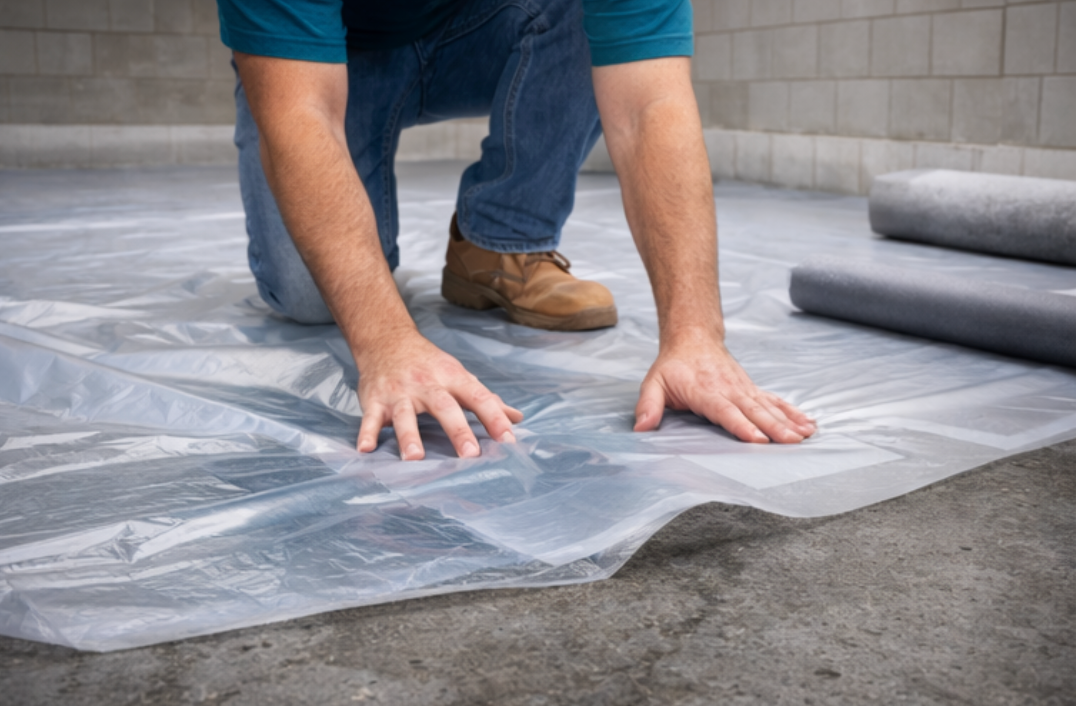
If there is one flooring topic that confuses Canadian homeowners more than it should, it is moisture and vapour barriers. People hear terms like moisture barrier, vapour barrier, waterproof flooring, attached pad, underlayment, basement slab, and concrete moisture, and before long the whole conversation turns into guesswork. One person says you always need a barrier. Another says you do not if the floor is waterproof. Someone else says the underlay already does the job. By that point, many homeowners are not making a clear flooring decision. They are just hoping they do not make an expensive mistake.
The short answer is this: Canadian homeowners do not always need the same moisture or vapour barrier solution in every room, but they do need to take moisture seriously. What you need depends on the subfloor, the room, the flooring product, and the installation method. A basement slab is not the same as a plywood subfloor. A waterproof floor is not the same as a moisture-proof floor system. And an attached pad is not automatically a complete answer.
That matters because moisture problems often do not show up on day one. The floor may go down and look fine. The trouble usually arrives later, when seasons shift, humidity changes, concrete releases moisture, or the wrong underlay and barrier combination starts affecting how the floor feels and performs. In many failed flooring jobs, the product gets blamed for a problem that really began underneath it.

Why This Topic Gets Confusing So Fast
Part of the confusion comes from the language. Many homeowners use moisture barrier and vapour barrier as if they mean exactly the same thing. In casual conversation that is understandable, but in flooring the more important question is not the label. It is the job the layer is supposed to do. The real issue is what kind of moisture risk exists below the floor and what the floor system needs to handle that risk properly.
That is where people get tripped up. A second-floor bedroom over plywood is not facing the same moisture conditions as a basement slab. A condo over concrete is not the same as a main floor over wood framing. A laminate floor does not always want the same setup as SPC vinyl, WPC vinyl, or engineered hardwood.
The other reason this gets confusing is marketing. The moment a floor is described as waterproof, many people assume the moisture conversation is finished. It is not. Waterproof flooring can be a very smart choice, but it does not mean the subfloor underneath has stopped mattering. Moisture below the floor can still affect the installation system, the transitions, the trims, nearby materials, and in some cases the warranty position if the floor was installed over the wrong conditions.
The Four Questions That Should Come First
Before choosing any barrier, underlay, or moisture-control layer, a homeowner should answer four basic questions. Getting these clear makes everything else easier.
First, what is the subfloor? Concrete and wood behave very differently. Concrete is the big one because it can hold and release moisture in ways that catch people off guard, especially below grade or in newer pours that are still drying. Second, what room is this? A basement rec room is not the same as a main-floor living room. Moisture risk changes with the room. Third, what flooring product is being installed? SPC vinyl, WPC vinyl, laminate, and engineered hardwood all bring different sensitivities and different manufacturer requirements. Fourth, what does the manufacturer actually require? Flooring warranties are not based on what sounds reasonable in the moment. They are based on whether the product was installed according to the manufacturer's instructions.
Concrete vs Plywood: Where the Moisture Question Starts
For most Canadian homeowners, the real dividing line is concrete versus plywood. Concrete is where moisture management becomes much more serious. Even when a slab looks dry on the surface, it can still hold moisture below. That is why concrete is the subfloor where testing and moisture-control decisions matter most, especially relevant in basements, lower levels, slab-on-grade homes, and many condos.
Plywood or wood-framed subfloors usually create a different conversation. The concern is often less about hidden slab moisture and more about room conditions, spills, humidity swings, and choosing the correct underlayment for the floor. That does not mean moisture never matters on wood subfloors. It means the answer is usually more room-specific and product-specific, not automatically a case of adding more layers because it sounds safer. That mindset causes plenty of problems. Flooring systems do not always improve when extra layers get added without a reason. In some cases, they get worse.

Do You Always Need a Vapour Barrier Under Flooring?
No, and that is probably the most important point in this article. You do not always need a vapour barrier under flooring. But sometimes you absolutely do. The right answer depends on the situation, not on a blanket rule.
Many floating floors installed over concrete do call for some form of moisture-control or vapour-control layer, because concrete introduces a real moisture risk. But over wood subfloors, the answer may be different. Some installations do not want an added poly layer. Some underlayments already include a moisture-control feature. Some products with attached pad still require additional steps over concrete, while others do not. This is why guessing is such a bad strategy. Homeowners often assume more layers must mean more protection, but flooring systems do not work that way. If the wrong layer is added in the wrong place, the floor may become less correct, not more.
Waterproof Flooring Does Not Mean Ignore the Moisture
This is one of the biggest misconceptions in modern flooring. Waterproof flooring is useful and can be an excellent choice in busy homes, entryways, basements, and family spaces. But waterproof flooring does not erase the need to understand what is happening underneath the floor.
A waterproof surface can handle spills from above far better than more sensitive materials. That is not the same thing as saying the subfloor and installation system are now immune to moisture from below. Concrete moisture, trapped humidity, condensation, and poor prep can still matter. This is especially important for homeowners comparing vinyl, laminate, and engineered hardwood. Vinyl can be more forgiving in real life, which is one reason it performs well in many Canadian homes. But that does not give anyone permission to skip moisture testing, ignore the subfloor, or assume every underlay decision has become irrelevant just because the top surface is waterproof.

What Different Flooring Types Usually Need
Different flooring categories bring different sensitivities to moisture, and the installation requirements reflect that. Here is an honest look at how the main categories compare.
Vinyl flooring is often one of the easier categories to live with in moisture-sensitive parts of the home, but it still needs the right setup. Over concrete, many vinyl floors still require the correct moisture-management layer or approved underlayment system based on product instructions. Over wood subfloors, the answer is often simpler, but that does not mean every extra layer is a good idea. One common mistake is adding underlays casually because they seem like a free upgrade. Some click floors are not meant to float over soft or incompatible underlays. The floor may feel better on day one and perform worse later.
Laminate flooring has improved a great deal, especially in better water-resistant lines, but it is still not the same category as vinyl when moisture is involved. It can work very well in many Canadian homes, but the underlayment and moisture-control details matter. Over concrete, this is often a category where the right barrier system can be very important. Over wood subfloors, the solution is usually more straightforward, but the correct answer still depends on the product.
Engineered hardwood is the category where moisture management tends to feel the least optional. It can be a beautiful floor, but it usually asks for more respect from the installation environment. Flatness matters. Moisture testing matters. Room conditions matter. This is not a category where homeowners should improvise the underlay and barrier conversation.
What Canadian Homeowners Usually Need by Situation
Every room creates a slightly different moisture equation. Here is a practical breakdown by the most common situations Canadian homeowners face.
Main Floor Over Plywood
In many main-floor installations over plywood, the homeowner does not need a heavy concrete-style barrier solution. The main concern is usually using the correct underlayment or system approved for the flooring product and making sure the room conditions and subfloor are sound.
Basement Over Concrete
This is where the moisture conversation becomes much more serious. Basements are one of the most common places for confusion because homeowners want the room to feel like the rest of the house, but the slab underneath is a different reality. This is where the wrong assumptions about waterproof flooring, underlayments, and vapour barriers can get expensive. The right flooring for Canadian basements starts with taking the concrete seriously.
Condo Over Concrete
Condos often create a double challenge: concrete below and sound requirements above. Homeowners can get caught between what the product needs, what the building requires, and what the underlay allows. This is one of the classic situations where assuming the attached pad is enough can go sideways if the full system is not considered together.
Entryways and Mudrooms
In these rooms, the moisture issue often includes both what comes from below and what comes from above. That is why the product choice matters so much. A water-friendly hard-surface floor helps, but if the installation over concrete was handled badly, the fact that the top surface is waterproof does not solve the whole system.
Engineered Hardwood Over Concrete
This is where homeowners need to be especially realistic. Sometimes the answer is yes, but very carefully. Sometimes the smarter answer is no. The more moisture-sensitive the product, the more disciplined the setup needs to be.

Moisture and Vapour Barrier Comparison by Situation
| Situation | Typical moisture concern | What usually matters most | Common mistake |
|---|---|---|---|
| Main floor over plywood | Humidity, spills, room conditions | Correct underlay and product-specific installation method | Adding extra layers without checking compatibility |
| Basement over concrete | Hidden slab moisture, below-grade conditions | Moisture testing and correct barrier system | Assuming waterproof flooring means no barrier planning is needed |
| Condo over concrete | Concrete moisture plus building sound rules | Matching product requirements with underlay and building rules | Choosing acoustic underlay without understanding moisture implications |
| Entryway over concrete | Moisture below plus wet traffic above | Durable product plus correct concrete prep and moisture strategy | Focusing only on surface waterproofing |
| Engineered hardwood over concrete | Moisture sensitivity and long-term performance risk | Testing, flatness, and strict installation compliance | Treating it like a forgiving floor category |
What Homeowners Get Wrong Most Often
The first mistake is assuming all barriers are interchangeable. They are not. Flooring systems are more specific than that. The second mistake is assuming attached pad means the entire underlay and vapour conversation is finished. Sometimes it helps. Sometimes it solves part of the issue. Sometimes it does not solve the concrete-side requirement at all.
The third mistake is assuming waterproof flooring eliminates subfloor moisture concerns. It does not. The fourth mistake is failing to test concrete properly. A slab can look ready and still be carrying enough moisture to affect the installation later. The fifth mistake is ignoring the manufacturer instructions because someone says they always do it this way. That kind of advice is how homeowners end up with denied claims and expensive frustration.
What a Good Installer Should Be Asking
A good installer or flooring advisor should be asking these questions before the floor goes down. If nobody is asking them, that is a warning sign.
- Is the subfloor concrete or wood?
- Is the space above grade, below grade, or on grade?
- Has the concrete been tested where needed?
- Does this product require a specific underlay or vapour-control system?
- Does the building have acoustic requirements?
- Does the product already have attached pad, and if so, what does the manufacturer still require?
- Is the room likely to experience meaningful moisture from above, below, or both?
Quick Checklist Before You Buy the Floor
Before buying flooring for a basement, condo, entryway, or any room over concrete, make sure you can answer these questions. This short list can prevent a surprising number of bad flooring decisions.
- What is the subfloor?
- Has concrete moisture been tested where needed?
- What does the flooring manufacturer require?
- Does the underlay already include moisture control, or not?
- Is the room exposed to moisture from below, above, or both?
- Are you adding layers because they are required, or just because they sound safer?
- Will the installation still comply with the warranty?
What Canadian Homeowners Actually Need
What most Canadian homeowners need is not a more complicated flooring system. They need the correct flooring system. That usually means treating concrete seriously, not assuming every room needs the same barrier solution, not confusing waterproof with moisture-proof system design, and not guessing when the room and subfloor clearly matter. The real answer is not always use a vapour barrier or never use one. The real answer is that every room needs the right solution for that room, nothing more and nothing less.
FAQ: Moisture and Vapour Barriers for Flooring
Here are the questions Canadian homeowners ask most often about moisture barriers under flooring.
Do I need a vapour barrier under vinyl flooring in Canada?
Sometimes. Over concrete, often yes, or some approved equivalent moisture-control solution depending on the product requirements. Over wood subfloors, not always. The right answer depends on the product and the substrate.
Does waterproof flooring mean I do not need to worry about moisture?
No. Waterproof flooring helps with spills and surface water, but it does not automatically eliminate moisture concerns below the floor.
Do basements in Canada need a vapour barrier under flooring?
Many basement installations over concrete need careful moisture planning, and often some form of approved moisture-control layer is part of that solution. But the exact answer still depends on the flooring product and installation system.
Is underlayment the same as a moisture barrier?
Not always. Some underlayments include moisture-control properties. Others do not. The name alone is not enough. The function and compatibility matter.
What is the biggest mistake homeowners make with moisture barriers?
The biggest mistake is guessing. The second biggest is assuming that adding extra layers automatically makes the floor safer.

Final Verdict
Moisture and vapour barriers are not one-size-fits-all decisions in Canadian flooring projects. What homeowners actually need depends on the subfloor, the room, the flooring product, and the installation method. The smartest approach is simple: treat concrete seriously, do not confuse waterproof with moisture-proof system design, and follow the product requirements instead of improvising your own barrier strategy.
That is how you avoid the flooring problems that show up later and feel confusing at the time. In many cases, the floor did not fail because the product was bad. It failed because the moisture conversation underneath it was handled badly. Contact us for help choosing a floor, or find a dealer near you for advice matched to your subfloor and room conditions.
Related Reading
These articles go deeper on topics covered in this guide: