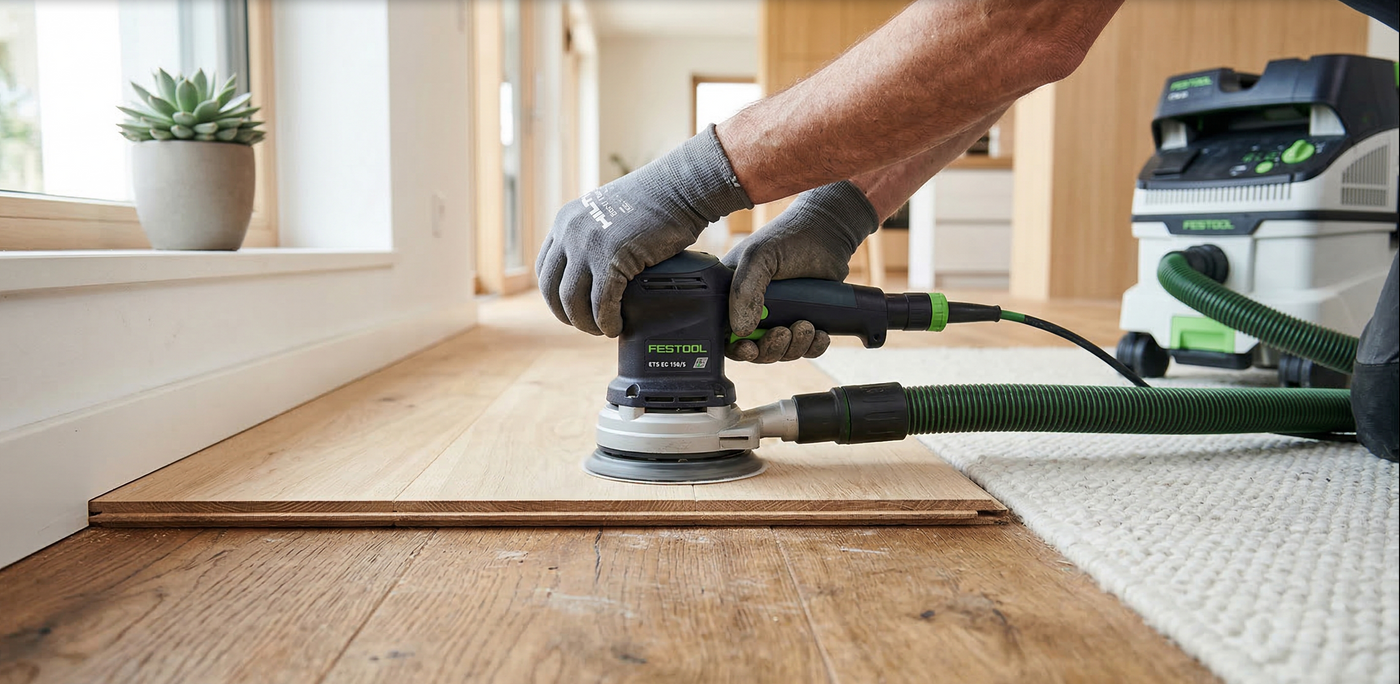
Can Engineered Hardwood Be Refinished? Yes, some engineered hardwood floors can be refinished.
But that answer only matters if you understand the catch: some engineered hardwood is built for long-term value, and some is built to look good at installation and hit a price point. Those are not the same product, even if they look similar on a showroom wall.
That is why this question matters. Many homeowners buy engineered hardwood assuming they are also buying future flexibility. Sometimes they are. Sometimes they are not. If the floor starts to show wear years from now, the difference becomes obvious.
If refinishing matters to you, this is not a side question. It is one of the most important buying questions you can ask. And in most cases, a 4mm wear layer deserves serious attention.

The Short Answer
Some engineered hardwood can be refinished. Some cannot.
The real answer depends on:
- the thickness of the wear layer
- the condition of the floor
- how deep the damage goes
- whether the floor needs a light refresh or a true refinishing job
If long-term renewability matters to you, wear layer thickness is where the conversation starts. That is also why 4mm stands out.
What “Refinishing” Actually Means
Homeowners often use the word refinishing for any process that makes an old floor look better. But there is a real difference between refreshing a finish and sanding into the wood itself.
Sometimes a floor only needs a recoat. That is a lighter maintenance step. Other times, the surface wear is more serious, and the floor needs to be sanded and refinished. That second option asks more from the floor and leaves less room for error.
So before asking whether engineered hardwood can be refinished, it helps to ask a better question: what kind of restoration are we really talking about?
A floor may be a decent candidate for a finish refresh and still be a poor candidate for a more substantial refinishing job.
Why Some Engineered Hardwood Can Be Refinished and Some Cannot
Engineered hardwood is built in layers. The top layer is real hardwood. Underneath it sits a core that gives the board structure and stability.
That top layer is the whole story here.
If there is enough real wood on the surface, and the floor is in the right condition, refinishing may be realistic. If the top layer is too thin, or the damage is too deep, or the floor has other problems, the answer changes quickly.
That is why two engineered hardwood floors can look similar in a store and still offer very different long-term value. One may leave you with real options later. The other may leave you with a replacement decision.

Wear Layer Thickness Is the Real Decision Point
If refinishing potential matters to you, wear layer thickness should not be treated like a minor specification buried in a product sheet. It should be one of the first things you ask about.
The wear layer is the real hardwood veneer on top of the board. And this isn’t guesswork: the National Wood Flooring Association (NWFA) publishes an actual threshold. Their Wood Flooring Sand and Finish Guidelines state plainly: if a floor’s wear layer is under 2.5mm (3/32 inch), it shouldn’t be sanded at all. A single full refinish typically removes somewhere around 0.8mm (1/32 inch), rising to as much as 1.6mm (1/16 inch) on a floor that needs real correction (deep scratches, cupping, unevenness).
2mm wear layer
Run the math and the problem shows up before a sander ever touches the floor: a 2mm wear layer starts out below the level NWFA itself says warrants sanding in the first place. It can still be a perfectly good floor for the right room or budget, but if long-term renewability matters to you, this is the level where a full refinish is not a realistic plan, not just a riskier one.
3mm wear layer
A 3mm wear layer clears NWFA’s 2.5mm threshold, but with half a millimetre of buffer once a typical refinish removes its share. It is a real step up from 2mm, and workable for many homeowners, but it does not leave much room if the floor needs a heavier correction pass rather than a light one.
4mm wear layer
If refinishing matters to you, 4mm should be strongly considered. It clears the NWFA threshold with roughly 1.5mm of margin to spare: enough to absorb a genuine refinish and still plausibly land at or above the same bar the industry uses to judge whether a floor is safely refinishable at all.
It does not guarantee that every future problem can be solved with sanding. It does not turn engineered hardwood into solid hardwood. But it does mean you are buying more real wood where it matters most, measured against a real published standard, not just a bigger number on a spec sheet.
Why 4mm Matters More Than People Think
Too many flooring conversations get pulled toward colour, trend, and whatever looks best under showroom lights. Those things matter, but they can pull attention away from the decisions that actually shape long-term value.
And veneer thickness is only half of it. Aluminum oxide finishes, standard on most factory-finished engineered floors today, are hard to abrade. They resist the sander too. One flooring professional, describing his first job on a prefinished aluminum oxide floor, put it bluntly:
“The first time I ran my belt sander on prefinished floors was a nightmare… my usual 50-grit belt didn’t even scratch the surface before losing any cutting capability.”
He got through it eventually, after burning through what he described as “an endless number of belts and edger discs” and later switched to specialized diamond-head equipment built for exactly this problem.
A 25-year flooring installer put the two problems together on a trade forum:
“Newer aluminum oxide finishes ARE MORE DIFFICULT to remove by sanding but it can be done”
The same installer also warned that less experienced finishers risk sanding straight through the veneer, and recommended a minimum 1/8 inch (roughly 3.2mm) of wear layer before attempting it.
Even experienced professionals are not immune to the thin-veneer risk. One sanding specialist, describing his own jobs, admitted:
“The number of times I have sanded through an engineered floor to see the plywood underneath, I could count on one hand”
He said it happened more than once, because the floor turned out to have a thinner veneer than anyone realized going in.
That is why 4mm matters. It gives the product more substance, measured against a real published sanding standard, not a marketing claim. It makes a genuine refinish survivable rather than a gamble. And if the day comes when the surface needs meaningful restoration, it gives you a much better chance that restoration is still on the table.
If you are buying engineered hardwood because you want real wood underfoot and real long-term value, 4mm is not a throwaway upgrade. It is one of the clearest signs that the floor was built with the future in mind.

Condition Still Controls the Real Answer
Even with a thicker wear layer, not every floor is a good refinishing candidate.
Condition matters just as much as construction. A floor can be technically refinishable on paper and still be the wrong candidate in real life. Deep gouges, moisture issues, instability, delamination, or broader structural problems can all change the answer.
That is why blanket statements are risky. The product matters, but the condition of the installed floor matters too.
If a homeowner is thinking about refinishing an existing engineered hardwood floor, the smartest next step is to have a qualified professional assess:
- wear layer thickness
- depth of wear
- type of damage
- finish condition
- overall floor stability
That is how you get a real answer instead of an optimistic one.
Refinishing Is Not the Same as Recoating
This is where many flooring conversations go sideways.
A homeowner hears that their floor may not be a great candidate for full refinishing and assumes the floor is finished as an asset. That is not always true.
Some floors are better suited to a lighter maintenance approach than a full sanding and refinish. That is exactly why this should not be treated as a blunt yes-or-no question.
A floor may still have useful life left in it even if a full restoration is not the right move. But if long-term renewability matters to you from day one, you still want the thickest practical wear layer you can justify.
When Refinishing Makes Sense
Refinishing may be worth considering when:
- the floor is stable
- the damage is mostly on the surface
- the wear layer is thick enough
- the owner likes the floor and wants to extend its life
- replacement would be more disruptive than restoration
This is where engineered hardwood can be better than many buyers assume. A well-built product with enough real wood on top can offer a level of long-term value that many shoppers underestimate at the time of purchase.

When Replacement Is the Better Move
Sometimes replacement is simply the smarter decision.
That may be true when:
- the wear layer is too thin
- the floor has deeper damage
- moisture has created larger problems
- the product was never built for long-term renewal
- the cost and risk of refinishing outweigh the likely result
One of the hard truths in flooring is that a lower upfront price can leave you with fewer good options later.
What to Ask Before You Buy
If refinishing potential matters to you, ask these questions before you commit.
How thick is the wear layer?
Do not settle for vague language. Ask for the actual number.
Was this floor built as a long-term product?
Some engineered hardwood is clearly built to a higher standard. Some is built to hit a price point. You want to know which one you are buying.
How long do I expect to live with this floor?
Ownership horizon matters more than many buyers realize.
Am I paying for short-term appearance or long-term value?
Those are not the same purchase.
So, Can Engineered Hardwood Be Refinished?
Yes, some engineered hardwood can be refinished.
But that answer only matters if you understand what sits underneath it. Wear layer thickness matters. Floor condition matters. Product quality matters. And if refinishing potential is important to you, 4mm should be taken seriously.
Not because it sounds premium. Because it gives you more real wood, more margin, and a better chance that the floor can be renewed later instead of replaced.
That does not mean every homeowner needs the thickest option available. But if renewability is part of the value equation for you, buying too thin can be the more expensive mistake.
A floor that preserves options later is usually worth more than a floor that only looks good on day one.
Frequently Asked Questions
A few quick answers to the questions people ask most about refinishing engineered hardwood.
Can all engineered hardwood be refinished?
No. Some engineered hardwood floors can be refinished, but some cannot. The answer usually depends on the thickness of the wear layer, the condition of the floor, and the depth of the damage.
Is a 4mm wear layer better than 3mm or 2mm?
If refinishing potential matters to you, 4mm is the strongest option of the three. It gives you more real wood on the surface and more long-term flexibility.
Is refinishing the same as recoating?
No. A recoat is a lighter maintenance step that refreshes the finish. Refinishing is a more involved process that usually requires sanding into the real wood surface.
Visit a Caledon dealer. Click here to find the closest one to you.
Have more questions about your specific floor? Contact Caledon Floors directly.