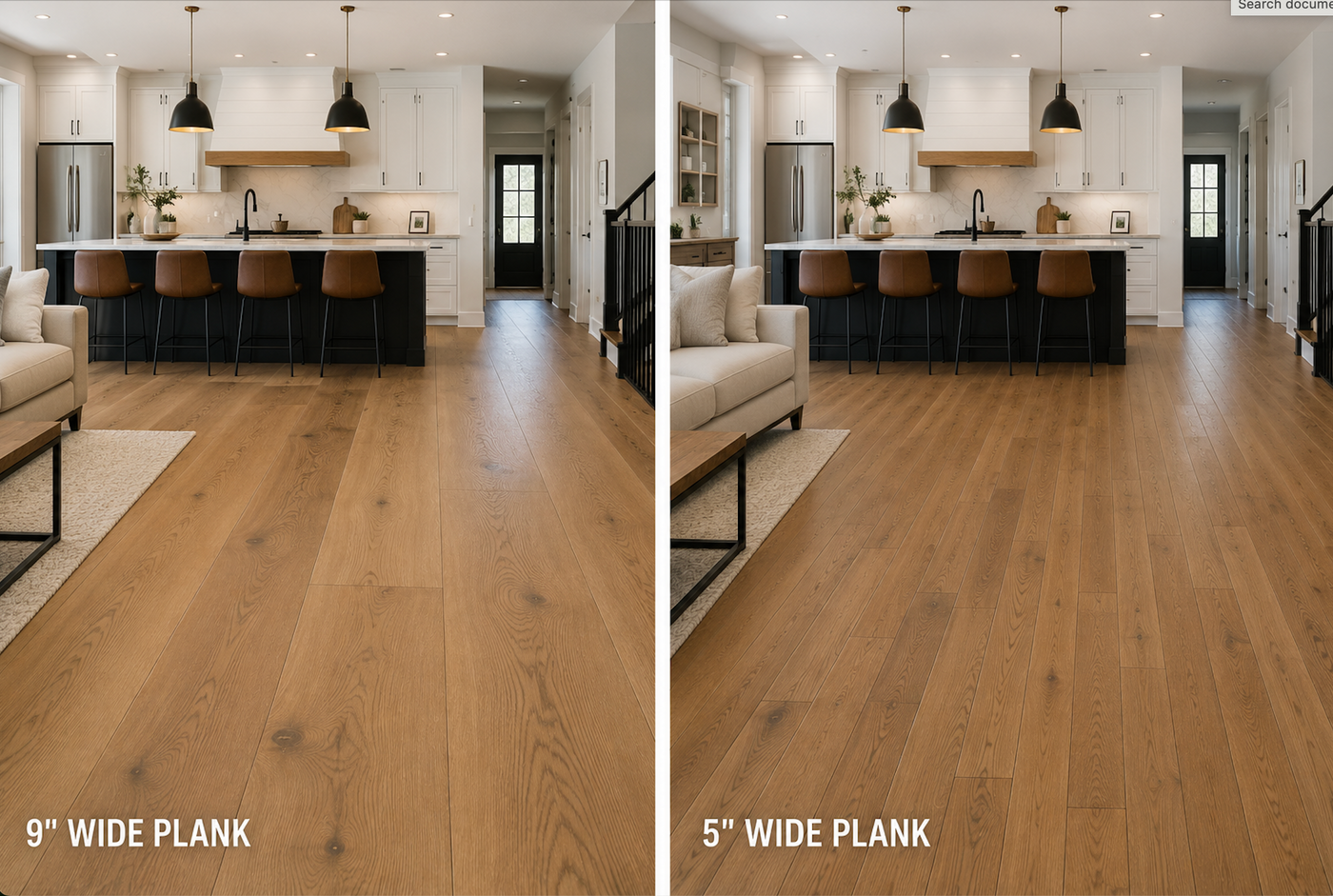
Engineered hardwood plank size changes the look of a floor more than many homeowners realize. Two floors can be the same species, colour, and grade, but look very different once installed if one has wider, longer boards and the other has narrower, shorter boards. Plank size affects how busy the floor feels, how premium it looks, how much visual flow the room has, and how well the floor suits the scale of the space.
The short answer is this: wider and longer engineered hardwood planks usually create a calmer, more expansive, and more premium look. Narrower or shorter boards usually create more seams, more lines, and more visual movement. Neither is automatically wrong, but plank width and length should be chosen intentionally, not treated as a minor specification. Flooring is not viewed one board at a time ; it is viewed across a full room, and the finished look depends on how hundreds of boards work together.

Quick Answer: What Engineered Hardwood Plank Size Should You Choose?
| Design goal | Better plank direction | Why |
|---|---|---|
| Calm, premium look | Wider planks with good average length | Creates fewer visual breaks and better flow |
| Traditional hardwood look | Narrower or moderate-width planks | Creates a more classic board pattern |
| Large open-concept space | Wider and longer planks | Reduces seams and end joints across a large area |
| Small room | Moderate or wide planks can both work | Colour, lighting, and grade matter just as much |
| Premium visual impression | Wider planks with stronger average lengths | Helps the installed floor look less choppy |
Why Engineered Hardwood Plank Size Matters
Plank size affects the visual rhythm of the floor. A floor with many narrow or short boards creates more seams and more pattern changes, which can make the floor feel busier. In some homes that look can feel traditional or detailed, but in others it can feel chopped up. A floor with wider and longer boards usually creates fewer visual breaks : the room can feel more open, more relaxed, and more refined. This is one reason wide plank engineered hardwood has become popular in modern and transitional interiors. Plank size changes the overall feel of the room, not just the technical spec of the product.
What Is Considered Wide Plank Engineered Hardwood?
There is no single universal definition, but in most homeowner conversations, wide plank engineered hardwood usually refers to boards that are wider than older traditional strip flooring. Traditional hardwood floors were often narrower. Modern engineered hardwood frequently comes in wider formats, commonly around 6 inches, 7 inches, 7.5 inches, or wider, depending on the product.
The wider the plank, the more each board can show the grain, grade, and colour of the wood. That can make the floor feel more natural and more premium, especially in larger rooms. But wider is not automatically better : the room size, style, installation conditions, and product construction all matter.
How Wider Planks Change the Look of a Room
Wider planks usually make a room feel calmer because there are fewer board edges and fewer seams across the floor. The eye sees broader pieces of wood, which creates a cleaner and more spacious look. This can work especially well in open-concept main floors, larger living rooms, dining areas, primary bedrooms, and modern or transitional interiors where the owner wants a premium, less busy floor.
Wider planks can also help show the beauty of the wood better : grain pattern, colour tone, and grade are easier to appreciate when each board has more surface area. The caution is that wider planks put more visual focus on each board. If the grade has strong variation, knots, or colour movement, those features may become more noticeable. That is not necessarily bad, but the buyer should understand the effect.
How Narrower Planks Change the Look of a Room
Narrower planks create more lines across the floor, which can make the floor feel more traditional, more detailed, and sometimes more formal. In certain homes that is exactly the right look : narrower boards can suit older homes, traditional interiors, or rooms where the owner wants a more classic hardwood appearance. The trade-off is that narrower planks can also feel busier, especially in large rooms. More board edges mean more visual interruption. In a modern open-concept home, that may not be the look the homeowner wants. Narrower planks are not bad ; they simply create a different visual effect.
Why Plank Length Matters Just as Much as Width
Many homeowners focus on width and forget about length. That is a mistake. Longer planks usually create better visual flow : they reduce the number of end joints across the floor, which can make the installation look calmer and more premium. Shorter planks create more end joints, which can make the floor feel more broken up.
This is especially noticeable in hallways, large living rooms, and open-concept spaces. If the boards are short, the floor may have a busier pattern even if the plank width is attractive. A wide board with short average lengths can still look choppy. A well-proportioned floor usually needs both width and length working together.
Random Lengths vs Fixed Lengths
Many engineered hardwood products use random lengths, and that can create a natural hardwood look because real wood floors are often installed with boards of different lengths. The important issue is not whether lengths are random ; it is the quality of the length mix. A good random-length floor should include enough longer boards to create visual flow. If too many boards are short, the floor can look busy or patchy.
Fixed lengths can also look excellent when the design suits the product and the installation is done well. But regardless of the system, what matters most is the average length , not just the maximum. The buyer should ask about average length, not just maximum length.
Maximum Length vs Average Length
Maximum length can be misleading. A product may advertise a long maximum board length, but that does not mean most boards in the box are that long. What often matters more is the average length and the overall length distribution. For example, a floor with a long maximum plank but many short pieces may not look as premium across a full room as the buyer expects. A floor with a strong average length and a good mix of longer boards may create a much better installed result.
This is one of the most important questions buyers can ask when comparing engineered hardwood: not just "How long are the boards?" but "What is the average length, and how many longer boards should I expect?"
How Width and Length Work Together
Width and length should be judged together. A wider plank usually looks better when it also has good length : if the plank is wide but the boards are mostly short, the floor can feel visually awkward. The width suggests a premium look, but the short lengths create too many breaks. A narrower plank can sometimes tolerate shorter lengths better because the overall look is already more detailed. But in wide plank engineered hardwood, length becomes more important. The best engineered hardwood floors often look good because the proportions are right : width, length, grade, colour, and texture all working together.

Engineered Hardwood Plank Size Comparison
| Plank feature | Visual effect | Best fit | Main caution |
|---|---|---|---|
| Wider planks | Calmer, broader, more premium look | Open-concept spaces, modern homes, larger rooms | Grade and colour variation may be more noticeable |
| Narrower planks | More lines, more traditional rhythm | Classic interiors, smaller rooms, traditional homes | Can feel busy in large open spaces |
| Longer planks | Better visual flow, fewer end joints | Main living areas, hallways, open layouts | Often associated with higher product quality and cost |
| Shorter planks | More end joints, more movement | Smaller rooms or more traditional looks | Can look choppy across large spaces |
| Good average length | More natural and balanced installation | Premium engineered hardwood projects | Buyers should not rely only on maximum length |
What Plank Size Works Best in Small Rooms?
Small rooms can usually handle a range of plank sizes. A common fear is that wide planks will make a small room look wrong, but that is not always true. Wide planks can sometimes make a small room feel calmer because there are fewer seams and fewer visual breaks. The key is proportion : extremely wide planks may feel oversized in certain small spaces, but moderate wide planks can work very well. Colour and lighting also matter. A light or natural wide plank may make a small room feel more open, while a very dark wide plank may feel heavier. For small rooms, the best answer is usually not "avoid wide planks" ; it is "choose plank size, colour, and grade together."
What Plank Size Works Best in Large Rooms?
Large rooms often benefit from wider and longer boards. In an open-concept living area, the floor is seen across a much bigger surface. Narrower or shorter boards can create a lot of visual lines that may make the room feel busier than intended. Wider and longer engineered hardwood planks can help the space feel more continuous and refined : this is one reason premium engineered hardwood often uses larger plank formats. In large rooms, average length becomes especially important. The bigger the room, the more obvious short boards and frequent end joints become.
Does Wide Plank Engineered Hardwood Look More Premium?
Often, yes. Wide plank engineered hardwood often looks more premium because it creates a broader, calmer visual surface and shows more of the wood in each board. Longer lengths can add to that effect by reducing the number of end joints. But premium appearance does not come from width alone. A wide plank with poor visuals, weak grade selection, short lengths, or poor milling will not automatically look premium. Wide plank is a strong visual feature, but a better floor is the result of multiple factors working together: plank width, plank length, grade, veneer, finish, milling, and installation quality.
Does Plank Size Affect Price?
Often, yes. Wider and longer engineered hardwood planks are often more expensive because they can require better raw material selection, more careful manufacturing, and stronger product design. Longer boards in particular can affect product value because they help create a more premium installed look. If a premium engineered hardwood floor costs more partly because it offers better plank width and length, that may be a real value difference, not just a marketing difference.
What Buyers Get Wrong About Width and Length
The first mistake is focusing only on colour ; colour matters, but plank size can change the entire look of the room. The second mistake is looking only at width, when a wide plank with short average lengths can still look busy. The third mistake is relying on maximum length instead of average length, since the longest board in the box does not tell the whole story. The fourth mistake is ignoring room size : large open spaces make plank length and seam pattern much more noticeable. The fifth mistake is assuming wider is always better, when width still needs the right grade, colour, length, and installation to deliver the expected result.
How to Choose the Right Width and Length
Start with the room. Ask yourself: Is the space large or small? Is the floor going through an open-concept area? Do you want the floor to feel calm or more detailed? Are you choosing a cleaner grade or a more character-heavy grade? Do you want a modern wide-plank look or a more traditional hardwood look? What is the average plank length, not just the maximum? Will short boards and frequent end joints bother you?
Those questions usually lead to a better decision than simply choosing the widest plank on the display.
Best Plank Size by Design Goal
| Design goal | Better direction | Why |
|---|---|---|
| Calm modern look | Wider and longer planks | Fewer visual breaks and broader wood surface |
| Traditional hardwood look | Narrower or moderate-width planks | More classic board rhythm |
| Large open-concept space | Wider planks with good average length | Better flow across a large area |
| Smaller room | Moderate or wider planks can both work | Colour, lighting, and grade also matter |
| Premium visual impression | Wider planks with stronger lengths | Creates a more refined installed look |
| More active natural look | Character grade with visible movement | Width and grade should be chosen together |
FAQ: Engineered Hardwood Width and Length
Does engineered hardwood plank width matter?
Yes. Plank width affects how calm, busy, modern, or traditional the floor feels once installed.
Are wider engineered hardwood planks better?
Not automatically. Wider planks often create a more premium and spacious look, but they still need the right grade, colour, length, and construction.
Does plank length matter in engineered hardwood?
Yes. Longer planks usually create better visual flow and fewer end joints. Shorter boards can make a floor look busier.
What is more important, plank width or plank length?
Both matter. Width affects the broad visual style, while length affects flow and how many end joints appear across the floor.
Should I choose wide plank engineered hardwood for a small room?
You can. Wide planks can work well in small rooms, especially in lighter colours, but the overall design should be considered alongside the plank choice.
Final Verdict
Engineered hardwood width and length change the look of a floor in a major way. Wider and longer planks usually create a calmer, more expansive, and more premium appearance. Narrower and shorter boards usually create more lines, more joints, and more visual movement. Neither is automatically right or wrong, but the choice should match the room and the design goal.
Do not judge engineered hardwood by colour alone. Look at width, average length, grade, and how the floor will appear across the full space. That is how you choose a floor that looks right once it is installed, not just on the sample board. Contact us for help choosing a floor , or find a dealer near you who can show you different plank sizes in your space before you decide.
Related Reading
These articles go deeper on choosing the right engineered hardwood: