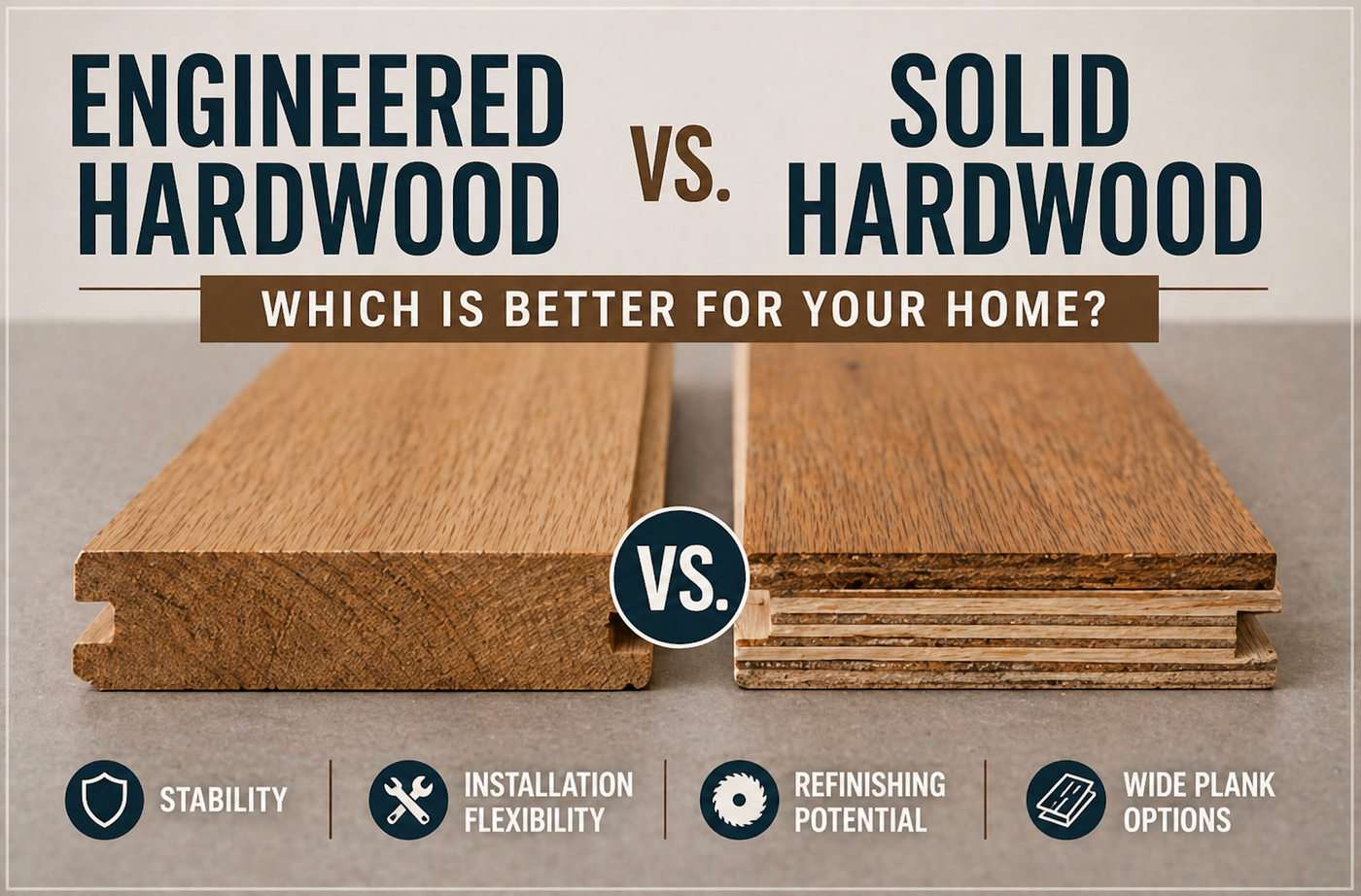
Solid hardwood has a strong reputation for a reason. It is traditional, familiar, and made from one piece of wood from top to bottom. For many homeowners, it still represents the classic idea of a real wood floor. But that does not mean solid hardwood is automatically the better choice.
In many homes, engineered hardwood can make more practical sense. It is still real wood on the surface, but it is built differently underneath. That construction can make engineered hardwood more stable, more flexible for different installation situations, and often better suited to modern flooring preferences like wider planks.
The short answer is this: solid hardwood is a strong option when the homeowner wants traditional wood construction, has the right subfloor, and values maximum long-term sanding potential. Engineered hardwood is often the more practical choice when the homeowner wants real wood with better dimensional stability, wider plank options, and more flexibility in where and how the floor can be installed. Premium engineered hardwood with a thicker veneer, such as 4mm, can also offer a strong refinishing option, which narrows one of the biggest traditional advantages of solid hardwood. Neither option is automatically best: the right answer depends on the home, the product, and what the homeowner values most.

What Is the Difference Between Engineered Hardwood and Solid Hardwood?
The main difference is construction. Solid hardwood is made from one solid piece of wood: the same material runs from the top surface all the way through the board. Engineered hardwood has a real wood top layer over a multi-layer core. The surface is still real wood, but the structure underneath is designed differently. That layered construction helps improve stability compared with solid hardwood, especially when humidity and seasonal movement are part of the equation.
The most important point for homeowners to understand: engineered hardwood is not fake wood. It is real wood on the surface. The difference is how the floor is built.
Is Engineered Hardwood Real Hardwood?
Yes. Engineered hardwood has a real hardwood surface. This is where many buyers get confused: they hear "engineered" and assume it means artificial. That is not accurate. Engineered hardwood is not the same as laminate or vinyl. Laminate and vinyl are wood-look products. Engineered hardwood has an actual wood veneer on top.
That top layer is what gives engineered hardwood its real wood appearance. Grade, species, colour, veneer thickness, surface texture, and finish quality all affect how the floor looks and performs. The core is what makes it engineered. The surface is what makes it hardwood.

Why Solid Hardwood Still Appeals to Homeowners
Solid hardwood has two major advantages: tradition and maximum refinishing potential. Some homeowners simply like the idea of a floor made from one piece of wood, and there is nothing wrong with that. Solid hardwood has been used for generations, and in the right setting it can be a beautiful, long-lasting floor.
The other major appeal is sanding depth. Because solid hardwood has more usable wood thickness, it can often be sanded and refinished multiple times over its life, depending on the product, installation, and condition of the floor. That matters to some buyers. If someone is thinking about a floor over several decades and wants the highest possible refinishing flexibility, solid hardwood can still make a strong case.
Why Premium Engineered Hardwood Changes the Comparison
Older or lower-end engineered hardwood products sometimes had thin veneers with limited refinishing potential. That made the comparison simple: solid hardwood had the refinishing advantage, and engineered hardwood had the stability advantage. But premium engineered hardwood is different.
A high-quality engineered hardwood floor with a thicker veneer, such as 4mm, can offer a meaningful refinishing option. It may not equal the maximum sanding life of solid hardwood, but it closes much of the practical gap for many homeowners. That matters because many people will never refinish a floor multiple times. For those buyers, a premium engineered floor with a strong veneer can provide the real wood surface, the modern stability benefits, and enough future flexibility to feel comfortable. That is why veneer thickness matters: a thin veneer and a 4mm veneer are very different quality conversations.

Why Engineered Hardwood Often Makes More Sense in Modern Homes
Engineered hardwood often makes sense because many homes are not ideal environments for solid wood. Homes have changing humidity, different subfloors, concrete areas, basements, radiant heat considerations, wider plank preferences, and open-concept layouts. Engineered hardwood was developed to help address some of those practical realities.
The layered construction of engineered hardwood can provide better dimensional stability than solid hardwood. That does not mean it is immune to moisture or movement: it still needs proper installation, normal indoor conditions, and realistic expectations. But compared with solid hardwood, engineered construction can be a better fit for many common installation situations.
This is especially true when homeowners want wider boards. Wider solid hardwood can be more prone to seasonal movement. Engineered hardwood often handles wider formats better because of its layered structure.
Engineered Hardwood vs Solid Hardwood: Quick Comparison
| Question | Engineered hardwood | Solid hardwood |
|---|---|---|
| Is it real wood? | Yes, real wood surface over engineered core | Yes, solid wood throughout |
| Best strength | Stability and installation flexibility | Traditional construction and maximum sanding depth |
| Wider plank options | Often better suited | Can be more movement-sensitive |
| Concrete installation | Often more possible with the right product and method | Usually more limited |
| Basement use | Sometimes possible with proper product and conditions | Usually not the preferred choice |
| Refinishing potential | Strong when veneer is thicker, such as 4mm; limited when veneer is thin | Usually greater overall |
| Moisture tolerance | More stable, but not waterproof | More sensitive to moisture and humidity |
| Best fit | Homes needing real wood with practical flexibility | Homes where traditional solid wood and maximum refinishing are priorities |
Which Is Better for Canadian Homes?
For many Canadian homes, engineered hardwood is often the more practical real wood choice. Canadian homes deal with seasonal changes: winters can be dry indoors because of heating, and summers can bring more humidity. Those swings can affect wood floors. Solid hardwood can perform well when properly installed and maintained, but it is more sensitive to expansion and contraction.
Engineered hardwood is not free from movement, but its construction is generally more dimensionally stable. That can make it a better fit for homeowners who want real wood but also want a floor that is better suited to common Canadian indoor conditions, especially in condos, townhomes, homes with concrete subfloors, and larger open-concept spaces.
Is Engineered Hardwood Better Over Concrete?
Usually, engineered hardwood is the more practical option over concrete. Solid hardwood is generally not the first choice for direct concrete situations. Engineered hardwood can often be installed over concrete using approved methods, depending on the product, moisture conditions, adhesive or floating system, and manufacturer instructions.
That does not mean every engineered hardwood floor can go over every concrete slab. Concrete moisture still matters. Subfloor preparation still matters. Installation method still matters. But if the question is engineered hardwood vs solid hardwood over concrete, engineered hardwood is usually the more realistic category to consider.

Which Is Better for Basements?
Engineered hardwood may be possible in some basement settings, but it needs caution. Basements are more complicated because moisture risk is higher. Even engineered hardwood is still a real wood product, so it should not be treated like waterproof flooring. If the basement has moisture concerns, water history, poor slab conditions, or humidity problems, homeowners should be careful.
Solid hardwood is usually not the practical basement choice. If a homeowner wants real wood in a basement, engineered hardwood is generally the more reasonable option to investigate, but only with the right product, proper moisture testing, correct installation, and realistic expectations.

Which Looks Better: Engineered or Solid Hardwood?
Both can look excellent. The look depends more on species, grade, colour, plank width, finish, texture, and installation than on whether the floor is engineered or solid. A high-quality engineered hardwood floor can look every bit like a premium real wood floor because the surface is real wood. A lower-quality solid hardwood floor is not automatically better looking just because it is solid. Do not judge appearance by construction category alone; judge the actual product.
Which Lasts Longer?
The honest answer depends on what "lasts longer" means. If the buyer means maximum sanding and refinishing potential, solid hardwood usually has the advantage because it has more usable wood thickness. But if the buyer means long-term performance in a modern home, engineered hardwood can make a very strong case, especially when it has a thicker veneer. A premium engineered hardwood floor with a 4mm veneer can offer meaningful refinishing potential while also providing the stability benefits of engineered construction.
That is why homeowners should not compare solid hardwood against engineered hardwood as if all engineered products are the same. A thin-veneer engineered floor and a premium 4mm veneer engineered floor are not the same long-term value proposition.
Can Engineered Hardwood Be Refinished?
Yes, some engineered hardwood can be refinished. The key is veneer thickness. A thicker veneer gives more future flexibility. A premium engineered hardwood floor with a 4mm veneer can offer a strong refinishing option compared with thinner-veneer products. The product construction, veneer thickness, condition of the floor, and professional assessment all matter. But the old idea that engineered hardwood cannot be refinished is too broad: some low-end engineered floors may have very limited options, while better products with thicker veneers can be much more capable.

Which Is More Stable?
Engineered hardwood is usually more dimensionally stable. That is one of the main reasons it exists: the layered core helps reduce some of the expansion and contraction issues that can affect solid wood. This can be especially useful for wider planks, changing indoor humidity, and certain installation conditions. The right wording is not "engineered hardwood does not move." It is "engineered hardwood is generally designed to be more stable than solid hardwood." It still needs reasonable indoor conditions, proper installation, and protection from excessive moisture.
Which Is Better for Wide Planks?
Engineered hardwood is often the better choice for wide planks. Wide plank floors are popular because they can make a room feel more open, clean, and premium. But wider solid boards can be more sensitive to movement. Engineered construction can make wider formats more practical: that is one reason engineered hardwood is widely used in modern wide-plank designs. If the homeowner wants wide boards, engineered hardwood often deserves serious consideration.
Which Is Better for Resale?
Both can support resale when chosen well. Solid hardwood still carries traditional appeal: some buyers like hearing that a floor is solid wood, and that perception can matter. Engineered hardwood can also feel premium, especially when it is a high-quality product with a good grade, attractive colour, thicker veneer, and strong overall presentation. In many modern homes, buyers care more about how the floor looks and feels than whether the core is solid or engineered. A dated or poorly chosen solid hardwood floor is not automatically better than a beautiful engineered hardwood floor.
When Solid Hardwood Makes More Sense
Solid hardwood can make more sense when the homeowner strongly prefers traditional solid wood construction, the installation is above grade over a suitable wood subfloor, maximum refinishing potential is a major priority, the homeowner accepts seasonal movement and maintenance expectations, the design does not require very wide planks, and the home is well suited to solid wood installation. Solid hardwood is still a good product in the right setting. The mistake is assuming it is always the best answer.
When Engineered Hardwood Makes More Sense
Engineered hardwood can make more sense when the homeowner wants real wood with better stability, wider planks are preferred, the project involves concrete or more complex installation conditions, the home has seasonal humidity changes, the buyer wants a modern real wood floor, or the homeowner wants a premium product with meaningful future flexibility such as a thicker 4mm veneer. For many homes, this is where engineered hardwood becomes the better fit.
What Buyers Get Wrong About Engineered vs Solid Hardwood
The first mistake is thinking engineered hardwood is fake wood: it is not, it has a real wood surface. The second mistake is thinking solid hardwood is automatically better because it is solid. Sometimes it is; sometimes it is not the best fit for the home. The third mistake is ignoring veneer thickness: a thin-veneer engineered floor and a premium 4mm veneer engineered floor should not be treated as equal. The fourth mistake is ignoring installation conditions: subfloor, moisture, grade level, humidity, and room use all matter. The fifth mistake is focusing only on refinishing: many homeowners never refinish their floors multiple times, and for those buyers, stability, appearance, and day-to-day performance may matter more. The sixth mistake is comparing categories instead of products. A high-quality engineered hardwood floor can be a better choice than a lower-quality solid hardwood floor.

Engineered Hardwood vs Solid Hardwood by Buyer Priority
| Buyer priority | Better fit to consider | Why |
|---|---|---|
| Traditional wood construction | Solid hardwood | Solid wood throughout |
| Wider plank look | Engineered hardwood | Often more practical for wider formats |
| Maximum refinishing potential | Solid hardwood | More usable wood thickness |
| Meaningful refinishing plus modern stability | Premium engineered hardwood | A thicker veneer, such as 4mm, can offer strong future flexibility |
| Installation over concrete | Engineered hardwood | Usually more realistic with approved methods |
| Basement real-wood option | Engineered hardwood, with caution | More practical than solid, but still needs moisture control |
| Modern real wood look | Engineered hardwood | Real wood surface with more flexible construction |
| Long-term stability | Engineered hardwood | Generally designed to reduce movement compared with solid wood |
FAQ: Engineered Hardwood vs Solid Hardwood
Is engineered hardwood real wood?
Yes. Engineered hardwood has a real wood surface over an engineered core. It is different from laminate or vinyl, which are wood-look products.
Is solid hardwood better than engineered hardwood?
Not automatically. Solid hardwood has advantages, especially maximum refinishing potential, but engineered hardwood may be the better fit for many modern homes.
Can engineered hardwood be refinished?
Sometimes, yes. It depends mainly on veneer thickness and product construction. A premium engineered hardwood floor with a thicker veneer, such as 4mm, can offer a strong refinishing option compared with thinner-veneer products.
Can solid hardwood go over concrete?
Usually solid hardwood is more limited over concrete. Engineered hardwood is generally the more practical category to consider for concrete installations, using approved methods.
Is engineered hardwood better for wide planks?
Often yes. Engineered construction is usually better suited to wider plank formats than solid hardwood.
Which is better for Canadian homes?
For many Canadian homes, engineered hardwood is often more practical because of its stability, installation flexibility, and suitability for wider modern plank formats. Solid hardwood can still be excellent in the right setting.
Final Verdict
Solid hardwood is traditional, familiar, and strong in the right home: its biggest advantage is maximum refinishing potential. Engineered hardwood is often the more practical real wood choice for many modern homes, offering a real hardwood surface with more stable construction, better flexibility for different installation situations, and strong suitability for wider plank designs.
Premium engineered hardwood with a thicker veneer, such as 4mm, also closes much of the refinishing gap for many homeowners. That makes the comparison less about "solid is real and engineered is a compromise" and more about choosing the right real wood product for the home. If the priority is tradition and maximum refinishing potential, solid hardwood can make sense. If the priority is real wood with more modern practicality, engineered hardwood often makes more sense. Contact us for help choosing a floor, or find a dealer near you who can walk you through the right product for your home and installation conditions.
Related Reading
These articles go deeper on engineered hardwood and what to look for: