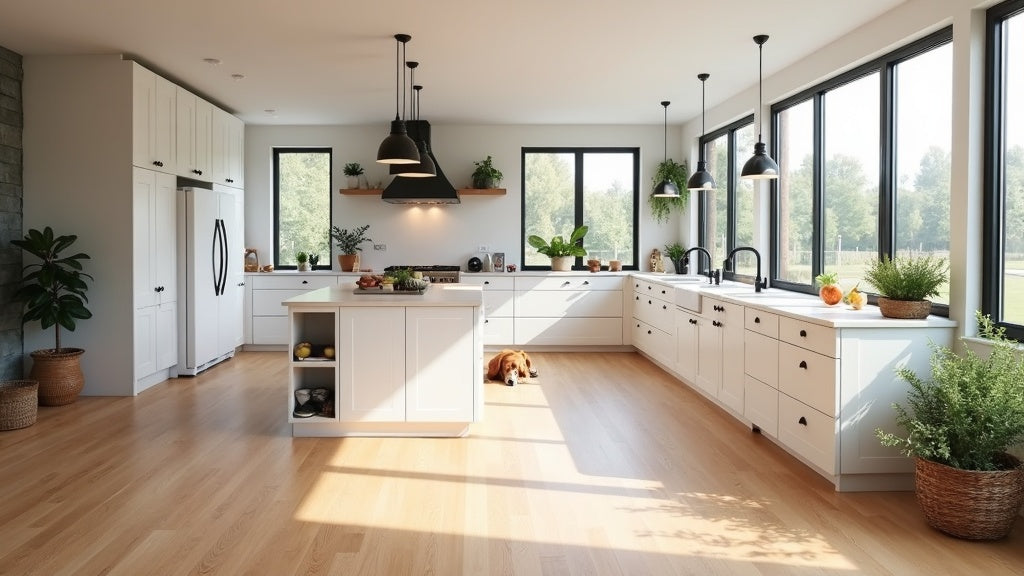
Modern farmhouse design leans on flooring more than most style guides admit, because a wide-plank floor with a warm, muted tone and real surface texture is often the single element that makes a room read as farmhouse rather than simply rustic or simply contemporary. Wide-plank formats, a warm neutral tone, and a matte, low-sheen finish are the three decisions that let a floor carry the style's mix of lived-in warmth and clean, uncluttered lines. Get the floor wrong, and a shiplap wall or a farmhouse sink will not carry the look on its own.
What Actually Defines Modern Farmhouse Design?
Modern farmhouse blends two instincts that sound like they should conflict: the warmth and texture of a traditional farmhouse, built around reclaimed wood, patina, and handmade detail, and the clean, restrained lines of contemporary design, built around simple trim, matte black hardware, and an open floor plan. The style works because neither instinct wins outright.
Three working principles show up across most modern farmhouse rooms. A warm, muted palette replaces both the stark white of a purely modern room and the deep, ornate tones of a traditional country interior. A deliberate amount of texture, most often in wood grain, woven fibres, or a raw wood beam, gets used against otherwise clean, simple surfaces rather than spread evenly through the whole room. And function-first materials that look honest and a little imperfect are favoured over anything that reads as polished or precious.
A fourth idea rides along with the first three: scale. Farmhouse design borrows its sense of proportion from working farm buildings, so oversized, unfussy elements, a long farmhouse table, a wide barn door, a big basin sink, tend to fit the style better than small, delicate ones.
Why Does Plank Width Matter So Much in This Style?
Wide, long-format planks read as more modern farmhouse than narrow strip flooring, because the style's floor proportions come from old farmhouses built with whatever full-width lumber was on hand, not from the narrow strip flooring that became the mass-market standard once milling made narrow boards cheaper to produce. Fewer seams across a wide-plank floor reinforce the simple, unfussy scale the rest of the style relies on.
This does not mean the widest plank available is automatically right for every room. A narrow hallway or a small mudroom can start to feel like it is wearing a floor built for a much bigger space if the plank width is out of proportion with the walls. Giant Plank vs Standard Format: How Vinyl Plank Size Changes the Feel of a Room covers how plank size changes a room's proportions in more detail.
What Wood Tones Read as Modern Farmhouse?
Warm, muted neutral tones, honey oak, warm greige, weathered brown, and soft driftwood-brown, read as modern farmhouse. Stark white or bleached tones tend to pull a room toward a Scandinavian-inspired look instead, a related but cooler and paler design language, and tones with a heavy, glossy red or orange undertone, like traditional golden oak, generally clash with modern farmhouse's quieter, more muted palette.
The undertone matters more than the exact shade. A warm greige with even a slight golden cast can still read as farmhouse, while the same shade with a cool grey undertone starts to drift toward a different, cooler design language. How to Match Your Floor Tone with Cabinets, Trim, and Walls goes deeper on choosing a tone that works with the rest of a room.

Does Surface Texture Change the Look?
Yes, more here than in almost any other interior style. A wire-brushed or lightly hand-scraped surface texture reads as authentically farmhouse in a way a perfectly smooth, glass-flat surface does not, because the texture visually echoes the reclaimed, weathered wood the style originally borrowed from old farm buildings.
A deep hand-scraped texture leans toward a more traditional, rustic farmhouse feel, while a lighter wire-brushed texture, one that simply follows the wood grain without deep grooves, tends to fit modern farmhouse better, since it keeps the room's clean-lines side balanced against its rustic side. A completely smooth surface still works in a more contemporary-leaning farmhouse room; it just shifts the balance further toward the modern half of the style.
Matte or Glossy: Which Finish Fits a Lived-In Room?
A matte or low-sheen finish generally fits modern farmhouse better than a high-gloss finish. Farmhouse rooms are meant to look genuinely lived in, and a glossy surface adds a polished shine that reads more formal than the style calls for. A matte finish lets the floor's tone and texture carry the room instead of competing with it for light and attention.
A matte finish also tends to disguise everyday dust, light scuffing, and footprints better than a glossy one, which suits the function-first, low-fuss instinct behind the style. Matte, Satin, or Glossy: How Floor Finish Changes a Room's Feel goes deeper on how sheen level changes a room's character.

How Does Flooring Echo a Shiplap Wall's Plank Language?
Modern farmhouse design frequently pairs a shiplap or board-and-batten wall with a wide-plank floor because both surfaces share the same visual grammar: parallel wood lines running at a consistent width. When a floor's plank width and orientation roughly complements the wall's board width, the room reads as one considered material story instead of two unrelated finishes competing for attention.
Proportion matters here as much as it does with plank width alone. A very narrow, tight-reveal shiplap board paired with an oversized floor plank can look mismatched, while a wider, more modern shiplap reveal generally pairs better with a wide-plank floor. Running the floor boards parallel to a shiplap accent wall tends to reinforce the room's sightline; running them perpendicular can work too, and reads as a more deliberate, layered choice rather than a default.
What Flooring Materials Can Actually Achieve This Look?
Several flooring materials can meet the warm, textured, wide-plank specification modern farmhouse calls for, and the honest answer depends on where in the home the floor is going, not on any one category being the automatic choice. Engineered hardwood, WPC vinyl flooring, and laminate can all be produced in warm, low-sheen, wide-plank formats with a wire-brushed or textured surface.
Engineered hardwood offers a genuine wood face and real grain variation, which many homeowners want in a style built partly around authentic, honest materials. Farmhouse layouts also lean heavily on wet-exposure rooms, a kitchen, a mudroom, an entryway off a covered porch, and in those zones, waterproof flooring becomes the more practical starting point: a fully waterproof core, the kind used in WPC vinyl flooring, holds up to standing water and spills without the moisture concerns a real wood veneer carries, while still being available in the warm, wide-plank, textured looks the style calls for. Neither category is the automatic right answer everywhere in a home; the room's real exposure to moisture and traffic should decide the material, while the tone, width, texture, and finish choices covered above are what actually make a floor read as modern farmhouse, regardless of which material is chosen.
How Do Design Choices Map to Modern Farmhouse Principles?
The table below summarizes which flooring choices support which core principle of the style, as a qualitative reference rather than a ranked list.
| Design principle | Flooring choice that supports it | Why it works |
|---|---|---|
| Warm, lived-in palette | Warm neutral tone (honey oak, warm greige, weathered brown) | Reflects the style's warmth instead of a cool, clinical tone |
| Farmhouse scale | Wide, long-format planks laid in a straight run | Matches the style's oversized, unfussy proportions and reduces busy seam patterns |
| Rustic-meets-clean texture | Wire-brushed or lightly hand-scraped surface texture | Adds tactile, lived-in character without looking worn out |
| Function-first practicality | Matte or low-sheen finish | Reads as honest and unfussy rather than polished or formal |
| Shiplap-plank harmony | Straight-run boards sized to complement a shiplap or board-and-batten wall | Echoes the linear plank language already present on the walls |

FAQ: Flooring and Modern Farmhouse Design
A few questions come up specifically once tone, width, texture, and finish choices meet the practical realities of a real home.
Does modern farmhouse design require reclaimed or distressed wood specifically?
No. Reclaimed wood is one way to get the look, but a wire-brushed or lightly textured surface in a warm, muted tone achieves the same visual effect without requiring an actual reclaimed material. The principle is texture and warmth, not a specific sourcing story.
Can vinyl flooring look convincingly like a modern farmhouse floor?
Yes. WPC vinyl flooring is available in warm, wide-plank formats with embossed textures that follow the printed wood grain, which lets it read as farmhouse-appropriate while adding a fully waterproof core for rooms like kitchens and mudrooms where real wood is a harder sell.
Is modern farmhouse the same as traditional or rustic farmhouse style?
Related, but not identical. Traditional or rustic farmhouse leans further into heavy distressing, darker or more saturated wood tones, and ornate detail. Modern farmhouse keeps the warmth and texture but pairs it with a more restrained, contemporary palette and simpler lines throughout the rest of the room.
Does a wide-plank floor work in a small farmhouse-style room?
It can, as long as the plank width stays proportionate to the room. A very wide plank in a small mudroom or hallway can visually shrink the space the same way an oversized rug would; a moderately wide plank, still wider than a traditional narrow strip floor, generally keeps the farmhouse look without overwhelming a smaller footprint.
Choosing flooring for a modern farmhouse room comes down to a small set of decisions made consistently: tone, width, texture, and finish, rather than to any single product category. Get those four choices right and the floor carries the style the way a shiplap wall or a farmhouse sink alone cannot.
Contact us with any questions about your project.
To find waterproof vinyl flooring, click here for a Caledon Floors dealer near you.