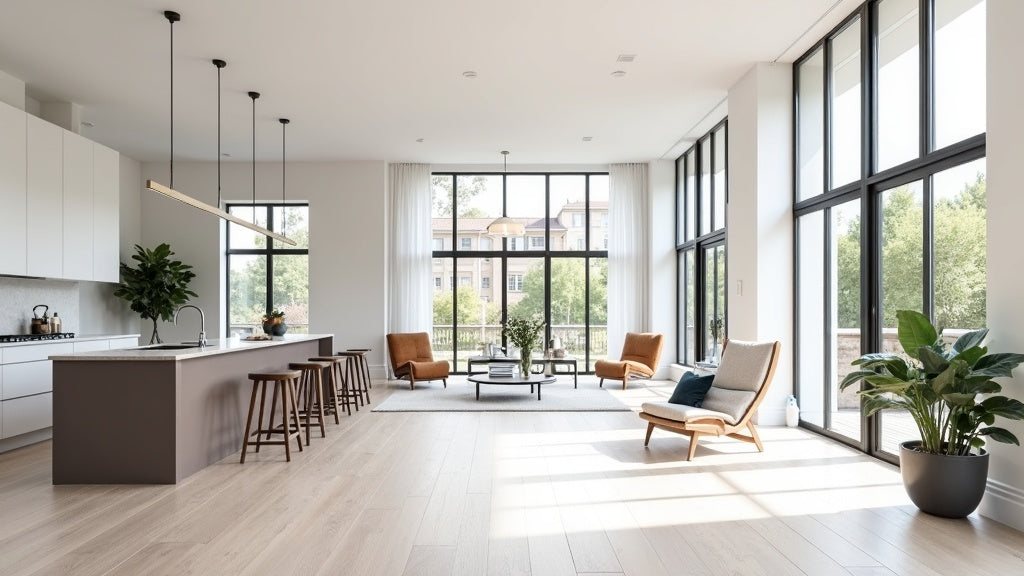
Scandinavian-inspired interior design depends on flooring more than most styles admit, because the floor is the single largest surface in any room and it decides whether that room reads as bright and calm or heavy and cluttered. Pale, low-contrast wood tones, wide simple plank formats, and a matte, low-glare finish are what let a Scandinavian-inspired room look open and considered rather than sparse or cold. Get the floor wrong and no amount of white paint or minimal furniture fixes the feeling.
What Actually Defines Scandinavian-Inspired Interior Design?
Scandinavian-inspired design rests on three working principles: a light, restrained material palette, function-first furnishing, and a deliberate push to maximize whatever natural light a room has. Nothing in the style is decorative for its own sake.
The light palette shows up as pale wood, white or off-white walls, and muted neutrals with the occasional soft accent colour, never a busy pattern mix. Function-first means furniture and materials earn their place by being useful and well made, not by being ornamental. Natural light maximization means every surface, especially the floor, is chosen partly for how it bounces available daylight around a room rather than absorbing it.
A fourth idea usually rides along with the first three: warmth without clutter, often described with the Danish word hygge. A Scandinavian-inspired room is not meant to feel bare. It is meant to feel calm, because everything visible is doing real work, and the palette stays quiet enough that texture and light can carry the warmth instead of ornament.

Why Does Flooring Tone Carry So Much Weight in This Style?
Flooring tone matters more here than in almost any other interior style because the floor is the largest continuous surface in a room and Scandinavian-inspired design is built around maximizing natural light. A pale surface reflects more of the light that reaches it; a dark surface absorbs more of it. Across an entire floor, that difference changes how bright and open a room feels far more than a wall colour choice does, simply because of the surface area involved.
This is a straightforward optical fact, not a claim about any product's performance. A room with large windows and a pale floor will read brighter and feel larger than the identical room with a dark floor, independent of anything else in the space.
What Wood Tones Read as Scandinavian-Inspired?
Pale, cool-to-neutral tones read as Scandinavian-inspired: whitewashed or bleached oak, ash, birch, and soft driftwood greys. Tones with a strong red, orange, or yellow undertone, like traditional golden oak or cherry, generally clash with the style's cool, quiet neutral palette and read as a different, more traditional design language.
The undertone matters more than the exact shade. A light tone with a warm orange cast will still fight a Scandinavian-inspired room's white walls and cool neutrals, while a slightly deeper grey-toned or driftwood finish can still read as Scandinavian-inspired as long as the undertone stays cool and muted. For a closer look at how tone and undertone are actually chosen, see How to Choose the Best Engineered Hardwood Colour for Your Home.
Does Plank Format Change the Look?
Yes. Wide, long planks laid in a straight run generally read as more Scandinavian-inspired than narrow strip flooring, because fewer seams and repeats across the floor create the uncluttered visual field the style depends on. A narrow strip floor breaks a room into many small repeating units, which adds visual texture that works against a minimalist aim.
This does not mean bigger is automatically better in every room. A very small space can start to feel like it is wearing a floor built for a much larger room if the format is too oversized relative to the walls. The right format is the widest, longest plank that still reads as proportionate to the room it is going into. Giant Plank vs Standard Format: How Vinyl Plank Size Changes the Feel of a Room covers how format changes a room's proportions in more detail.
Which Direction Should the Flooring Run?
In an open-concept Scandinavian-inspired space, running boards along the longest sightline, typically toward the main source of natural light, generally reinforces the sense of openness the style is built around. Running boards the length of a room, rather than across it, extends the visual line the eye follows and can make a space feel longer and calmer.
This is a layout decision, not a fixed rule. Room shape, doorway placement, and where light actually enters all affect which direction genuinely helps, and the honest answer changes room to room. Which Direction Should Flooring Run in a Room? walks through the layout factors in more detail.
Matte or Glossy: Which Finish Fits a Function-First Room?
A matte or low-sheen finish generally fits Scandinavian-inspired minimalism better than a high-gloss finish. Gloss adds visual shine and reflection that competes with the room for attention, which runs against a style built on quiet, function-first surfaces. Matte finishes let the floor read as a calm plane of tone and let the room's light and proportions do the visual work instead.
A matte finish also tends to disguise everyday dust, light scuffing, and footprints better than a glossy one, which fits the function-first, low-fuss instinct behind the style. Matte, Satin, or Glossy: How Floor Finish Changes a Room's Feel goes deeper on how sheen level changes a room's character.

Is There Room for Pattern in a Minimalist Floor?
Sparingly, and usually in a single tone. A herringbone layout in one pale wood tone is a common Scandinavian-inspired choice for an entryway or a defined living space, because the texture reads as subtle craft rather than decoration. The pattern adds visual interest through geometry and light play across the joints, not through added colour or contrast, which is why it fits a style that otherwise avoids busy visuals.
A multi-tone pattern, or a pattern used across an entire open floor plan rather than a defined zone, tends to read as a statement rather than a quiet texture choice, and works against the calm the style is aiming for.
What Flooring Materials Can Actually Achieve This Look?
Several flooring materials can meet the pale, matte, wide-format specification a Scandinavian-inspired room calls for, and the honest answer depends on where in the home the floor is going, not on any one category being the default choice. Engineered hardwood, WPC vinyl flooring, and laminate can all be produced in pale, low-sheen, wide-plank formats.
Engineered hardwood offers a genuine wood face and the grain variation of a real material, which some homeowners want even in an otherwise minimalist room. In wetter zones, like a kitchen, entryway, or bathroom, waterproof flooring becomes the more practical starting point: a fully waterproof core, the kind used in WPC vinyl flooring, holds up to standing water and spills without the moisture concerns a real wood veneer carries, while still being available in the pale, matte tones the style calls for. Neither category is the automatic right answer everywhere in a home; the room's real exposure to moisture and traffic should decide the material, and the tone, format, and finish choices covered above are what actually make a floor read as Scandinavian-inspired, regardless of which material is chosen.
How Do Design Choices Map to Scandinavian-Inspired Principles?
The table below summarizes which flooring choices support which core principle of the style, as a qualitative reference rather than a ranked list.
| Design principle | Flooring choice that supports it | Why it works |
|---|---|---|
| Maximize natural light | Pale, low-contrast tone (whitewashed oak, ash, birch, driftwood grey) | Reflects more of the available light than a dark or high-contrast tone |
| Visual minimalism | Wide, long-format planks laid in a straight run | Fewer seams and repeats reduce visual texture across the floor |
| Function-first practicality | Matte or low-sheen finish | Reads as calm rather than showy, and disguises everyday dust and scuffing |
| Openness in open-concept spaces | Consistent tone and a run direction along the main sightline | Keeps a continuous, uninterrupted visual field across connected rooms |
| Warmth without clutter (hygge) | A single-tone pattern, such as herringbone, used in a defined zone | Adds texture and light play without introducing colour contrast or visual noise |

FAQ: Flooring and Scandinavian-Inspired Design
A few questions come up specifically once tone, format, and finish choices meet the practical realities of a real home.
Does Scandinavian-inspired design require white or very pale floors?
No. Pale is the most common choice because it supports the style's light-maximizing goal, but the underlying principle is a muted, low-contrast tone, not one mandated colour. A soft honey tone or a driftwood grey can fit just as well as whitewashed oak, as long as the undertone stays cool and quiet rather than warm and saturated.
Can dark flooring ever work in a Scandinavian-inspired room?
Occasionally, but as a deliberate exception rather than the default. A dark floor set against white walls and very sparse furnishing can work in a small, carefully composed space, but it visually shrinks a room and works against the light-bounce the style typically relies on, so it only holds up when everything else in the room stays extremely restrained.
Is Scandinavian-inspired design the same as Japandi?
Related, but not identical. Japandi blends Scandinavian minimalism with Japanese wabi-sabi and tends to lean toward warmer, deeper wood tones, more asymmetry, and more visible material texture. Classic Scandinavian-inspired design generally stays paler, cooler in undertone, and more symmetrical in its use of pattern and layout.
Does a Scandinavian-inspired room need engineered hardwood specifically?
No. The look is defined by tone, format, and finish, not by one material category. Engineered hardwood, WPC vinyl flooring, and laminate can all achieve the same pale, wide-plank, matte look if the tone, format, and finish choices line up, and the room's real exposure to moisture and traffic is what should decide which material fits best.
Choosing flooring for a Scandinavian-inspired room comes down to a small set of decisions done consistently, tone, format, finish, and pattern restraint, rather than to any single product category. Get those four choices right and the floor does the quiet work the style depends on.
Contact us with any questions about your project.
To find waterproof vinyl flooring, click here for a Caledon Floors dealer near you.