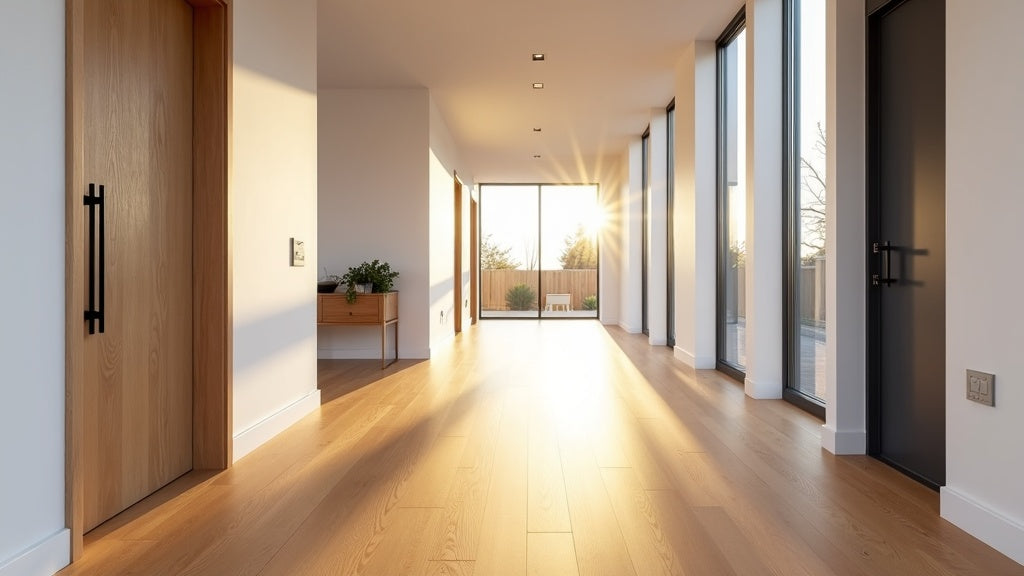
Plank size changes how a vinyl floor reads in a room more than almost any other single decision. A giant plank format, wider and longer than the industry standard, creates fewer seams, more visible wood grain per board, and a calmer, more expansive feel. A standard or narrower plank creates a busier rhythm underfoot, which can suit a smaller room or a more traditional look.
Colour and finish tend to get most of the attention when choosing a vinyl floor, but format, meaning the width and length of each plank, is doing just as much visual work. It affects how large a room feels, how the light falls across the floor, and how closely the finished result resembles genuine hardwood. This matters as much for waterproof flooring as it does for any other type, since format is a purely visual and dimensional choice that sits on top of whatever core construction you select.
This guide breaks down what plank format actually means for WPC vinyl flooring, how giant plank compares to standard sizing, and how to think about the decision for your own space.
What Counts as a "Giant Plank" in Vinyl Flooring?
A giant plank is a WPC vinyl format that is noticeably wider and longer than the industry-standard plank, typically in the range of 7 to 9 inches wide and 60 to 71 inches long, compared to a standard plank closer to 5 to 6 inches wide and 48 inches long.
The extra size is not just a cosmetic choice. Wider, longer planks require more precise manufacturing to stay dimensionally stable, since a larger single piece has more surface area that needs to expand and contract evenly with temperature changes. This is part of why giant plank formats tend to appear in higher-thickness WPC constructions with a stable composite core.
Caledon's Goliath collection is a working example of the format: a 71 inch by 9 inch plank at 12mm thick. That is a substantially larger single piece of flooring than a standard plank, and it changes how the floor reads the moment you walk into the room. As with any WPC vinyl flooring, the composite core is what makes the larger format possible while keeping the floor waterproof and dimensionally stable.

How Does Plank Width Change the Feel of a Room?
Wider planks make a room feel more expansive and show more of the wood grain character on each individual board. Narrower planks create a tighter, more traditional visual rhythm that can suit smaller or more formal rooms.
A 9 inch wide plank covers roughly the same floor area with far fewer total boards than a 5 inch plank. Fewer boards means fewer seams, and fewer seams reads visually as fewer interruptions. In an open-concept space, this can make sightlines feel longer and the room feel calmer, since the eye is not tracking a dense grid of joints.
Width also affects how much of the wood-look pattern you actually see per board. A wider plank shows more of the printed or embossed grain detail in a single continuous piece, which tends to look more like a real, wide-sawn hardwood board and less like a repeating pattern.
The trade-off is proportion. In a genuinely small room, such as a narrow hallway or a compact bathroom, an oversized plank can occasionally look slightly out of scale, the way an XL area rug can overwhelm a small living room. This is a matter of taste more than a hard rule, and many small rooms carry a wide plank beautifully, but it is worth viewing a sample in the actual space before deciding.
How Does Plank Length Change the Feel of a Room?
Longer planks reduce the number of end joints running across the floor, which creates a smoother, more continuous visual line, especially when light travels across the room.
Standard planks around 48 inches long create end joints relatively frequently as they run across a room. Longer formats, such as a 71 inch plank, cut that frequency significantly. The result is a floor with fewer short interruptions and a longer, calmer sightline, particularly noticeable in hallways, open-concept living areas, and rooms with strong natural light where every seam catches a bit of shadow.
Length also plays into how the floor is laid out. Longer planks allow for a more randomized, natural-looking stagger pattern, since there is more room to offset joints without repeating a visible pattern too quickly.
Does a Bigger Plank Format Look More Premium?
Generally, yes, though it depends on the room and the finish paired with it. Fewer seams and more visible grain per board are widely associated with a higher-end look in flooring, largely because oversized formats echo the wide-plank hardwood floors found in premium homes and design publications.
That said, plank format is one input among several. A giant plank in a low-quality finish will not look premium, and a well-finished standard plank in a well-proportioned room can look every bit as intentional. Format amplifies whatever finish and colour choice sits on top of it. It does not substitute for them.
Giant Plank vs Standard Plank: A Qualitative Comparison
| Factor | Giant Plank (7 to 9 inches wide, 60 to 71 inches long) | Standard Plank (5 to 6 inches wide, 48 inches long) |
|---|---|---|
| Visual seams | Fewer, longer sightlines | More frequent, tighter rhythm |
| Wood grain visibility per board | High, more continuous detail | Moderate, more repetition |
| Room feel | Expansive, calm, open | Traditional, structured |
| Best-suited room size | Open-concept, larger rooms | Any size, especially compact rooms |
| Design association | Contemporary, premium | Classic, versatile |
| Manufacturing demand | Higher (dimensional stability at scale) | Lower |
| Layout flexibility | Strong randomized stagger with more offset room | Reliable, familiar stagger pattern |

Does Room Size Determine Which Format to Choose?
Room size is a strong factor but not the only one. Large, open-concept spaces tend to benefit the most from giant plank formats because there is enough floor area for the fewer-seams effect to register visually. In a small, closed-off room, that same effect is less pronounced simply because there is less floor to see at once.
Ceiling height also plays a role. Taller ceilings pair naturally with wider, longer planks, since the proportions of the room already lean toward the expansive. Standard rooms with average ceiling heights work well with either format.
The honest answer is that both formats work in most rooms. The decision comes down to the mood you want: a wide, continuous, contemporary feel favours giant plank, while a tighter, more traditional rhythm favours standard sizing.
Does Format Affect How a Floor Feels Underfoot?
Not directly. Underfoot comfort comes from the core construction and any attached underlayment pad, not from the plank's width or length. A giant plank and a standard plank built with the same core material and the same attached pad will feel similar underfoot, even though they look different. This is one of the practical advantages of waterproof flooring built on a composite core: the size of the plank can change dramatically without changing how stable or comfortable the floor feels day to day.
Where format does interact with comfort is durability perception. Fewer seams can mean fewer points where dust and debris settle over time, which some homeowners find easier to keep looking clean, though this is a minor factor compared to the finish and wear layer.
For more on how sheen and texture affect a floor's look and feel, see Matte, Satin, or Glossy: How Floor Finish Changes a Room's Feel.
How Does Plank Format Compare to Pattern Choices Like Herringbone?
Format and pattern are two separate design decisions that can work together. Plank format is about the size of each individual board. Pattern is about how those boards are arranged, whether in a straight running layout, a herringbone, or a chevron design.
A giant plank format is generally laid in a straight running pattern to take full advantage of its length and grain visibility. Herringbone and chevron patterns typically use shorter, narrower pieces, since the geometry of the pattern depends on more frequent angled cuts. Homeowners choosing between the two are really choosing between two different visual philosophies: the long, continuous sightline of a giant plank, or the intricate, structured geometry of a pattern layout.
For a full look at pattern flooring, see Herringbone and Chevron Flooring: The Look, and What to Know Before You Choose.

Frequently Asked Questions
These are the questions Canadian homeowners most often ask when comparing plank formats.
Is a wider plank harder to keep looking straight over time?
A quality WPC vinyl plank, regardless of width, is engineered with a stable composite core specifically so it holds its shape through normal indoor temperature and humidity changes. Width alone does not make a floor more prone to shifting when the product is built for dimensional stability.
Does giant plank vinyl look like real hardwood?
A giant plank format paired with a realistic embossed texture and a well-designed wood-look pattern can read very convincingly as real hardwood, particularly from a normal viewing distance. The larger single-board size is one of the main reasons contemporary WPC vinyl has closed the visual gap with genuine wide-plank hardwood.
Can I mix plank formats in the same home?
It is possible, though most homeowners choose one primary format for visual consistency across connected spaces. Where a genuine separation exists, such as between a main floor and a fully separate basement level, using a different format in each area is a reasonable design choice.
Is standard plank format going out of style?
No. Standard plank remains a widely used, versatile format that suits a broad range of home styles, particularly more traditional or period homes where an oversized plank might look visually mismatched. Giant plank has grown in popularity for contemporary and open-concept homes, but it has not replaced standard sizing as the default choice.
The Bottom Line
Plank format is a genuine design decision, not just a manufacturing detail. A giant plank format creates an expansive, contemporary feel with fewer seams and more visible grain character, while a standard plank offers a familiar, versatile rhythm that suits a wide range of homes. Neither is objectively better. The right choice depends on the room, the ceiling height, and the mood you are trying to create.
For more on how flooring choices shape the overall feel of a home, see What Flooring Makes a Home Look More Expensive? and Canada Flooring Trends 2026: What Looks Current and What Already Feels Dated.
If you have questions about which plank format fits your space, our team is glad to help. Contact us here.
To find waterproof vinyl flooring in Canada, click here for a Caledon Floors dealer near you.