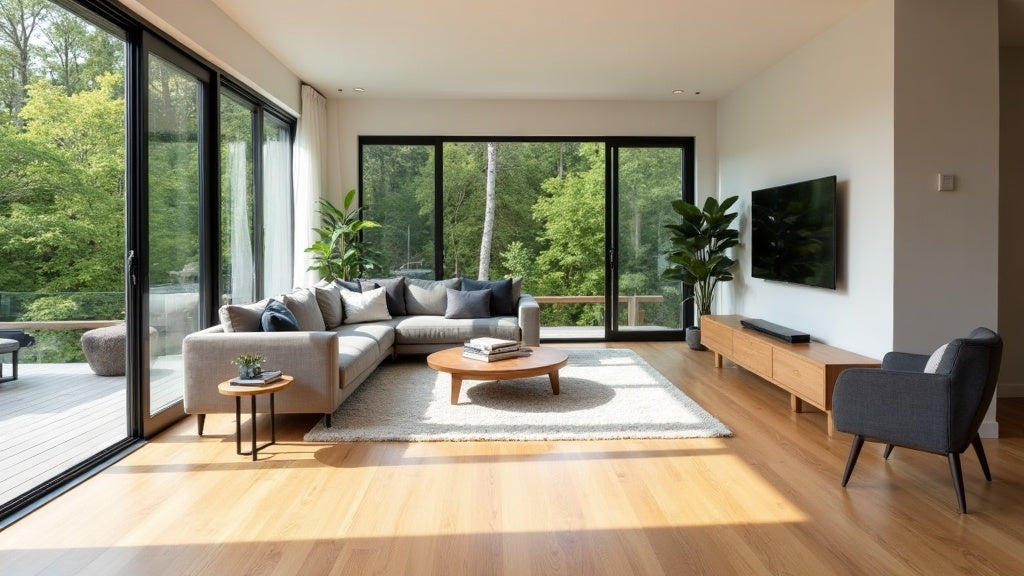
Working out how much flooring you need comes down to three steps: measure the area of each room, add a waste factor for cuts and mistakes, then divide by the coverage of one box and round up. Get those three right and you order the correct amount the first time, without the stress of running short halfway through the job or paying for far more than you need.
It sounds simple, and it mostly is. But a few details trip people up, and the cost of getting them wrong is real. This guide walks through the method, the waste factors that actually apply in Canadian homes, and the mistakes worth avoiding.
How do you calculate how much flooring you need?
Measure the length and width of each room in feet, multiply them to get the square footage, and add up every room you are flooring. That total is your base number. Then add a waste factor, which we cover below, and divide the result by the square footage that one box of your chosen floor covers. Always round up to the next whole box, because flooring is sold by the box, not by the square foot.
The formula in plain terms is the total square feet plus waste, divided by coverage per box, rounded up. Whether you are buying WPC vinyl flooring, engineered hardwood, or another waterproof flooring, the math is identical. Only the coverage per box changes, and that figure is printed on every box.

What is a flooring waste factor, and how much should you add?
A waste factor is the extra flooring you buy to cover cuts, trimming, mistakes, and the occasional damaged plank. It is not really waste. It is insurance against running short. For a straight, simple home, add about 7 to 10 percent. For a complex space with lots of angles, diagonals, or cuts around cabinets and islands, add about 10 to 15 percent. Be aware that 15 percent is a lot of extra product, so save the top of that range for genuinely complicated rooms.
| Layout | Waste factor to add |
|---|---|
| Straight, simple home | 7 to 10 percent |
| Complex space (angles, diagonals, cabinet cuts) | 10 to 15 percent |
| Herringbone or chevron patterns | 15 to 20 percent |
As a general rule, 10 percent is a safe target. It protects you against wasteful cuts, install mistakes, and slightly complicated rooms without leaving you with boxes you will never use. The bigger and more complex the space, the more the waste factor earns its place.
Does the type of flooring change how much extra you need?
It does, and it is worth knowing before you settle on a number. Vinyl and laminate come in fixed lengths with a printed, man-made surface, so there is no natural variation to work around and the offcuts are predictable. They tend to waste a little less, which means you can usually aim for the low end of the ranges above.
Natural wood products, like engineered hardwood, run a little higher. Their random lengths and natural colour variation are part of the beauty, but they also mean you want extra material on hand to choose the best pieces, which we cover next.
Tile is its own case, and it is worth a heads-up even though it is a different material. Tile has a higher damage rate in shipping, and some breakage is simply expected in transit. Many retailers will not reimburse for breakage unless it exceeds roughly 10 percent of the order, so it is normal to buy extra tile specifically to absorb the pieces that arrive cracked. If tile is part of your project, build that into your count.
Why buying a little extra lets you cherry-pick the best pieces
Extra material does more than cover mistakes. It gives you the freedom to choose which pieces go where, and that matters most with products like engineered hardwood that come in random lengths. Picture a box with six rows, where three are full length, say six feet, and the other three are random, anywhere from one to five feet. A good installer pulls the long pieces and runs them through the centre of the room, where the eye naturally lands, and saves the short pieces for the start and end of each run, where a cut happens anyway.
The rule installers live by is simple: never cut a long piece if you can avoid it. Those long boards are the premium pieces, and a floor laid with long boards down the middle looks more expensive and more seamless. Extra material is what gives you that flexibility. Order tight to the square footage and you lose the ability to cherry-pick, because every piece has to be used somewhere.
Two more things that change your number: who installs it, and stairs
Who lays the floor matters. A professional installer is dialled in and cuts efficiently, so waste stays low. A do-it-yourself installer is usually less practised, makes more trial cuts, and should build in a little more forgiveness. If this is your first floor, lean toward the higher end of the range.
Stairs are the other thing people forget. If you are wrapping stairs or making custom stair nosing, you need longer pieces than a flat floor does, and those pieces come out of the same boxes. Measure your stairs and factor them into the purchase from the start, rather than discovering halfway through that the long boards you needed for nosing are already down on the floor.

How do you measure an irregular or L-shaped room?
Break the space into rectangles. Most rooms that are not simple boxes can be split into two or three rectangular sections. Measure each section, calculate its area, and add them together. For closets and doorway nooks, measure them as their own small rectangles and include them, because flooring still goes there.
Round each measurement up to the nearest few inches rather than down. It is better to base your estimate on a slightly larger room than a slightly smaller one.
Why is flooring sold by the box, and why do you round up?
Flooring comes in boxes that each cover a set number of square feet, and you can only buy whole boxes. A box typically covers somewhere between 20 and 30 square feet, but the exact figure is printed on the box and varies by product and plank size. To convert your square footage into boxes, divide your total, including waste, by the coverage per box, then round up to the next whole number.
Rounding up is not optional. If the math says 14.2 boxes, you buy 15. That fraction of a box is often the difference between finishing the job and stopping one row short.
Should you order extra flooring?
Yes, and there are two good reasons beyond the waste factor. The first is dye lots. Flooring is produced in batches, and colour can vary slightly between one batch and the next. Ordering everything at once, from the same batch, keeps the whole floor consistent. If you run short and reorder later, the new boxes may not match exactly. The second reason is repairs. Keep a spare box or two after the install, because floors take damage over the years, and having matching planks on hand turns a future repair from impossible into simple.
The honest trade-off is this. A little leftover flooring is a minor cost. Running short in the middle of an installation stalls the whole project and risks a colour mismatch when you reorder. Slightly too much is almost always the cheaper mistake.
What are the most common mistakes when estimating flooring?
The most common mistake is skipping the waste factor and ordering the exact square footage, which almost guarantees coming up short. Another is measuring only the open floor and forgetting closets, nooks, and transitions. A third is reordering mid-project and ending up with a different dye lot. The fourth is rounding box counts down instead of up to save a few dollars, which is the most expensive saving in flooring.
If you are planning a larger renovation, our guide to the best flooring for a main floor renovation in Canada covers how to think about the whole space at once.

A simple worked example
Say you are flooring a living room that measures 12 feet by 15 feet, plus a hallway of 4 feet by 10 feet. The living room is 180 square feet and the hallway is 40, for a base of 220 square feet. Add a 10 percent waste factor and you reach 242 square feet. If your chosen floor covers 25 square feet per box, that is 9.68 boxes, which rounds up to 10. Buy 10, keep the leftovers as your spare, and you are covered.
Frequently asked questions
Here are the questions Canadian homeowners ask most often when estimating flooring.
How do I convert square feet to boxes of flooring?
Divide your total square footage, including the waste factor, by the coverage per box printed on the product, then round up to the next whole box. You can only buy whole boxes.
How much extra flooring should I buy?
For a straight, simple home, 7 to 10 percent. For a complex space, 10 to 15 percent, though 15 percent is a lot of extra product. Add a little more if you are installing it yourself or wrapping stairs, and keep a spare box afterward for future repairs.
Do I include closets in my flooring estimate?
Include closets and any area where flooring will actually be installed. Whether flooring runs under large appliances depends on your install plan, so confirm that with your installer.
What happens if I run out of flooring partway through?
You reorder, but the new boxes may come from a different dye lot and not match exactly. This is why ordering enough at once, from one batch, matters.
Does the type of flooring affect how much extra to buy?
A little. Vinyl and laminate come in fixed lengths and tend to waste less, so you can aim for the low end of the range. Natural wood runs a bit higher because of random lengths and cherry-picking. Tile is higher still, partly because some breakage in shipping is expected.
How accurate does my measurement need to be?
Close, and always rounded slightly up. The waste factor absorbs small errors, but it is not a substitute for measuring each room properly.
Getting it right the first time
Measuring for flooring is not complicated, but it rewards a little care. Measure each room, add the right waste factor, divide by the coverage per box, and round up. Do that and you avoid both the stress of running short and the cost of a pile of leftover boxes. If you would like help estimating the right amount for your project, contact us and we are glad to help you get the number right.
To find waterproof vinyl flooring in Canada, click here for a Caledon Floors dealer near you.