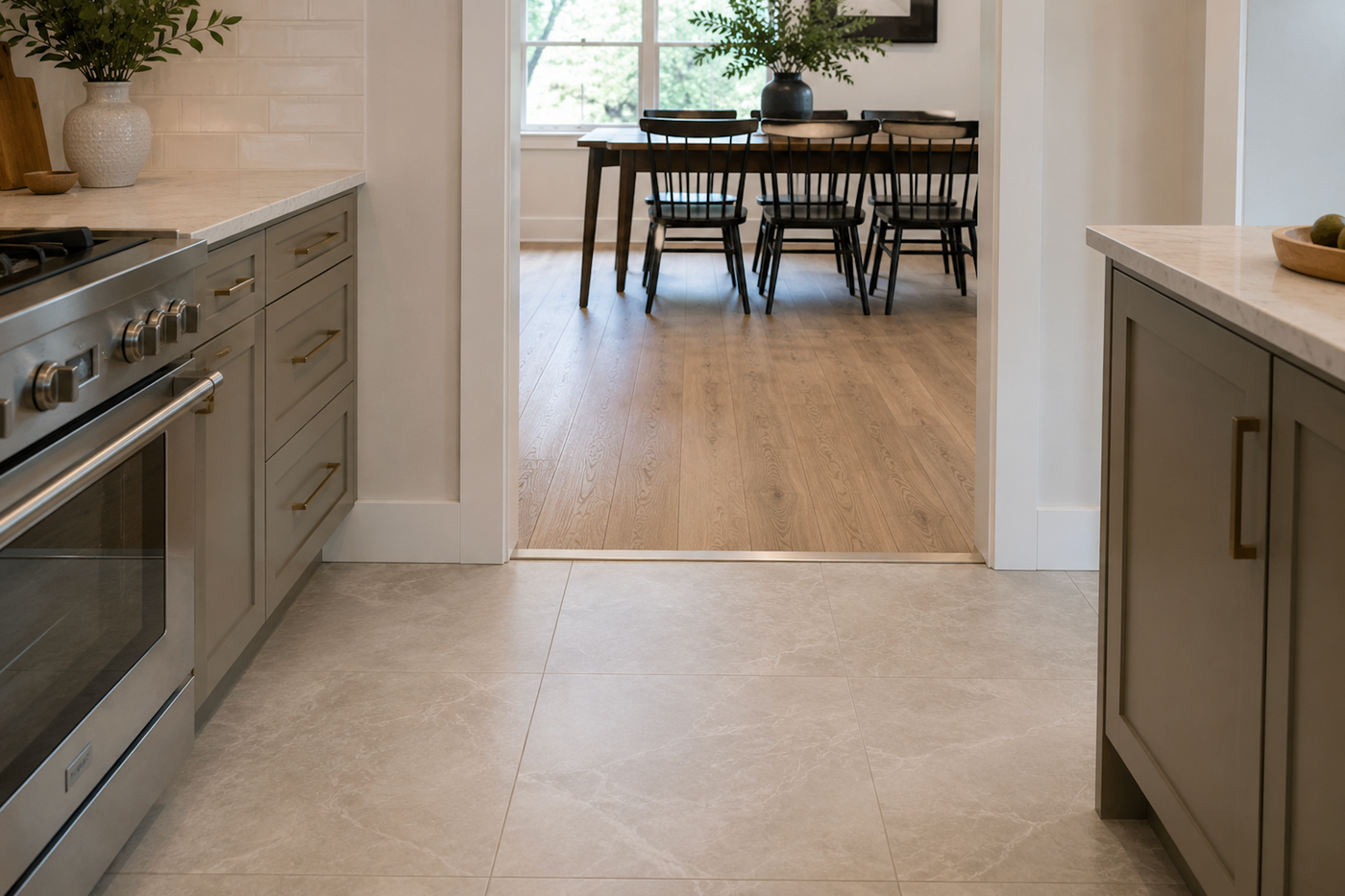
Tile and vinyl flooring work well together when each material is placed where its strengths matter most: tile in a fully wet, high-traffic zone like an entryway or a bathroom, and vinyl in the connected living spaces where warmth, comfort, and a wood-look aesthetic take priority. Pairing the two is a common and practical approach in Canadian homes, not a compromise between two competing choices.
Tile and vinyl are often framed as competitors, since many buyers are choosing between them for the same room. In practice, plenty of homes use both, each doing the job it does best, with a thoughtful transition connecting the two. Understanding where and how to combine them well is its own useful design skill.
This guide covers where tile and vinyl flooring genuinely complement each other, how to coordinate them visually, and where the combination tends to work best in a real home.
Why Pair Tile and Vinyl Instead of Choosing One for the Whole Home?
Different rooms in a home genuinely ask for different things. Tile brings a hard, fully waterproof, easy-to-clean surface that performs exceptionally well in wet zones. Vinyl brings warmth, softness underfoot, and a wood-look aesthetic that suits living spaces where comfort matters as much as performance, while still delivering the same waterproof flooring performance tile is known for.
Rather than compromising on either quality by choosing a single material for the entire home, pairing tile and vinyl lets each room get the material best suited to how it is actually used. A bathroom benefits from tile's full waterproof performance and easy-clean surface. A living room benefits from vinyl's comfort and visual warmth. Neither material has to stretch beyond its strengths to cover the other's job.
Which Rooms Work Best With Tile, and Which Work Best With Vinyl?
Tile tends to be the stronger choice in fully wet rooms and entryways: bathrooms, mudrooms, and sometimes kitchens, particularly where a homeowner wants a distinct, hard-surfaced zone that reads as clearly separate from the rest of the home.
Vinyl tends to be the stronger choice in living spaces, bedrooms, home offices, and any room where comfort underfoot and a warm, wood-look aesthetic are priorities. WPC vinyl flooring in particular offers a genuinely waterproof core alongside real comfort, which makes it a strong all-around choice for the majority of a home's square footage.
Kitchens are the room most often debated between the two. Some homeowners choose tile for its classic hard-surface durability. Others choose vinyl to maintain visual and physical continuity with an adjoining open-concept living space. Both are valid, well-established approaches.
How Do You Make Tile and Vinyl Look Coordinated Rather Than Disconnected?
The strongest coordination comes from a shared colour palette and a shared design language between the two materials, even though they are physically different products. A warm oak-toned vinyl plank paired with a warm-toned tile, rather than a cool-toned one, creates visual continuity even across a hard transition line.
Grout colour matters more than homeowners often expect. A grout tone that echoes the vinyl's colour palette helps the tile zone feel like part of the same design story rather than an abrupt departure. A stark contrast in grout tone, while sometimes intentional, can make the tile area read as a separate, disconnected space.
Consistent trim, baseboard colour, and door hardware finish across both zones also reinforces a sense that the whole home was designed as one coordinated plan, even where the flooring itself changes materials.

Where Should the Transition Between Tile and Vinyl Happen?
The same principle that applies to any flooring transition applies here: the switch should happen at a natural architectural break, most often a doorway or threshold, rather than in the open middle of a shared sightline.
A bathroom doorway is the clearest example, since the door itself already signals the room's separate function. An entryway or mudroom transitioning into a main hallway is another natural break point, particularly where a change in ceiling height or a half-wall already exists.
For a full breakdown of transition placement, see Mixing Two Flooring Types in One Home: Where Should the Transition Happen?.

Tile-Look Vinyl: A Middle-Ground Option
For homeowners who like the visual language of tile but want a warmer, softer, more forgiving surface, some WPC vinyl collections offer tile-look visuals within the same waterproof, cushioned construction as their wood-look counterparts. This allows a laundry room or mudroom to echo the tile aesthetic used in an adjoining bathroom while staying softer and warmer underfoot than genuine tile.
This is not a substitute for tile everywhere. Genuine tile still has its own distinct performance profile and aesthetic character. But tile-look vinyl is a useful middle-ground option for rooms where the tile look is desired but tile's hardness and cold surface are not.
Comparing Tile and Vinyl by Room: A Qualitative Look
| Room | Typically Tile | Typically Vinyl | Common Approach |
|---|---|---|---|
| Bathroom | Strong choice | Workable choice | Tile for full wet-zone performance |
| Entryway or mudroom | Strong choice | Workable choice, or tile-look vinyl | Tile or tile-look vinyl for grit and moisture |
| Kitchen | Common, classic choice | Common, especially in open-concept homes | Either, depending on adjoining spaces |
| Living room | Uncommon | Strong choice | Vinyl for comfort and warmth |
| Bedroom | Rare | Strong choice | Vinyl for comfort |
| Laundry room | Common | Strong choice | Either, both fully waterproof options |

Coordinated in tone and transitioned at natural breaks, tile and vinyl read as one deliberate design rather than two unrelated choices.
Frequently Asked Questions
These are the questions Canadian homeowners most often ask about combining tile and vinyl flooring.
Does tile and vinyl flooring need a special threshold piece where they meet?
Most transitions between tile and vinyl use a threshold or transition strip to bridge any height difference between the two materials and create a clean, finished edge. The specific style is worth coordinating with both flooring colours so it reads as part of the plan.
Can WPC vinyl flooring go right up to a tile shower or wet area?
Vinyl flooring is commonly used up to the edge of a tiled wet area, such as a shower threshold, provided the transition point is planned properly. WPC vinyl flooring's own waterproof core means the material itself handles occasional moisture at the transition point without concern.
Is it more common in Canadian homes to use tile or vinyl in the kitchen?
Both are common, and the choice often comes down to how the kitchen connects to the rest of the main floor. A kitchen that flows directly into an open-concept living area frequently uses vinyl for visual and physical continuity. A more separated, traditional kitchen layout sees tile used just as often.
Does mixing tile and vinyl flooring hurt a home's overall design cohesion?
Not when the two materials are coordinated in tone and the transition points are placed at natural architectural breaks. A thoughtfully paired combination of tile and vinyl often reads as more considered than a single material stretched across every room regardless of function.
The Bottom Line
Tile and vinyl are not rivals competing for the same job. They are two materials with different strengths that, placed well, complement each other across a home. Tile earns its place in fully wet, high-traffic zones. Vinyl earns its place everywhere comfort, warmth, and a wood-look aesthetic matter most. Coordinated in tone and transitioned at natural architectural breaks, the combination reads as a deliberate, well-designed home rather than two unrelated choices under one roof.
For more on flooring choices in wet-traffic rooms, see Best Bathroom Flooring in Canada: Tile, Vinyl, or Laminate? and Vinyl Flooring vs Tile in Canada: Which Is Better for Kitchens, Bathrooms, and Everyday Living.
If you have questions about coordinating tile and vinyl flooring across your home, our team is glad to help. Contact us here.
To find waterproof vinyl flooring in Canada, click here for a Caledon Floors dealer near you.