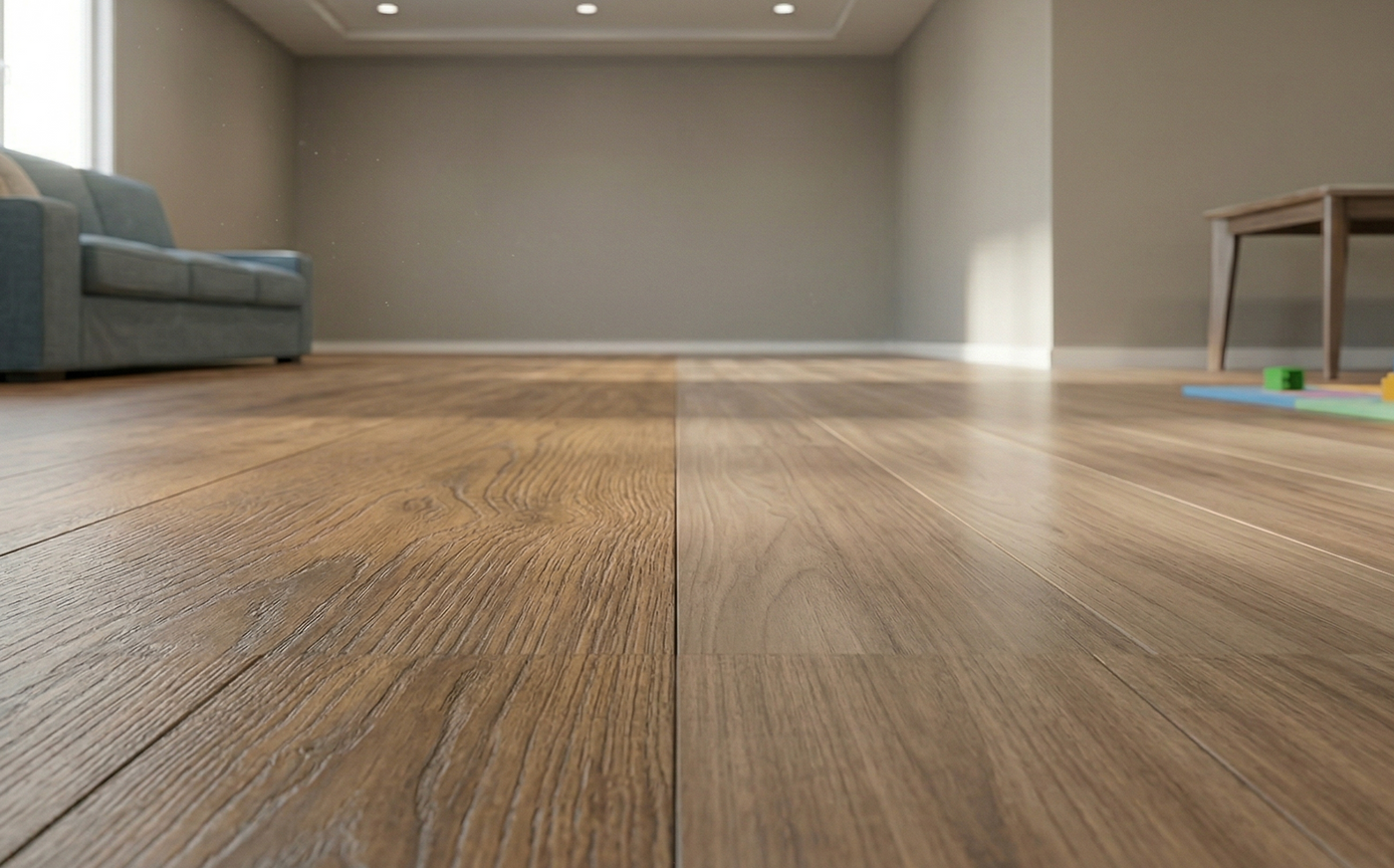
Most people compare vinyl flooring and laminate as if they are basically the same product.
They’re not.
They may sit beside each other in a showroom. They may overlap on price in some categories. They may even look similar in a small sample. But once they’re installed in a real Canadian home, the differences show up in practical ways.
That matters because this is not just a style decision. It’s a use-case decision.
The wrong floor can still look good on day one. The real test comes later, after a winter of wet boots, a few months of kitchen traffic, a dog running the same path every day, or a basement that feels dry until it doesn’t.
That is where vinyl flooring and laminate start to separate.
If you’re trying to choose between the two, the better question is not which one is “best” overall. It’s which one fits the room, the conditions, and the way you actually live.

What is the real difference between vinyl flooring and laminate?
Vinyl flooring is built around moisture resistance first.
Laminate is built around a hard, durable surface over a wood-based core.
That difference matters, but it should not be oversimplified.
Vinyl flooring, especially waterproof vinyl flooring, is more forgiving when water and moisture are part of normal life. Laminate is less forgiving if water gets into the joints or reaches the core.
At the same time, modern laminate is much better than many people assume. A good laminate today can be very durable, easy to install, and highly water resistant compared with older generations of laminate. Products with stronger cores and lower swell rates have improved the category meaningfully.
So the real distinction is not that one is modern and the other is outdated. It’s that they solve slightly different problems.
Which one looks better?
Vinyl flooring usually has the edge.
That wasn’t always true, but it is increasingly true now, especially at the higher end of the category.
Large plank vinyl flooring with good colour work and a realistic EIR surface can look extremely convincing. In many cases, it looks better than laminate because the texture follows the grain more naturally, the plank format feels more premium, and the overall visual reads cleaner and more intentional.
Laminate can still look good. A strong laminate product can absolutely be competitive visually, and in some rooms the difference may not feel dramatic.
But if you compare good vinyl planks to good laminate, vinyl will usually come out ahead on appearance.
That is especially true in more modern interiors, where wider planks, lower gloss, and a more realistic textured surface tend to make the floor feel more current.

Where vinyl flooring usually has the advantage
Vinyl flooring tends to make the most sense where moisture risk is part of everyday life.
Kitchens, entryways, mudrooms, basements, and homes with pets or kids are the obvious examples. These are spaces where spills, tracked-in water, grit, and repeated traffic are normal.
That is where waterproof flooring earns its value.
Vinyl flooring reduces the stress around those conditions. You are not thinking about every spill or wondering whether damp boots by the door will matter later. That peace of mind is real, and it is one of the reasons vinyl flooring has become such a strong option in Canada.
If the room has meaningful moisture exposure, vinyl usually has the edge.
Where laminate deserves more credit
Laminate is often underestimated, and that is a mistake.
In dry or reasonably controlled spaces, laminate can be a very good flooring choice. Bedrooms, living rooms, home offices, and many upper-floor areas are all legitimate use cases.
It also offers some practical advantages that matter to buyers.
Laminate is often attractive on price. It is typically very durable on the surface. It is easy to install. With the right underlay, including a quality 3mm underlayment, it can achieve very strong sound performance. For many homeowners, that combination is compelling.
That is why laminate continues to be a serious option.
The mistake is not choosing laminate. The mistake is choosing it for a room with real moisture exposure and expecting it to behave like vinyl.

What about basements in Canada?
This is where the choice becomes more specific.
Basements in Canada sit over concrete, tend to run cooler, and carry more moisture risk than upper floors, even when they look finished and feel dry.
That tends to favour vinyl flooring, especially when the basement is a suite, gym, family room, or other heavy-use space. It removes the biggest variable, which is moisture.
That said, laminate is not automatically off the table. In a dry, well-controlled basement, a good water-resistant laminate can still be a reasonable option, particularly when budget and appearance both matter.
The right answer depends on how controlled the basement really is.
If there is any real uncertainty around moisture, vinyl is usually the safer call. If the basement is consistently dry and the product is well chosen, laminate can still make sense.
What about kitchens?
Kitchens tend to favour vinyl flooring for a simple reason: risk is repetitive.
Water near sinks, dropped ice, dishwasher issues, regular spills, and heavy foot traffic all add up over time. Vinyl flooring is built to handle that kind of environment with less concern.
Laminate can still work in a kitchen, especially newer water-resistant products, but it comes with less margin for error.
So this is not a case of laminate being wrong. It is a case of vinyl usually being the lower-risk option.
Which one lasts longer?
That depends heavily on where it is installed.
Laminate can last a long time in the right environment. Vinyl flooring can also last a long time, and it tends to be more consistent when conditions are harder on the floor.
That is the real distinction.
Laminate performs well when the room stays within its comfort zone. Vinyl performs well when the room is less predictable.
In many Canadian homes, that makes vinyl the more versatile long-term option. But that does not mean laminate is short-lived. In the right room, laminate can absolutely be a durable and worthwhile choice.
Which one is better for condos?
This depends on the building, the sound requirements, and the rooms involved.
Vinyl flooring often has an advantage because it is versatile and easier to recommend across multiple spaces, especially where there may be moisture concerns.
Laminate should not be dismissed, though. With the right underlayment, it can perform very well acoustically, which is a real strength in condo settings.
So the better condo choice depends on the broader goal.
If you want maximum versatility across kitchens, entry areas, and general living space, vinyl may be the safer recommendation. If the focus is dry interior areas, sound performance, and value, laminate can be a very good option.
So what should you actually do?
Stop treating vinyl flooring and laminate as interchangeable, but also stop treating one as universally better.
Choose vinyl flooring when the room sees moisture, heavier wear, or daily conditions that make waterproof performance a major advantage.
Choose laminate when the room is dry, the budget matters, and you want a durable, attractive floor with strong value and easy installation.
That is the more honest answer.
Vinyl is usually the more versatile product in Canada because it works in more demanding conditions. Laminate is still a very good option when those conditions are controlled.
The right choice depends less on which category sounds better, and more on whether the floor matches the room.
FAQ
Is vinyl flooring better than laminate in Canada?
Not in every room. Vinyl flooring is usually safer where moisture, spills, and seasonal conditions matter. Laminate can be an excellent option in dry or reasonably controlled spaces.
Does laminate look better than vinyl flooring?
Not usually at the higher end. Large plank vinyl with a realistic EIR surface will often look better today, though a good laminate can still be close.
What is better for basements: vinyl flooring or laminate?
Vinyl flooring is usually the safer basement choice in Canada because it handles moisture better. But in a dry, well-controlled basement, a good water-resistant laminate can still be a reasonable option.
Is laminate cheaper than vinyl flooring?
Sometimes, yes. Laminate is often attractive on price and can offer very strong value. But the better choice still depends on where the floor is going and how the space will be used.
Extra content related to Vinyl and Laminate:
Waterproof Flooring - details on vinyl options
Laminate, Tile or Vinyl for Bathrooms?
Best Flooring for Canadian Basements
Contact us for help choosing a floor