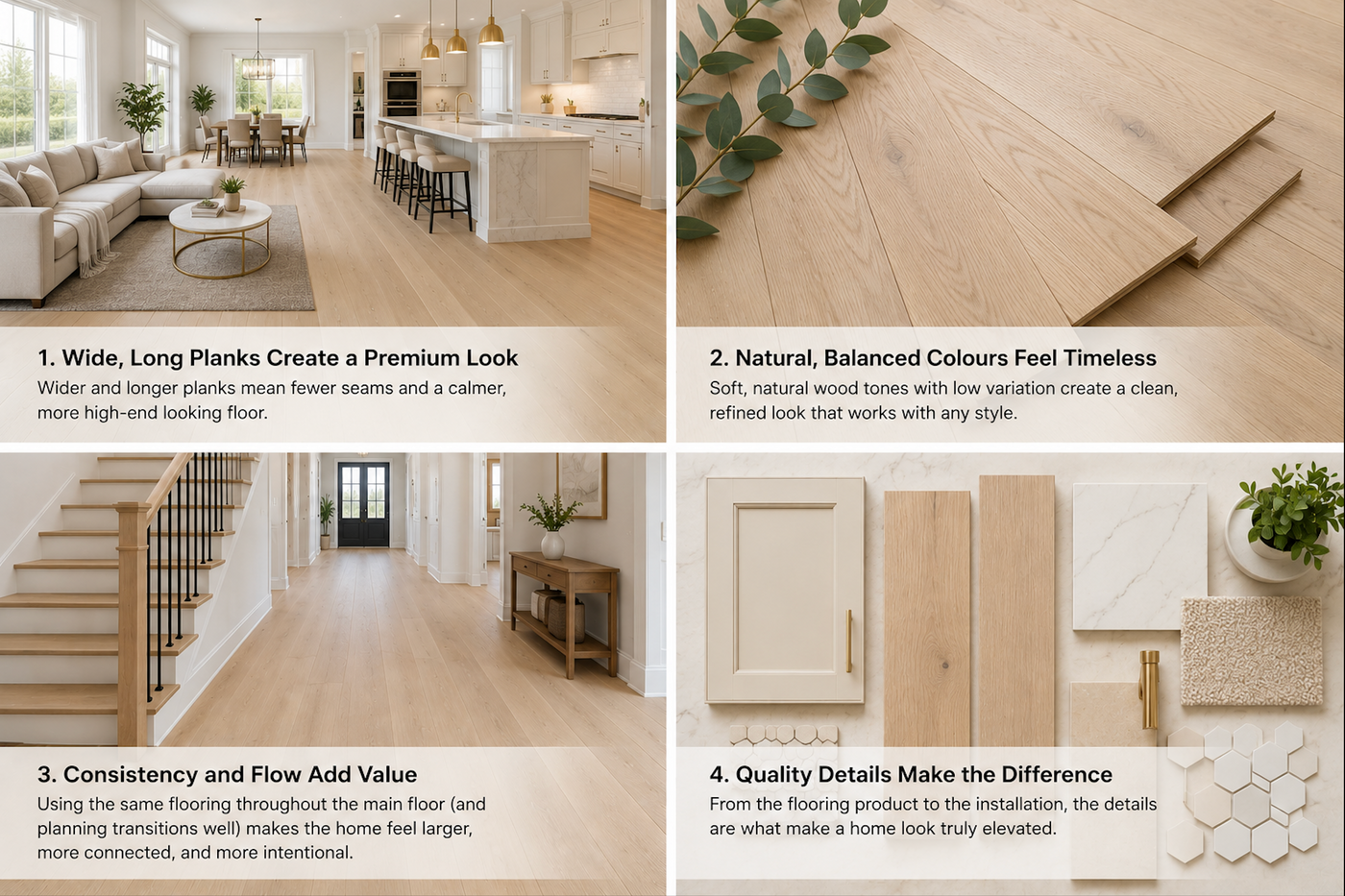
The flooring that makes a home look more expensive is the flooring that looks intentional. It fits the architecture. It suits the light. It works with the cabinets, stairs, furniture, and wall colour. It creates flow instead of noise.
A floor does not need to be the highest-priced product in the showroom to make a home feel elevated. The right floor can make a house feel larger, warmer, calmer, and more finished. The wrong floor can make even a good renovation feel disconnected.
For Canadian homeowners comparing engineered hardwood, vinyl flooring, laminate, tile, or WPC vinyl flooring, the real question is not only "Which floor is best?" The better question is: "Which floor will make my home feel more valuable, more current, and more thoughtfully designed?"
That answer usually comes down to six things: material quality, colour tone, plank width, plank length, visual variation, and installation details.

What type of flooring makes a home look most expensive?
Engineered hardwood usually creates the most natural high-end look because it is real wood. Natural wood grain, cleaner grades, longer boards, and a quality finish can bring warmth and depth that wood-look products try to imitate.
That does not mean engineered hardwood is the only good choice. A high-quality vinyl floor can look better than a poorly chosen hardwood floor. A thicker WPC vinyl flooring product with realistic wood visuals, good proportions, and a natural colour can make a home feel polished, especially when waterproof flooring is the practical priority.
Tile can also look beautiful in the right place, especially in bathrooms, entries, laundry rooms, and modern kitchens. But tile can interrupt the flow of a home when it creates an awkward transition into wood or vinyl.
The most expensive-looking floor is rarely about material alone. It is about whether the floor belongs in the home. A beautiful floor should make the whole space feel more resolved.
Why does flooring change how expensive a home feels?
Flooring changes how expensive a home feels because it covers so much visual space. The floor is one of the largest design surfaces in the home, so the wrong choice is hard to hide. Cabinets, counters, furniture, lighting, and paint all matter. But the floor is the foundation. If the floor looks busy, dated, patchy, thin, or disconnected, the home can feel less finished.
An expensive-looking floor usually does five things well:
| Design effect | Why it matters |
|---|---|
| Creates visual flow | Makes rooms feel larger and more connected |
| Looks calm instead of busy | Gives the home a cleaner, more elevated feel |
| Uses better proportions | Wider and longer planks often feel more substantial |
| Matches the quality of the room | Helps cabinets, stairs, furniture, and finishes feel intentional |
| Avoids awkward transitions | Prevents the home from feeling chopped up |
The floor does not need to dominate the room. In many well-designed homes, the floor works quietly, adding warmth, scale, and structure without demanding all the attention. That quiet confidence is often what makes a floor feel expensive.

Do wider planks make a home look more expensive?
Wider planks often make a home look more expensive because they create a more modern, substantial, and architectural feel. A wider plank reduces the number of seams across the room and can make the floor feel calmer.
In many Canadian renovations, wide plank flooring has become associated with a more premium look. A 7-inch to 9-inch plank can look especially strong in open-concept homes, larger living spaces, primary bedrooms, and main floors with longer sightlines.
But width alone is not enough. A wide plank with poor colour, too much pattern repetition, or too many short boards can still look ordinary. A narrower plank can still look beautiful in the right traditional home. The important point is proportion. Wide planks tend to look best when they are paired with longer board lengths, a cleaner visual, low colour variation, good installation, and a colour that suits the home. A wide plank should make the floor feel calmer, not louder.
Do longer planks make flooring look more expensive?
Longer planks are one of the strongest signals of a more expensive-looking floor. Long boards reduce visual breaks, create better flow, and make the room feel more open.
Short-board-heavy floors can make a space feel busy. Even when the colour is attractive, too many short pieces create more seams and more interruptions. That can make a floor feel less elevated once it is installed across a full room.
Longer plank formats matter most in open-concept main floors, living rooms, dining rooms, hallways, primary bedrooms, larger renovation projects, and homes with long sightlines. This is why premium engineered hardwood collections often emphasize plank length. Board length is not just a technical detail; it changes the rhythm of the room. A homeowner may not notice plank length on a sample board. They will notice it when the floor is installed.

What flooring colour makes a home look more expensive?
Natural, warm, balanced wood tones often make a home look more expensive. The safest premium direction today is usually a soft natural oak-inspired tone that works with modern cabinets, white walls, warm neutrals, black accents, stone, and natural textures.
Floors that are too grey, too orange, too red, too dark, or too high-variation can be harder to design around. Some of those tones can work in the right home, but they require more care.
A more expensive-looking floor usually has these colour qualities:
| Colour quality | Why it works |
|---|---|
| Natural warmth | Feels inviting and less artificial |
| Low colour variation | Creates a calmer full-room visual |
| Soft neutral undertone | Works with more cabinet and furniture styles |
| Not overly grey | Avoids a dated renovation look |
| Not overly orange or red | Feels more current and easier to design around |
Light floors can make a home feel larger, brighter, and more modern. Medium warm floors can make a home feel richer and more grounded. Dark floors can look dramatic, but they often show dust, pet hair, and scratches more easily. The best colour is not the trendiest colour; it is the one that makes the home feel balanced.
Does low colour variation make flooring look more premium?
Low colour variation can make flooring look more premium when the goal is a clean, refined, modern interior. A calmer floor lets the rest of the home breathe.
High colour variation can be beautiful in rustic homes, cabins, farmhouses, and character-heavy interiors. But in many modern homes, too much variation can make the floor feel busy. It can compete with cabinets, counters, rugs, furniture, and natural light.
Low colour variation is especially useful in open-concept spaces because the floor is seen across multiple rooms at once. A calmer floor helps connect the kitchen, dining area, living room, and hallway. This is why many higher-end floors focus on controlled variation; the wood still has natural beauty, but the finished room feels more refined. The goal is not to remove character. The goal is to control it.

Does engineered hardwood make a home look more expensive than vinyl?
Engineered hardwood usually has the highest natural design ceiling because it is real wood. A strong engineered hardwood floor brings depth, grain, warmth, and authenticity that wood-look products try to recreate.
But the better answer is more nuanced: a high-quality vinyl floor can look better than a lower-quality hardwood floor. Material category matters, but quality matters more.
A clean, realistic, well-proportioned WPC vinyl flooring product can make a home look very good, especially for families who want waterproof flooring and easier maintenance. A thin, flat, repetitive vinyl floor may not create the same impression.
The same is true for engineered hardwood. A premium engineered hardwood floor with a thicker veneer, cleaner grade, longer planks, and low colour variation will usually look more expensive than a lower-grade hardwood with heavy character, short boards, or a thin surface story. Engineered hardwood has the strongest natural premium look, but the final result still depends on the specific product.
What engineered hardwood features make a home look more expensive?
The engineered hardwood features that make a home look more expensive are veneer thickness, grade, plank length, plank width, colour control, and finish quality. This is where homeowners should look beyond the sample colour: two engineered hardwood floors can look similar in a showroom but be very different once installed.
| Feature | Why it matters |
|---|---|
| Veneer thickness | Gives the floor more real wood surface and a stronger long-term story |
| Grade | Cleaner grades create a more refined appearance |
| Plank length | Longer boards create a calmer, more premium visual |
| Plank width | Wider planks add modern scale and presence |
| Colour variation | Lower variation helps the floor feel more controlled |
| Finish quality | Supports everyday wear and long-term appearance |
| Installation quality | Even a great floor can look weak if installed poorly |
For example, a 4mm veneer gives engineered hardwood a more substantial real wood surface than many thinner-veneer products. Select & Better grade creates a cleaner, higher-grade hardwood appearance. Longer planks reduce the busy look that comes from too many short boards. A premium engineered hardwood floor should not only look good on one sample; it should look good across the full home.

Can vinyl flooring make a home look expensive?
Vinyl flooring can make a home look expensive when the product has realistic visuals, good plank proportions, a substantial feel, and a colour that fits the home. The best vinyl floors do not look flat, thin, overly patterned, or artificial. They have better texture, more natural colour, less obvious repeat, and a stronger underfoot feel.
This is especially true with higher-quality waterproof vinyl flooring and WPC vinyl flooring. WPC vinyl flooring can offer a thicker, warmer, more comfortable feel than many thinner rigid products, which makes the floor feel more substantial in real life.
Vinyl flooring works best visually when the colour is natural and not overly grey, the pattern repeat is not obvious, the plank size fits the room, the texture supports the visual, transitions are handled cleanly, and the floor continues through connected spaces. Vinyl flooring should not be judged only by price; a better vinyl floor can be a smart choice for families, condos, basements, rentals, and open-concept homes where waterproof practicality matters. The goal is not to pretend vinyl is hardwood. The goal is to choose a vinyl floor that looks intentional and performs well for the home.
What flooring mistakes make a home look less expensive?
The biggest flooring mistakes are choosing the wrong colour, using too many flooring types, ignoring plank proportions, accepting awkward transitions, and choosing a floor based only on a small sample. A floor can make a home feel less expensive when it looks disconnected from the rest of the space.
| Mistake | Why it weakens the home |
|---|---|
| Too many flooring changes | Makes the home feel chopped up |
| Awkward transitions | Draws attention to layout problems |
| Too much colour variation | Can make the floor feel busy |
| Short-board-heavy layouts | Creates too many seams and interruptions |
| Overly grey tones | Can make a renovation feel dated |
| Thin-looking vinyl | Reduces the sense of quality |
| Heavy knots in the wrong design | Can make a modern home feel visually cluttered |
| Poor stair details | Makes the installation look unfinished |
| Ignoring lighting | Floors change dramatically under different light |
The strongest flooring choices feel intentional; the weakest ones feel accidental. The best floors do not fight the home. They improve it.
Should you use the same flooring throughout the main floor?
Using the same flooring throughout the main floor often makes a home look more expensive, especially in open-concept layouts. A continuous floor can make the space feel larger, cleaner, and more planned.
This does not mean every room needs the same material. Bathrooms, laundry rooms, mudrooms, and basements may need different flooring. But when the kitchen, dining room, living room, and hallway are visually connected, fewer flooring changes usually create a more premium result.
The transition points matter. A transition should land where the home naturally changes, such as a doorway, hallway, stair edge, or defined room break. Random transitions across open spaces can make the floor look like an afterthought. If the goal is to make the home look more expensive, continuity is usually your friend.
What flooring works best with stairs?
The flooring that works best with stairs is the flooring that creates a clean, finished transition between levels. Stairs are one of the most visible parts of a home, and stair details can strongly affect how expensive the flooring looks.
Engineered hardwood often works beautifully on stairs because it creates a real wood visual and can be coordinated with matching or complementary nosings. Vinyl flooring can also work well when the stair nosings are properly designed and installed.
The mistake is treating stairs as an afterthought. A beautiful main floor can lose impact if the stairs look mismatched, bulky, or unfinished. Stair nosings, colour matching, installation quality, and direction changes all matter. For homes where the stairs are visible from the entry, living room, or kitchen, flooring should be planned with the stairs from the beginning.
What flooring makes small homes look larger?
Light to medium natural wood tones often make small homes look larger. The floor should feel calm, continuous, and not overly busy.
In smaller homes, condos, and townhouses, flooring can either open the space or break it up. A continuous floor through the main living areas can help the home feel larger. Low colour variation also helps because the eye moves across the room more easily.
Good choices for smaller homes often include light natural engineered hardwood, soft warm oak tones, realistic wood-look vinyl flooring, WPC vinyl flooring in a calm colour, fewer transitions, and longer plank visuals where possible. Very dark floors can still look beautiful, but they may make a small home feel heavier if the lighting is limited. Highly varied floors can also make smaller spaces feel busier. The best small-home flooring feels quiet, warm, and connected.

What flooring makes a home better for resale?
Flooring that looks current, neutral, durable, and broadly appealing is usually best for resale. Most buyers respond well to floors that feel clean, warm, and easy to design around.
For resale, avoid extreme colours and overly specific styles unless they truly fit the home. A soft natural wood tone, clean engineered hardwood, or high-quality vinyl flooring can appeal to a wider range of buyers.
Engineered hardwood can support a premium resale impression because many buyers value real wood. Waterproof vinyl flooring can also be attractive when buyers care about pets, kids, basements, rentals, or easy maintenance. The best resale floor is not always the highest-priced floor; it is the floor that makes the home feel move-in ready, well cared for, and visually current.
Best flooring choices for an expensive-looking home
| Goal | Strong flooring choice | Why it works |
|---|---|---|
| Most natural high-end look | Engineered hardwood | Real wood gives warmth, depth, and authenticity |
| Best practical whole-home option | WPC vinyl flooring | Waterproof flooring with comfort and a more substantial feel |
| Bright modern look | Light natural wood tones | Makes spaces feel larger and cleaner |
| Warm luxury look | Medium natural oak tones | Adds richness without feeling overly dark |
| Cleaner full-room visual | Low colour variation | Helps the floor feel calmer and more refined |
| Higher-end hardwood appearance | Longer, wider planks | Creates better proportions and fewer visual breaks |
| Better resale appeal | Neutral, current flooring | Works with more buyers and interior styles |
The best floor is not chosen in isolation. The best floor is chosen with the full home in mind.
How do you choose flooring that looks expensive but still feels practical?
Choose flooring by balancing design, lifestyle, and product quality. A floor that looks beautiful but does not fit the household can become frustrating. A floor that performs well but does not suit the home can make the renovation feel unfinished.
Before choosing, homeowners should ask: Does the floor work with the cabinets, stairs, walls, and furniture? Does the colour look good in natural and artificial light? Will the floor continue through connected spaces? Are the planks wide and long enough for the room? Does the product feel substantial underfoot? Is the floor realistic for pets, kids, moisture, and daily cleaning? Are the stair nosings and transitions properly planned? Does the floor support resale value?
A more expensive-looking home usually comes from fewer random choices and more intentional decisions.
Final thoughts: what flooring makes a home look more expensive?
The flooring that makes a home look more expensive is the flooring that looks intentional, balanced, and appropriate for the space.
Engineered hardwood often creates the strongest premium impression because it is real wood. A cleaner grade, thicker veneer, longer planks, wider boards, and low colour variation can make a major difference in how the home feels. High-quality vinyl flooring and WPC vinyl flooring can also create a beautiful result when homeowners want waterproof flooring, comfort, and practical durability. Tile can look premium in the right spaces, especially when planned carefully and installed well.
The key is to avoid choosing flooring one room at a time without thinking about the whole home. A great floor should make the home feel calmer, larger, warmer, and more finished. Contact us for help choosing a floor, or find a dealer near you.