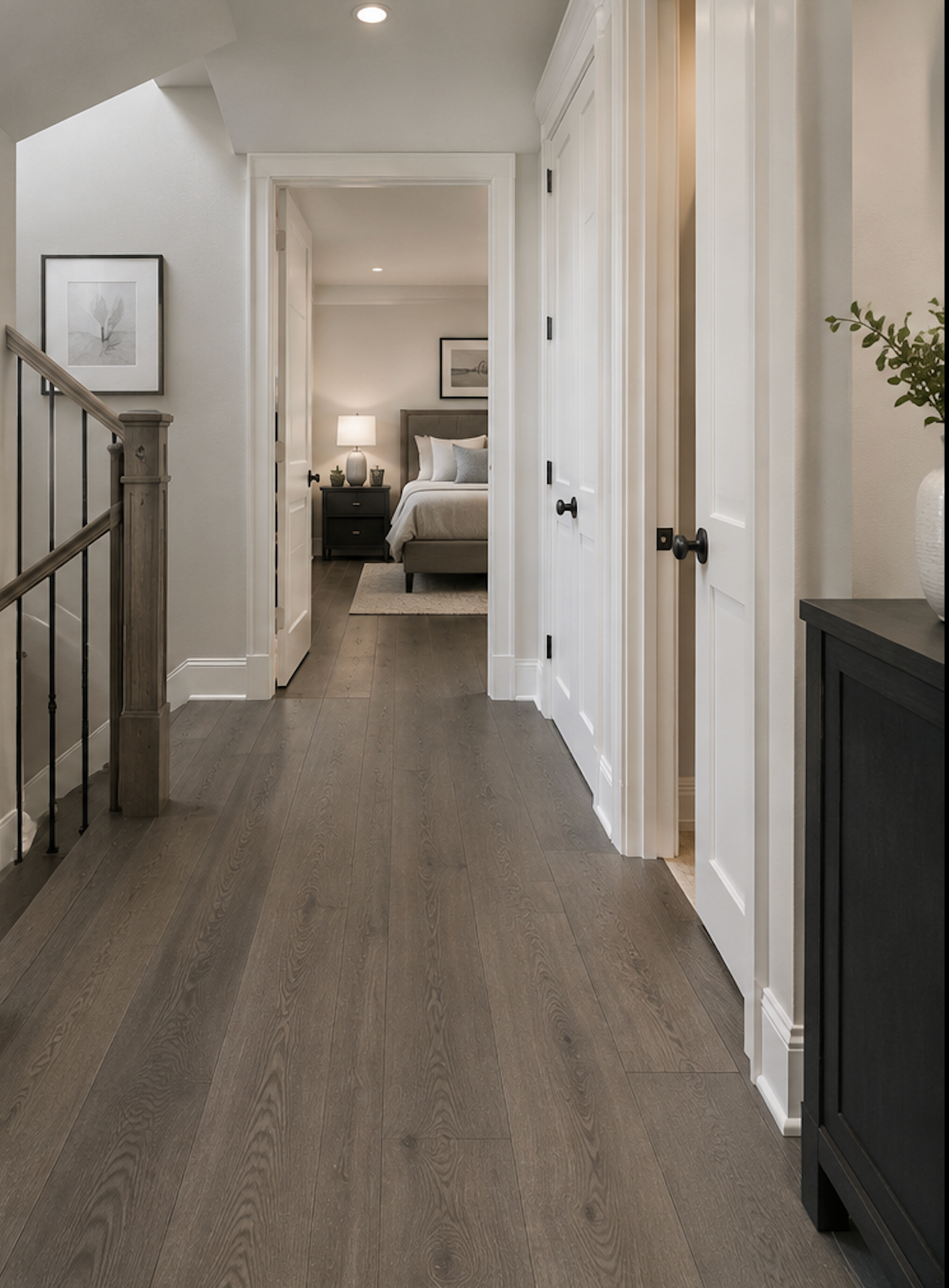
Using the same flooring throughout the house can make a home feel larger, calmer, and more connected. That is why many homeowners consider it, instead of dividing the home into separate flooring zones, one continuous floor can create better visual flow from the entryway to the living room, kitchen, dining area, hallway, bedrooms, and stairs. For engineered hardwood, this can be especially attractive. Real wood adds warmth, and a consistent floor can make the whole home feel more intentional.
The short answer is this: using the same engineered hardwood through the main living areas, hallways, dining room, and bedrooms is often a strong design choice. It can also work in kitchens when the homeowner accepts the water-related trade-offs. But it should not be forced into every room. Bathrooms, laundry rooms, some basements, and other moisture-prone spaces need more careful thinking. The best flooring plan balances visual flow with practical room-by-room risk.

Quick Answer: Should You Use the Same Engineered Hardwood Throughout?
| Area of the home | Recommendation | Why |
|---|---|---|
| Living room | Usually yes | Strong visual continuity and real wood feel |
| Dining room | Usually yes | Works well when connected to main living areas |
| Hallways | Usually yes | Helps the home feel connected |
| Bedrooms | Often yes | Creates warmth and consistency |
| Kitchen | Often possible, with care | Looks cohesive, but water needs to be managed |
| Stairs | Often yes | Creates a finished, continuous look |
| Bathrooms | Usually no | Moisture risk is usually too high |
| Laundry room | Usually no | Appliance leaks and repeated moisture are concerns |
| Basement | Maybe | Depends on moisture conditions and product suitability |
Why Homeowners Like One Continuous Floor
The biggest benefit is visual continuity. When the same engineered hardwood runs through multiple rooms, the home often feels more open and intentional. This is especially true in many Canadian homes where the kitchen, dining area, and living room are connected. Different flooring in every room can make a home feel busy: it creates breaks, transitions, and visual interruptions. One continuous floor reduces that effect.
A consistent engineered hardwood floor can help the home feel larger, calmer, more cohesive, more premium, easier to decorate, and less chopped up. That does not mean every room must have the same floor. It means flooring changes should be planned, not random.

Same Flooring in Open-Concept Homes
Open-concept homes usually benefit most from consistent flooring. When the kitchen, dining area, and living room are all visible at once, changing the floor between spaces can make the home feel smaller and more segmented. A continuous engineered hardwood floor can help the space feel more unified.
This is one of the strongest arguments for using the same floor through the main level. In an open-concept home, flooring is not just a surface: it is one of the biggest design elements in the room. If the flooring changes too often, the home can lose visual flow.
Should the Kitchen Match the Living Room?
Often, yes, if the homeowner accepts the trade-offs. Many people choose engineered hardwood in kitchens because they want the same floor running through the main level. It can look warm, premium, and cohesive. But the kitchen has more water risk than the living room: wood and water do not do well together, and spills, leaks, wet shoes, pet bowls, and appliance areas need to be managed carefully.
So the practical answer is this: if the homeowner values one continuous real wood look and is careful with water, matching the kitchen to the living room can make sense. If the homeowner wants the lowest-risk kitchen floor, a more water-forgiving category may be better.
Should Bedrooms Have the Same Engineered Hardwood?
Often, yes. Using the same engineered hardwood in bedrooms can make the home feel more consistent and finished, and it avoids awkward transitions between hallways and bedrooms. Bedrooms are usually lower-risk spaces for engineered hardwood because they typically have less water exposure and less heavy daily mess than kitchens, bathrooms, or laundry rooms.
Some homeowners still choose carpet in bedrooms for softness, warmth, or sound control; that can be a reasonable personal choice. But from a visual-flow perspective, continuing engineered hardwood into bedrooms is often a strong option.
Should Hallways Match the Main Living Areas?
Usually, yes. Hallways are visual connectors. If the hallway flooring changes for no practical reason, the home can start to feel more broken up. Using the same engineered hardwood through hallways helps connect bedrooms, living areas, stairs, and entry points, and it reduces unnecessary transition strips. If the goal is a cleaner, more premium look, hallways are usually one of the places where matching the main floor makes the most sense.
Should Bathrooms Have Engineered Hardwood?
Usually, no. Bathrooms are high-moisture areas: showers, tubs, toilets, steam, wet feet, and water splashes create more risk than most other rooms. Engineered hardwood is real wood and should not be treated like tile or waterproof vinyl. Even if the look is attractive, bathrooms are usually not the best place to push the limits of wood flooring. For most homeowners, the better choice is to use a more water-forgiving floor in bathrooms and transition cleanly from the engineered hardwood outside the room.
What About Laundry Rooms?
Laundry rooms are also higher-risk areas. The concern is not just normal moisture: it is the possibility of appliance leaks, drain issues, and repeated dampness. A washing machine problem can create serious water exposure quickly. For that reason, engineered hardwood is usually not the lowest-risk choice for laundry rooms. A homeowner may still choose it in some situations, but it should be done with caution and realistic expectations. In most cases, a more water-tolerant floor is the safer laundry-room decision.
Can Engineered Hardwood Go on Stairs?
Yes, engineered hardwood is often used on stairs, but stairs need proper planning. The stair nosing, tread construction, installation method, and safety details matter: stairs are not just another flat floor area. They are a separate part of the project and usually require more labour and more detailed finishing.
Using the same engineered hardwood on stairs can look excellent because it connects different levels of the home and makes the house feel more finished and intentional. But homeowners should understand that stairs often cost more and take more planning than standard floor areas.

Should the Basement Match the Main Floor?
Maybe, but the basement needs its own decision. Basements are more complicated because moisture risk is higher. Even if the main floor is ideal for engineered hardwood, the basement may have different conditions. Engineered hardwood can sometimes be used in basements, depending on the product, slab moisture, installation method, humidity control, and manufacturer instructions, but it should not be assumed.
Before choosing engineered hardwood for a basement, homeowners should think carefully about moisture history, subfloor preparation, concrete conditions, and whether a more water-forgiving floor may be smarter. A basement can match the main floor visually, but it should not be forced if the conditions are wrong.
Where Matching Flooring Usually Works Best
| Area | Why matching often works |
|---|---|
| Main living room | Keeps the main floor cohesive |
| Dining area | Usually connects naturally to living and kitchen spaces |
| Hallways | Reduces visual breaks and unnecessary transitions |
| Bedrooms | Creates consistency and warmth |
| Stairs | Helps connect levels of the home |
| Open-concept spaces | Makes the home feel larger and more intentional |
Where a Different Floor Often Makes Sense
| Area | Why a different floor may be smarter |
|---|---|
| Bathrooms | High moisture and water exposure |
| Laundry rooms | Appliance leaks and repeated dampness |
| Mudrooms | Wet shoes, snow, salt, and heavy use |
| Some basements | Moisture risk and concrete conditions |
| Utility areas | Practical performance may matter more than visual continuity |
How Flooring Transitions Affect the Look
Even if a homeowner does not use engineered hardwood everywhere, the transitions should look intentional. A clean transition between engineered hardwood and tile, vinyl, carpet, or another surface can still look very good. The problem is when transitions feel random: too many flooring changes can make a home feel patched together. A few smart transitions can make sense. The goal is to avoid unnecessary breaks while still respecting the needs of each room.
Common transition points include bathroom doorways, laundry rooms, basement entries, stair landings, mudrooms, and rooms with different moisture needs. The best transitions feel planned, not accidental.

Whole-House Engineered Hardwood: Benefits and Cautions
| Benefit or caution | What it means |
|---|---|
| Better visual flow | Fewer flooring breaks can make the home feel larger and calmer |
| Premium appearance | A continuous real wood floor can feel more intentional |
| Easier design coordination | One flooring foundation can simplify furniture and colour choices |
| Strong main-floor impact | Works especially well in open-concept layouts |
| Fewer awkward transitions | Less visual chopping between rooms |
| Moisture-prone rooms need care | Bathrooms, laundry rooms, mudrooms, and some basements may be poor fits |
| Kitchen use requires realistic expectations | Wood and water need to be managed |
| Stairs require extra planning | Nosings, labour, and safety details matter |
| Product choice matters | Not all engineered hardwood is equal |
| Installation quality matters | A whole-house floor needs proper prep and execution |
How to Decide Where to Use the Same Floor
Start with the layout of the home. Ask yourself: Is the main level open-concept? Will different floors make the home feel chopped up? Is the kitchen part of the main living area? Are there bathrooms, laundry rooms, or mudrooms where water risk is higher? Are the stairs part of the visual flow? Does the basement have moisture concerns? Do I want the home to feel cohesive or more room-specific? Am I choosing based on appearance only, or practical room conditions too?
Those questions usually lead to a better flooring plan than deciding room by room without a bigger picture.
What Homeowners Get Wrong
The first mistake is assuming the same floor should go everywhere no matter what: bathrooms, laundry rooms, mudrooms, and some basements may need different thinking. The second mistake is changing flooring too often, since too many flooring types can make a home feel smaller and less cohesive. The third mistake is ignoring the kitchen trade-off, because engineered hardwood can work in kitchens but it is still wood. The fourth mistake is forgetting about stairs, which can make or break the continuous look. The fifth mistake is choosing room by room without thinking about the whole home: flooring decisions should be made as part of a larger design plan.
FAQ: Same Flooring Throughout the House
Is it a good idea to use the same flooring throughout the house?
Often, yes. Using the same flooring through main living areas, hallways, dining rooms, and bedrooms can make a home feel more cohesive and premium.
Should I use the same engineered hardwood throughout the main floor?
Often, yes, especially in open-concept homes. A continuous engineered hardwood floor can make the main level feel larger, calmer, and more connected.
Should engineered hardwood go in the kitchen?
It can, and many homeowners choose it successfully. But wood and water do not do well together, so spills and leaks need to be managed carefully.
Should engineered hardwood go in bathrooms?
Usually no. Bathrooms are high-moisture spaces, and engineered hardwood is still real wood.
Should bedrooms match the hallway flooring?
Often, yes. Matching bedrooms and hallways can reduce transitions and make the home feel more consistent.
Should stairs match the engineered hardwood floor?
Often, yes, if the goal is a continuous premium look. But stairs require proper stair nosings, planning, and installation.
Is it bad to mix flooring types in a house?
No. Mixing flooring types can be smart when rooms have different needs. The key is to make transitions look intentional.
Final Verdict
Using the same engineered hardwood throughout the house can be a strong design choice. It often works especially well through main living areas, hallways, dining rooms, bedrooms, and stairs, making the home feel larger, calmer, and more cohesive. But it should not be forced into every room. Bathrooms, laundry rooms, mudrooms, some basements, and kitchens all need more careful thought because moisture and installation conditions matter.
The best flooring plan balances visual continuity with practical risk. Use the same floor where it improves the home, and use a different floor where the room genuinely needs it. Contact us for help choosing a floor, or find a dealer near you who can help you plan the right flooring approach for your whole home.
Related Reading
These articles go deeper on topics covered in this guide: