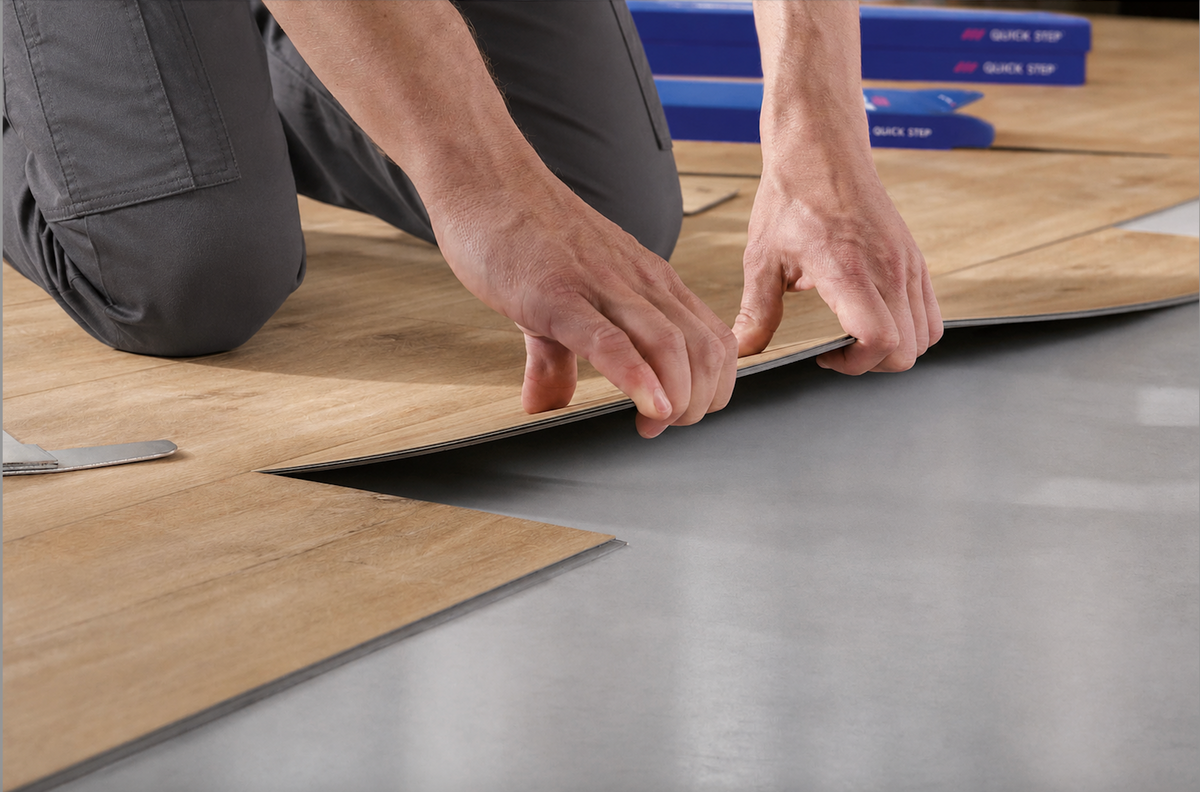
No, click-lock systems are not all the same. "Click-lock" is a catch-all term for any floating floor that connects with a mechanical joint instead of glue or nails, but underneath that one word are several distinct engineering families, each developed and patented by a different company, each assembling in a different way. Knowing the difference helps explain why one floor snaps together in an afternoon while another needs careful angling and tapping row by row, and why two floors that both say "click-lock" on the box can install, and perform at the seam, quite differently.
This guide breaks down the three names buyers run into most, Uniclic, Valinge, and I4F, what each one actually is, how their locking mechanisms differ, and what that difference does and does not tell you about the floor itself. For the broader picture of how vinyl flooring is constructed and bought beyond the locking joint, see Vinyl Flooring in Canada: The Complete Guide to Types, Costs, Waterproofing, and Best Uses.
What Is a Click-Lock System, Actually?
A click-lock system is a machined joint profile cut into the long and short edges of a plank so that adjacent pieces interlock mechanically, holding the floor together as a connected, floating surface. That machining tolerance is the same kind of manufacturing precision that goes into how a wear layer is actually made, just applied to the plank's edge instead of its surface. Every plank has a tongue profile on one edge and a groove profile on the opposite edge; when two planks meet, the tongue seats into the groove and a locking lip or strip holds the joint under tension.
That basic idea is shared across every click-lock product, laminate, engineered hardwood, and vinyl plank alike. What differs is the shape of the tongue and groove, the assembly motion required to engage them, and whether the mechanism uses a rigid locking lip milled directly into the plank or a separate flexible strip inserted into the groove. Those differences come from patented profile designs owned by specific companies, most commonly Unilin (the developer of Uniclic), Valinge Innovation, and the I4F patent licensing group. For a step-by-step look at what assembling one of these joints actually involves, see Click Lock Vinyl Flooring: Pros, Cons and Installation Guide.

What Is Uniclic, and How Does It Work?
Uniclic is a patented angle-tap locking profile developed by Unilin, a Belgian flooring technology company that has been part of Mohawk Industries, the world's largest flooring manufacturer, since 2005. Unilin also owns the Quick-Step and Pergo flooring brands, though Uniclic itself is licensed out to many other manufacturers across laminate, engineered wood, and vinyl.
Uniclic uses an angle-angle design with a pre-tension lip. The installer holds a plank at roughly a 20 to 30 degree angle against the row already down, then lowers it into place. As it seats, the lip flexes and pulls the two planks tight against each other. That built-in tension is what gives an angle-tap joint its reputation for a strong, tight mechanical connection once fully engaged.
Uniclic profiles typically support three assembly methods: angling on both long and short edges, tapping the planks together horizontally when angling is not possible (under a doorway casing or radiator, for instance), and a fold-down variant on some product lines. That flexibility is a real practical advantage in rooms with awkward obstructions.
What Is Valinge's Locking System, and How Is 5G Different From 2G?
Valinge Innovation is a Swedish company, not a flooring manufacturer, that develops and licenses mechanical locking technology the same way Unilin does. Its two most common profiles work differently from each other.
Valinge 2G is a traditional angle-angle system. Both the long and short edges lock by angling the plank down, similar in principle to Uniclic. Valinge 5G changes the short-edge assembly entirely: the long edge still angles in, but the short edge locks with a fold-down motion instead of a second angling step. A flexible strip built into the groove gets pushed down and out of the way as the plank drops into place, then pops back to seat the joint once the plank is flat.
That removes the need to angle and align the short end at all, which is why 5G and similar fold-down systems are marketed heavily on installation speed, especially on rigid-core products like SPC and WPC vinyl where an all-angling assembly is more physically demanding. Many of these rigid-core products also ship with an attached underlayment pad already bonded to the core, which changes the installation math further. See Do You Really Need Underlayment Under Vinyl Plank Flooring? for how that factors in.
The practical difference for a buyer: 2G behaves like Uniclic's angle-tap approach on both edges. 5G trades a small amount of that angle-tap tension on the short edge for meaningfully faster, more forgiving installation.
What Is I4F, and Why Is It Different From Uniclic and Valinge?
I4F, short for Innovations4Flooring, is not a manufacturer and does not own a single named locking profile the way Uniclic or Valinge do. It is a patent licensing consortium, founded in 2013, that pools locking-system and related manufacturing patents from multiple companies, including Classen, Windmöller, and USFloors. I4F licenses bundles of these patents to flooring manufacturers under what it calls a Patent Cluster Concept, so a manufacturer can license just the pieces of technology it needs, including drop-lock profile designs, rather than negotiating with each patent holder separately.
The practical result for a buyer is that a floor might carry a manufacturer's own trade name for its locking system (a "drop-lock" or similar branded mechanism) that is actually built on an I4F-licensed patent underneath, rather than a name recognizable on its own. This is one reason two floors with completely different marketing names for their locking system can still assemble in a nearly identical way: a shared patent licence, not a shared brand, is doing the engineering work.

Angle-Lock vs Drop-Lock: What Actually Changes for the Installer?
The meaningful technical split across all three names above is not Uniclic versus Valinge versus I4F, it is angle-lock versus drop-lock as assembly methods.
Angle-lock (Uniclic's core design, and Valinge 2G) requires angling the plank on both the long and short edges before pressing it down, which produces a tight, tension-loaded joint but takes more time and more careful alignment, especially near walls, cabinets, or door casings where a full angling motion is not physically possible. Drop-lock (Valinge 5G, and most I4F-licensed profiles) angles only the long edge and lets the short edge snap down vertically, which installs noticeably faster and tolerates minor misalignment better, at the cost of a short-edge joint that is generally considered slightly less tension-loaded than a full angle-tap connection.
Neither approach is universally "better." An angle-lock joint is often preferred by installers doing large, uninterrupted runs where the extra assembly time is offset by joint tightness. A drop-lock joint is often preferred in rooms with more cuts, obstructions, or first-time DIY installers, where forgiveness and speed matter more.
| Locking family | Owned or licensed by | Assembly method | Where it tends to show up |
|---|---|---|---|
| Uniclic | Unilin (Mohawk Industries) | Angle-angle, with a fold-down and flat-tap option on some lines | Laminate, engineered hardwood, vinyl plank |
| Valinge 2G | Valinge Innovation | Angle-angle on both edges | Thinner resilient flooring, some laminate |
| Valinge 5G | Valinge Innovation | Long edge angles, short edge folds down | Rigid-core vinyl (SPC, WPC), engineered hardwood |
| I4F-licensed drop-lock | I4F patent pool (multiple manufacturers) | Long edge angles, short edge drops vertically | Rigid-core vinyl and laminate across many private-label and branded lines |
Does the Locking System Brand Name Actually Predict Floor Quality?
Not on its own. The named locking system tells you which mechanical family a plank belongs to, angle-lock or drop-lock, but it does not tell you how precisely that particular manufacturer machined the profile. Because Uniclic, Valinge, and I4F all license their designs to many different manufacturers, two floors can use the exact same underlying patent and still perform differently at the joint if one factory holds tighter tolerances than another.
A tight, gap-free lock depends on consistent milling accuracy across every plank in a run, not just which company's patent the profile is based on, and manufacturing tolerance matters even more as plank formats get larger; see Giant Plank vs Standard Format: How Vinyl Plank Size Changes the Feel of a Room. A buyer comparing floors is better served asking how a specific product's joints feel in a sample (snug, no play, no visible gap), and how its wear layer thickness compares, both separate specs from the locking profile entirely, than assuming a recognizable licensor name guarantees a premium result.
Does a Tighter Lock Mean a More Waterproof Floor?
A locking system and a waterproof core are two different things, and a tight joint does not make a product waterproof if it was not already built that way. WPC vinyl flooring gets its waterproof rating from its composite core construction, not from its locking profile, so waterproof flooring and a well-engineered locking joint are two separate purchase decisions that happen to sit on the same plank. The locking mechanism affects how tightly the seams sit together and how well the floor resists visible gapping over time, which matters for appearance and for keeping surface debris and moisture from working into the joint.
Even a well-engineered, tightly locking floating floor is not designed to have standing water sit on a seam indefinitely. Spills should be wiped up promptly regardless of which locking system a product uses, since prolonged standing water at any floating floor's joints, even a fully waterproof vinyl, can eventually find its way to the subfloor beneath rather than staying on the surface where it is easy to clean.
Can You Mix Locking Systems From Different Brands in the Same Room?
No. Locking profiles are precision-milled to interlock with the exact matching profile they were designed against, so planks using Uniclic will not seat correctly against planks using a Valinge or I4F-licensed profile, even if the plank thickness looks similar. This applies within a single manufacturer's catalogue too: two product lines from the same company can use different locking profiles if they were engineered at different times or for different core types, so a spare box from one line is not automatically compatible with another. Always confirm the exact product line, not just the brand, before ordering replacement or extension material.

Frequently Asked Questions
These are the questions that come up most often once buyers realize their flooring's locking system has an actual name attached to it, not just a generic "click-lock" label.
Is Uniclic better than Valinge?
Neither is categorically better. Uniclic's angle-angle design and Valinge 2G behave similarly, both trading installation speed for a fully tension-loaded joint on both edges. Valinge's 5G and other drop-lock designs trade a small amount of that short-edge tension for faster, more forgiving installation. The right choice depends on the room and the installer's priorities, not a universal quality ranking.
Which locking system is easiest to install without professional help?
Drop-lock systems (Valinge 5G and most I4F-licensed profiles) are generally the easier starting point for a first-time DIY installer, since only the long edge needs angling and the short edge snaps down with less precision required. Angle-lock systems like Uniclic's core design reward a bit more experience, particularly around obstructions.
Does a click-lock floor need glue or nails?
No. Click-lock, whether it uses an angle-lock or drop-lock profile, is designed as a floating floor that connects plank to plank without adhesive or fasteners into the subfloor. That is the entire point of the mechanical joint. A glue-down or nail-down installation is a different method used for certain product types or specific site conditions, not something a click-lock profile requires.
Can I repair or replace a single plank if I don't know which locking system it uses?
You can, but you will need to identify the exact product line first, not just the general locking family. Because Uniclic, Valinge, and I4F-licensed profiles are not cross-compatible, and because manufacturers sometimes change locking profiles between production runs of the same product name, the safest approach is to keep a labelled spare box from the original purchase or confirm the exact profile with the retailer before buying a replacement.
Does the locking system affect long-term gapping or noise?
It can. A well-machined joint, in either the angle-lock or drop-lock family, holds planks tightly enough to resist visible gapping and minimize the hollow clicking sound some floating floors develop underfoot over time. Inconsistent milling tolerances, not the locking family itself, are the more common cause of a floor that gaps or sounds loose after installation, which is why sample quality matters more than the name on the profile.
Have a question about a specific product's locking system before you buy? You can reach the Caledon Floors team here for honest, no-pressure guidance.
To find waterproof vinyl flooring, click here for a Caledon Floors dealer near you.