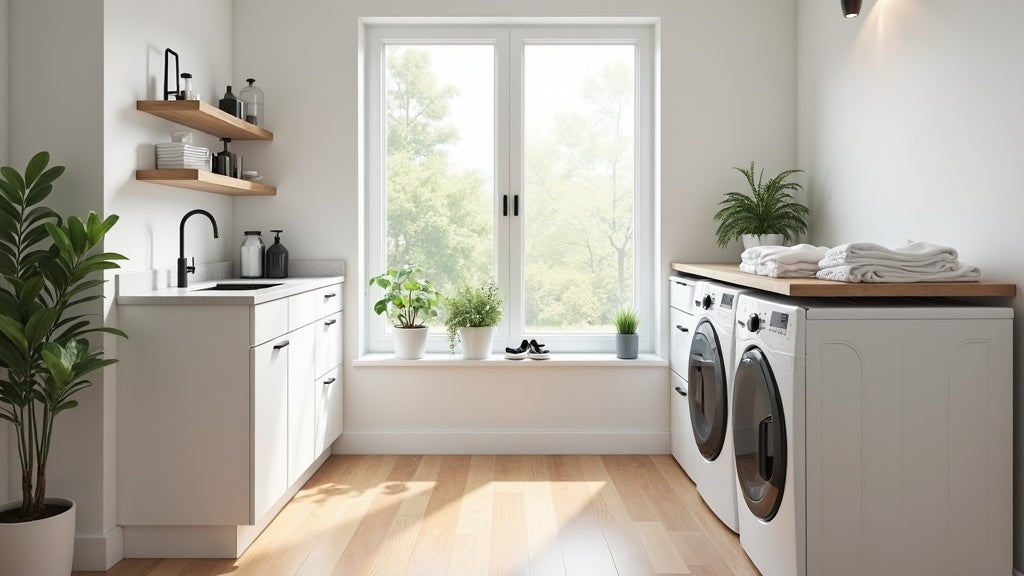
The best flooring for a laundry room is a fully waterproof surface that can handle standing water, temperature shifts, and constant foot traffic without warping, staining, or losing its finish. In most homes, that points to WPC vinyl flooring, though a few other options can work depending on where the laundry room sits in the house.
Laundry rooms are one of the hardest-working spaces in a home. Washing machines cycle through water and heat. Dryers generate warmth and vibration. Baskets get dragged across the floor, and spills happen the moment a hose connection loosens or a detergent cap tips over. The floor in this room needs to be practical first and good-looking second, though the two are no longer a trade-off the way they once were.
This guide covers what actually matters when choosing laundry room flooring, and how to think about the decision whether your laundry space is a basement utility room, a main-floor mudroom combo, or a small upstairs closet.

What Makes a Floor Suitable for a Laundry Room?
A suitable laundry room floor needs to be waterproof through its full construction, not just water-resistant on the surface. It should also tolerate temperature and humidity swings, stay comfortable to stand on, and be easy to keep looking clean.
Waterproof means the core of the plank itself will not absorb water and swell, even if water sits on the surface for a while. This matters more in a laundry room than almost anywhere else in the house, since a slow drip or an overflow can go unnoticed for hours.
Temperature and humidity swings matter because laundry rooms run warmer and more humid than the rest of the home during a wash and dry cycle, then cool back down between loads. A floor that expands and contracts too much with these swings over the years is a poor match for the room.
Comfort underfoot is easy to overlook but genuinely matters. Laundry is not a passive task. Sorting, folding, and standing at a counter or ironing board add up to real time on your feet, and a softer floor makes that time noticeably easier on the legs and back.
Is Vinyl Flooring Good for a Laundry Room?
Yes. WPC vinyl flooring is one of the strongest choices for a laundry room because its core is fully waterproof, unlike wood-based products that rely only on a surface seal.
The core in quality WPC vinyl is a stable composite material, which is exactly what allows the plank to stay dimensionally steady even when the room around it heats up, cools down, or sees the occasional puddle.
Beyond the waterproof core, WPC vinyl planks typically include an attached comfort pad on the underside. That pad adds a noticeable softness underfoot compared to a hard tile or bare concrete floor, which is a real advantage in a room where you are often standing in one place for a stretch of time. It also helps dampen the vibration and hum from a washer or dryer running through a cycle.
WPC vinyl also holds up well to the kind of daily wear a laundry room sees. Dragging a heavy basket, wheeling in a hamper, or a dropped shoe are the kind of everyday abrasion a quality wear layer is designed to resist, though no wear layer is scuff-proof against every impact.
Is Tile a Good Option for a Laundry Room?
Tile is also fully waterproof and has long been a traditional choice for laundry and utility rooms, particularly in basements. It handles moisture well and holds up to heavy use for decades.
The trade-off is comfort and warmth. Tile is a hard, cold surface, and standing on it for any length of time is noticeably less comfortable than a vinyl floor with an attached pad. Tile is also unforgiving if something is dropped on it, and grout lines require more attention to keep looking clean over the years.
For homeowners who want the classic tile look in a laundry room without giving up comfort underfoot, some WPC vinyl collections offer tile-look visuals with the same waterproof core and cushioned base as their wood-look counterparts. This lets a laundry room echo the tile style used in an adjacent bathroom or mudroom while staying softer to stand on.
What About Laminate or Engineered Hardwood?
Standard laminate flooring is generally not recommended for laundry rooms. Most laminate uses a wood-fibre core that can swell if it absorbs water, and a laundry room is exactly the environment where a leak or spill is most likely to happen unnoticed.
Engineered hardwood is not typically recommended for a laundry room either, for similar reasons. Even a quality engineered product with a real wood veneer is more vulnerable to sustained moisture exposure than a WPC vinyl floor. If the laundry space is combined with a main-floor mudroom or hallway that uses engineered hardwood for design continuity, it is worth treating the immediate laundry zone as its own waterproof island rather than extending hardwood directly beneath the machines.

Laundry Room Flooring by Location in the Home
Where the laundry room sits in your house changes what matters most.
Basement laundry rooms deal with the coolest, often most humid conditions in the home, especially in older houses without finished basement insulation. A fully waterproof floor with a comfort pad is particularly valuable here, since concrete subfloors can feel cold underfoot even through a floating floor. This is one of the reasons WPC vinyl has become a common basement flooring choice in general, not just in laundry rooms specifically.
Main-floor laundry rooms, often combined with a mudroom near a side or garage entry, see the same wet-boot and wet-floor traffic as an entryway on top of the laundry load itself. Matching the flooring across the combined space, rather than switching materials at an arbitrary line, tends to look more intentional and wears more evenly.
Upstairs laundry closets, increasingly common in newer home builds, are compact spaces where a leak has real consequences for the floor below. A fully waterproof floor is the highest-value choice in this location precisely because there is no forgiving concrete subfloor underneath to absorb a slow leak before it is noticed.
Comparing Laundry Room Flooring Options
| Factor | WPC Vinyl | Tile | Laminate | Engineered Hardwood |
|---|---|---|---|---|
| Waterproof core | Yes | Yes | No | No |
| Comfort underfoot | Soft, cushioned | Hard, cold | Firm | Firm |
| Sound and vibration dampening | Strong (attached pad) | Minimal | Minimal | Minimal |
| Style range | Wood-look and tile-look options | Tile only | Wood-look and stone-look | Real wood only |
| Suitability for basement laundry | Very well suited | Well suited | Not recommended | Not recommended |
| Suitability for upstairs laundry closets | Very well suited | Well suited | Not recommended | Not recommended |
Does the Laundry Room Floor Need to Match the Rest of the House?
Not necessarily, though there are good reasons to keep it visually connected where possible. A laundry room that flows directly off a kitchen, mudroom, or main hallway tends to look more cohesive when the flooring continues rather than switching abruptly at the doorway.
If your laundry room is a separate, closed-off space such as a basement utility room or an upstairs closet, you have more freedom to choose a floor based purely on function, since the room is not visually connected to the rest of the home's flooring story. This is where a tile-look or a distinct wood-look WPC vinyl plank can be selected for its practicality without needing to match anything nearby.

Frequently Asked Questions
These are the questions homeowners most often ask when choosing flooring for a laundry room.
Can you put vinyl plank flooring under a washing machine?
It depends on more than the floor being waterproof. A floating click-lock floor works by letting the entire connected surface expand and contract together across the room. A washing machine and dryer are heavy enough to anchor the floor underneath them in place, so that section stops moving with the rest of the floor, and the room's expansion has to be accounted for elsewhere rather than assumed to happen evenly at the perimeter. This is a genuine installation planning question, especially in a smaller laundry room where the appliances cover a large share of the floor area, and it is worth discussing directly with whoever installs the floor rather than assuming a standard perimeter gap automatically covers it.
Does a laundry room need waterproof flooring?
A laundry room benefits more from waterproof flooring than almost any other room in the house, aside from a bathroom. Water exposure in a laundry room is not hypothetical. It is a routine part of how the room is used, which makes a fully waterproof core a practical baseline rather than an upgrade.
Is cushioned vinyl flooring good for standing while doing laundry?
Yes. WPC vinyl with an attached comfort pad noticeably reduces fatigue compared to standing on tile or bare concrete, which matters in a room where folding and sorting often mean minutes at a time on your feet.
What flooring works best for a small laundry closet?
In a compact laundry closet, a fully waterproof floor matters just as much as in a larger utility room, since there is less room for a leak to spread before it is noticed and addressed. A wood-look or tile-look WPC vinyl plank in a lighter tone can also help a small, enclosed laundry space feel less cramped.
The Bottom Line
A laundry room asks more of its floor than most rooms in the home: real water exposure, temperature swings, standing time, and constant foot traffic. A fully waterproof floor with genuine comfort underfoot, rather than a floor that is merely water-resistant on the surface, is the standard worth building toward, whether the space is a basement utility room, a main-floor mudroom combination, or a small upstairs closet.
For more on flooring choices in adjoining wet-traffic spaces, see Best Flooring for Entryways and Mudrooms in Canada, The Best Flooring for Canadian Basements, and Best Waterproof Flooring for Kitchens and Bathrooms in Canada. For the full picture on how waterproof flooring works, see Waterproof Flooring: What Canadian Homeowners Need to Know.
If you have questions about which flooring option fits your laundry room, our team is glad to help. Contact us here.
To find waterproof vinyl flooring, click here for a Caledon Floors dealer near you.