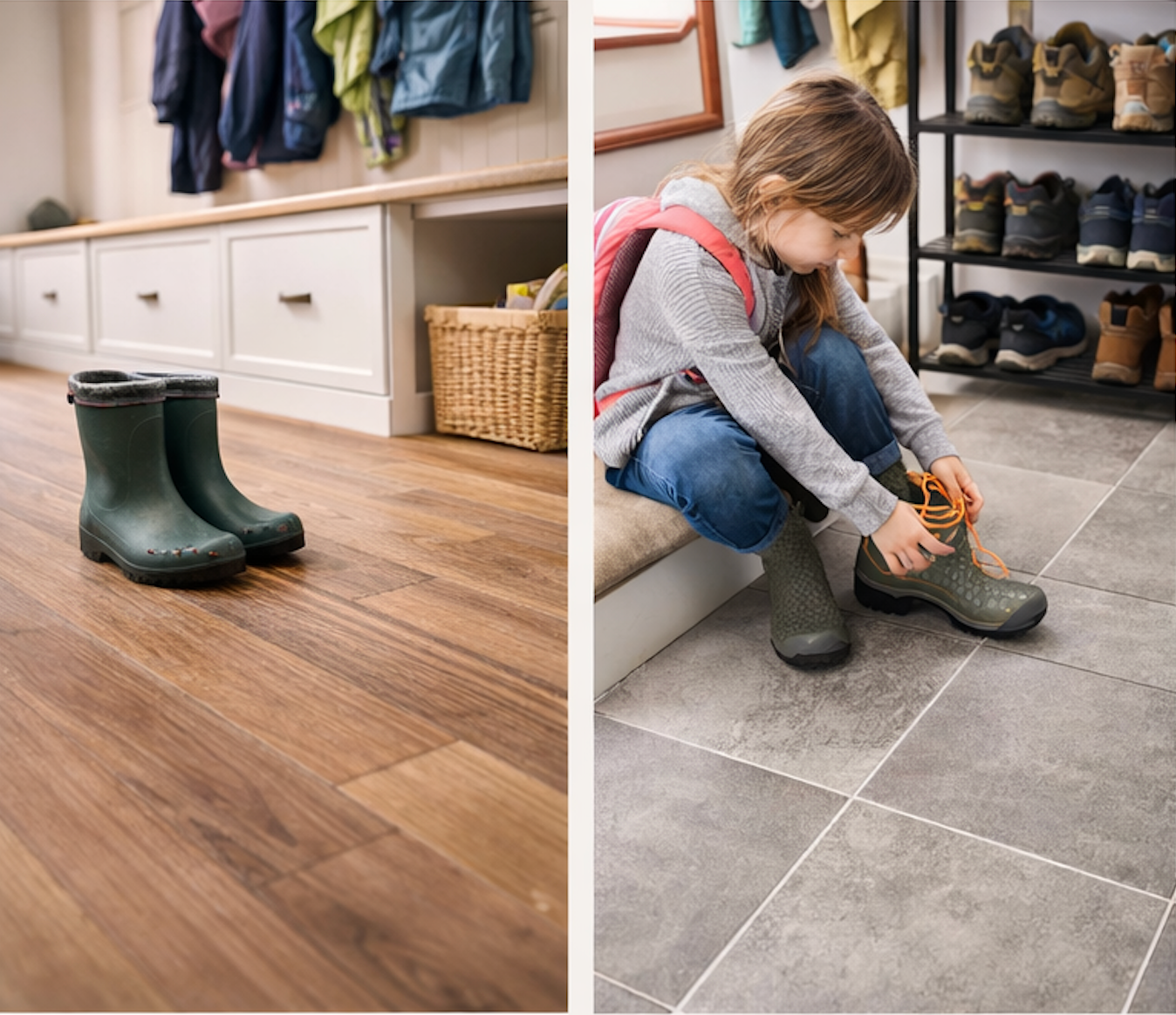
If there is one place in a Canadian home where a floor gets tested quickly, it is the entryway. This is where wet boots land. This is where snow melts. This is where slush, salt, grit, dog paws, grocery bags, hockey gear, backpacks, and everyday traffic all come through the door. A beautiful floor that works perfectly in a bedroom can become a frustrating mistake in an entryway or mudroom if it was chosen for appearance first and performance second.
That is why the best flooring for entryways and mudrooms in Canada is usually a floor that handles moisture, dirt, grit, and repeated abuse without becoming a maintenance headache. For many homes, that means practical hard-surface options like SPC vinyl, WPC vinyl, tile, or in some cases a good water-resistant laminate used in the right way. The wrong floor in this part of the house does not just wear faster ; it makes the whole home feel harder to keep clean and harder to live in.
This is also one of those decisions where Canadian context matters. Advice written for a dry climate or a low-traffic suburban foyer does not always translate well to a real Canadian entryway in November, January, or early spring. The floor has to perform when people are coming in with wet shoes, melting snow, road salt, sand, and the kind of mess that gets ground in before anyone has time to stop it.

Why Entryways and Mudrooms Are Harder on Floors Than Most Rooms
The wear pattern in an entryway is different from almost anywhere else in the home. A living room gets foot traffic, but it does not usually get standing moisture from boots. A kitchen gets spills, but it does not usually get grit and salt dragged across the surface several times a day. Entryways and mudrooms get a combination of abuse that is uniquely hard on flooring: water, debris, scraping, and repeated impact in a concentrated zone.
That combination exposes weak choices quickly. A floor that is too delicate may show wear sooner than expected. A floor that is too slippery may become annoying or even unsafe in wet weather. A floor that is difficult to clean may make the entire house feel dirtier because the mess starts at the door and then gets tracked inward. This is why the best flooring for mudrooms and entryways is not necessarily the most beautiful material in the showroom ; it is the material that still makes sense after hundreds of wet entries, muddy days, and real family use.
What the Best Entryway Flooring Needs to Do
A good mudroom or entryway floor needs to do four things well. First, it needs to handle moisture : not be indestructible, but not become vulnerable every time wet boots come through the door. Second, it needs to resist surface wear from small stones, sand, salt, and everyday debris. Third, it needs to clean up easily, because a floor that is technically durable but annoying to clean can still become a bad choice in daily life. Fourth, it needs to feel right in the home : the look, the comfort underfoot, the sound, and how well it transitions into the rest of the space.
The best flooring for entryways in Canada usually succeeds because it balances all four. It is not just a waterproof story or just a style story. It is a whole-use-case decision.
Best Flooring Options for Entryways and Mudrooms in Canada
There is no single perfect floor for every Canadian mudroom, but some categories clearly make more sense than others.
SPC Vinyl: One of the Smartest Overall Choices
For many homes, SPC vinyl is one of the best overall choices for entryways and mudrooms. It works because it is practical : it handles everyday mess well, resists water better than more vulnerable flooring categories, and usually gives the homeowner a strong durability-to-cost ratio. In a room where the floor is expected to take abuse, that matters.
SPC also tends to make sense for families who want a hard-surface floor that looks good without becoming a stress point every time the weather turns bad. A solid mid-tier SPC floor can be a very smart decision in these spaces because it is built for real use, not delicate use. The trade-off is comfort : SPC is typically firmer underfoot than WPC, which in some homes does not matter much and in others may.

WPC Vinyl: A More Comfortable Hard-Surface Option
WPC vinyl is another strong choice, especially for homeowners who want a little more comfort and warmth underfoot. In a family home where kids are regularly sitting down to take off shoes or where the mudroom functions as a true everyday drop zone, that comfort can be meaningful. The main trade-off is cost : WPC is often more expensive, and some homeowners will decide the added comfort is not worth the added spend in a high-abuse zone near the door. Others may decide the better feel is worth it, especially if the mudroom connects to other main living areas using the same flooring.
Tile: Very Strong in Wet, Messy Zones
Tile still deserves respect in entryways and mudrooms. If the priority is direct resistance to water, slush, and messy boots, tile remains one of the strongest options , especially in homes where the entry area is clearly defined and regularly exposed to a lot of moisture and dirt. It also gives homeowners a lot of design flexibility and can create a very intentional look in a mudroom or entryway.
But tile is not automatically the best choice either. It is harder, colder, and less forgiving underfoot. In some homes, especially in colder climates or family houses where comfort matters, that can make the space feel more severe than the owner wants. The best tile entryways usually work because the homeowner wants maximum practicality and understands the trade-offs going in.

Water-Resistant Laminate: Possible, but Be Selective
A good water-resistant laminate can work in some entryways and mudrooms, but this is the category where judgment matters. If the entry zone is less exposed, the household is disciplined, and the product quality is strong, water-resistant laminate can be a reasonable option , especially when the homeowner wants strong wood-look value and continuity with adjacent rooms. But this is not the most forgiving category for heavy wet-boot environments. If the space gets hammered by weather, pets, kids, and repeated wet traffic, vinyl or tile is usually the safer answer.
Engineered Hardwood: Usually Not the Smart Answer Here
Engineered hardwood can look beautiful almost anywhere, but entryways and mudrooms are usually not where it makes the most sense. This is one of the most common "looks good on paper, wears poorly in real life" decisions. The front door is simply too harsh an environment for a floor you want to preserve visually over time. Moisture, grit, scraping, and concentrated wear all work against it. For most Canadian homes, engineered hardwood is usually not the best entryway flooring choice : this is one room where practical flooring tends to beat premium-but-sensitive flooring.
Flooring Types Compared for Entryways and Mudrooms
| Flooring type | Best use case | Main strengths | Honest trade-offs |
|---|---|---|---|
| SPC vinyl | Best all-around practical choice for many homes | Durable, water-friendly, good value, easy everyday ownership | Harder feel underfoot |
| WPC vinyl | Best for comfort-focused hard-surface entryways | Warmer, quieter, softer feel, strong practicality | Higher upfront cost |
| Tile | Best for direct wet exposure and messy boot zones | Strong water resistance, durable surface, easy wet-zone logic | Colder, harder, less forgiving underfoot |
| Water-resistant laminate | Best for lower-moisture or more controlled foyers | Strong visual value, good wood-look, reasonable cost | Less forgiving than vinyl or tile in heavy wet use |
| Engineered hardwood | Limited exception only | Beautiful appearance, premium look | Usually too vulnerable for a true Canadian entryway or mudroom |
Mudroom Flooring vs Entryway Flooring: Is There a Difference?
Sometimes yes. An entryway can range from a small foyer to a heavily used front-door landing. A mudroom is usually more functional : the real work zone of the house, where shoes come off, coats get dropped, bags get piled, dogs shake off water, and the mess of the outside world enters the home. That means mudroom flooring usually needs to be judged even more heavily on practicality.
If the room functions as a true mudroom with repeated wet use, storage, family traffic, and seasonal mess, the flooring should lean harder toward SPC, WPC, or tile. Water-resistant laminate may still work in some cases, but the margin for error is smaller. This is one reason homeowners should be honest about how they live. Many people like the sound of a mudroom until it is time to choose materials , then they start picturing a beautiful design vignette instead of the room where soaked boots actually land. The best mudroom flooring is the one that suits the real room, not the imagined room.

What Homeowners Get Wrong About Entryway Flooring
The first mistake is choosing based on look alone. That is understandable because entryways are highly visible and create a first impression. But this is also the room where performance issues show up early. A floor that only wins on appearance often becomes annoying very quickly if it does not handle moisture and debris well.
The second mistake is underestimating grit. A lot of people think mainly about water, but the small bits of sand, dirt, and salt dragged in from outside are often just as important : they create abrasion near the door where people pivot, stop, and scrape their shoes. The third mistake is thinking waterproof solves everything. A water-friendly floor is usually the right direction, but the room still needs good real-world management. Mats matter. Cleaning matters. Subfloor prep still matters. Waterproof does not mean careless.
The fourth mistake is forcing the same flooring everywhere when the use case clearly changes at the door. Continuity can look great, but not every room needs the exact same answer. Sometimes the smartest design decision is admitting that the front entry has its own demands.
Best Entryway Flooring by Household Type
Different households have different priorities for this space. Here is a quick guide based on how the home is actually used.
Busy families: SPC vinyl is often the strongest overall answer : practical, durable, and easy to live with when traffic is high and mess is normal.
Families who want a softer feel: WPC vinyl is worth considering when the owner wants the practicality of vinyl but a more comfortable feel underfoot.
Very wet or messy mudrooms: Tile is still one of the strongest solutions when direct moisture and mud are constant concerns.
Cleaner, more formal front foyers: A good water-resistant laminate may work if the space is controlled and the owner wants stronger wood-look value.
Usually not recommended: Engineered hardwood, unless the entry is unusually protected and lightly used.
Best Entryway and Mudroom Flooring by Priority
| If your priority is… | Best direction | Why it makes sense |
|---|---|---|
| Lowest long-term hassle | SPC vinyl | Handles abuse well and is easy to live with through Canadian weather |
| More comfort underfoot | WPC vinyl | Softer and quieter feel in a hard-working family zone |
| Maximum wet-zone practicality | Tile | Very strong for slush, water, and messy boot traffic |
| Best wood-look value | Water-resistant laminate | Can work well in more controlled entry spaces at a good price point |
| Premium appearance only | Engineered hardwood | Usually better in limited exceptions than as the default smart choice |
What the Best Entryway and Mudroom Floor Looks Like Over Time
The best floor is not the one that looks best on installation day. It is the one that still feels like a smart decision after several Canadian winters, dozens of wet entries, and everyday wear from real life. That means the best entryway flooring usually looks slightly less precious at the start and slightly smarter after a few years. It wears the reality of the room better. It asks for less emotional energy from the homeowner. It lets the house function the way it is supposed to function.
The wrong floor becomes annoying every winter. It shows the mess faster, holds onto the wear longer, and keeps reminding the homeowner that the front door is a tougher environment than they planned for. The right floor does the opposite : it absorbs the reality of the space and lets the house keep moving.
FAQ: Best Flooring for Entryways and Mudrooms in Canada
Here are the questions Canadian homeowners ask most often when choosing flooring for entryways and mudrooms.
What is the best flooring for entryways in Canada?
For many Canadian homes, the best entryway flooring is usually SPC vinyl, WPC vinyl, or tile, depending on how wet, busy, and hard-used the space really is.
What is the best flooring for mudrooms in Canada?
For true mudrooms, the best flooring is usually a practical hard-surface option such as SPC vinyl, WPC vinyl, or tile. These categories generally handle moisture, mess, and repeated use better than more sensitive flooring types.
Is laminate good for entryways?
A good water-resistant laminate can work in some entryways, especially in more controlled foyers, but it is usually a more selective option than vinyl or tile in heavily used wet zones.
Is engineered hardwood good for mudrooms?
Usually no. Mudrooms are typically too harsh an environment for engineered hardwood to be the smartest long-term choice.
Is tile better than vinyl for entryways?
Not always. Tile can be stronger for direct wet exposure, but vinyl is often warmer, quieter, and more comfortable underfoot. The best choice depends on the household and how the space is used.
Final Verdict
The best flooring for entryways and mudrooms in Canada is the flooring that handles moisture, grit, traffic, and cleanup without making the homeowner regret the choice every winter. For many homes, that means SPC vinyl as the smartest all-around answer. WPC vinyl is a strong comfort-focused alternative. Tile remains very strong in wet, messy zones. Water-resistant laminate can work in more controlled settings. Engineered hardwood is usually not the best fit for this part of the house.
The key is to choose the floor for the real room, not the idealized room. Entryways and mudrooms are working parts of the home ; the best floor here is the one that works with them, not against them. Contact us for help choosing a floor , or find a dealer near you for advice matched to your home and climate.
Related Reading
These articles go deeper on topics covered in this guide: