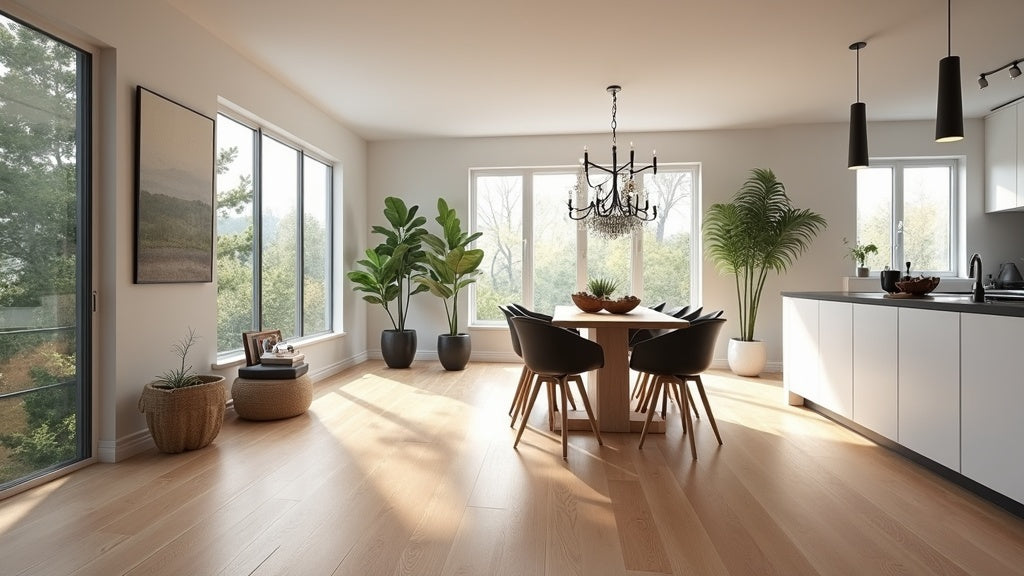
Engineered hardwood is water-resistant, not waterproof. That distinction matters more than most product descriptions let on, and understanding it helps you choose the right floor for every room in your home.
The confusion is understandable. Engineered hardwood outperforms solid hardwood in humid environments. It holds its shape better through seasonal moisture swings. But it still has a real wood veneer on top, an engineered wood core underneath, and seams between every plank. Water given enough time, enough volume, or direct access to those seams behaves very differently than surface moisture from a spilled glass. Knowing the difference between the two is the core of this guide.

What makes engineered hardwood water-resistant?
Engineered hardwood is built in layers. A real wood veneer sits on top of a cross-ply or high-density fibreboard core. That layered construction is more dimensionally stable than solid wood: it expands and contracts less when humidity rises and falls. The surface is finished with a protective coating, typically an aluminum oxide or urethane finish, that seals the face of the plank against routine moisture.
That combination handles everyday exposure well. A splash from a glass of water, a damp mop, a pet's water bowl with a small overflow, morning humidity from an open window. The surface sheds that moisture, and the plank is none the worse.
What it cannot do is stop sustained moisture from working its way in through the edges and seams. The ends of each plank, where the core is exposed, and the tongue-and-groove joints where planks click together are less protected than the face. In a flooded room, a chronically wet environment, or a space where water regularly pools at the perimeter, moisture enters from the sides and bottom rather than the top.
A 4mm veneer, like the Select & Better grade used in premium engineered hardwood collections, adds more real wood than a standard 1.2mm or 2mm veneer. That thicker layer has genuine advantages: it can be refinished, it ages gracefully, and it brings more authentic wood character. But veneer thickness does not change the fundamental physics of how water reaches the core.
Where engineered hardwood handles moisture well
For most rooms in a Canadian home, engineered hardwood is an excellent choice, and moisture is not a meaningful concern.
Main floor living rooms, dining rooms, and hallways see foot traffic, general cleaning, and the seasonal humidity swings that come with a sealed Canadian home in winter and a wetter summer. Engineered hardwood is well suited to all of that. A properly acclimated and installed floor in these spaces performs reliably for decades.
Bedrooms perform similarly. Moisture levels are stable, foot traffic is light, and there is no plumbing nearby to create unexpected wet events.
Home offices, playrooms, and finished main-floor areas are all reasonable candidates as well. Canadian homes in Vancouver, where ambient humidity runs higher, and Prairie homes, where winters pull moisture out of the air aggressively, both see engineered hardwood perform well when it is matched to the right space.
Kitchens are worth a closer look. The honest answer is that most kitchens work fine with engineered hardwood: countertop splashes, the occasional dropped ice cube, and wet-mop cleaning are all within its capability. The area directly in front of the sink, where standing water and daily wet exposure concentrate, is the one spot where some homeowners prefer the unconditional protection of a fully waterproof floor. For more on this specific question, the guide on engineered hardwood in kitchens covers the tradeoffs in detail.

Where waterproof flooring is the smarter choice
Some rooms are genuinely wet rooms. Bathrooms, laundry rooms, and finished basement spaces sit in a different category entirely.
In a bathroom, water does not just splash occasionally. It accumulates near the toilet, around a vanity, and along the base of the shower or tub. Humidity spikes after every shower. Grout lines and seams near the perimeter can hold standing water after a wet floor mat is moved. These are conditions that go beyond water-resistance.
Laundry rooms present a similar picture. A slow drip from a supply line, a door seal that fails on a front-load washer, or a small overflow from a utility sink are routine enough possibilities that a floor that holds up to standing water is simply the more practical choice.
Fully finished basements, particularly those at or below grade, sit on concrete that can release moisture upward through vapour transmission. That is a different kind of moisture than surface spills. For more on how moisture moves in these spaces and what it means for your floor selection, the guide on moisture and vapour barriers for Canadian homeowners is worth reading alongside this one.
In these spaces, the right answer is a floor that is genuinely waterproof from the face all the way through the core and down through the underlayment. WPC vinyl flooring achieves that. The core is a waterproof composite material, which means water reaching the edges or seams does not swell the plank. The entire profile, top to bottom, is stable in wet conditions.
For a complete look at waterproof flooring options and what "waterproof" means in practice, the guide on waterproof flooring for Canadian homeowners is a useful reference.
How engineered hardwood and WPC vinyl compare
The table below outlines the key differences in practical terms, without cost. The right choice depends on which qualities matter most for your specific space.
| Quality | Engineered Hardwood | WPC Vinyl Flooring |
|---|---|---|
| Water resistance | Surface-resistant; not fully waterproof | Fully waterproof, face to core |
| Real wood | Yes, genuine wood veneer on top | No; realistic wood appearance via printed layer |
| Core material | Engineered wood (cross-ply or HDF) | Waterproof composite core |
| Seam protection | Seams and edges can absorb moisture | Seams and core are stable in water |
| Warmth underfoot | Natural wood warmth | Warmer than tile; comfort pad adds cushion |
| Visual character | Authentic grain, knot patterns, natural variation | High-resolution print; can be very convincing |
| Refinishable | Yes, with sufficient veneer thickness | No (wear layer is not sanded) |
| Ideal rooms | Living, dining, bedrooms, kitchen (most areas) | Bathrooms, laundry, basement, high-spill zones |
| Canadian climate fit | Excellent in stable-humidity main floor spaces | Excellent across all spaces, including grade and below-grade |
Both flooring types can be beautiful in the right setting. Premium engineered hardwood brings the irreplaceable character of real wood: the warmth, the grain depth, the way light catches a bevelled plank edge. Premium WPC vinyl flooring, in wider formats with textured surfaces and quality finishes, brings a level of visual richness that has closed the gap with real wood considerably. The choice is not about which is better in the abstract. It is about which is better matched to the room.
How to choose the right floor for your space
Start with the moisture profile of the room, not the aesthetic.
For living rooms, dining rooms, bedrooms, and main-floor spaces away from plumbing, engineered hardwood is a strong candidate. It rewards that choice with real wood character that appreciates differently over time than any manufactured alternative.
For bathrooms, laundry rooms, and below-grade spaces, waterproof vinyl flooring is the more practical foundation. It handles the moisture without compromise, and in wide-plank formats with quality surface textures, it still reads as a premium floor.
Kitchens and entryways fall in the middle. Both flooring types work well here; the tipping point is often how much standing water the space sees and how much the homeowner values the specific character of real wood.
If you are designing a whole-home renovation, many homeowners use engineered hardwood through the main living areas and transition to WPC vinyl in the kitchen, bathrooms, and any below-grade space. The visual gap between the two has narrowed enough that a well-chosen transition looks intentional rather than mismatched. For a fuller comparison of how these two categories sit alongside each other in a real renovation, the guide on engineered hardwood vs vinyl flooring in Canada works through the decision in more depth.

Frequently asked questions
Can engineered hardwood go in a bathroom?
Most flooring professionals recommend against it for full bathrooms. The combination of high humidity, frequent water on the floor near the toilet and vanity, and potential splash from a shower or tub goes beyond what water-resistance is designed to handle. A fully waterproof floor is the standard recommendation for full bathrooms. For a half-bath with lower humidity exposure, some homeowners do install engineered hardwood with satisfactory results, though the risk profile is higher. Simple answer: no. Do not use in a bathroom.
Does a thicker veneer make engineered hardwood more water resistant?
Not in a meaningful way. A thicker veneer, such as the 4mm veneer on premium engineered hardwood collections, adds refinishing potential and durability to the top surface. It does not significantly change how moisture behaves at the seams and edges of the plank. The core is still an engineered wood product that absorbs moisture if water reaches it through the sides.
What is WPC vinyl and why is it different?
WPC vinyl flooring is built around a waterproof composite core. That core does not absorb or react to moisture the way an engineered wood core does. The result is a floor that is stable in fully wet conditions: bathrooms, below-grade spaces, and areas where standing water is a realistic possibility. The wear layer on top is vinyl rather than finished wood, so it does not need refinishing. It is genuinely waterproof in a way that engineered hardwood is not designed to be.
Is engineered hardwood a good choice for a Canadian home?
Yes, for the right rooms. Canadian homes see real seasonal humidity swings: dry Prairie winters, damp Vancouver winters, warm humid summers in Ontario. Engineered hardwood handles those swings better than solid hardwood. For main-floor living spaces, it is a tested and well-regarded choice. For spaces that see more direct water exposure, pairing engineered hardwood in the main areas with WPC vinyl in kitchens, bathrooms, and basements is a practical approach that many Canadian homeowners follow.
How does engineered hardwood compare to solid hardwood for moisture?
Engineered hardwood outperforms solid hardwood in humid environments. The layered construction reduces the seasonal expansion and contraction that causes solid hardwood to gap and cup in dry Canadian winters. For above-grade applications in a well-conditioned home, engineered hardwood is generally the more forgiving choice. Neither is designed for genuinely wet conditions.
Ready to choose the right floor for your home? Caledon Floors, a Canadian hard-surface flooring distributor based in Vancouver, BC, can help you find the right fit for your space. Contact us here.
To find waterproof vinyl flooring in Canada, click here for a Caledon Floors dealer near you.