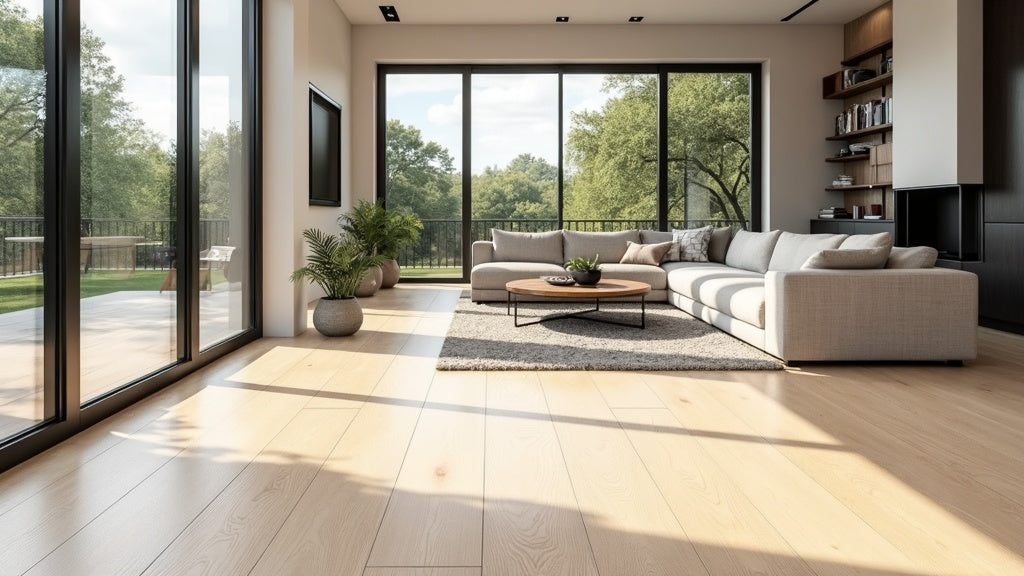
Vinyl flooring carries a reputation that often has little to do with the product being sold today. Several common vinyl flooring myths trace back to decades of older, thinner sheet vinyl, while newer engineered constructions like WPC vinyl flooring work very differently. Some of these myths hold a real kernel of truth from an earlier generation of product. Others never had much basis at all.
This guide looks at five of the most common vinyl flooring myths, explains the grain of truth behind each one where one exists, and lays out what is actually accurate about vinyl flooring today.

Does Vinyl Flooring Always Look Fake?
No, not anymore, though the myth has a real history behind it. Older sheet vinyl and early printed planks often used a single repeating pattern under a flat, glossy surface, and that combination is genuinely easy to spot as an imitation from across a room.
Modern vinyl plank, particularly wide-plank and giant-plank formats, uses embossed-in-register texturing, where the physical surface texture is aligned to match the printed wood grain underneath it rather than sitting as a smooth layer over a printed pattern. Manufacturers also print far more colour and grain variations per production run, so a floor no longer reads as one design tile repeated wall to wall. For a closer look at how this specific texturing technique works, see What Embossed-in-Register Texture Means.
The honest caveat: not every vinyl product on the market uses this level of detail. Entry-level sheet vinyl and older-style printed planks still exist, and they still look more obviously synthetic. The myth is not wrong about every vinyl floor. It is wrong about assuming all vinyl flooring is that floor.
Is Vinyl Flooring Automatically Bad for the Environment?
Not automatically, and this question deserves a fair look rather than a simple yes or no. Vinyl flooring is a synthetic, plastic-based product, and that is a real, honest starting point. It is not a rapidly renewable material the way cork or bamboo is, and pretending otherwise would not be honest.
But environmental impact is not decided by material category alone. Lifespan matters: a floor that performs well for decades without needing replacement has a different footprint than one replaced every few years. Indoor air quality matters too, and this is where certifications become genuinely useful rather than marketing noise. GreenGuard Gold and FloorScore both test and certify low chemical emissions from finished flooring products, while CARB2 governs formaldehyde emissions from composite wood products specifically. Low-VOC does not mean zero-VOC, but it is a real, third-party-verified distinction from an uncertified product. For a full explanation of what these certifications actually test and mean, see Low-VOC and Non-Toxic Flooring: What GreenGuard Gold Actually Means.
The fair answer: vinyl is not automatically the greenest option on the market, and it is not automatically the worst either. Looking at a specific product's certifications and expected lifespan tells you far more than the material category by itself.
Is WPC Vinyl Flooring Really Waterproof All the Way Through?
Yes. It is easy to assume a plank with a printed wood-look surface behaves like wood underneath, but a WPC vinyl core is built very differently from the core of engineered hardwood.
A genuine WPC vinyl core is an engineered composite material, built for dimensional stability and a fully waterproof structure. This construction is exactly what allows WPC vinyl flooring to be genuinely waterproof flooring: there is nothing in the plank to swell, warp, or absorb water the way natural wood-based materials can. For more on what actually goes into this category, see What Is WPC Vinyl Flooring? A Friendly Guide.
Does "Waterproof" Mean a Vinyl Floor Cannot Be Damaged?
No, and this is one of the more important distinctions to understand before buying. Waterproof is a specific, verifiable claim about how a plank's core reacts to moisture. A genuinely waterproof core will not swell, warp, or absorb water from spills, humidity, or standing liquid. That is a real, tested property, not marketing language.
It is not, however, a claim about scratch resistance, dent resistance, or how a surface ages under daily foot traffic. Those outcomes come from a different part of a plank's construction: the wear layer on the surface and the rigidity of the core beneath it. A floor can be completely waterproof and still show wear over time the way any hard-surface floor does. For a realistic look at what scratch resistance does and does not mean, see Is Vinyl Flooring Really Scratch Resistant?. For the fuller picture of what a waterproof core actually protects against, see Waterproof Flooring: What Homeowners Need to Know.
The two properties are not in conflict. They simply answer different questions. Waterproof answers "will this floor be damaged by water." It does not answer "will this floor show wear after years of foot traffic," which is a fair question for any hard flooring material, not a shortcoming unique to vinyl.

Is Vinyl Flooring Only Suited to Basements and Utility Spaces?
No, though this myth has a real history worth acknowledging. Vinyl earned its utility-space reputation honestly. For years, the most common vinyl products were budget sheet vinyl in basements, laundry rooms, and rental units, chosen mainly for cost and water tolerance rather than style.
That is no longer the full picture. Wide-plank and giant-plank vinyl formats, more refined finishes, and a broader range of colourways designed to coordinate with cabinetry, trim, and wall tones have moved vinyl into kitchens, dining rooms, and main living spaces alongside more traditional materials. The format and finish of a plank change how a room reads far more than the base material category does. For a look at how plank size specifically changes the feel of a room, see Giant Plank vs Standard Format.
Like most flooring categories, vinyl spans a genuine range from budget to premium. A basic sheet vinyl product and a premium wide-plank WPC floor are both technically vinyl, and they belong in very different conversations. The myth mistakes one end of that range for the whole category.
Common Vinyl Flooring Myths at a Glance
| Myth | The Reality |
|---|---|
| All vinyl flooring looks fake | Embossed-in-register texturing and varied print runs make premium vinyl closely resemble real wood grain; budget products still look more synthetic |
| Vinyl is automatically bad for the environment | Impact depends on the specific product's certifications and lifespan, not the material category alone |
| WPC vinyl flooring is only waterproof on the surface | The core is an engineered composite built for a fully waterproof structure, from the surface through the core |
| Waterproof means indestructible | Waterproof describes how the core handles moisture; scratch and wear resistance come from the wear layer and core separately |
| Vinyl can't go anywhere nice | Premium wide-plank and giant-plank formats are now used in main living spaces, not just basements and utility rooms |

Frequently Asked Questions
A few more questions that come up alongside these vinyl flooring myths.
Is WPC vinyl the same as SPC vinyl?
No. Both are waterproof vinyl categories, but they use different core constructions. Both have durable rigid cores. WPC is warmer and quieter underfoot, while SPC uses a denser, harder stone-composite core that is also colder and heavier underfoot. Each has genuine trade-offs in comfort and feel underfoot. See SPC vs WPC Vinyl Flooring for a full comparison.
Do all vinyl floors use the same printing and texturing technology?
No. Print resolution, the number of unique grain patterns per production run, and whether the surface texture is aligned to the print all vary between manufacturers and price tiers. This is a large part of why two vinyl floors can look dramatically different in person even though both are technically the same flooring category.
Can vinyl flooring be recycled?
It depends on the specific product and on local recycling infrastructure, which varies widely and is not something to assume either way. Some manufacturers run take-back or recycling programs for their own products, and many municipal recycling systems do not accept flooring material at all. Checking with the specific manufacturer is more reliable than assuming a category-wide answer.
The Bottom Line
Most vinyl flooring myths trace back to an older generation of product, not the category as it exists today. Vinyl does not automatically look fake, a WPC vinyl core is waterproof all the way through, and a genuinely waterproof core solves a different problem than scratch resistance does. Vinyl also is not automatically better or worse for the environment than any other material; that depends on the specific product's certifications and how long it actually lasts in a home.
The most useful habit when weighing any of these claims, myth or fact, is the same: look at the specific product's construction and certifications rather than assuming something is true of an entire flooring category.
For more on how a wear layer factors into a plank's everyday durability, see How to Choose the Right Wear Layer for Vinyl Flooring.
If you have questions about a specific vinyl product or how it is actually built, our team is glad to help. Contact us here.
To find waterproof vinyl flooring, click here for a Caledon Floors dealer near you.