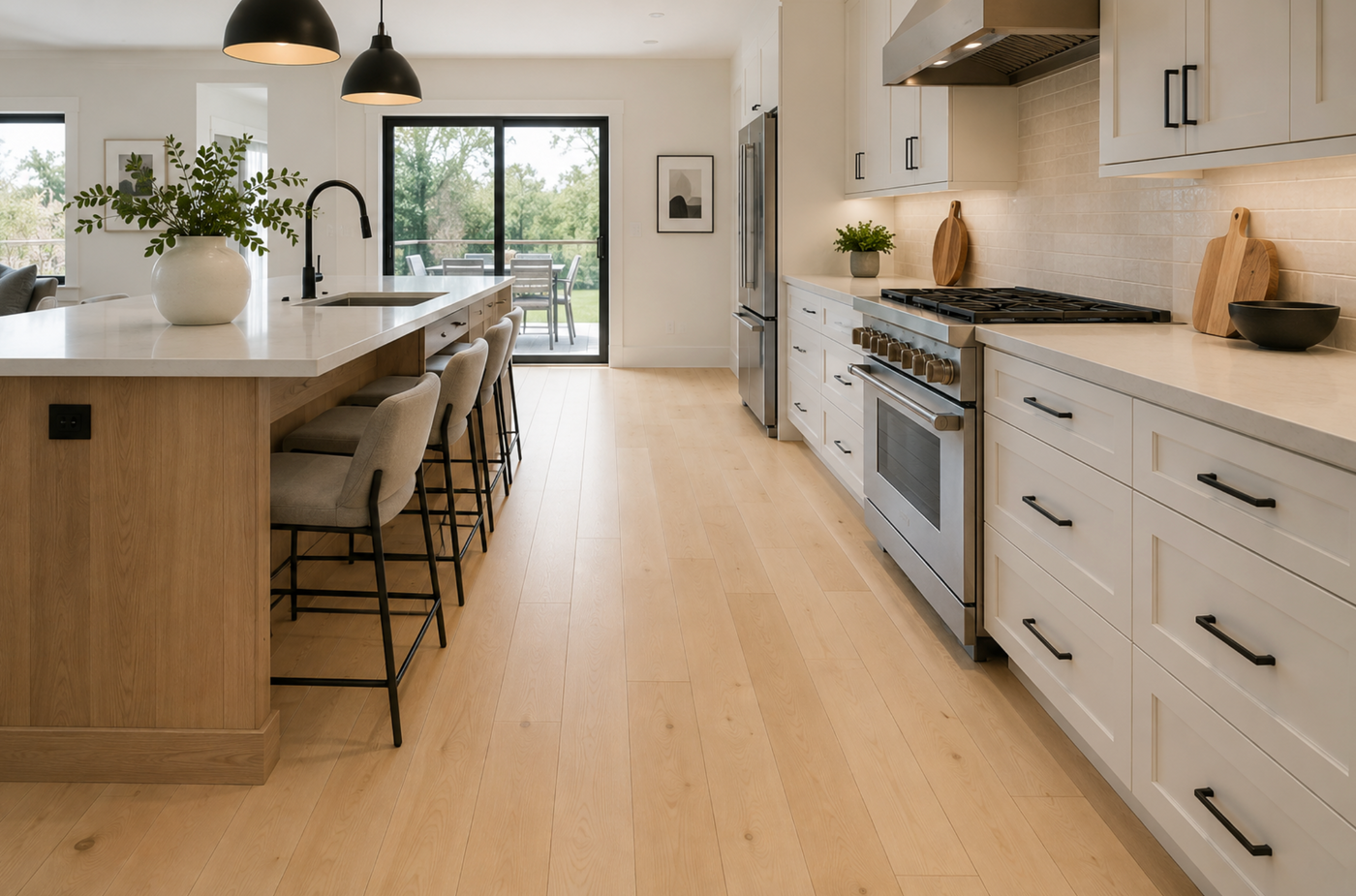
Engineered hardwood in kitchens is common, and many homeowners choose it successfully. The reason is easy to understand: a kitchen often connects to the main living area, dining room, hallway, or family room, and using the same engineered hardwood throughout can make the home feel warmer, larger, and more continuous. For people who love real wood, that visual flow can be worth it.
But the decision needs realistic expectations. Wood and water do not do well together. Engineered hardwood is more stable than solid hardwood, but it is still a real wood floor. It should not be treated like tile, vinyl, or another more water-forgiving surface. If a homeowner chooses engineered hardwood in a kitchen, spills, leaks, pet bowls, appliance areas, and repeated moisture all need to be managed carefully.
The short answer is this: engineered hardwood can work in kitchens, but it is not the lowest-risk flooring option. It makes the most sense for homeowners who value the look and feel of real wood, want continuous flooring through the main level, and are willing to clean spills quickly and manage water exposure.

Quick Answer: Should You Use Engineered Hardwood in a Kitchen?
| Buyer situation | Answer | Why |
|---|---|---|
| You want one continuous main-floor look | Often reasonable | Engineered hardwood can create visual flow through the kitchen, dining, and living areas |
| You want the lowest water-risk floor | Usually not the best fit | Wood and water do not do well together, even with engineered construction |
| You clean spills quickly and maintain the home carefully | More realistic | Many kitchen issues come from standing water, leaks, and repeated moisture |
| You have pet bowls, frequent spills, or rough wet use | Use caution | Repeated moisture exposure increases risk |
| You value real wood more than lowest-maintenance ownership | Can make sense | The decision is about accepting the trade-off |
Is Engineered Hardwood a Good Choice for Kitchens?
Engineered hardwood can be a good kitchen choice for the right homeowner, but it is not the most water-forgiving choice. If the priority is maximum water resistance and easiest maintenance, other flooring categories may be more practical. But if the priority is a warm, premium, real wood look throughout the home, engineered hardwood can be a reasonable choice in many kitchens.
The key is understanding what you are choosing. You are choosing real wood. That means you get the beauty, warmth, and natural feel of wood, but you also accept that water needs to be managed.
Why Homeowners Choose Engineered Hardwood in Kitchens
The biggest reason is visual continuity. In many Canadian homes, the kitchen is not a separate closed-off room anymore: it is part of an open-concept main floor where the flooring may run from the entryway into the kitchen, dining area, living room, and hallway. If the kitchen has a different floor, the space can feel more broken up. Engineered hardwood helps create one continuous surface that can make the home feel larger, calmer, and more finished.
Homeowners also choose engineered hardwood because they like the feel of real wood. It is warmer and more natural than many hard-surface alternatives. For some buyers, that matters enough to accept the extra care required in a kitchen.
The Main Risk: Water
The main risk with engineered hardwood in a kitchen is water, and that includes sink spills, dishwasher leaks, fridge water-line issues, ice-maker leaks, wet shoes, pet bowls, repeated damp mopping, and water sitting near cabinets or appliances. A small spill cleaned quickly is very different from water sitting on the floor for hours. The problem is not normal kitchen use. The problem is repeated moisture, standing water, leaks, and careless maintenance. Engineered hardwood is not waterproof and should not be sold or treated that way.

Engineered Hardwood vs Other Kitchen Flooring Options
| Flooring option | Why homeowners choose it | Main caution |
|---|---|---|
| Engineered hardwood | Warm real wood look, premium feel, continuous main-floor design | Water needs to be managed carefully |
| Vinyl flooring | More forgiving around water and spills | Does not provide the same real wood surface |
| Laminate flooring | Good visual value in some homes | Water exposure and seams need careful consideration |
| Tile | Very strong water performance | Harder, colder, and less comfortable underfoot |
The right kitchen floor depends on what the homeowner values most. If water forgiveness is the top priority, engineered hardwood is not usually the easiest answer. If real wood and main-floor continuity matter most, engineered hardwood can still make sense.
When Engineered Hardwood Makes Sense in a Kitchen
Engineered hardwood is more likely to make sense when the kitchen is part of an open-concept main floor, the homeowner wants the same flooring throughout the main level, the household is careful with spills, the kitchen does not have a history of leaks or moisture problems, the homeowner understands that wood requires more care than waterproof flooring, the product is high quality and properly installed, and the owner values real wood enough to accept the trade-offs. This is not about pretending engineered hardwood is perfect for kitchens: it is about matching the flooring choice to the homeowner's priorities.
When Engineered Hardwood May Not Be the Best Kitchen Choice
Engineered hardwood may not be the best choice when the homeowner wants the lowest-maintenance kitchen floor possible. It may also be less ideal in homes where spills are often left sitting, pets knock over water bowls frequently, the dishwasher or fridge has had leak issues, the homeowner wants to damp mop aggressively, the kitchen sees heavy wet use, or the buyer expects the floor to behave like tile or waterproof vinyl.
In those situations, a more water-forgiving floor may be a better fit. The issue is not that engineered hardwood cannot be used: it is whether the homeowner is willing to live with the care expectations that come with real wood.
Tips for Success With Engineered Hardwood in a Kitchen
If you choose engineered hardwood in a kitchen, the goal is to reduce avoidable moisture risk.
Clean spills quickly
This is the most important habit. Do not let water sit on the floor. Wipe spills, drips, and wet footprints quickly, especially around the sink, dishwasher, fridge, and pet bowls.
Use mats carefully
A mat near the sink can help catch drips, but avoid rubber-backed mats that may trap moisture or affect the finish. Choose breathable mats and lift them regularly to make sure moisture is not sitting underneath.
Watch appliance areas
Dishwashers, fridges, and ice makers are common leak points. Check around appliances regularly. If there is a leak, deal with it immediately.
Avoid wet mopping
Engineered hardwood should not be cleaned with excessive water. Use cleaning methods recommended by the flooring manufacturer. Damp is different from wet.
Keep pet bowls off the wood if possible
Pet bowls can create repeated water exposure in the same spot. Use a tray or place bowls on a more protected surface, and check underneath regularly.
Maintain normal indoor humidity
Wood floors respond to indoor conditions. Keeping the home within a reasonable humidity range helps reduce unnecessary movement and stress on the floor.
Choose the product carefully
Not all engineered hardwood is equal. Grade, veneer, finish quality, milling, construction, and installation method all matter. A kitchen is not the place to ignore product quality.
Why Installation Matters
Installation matters in every room, but it matters even more in a kitchen. A good product can still perform poorly if the subfloor is not prepared properly, the installation method is wrong, or moisture conditions are ignored. The kitchen also has more edges, cabinets, appliances, transitions, and potential water points than many other rooms.
Homeowners should make sure the installer follows the manufacturer's installation instructions, including subfloor preparation, expansion space, moisture checks where required, adhesive or floating system requirements, and cleaning recommendations. If the floor fails because the installation was careless, the product may not be the real problem.
Should You Put Engineered Hardwood Under Kitchen Cabinets?
This depends on the installation method, cabinet plan, and manufacturer instructions. In many projects, flooring is installed after cabinets, especially with floating floors that need to move properly. Other installations may be handled differently depending on the product and site conditions. The important point is simple: do not guess. The cabinet and flooring sequence should be planned before installation starts, and the installer should follow the flooring manufacturer's requirements. This is especially important with floating floors, island cabinets, heavy built-ins, and appliance areas.
What About Dishwasher Leaks?
Dishwasher leaks are one of the biggest concerns with any wood floor in a kitchen. A slow leak can cause more damage than a visible spill because it may go unnoticed for a long time. That is why engineered hardwood in kitchens requires common sense around appliance maintenance. Homeowners should check appliance connections, watch for moisture near the dishwasher, respond quickly to any leak, consider leak-detection alarms in higher-risk areas, and avoid ignoring small signs of swelling, cupping, or discolouration. The best kitchen flooring decision still cannot prevent damage from a leak that is left unresolved.
Is Engineered Hardwood Better Than Solid Hardwood in a Kitchen?
Engineered hardwood is usually the more practical real wood option for kitchens. Solid hardwood can be more sensitive to movement from moisture and humidity changes. Engineered hardwood has a layered construction that is generally designed for better dimensional stability. That does not make it waterproof, but it often makes engineered hardwood the more practical real wood category for modern homes and open-concept layouts. If the homeowner wants real wood in a kitchen, engineered hardwood is usually the category to consider first.
Is Engineered Hardwood in Kitchens Good for Resale?
It can be. Many buyers like the look of continuous wood flooring through a main level, and a kitchen with engineered hardwood can feel warm, cohesive, and premium, especially in an open-concept home. But resale depends on condition. A well-maintained engineered hardwood kitchen floor can support a strong overall impression. A damaged wood kitchen floor can do the opposite. The resale value is not just about the material: it is about whether the floor still looks good when the home is being shown.
Engineered Hardwood in Kitchens: Decision Summary
| Buyer priority | Is engineered hardwood a good fit? | Why |
|---|---|---|
| Continuous main-floor look | Often yes | Creates visual flow through open spaces |
| Real wood feel | Often yes | Provides a real wood surface |
| Lowest water risk | Usually no | Other floors are more forgiving around water |
| Busy family kitchen | Maybe | Works best with realistic care habits |
| Pet bowls and frequent spills | Use caution | Repeated water exposure needs to be managed |
| High-end design look | Often yes | Can create a warm, premium kitchen finish |
What Homeowners Get Wrong
The first mistake is assuming engineered hardwood is waterproof: it is not. The second mistake is assuming kitchens automatically rule out wood: they do not, and many homeowners choose engineered hardwood in kitchens and are happy with the result. The third mistake is ignoring lifestyle: a careful household and a rough-use household may have very different results with the same floor. The fourth mistake is treating the kitchen like every other room when kitchens have more water risk, more appliances, and more cleaning demands. The fifth mistake is choosing the floor only from a sample when in a kitchen the floor needs to work with cabinets, counters, lighting, appliances, and the connected rooms around it.
FAQ: Engineered Hardwood in Kitchens
Can you put engineered hardwood in a kitchen?
Yes, engineered hardwood can be installed in many kitchens, but it requires realistic expectations. It is real wood, so spills and water exposure need to be managed.
Is engineered hardwood waterproof?
No. Engineered hardwood is not waterproof. It may be more stable than solid hardwood, but it is still a wood product.
Is engineered hardwood better than solid hardwood for kitchens?
Usually, yes. If a homeowner wants real wood in a kitchen, engineered hardwood is generally the more practical option because it is usually more dimensionally stable than solid hardwood.
What is the biggest risk with engineered hardwood in kitchens?
Water is the biggest risk. Spills, leaks, pet bowls, and standing moisture need to be handled quickly.
Is engineered hardwood in a kitchen a bad idea?
Not automatically. Many homeowners choose it successfully. It is a good idea when the homeowner values real wood, wants a continuous main-floor look, and understands the care required.
Final Verdict
Engineered hardwood in kitchens is a real option, and many homeowners choose it successfully. It is not the lowest-risk flooring choice around water, and it should not be treated like waterproof flooring. Wood and water do not do well together, so spills, leaks, and repeated moisture need to be managed carefully.
For homeowners who want the warmth, beauty, and continuity of real wood through the main level, engineered hardwood can make sense in a kitchen. The key is choosing it with open eyes, using the right product, installing it properly, and taking normal care once it is in place. Contact us for help choosing a floor, or find a dealer near you who can walk you through the right product for your kitchen and home.
Related Reading
These articles go deeper on topics covered in this guide:
- Engineered Hardwood vs Solid Hardwood: Which Is Better for Your Home?
- Waterproof Flooring: What Canadian Homeowners Need to Know
- Subfloor Preparation Mistakes That Cause Vinyl and Engineered Hardwood Floors to Fail
- Best Waterproof Flooring for Kitchens and Bathrooms in Canada
- Kitchen Flooring in Canada: Tile, Engineered Hardwood, or Vinyl?