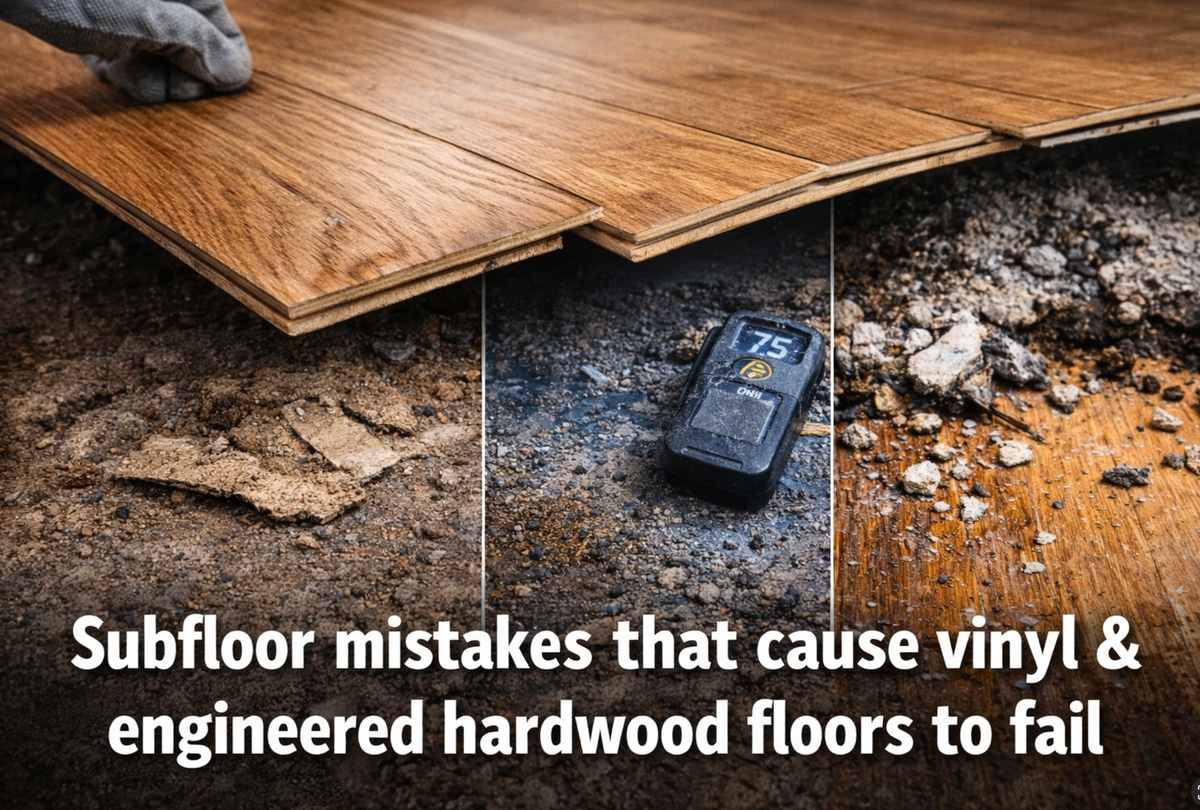
Subfloor preparation mistakes are one of the biggest reasons vinyl and engineered hardwood flooring installations fail. Homeowners often spend weeks choosing the right floor, comparing colours, plank sizes, finishes, and price points, then lose the job underneath the job. The visible floor gets all the attention. The subfloor decides whether that floor will feel solid, stay quiet, hold together properly, and still look right a few years later. In real homes, bad prep ruins more good flooring than bad colour choices ever will.
For most serious buyers, the short answer is simple: if the subfloor is not flat, sound, dry, clean, and properly prepared, the installation is already at risk. That applies whether the product is WPC vinyl flooring or engineered hardwood. A quality floor over a careless base is still a careless installation. And when the floor fails later, the problem is often not the product. It is the prep.

Why This Matters More Than Most Buyers Realize
People naturally focus on what they can see. They choose the floor that looks best in the room, fits the budget, and feels like the right fit for their home. That is understandable. Flooring is one of the largest visual surfaces in the house. It changes the entire character of a space.
But visually attractive flooring is not the same thing as a successful flooring installation. The part that makes a floor successful is often the part nobody sees once the job is done. If the subfloor has dips, humps, loose panels, moisture issues, contamination, or weak structure, the finished floor has to live on top of that reality every day. A floor may still go down. It may even look fine when the installer leaves. Then time passes. Furniture goes in. Kids run through the room. Seasonal humidity changes. Foot traffic builds. That is when small problems underneath become real problems above.
This is where buyers get frustrated, because the failure often feels unfair. They paid for a new floor and expected a new-floor result. What they got was a product sitting on a base that was never truly ready for it. That is why subfloor preparation is not a side issue. It is the foundation of the installation, more important to long-term performance than almost any feature listed on the sample board.

The Most Common Subfloor Preparation Mistakes
There are a handful of subfloor preparation mistakes that come up again and again, and they are surprisingly consistent whether the product is vinyl or engineered hardwood.
The first is poor flatness. A subfloor can look flat enough and still be outside the tolerance needed for a proper installation. Slight dips, ridges, patched areas, raised seams, or humps near transitions may not seem dramatic when you are standing in the room, but flooring notices them immediately. Long planks notice them even more. The floor starts bridging low spots, rocking over high spots, or flexing where it should sit solidly. That is how movement starts.
The second is moisture, especially over concrete. This is one of the most misunderstood issues in flooring. Buyers hear the word waterproof and assume they can stop worrying about what is happening underneath the floor. That is not how real installations work. Waterproof flooring does not mean subfloor moisture does not matter. Moisture below the floor can still create installation problems, affect surrounding materials, and put claims at risk if the floor was installed without proper testing and prep. That matters even more with engineered hardwood, where installation conditions need to be taken seriously from the start.
The third is contamination. Dust, paint residue, drywall powder, old adhesive, oil, and general construction debris all interfere with proper prep. A quick sweep is not the same thing as a properly prepared surface. Patching compounds, adhesives, and even the seating of the planks themselves can be affected when the subfloor is dirty.
The fourth is structural weakness. Loose panels, squeaks, bounce, damaged plywood, and unsupported movement do not disappear because new flooring is installed over top. Flooring does not solve structural problems. It reflects them.
The fifth is rushing the fix. This is where jobs quietly go bad. Low spots get patched casually. Cure times get ignored. Leveling gets skipped because it feels expensive. The installer says it is close enough. The homeowner wants the room finished. Everyone moves on. Then the floor starts telling the truth later.
Common Subfloor Mistakes and What Happens Later
| Subfloor preparation mistake | What happens later | Why it matters |
|---|---|---|
| Floor is not flat enough | Movement, hollow spots, stressed joints, visible unevenness | Click systems and long planks take repeated stress where the base is wrong |
| Moisture is ignored | Instability, performance issues, failed claims, broader installation problems | Waterproof flooring is not a free pass for bad slab conditions |
| Surface is dirty or contaminated | Poor bond, poor patch performance, uneven seating | Prep materials and finished flooring both depend on a clean base |
| Weak or noisy subfloor is left in place | Bounce, squeaks, shifting feel underfoot | The finished floor follows the structure underneath |
| Leveling is skipped to save money | Early movement, noise, edge stress, eventual reinstall risk | The money saved upfront often gets spent later |
| Cure times are ignored | Patches fail, surface becomes unstable, install integrity drops | Rushed prep creates hidden weakness from day one |
DIY Is Fine, but the Installer Has to Think Like a Pro
There is nothing wrong with DIY flooring. Plenty of homeowners can do a very good installation. But once you decide to install the floor yourself, you become the pro on that job. That means you do not get to treat subfloor prep like an optional extra.
One of the biggest mistakes in flooring is spending thousands of dollars on a new floor, then trying to save money by skipping the hard part underneath. Homeowners will compare products carefully, upgrade into a better construction, pay more for a beautiful finish, and then talk themselves into believing the subfloor is probably close enough. That is backwards thinking. Why spend thousands on flooring only to have it fail because you did not want to do the full job?
Subfloor preparation is more important to the success of the installation than any other aspect of the project. More important than colour. More important than brand name. More important than plank width. More important than the excitement of choosing the floor itself. Yes, proper prep can be expensive. Yes, leveling can add cost. Yes, it is frustrating when the hidden part of the job demands more attention than expected. But it is vital.
In flooring, this is often a pay now or pay later decision. Either you invest in the subfloor properly at the start, or you risk paying for the mistake later through movement, joint stress, visible unevenness, noise, reduced lifespan, or complete failure.

Cheap Installers, Cash Jobs, and Why Homeowners Get Burned
The same principle applies when the homeowner hires someone else. There is nothing wrong with wanting a fair price or hiring an independent installer. But homeowners need to be honest with themselves about warning signs. If someone is doing the job cheaply for cash, seems rushed, does not ask serious questions about the subfloor, and shrugs off leveling or prep as unnecessary, that is not a hidden gem. That is risk.
Flooring failures often do not begin with the product. They begin with a rushed install mindset. The floor gets laid. The room looks finished. Everyone feels good because money was saved. Then a year or two passes. The floor starts moving. Some areas sound hollow. Joints take stress. A claim is made. The installer is gone. The homeowner is left with the bill.
That last point matters more than most buyers expect. In many cases, poor subfloor prep leaves the warranty effectively void. Manufacturers generally do not take responsibility for installations that ignored flatness requirements, moisture testing, structural readiness, or proper prep. A warranty is not a rescue plan for cutting corners.
Vinyl and Engineered Hardwood Do Not Fail in Exactly the Same Way
Vinyl and engineered hardwood both depend on good prep, but they do not always show their problems the same way.
With vinyl flooring, especially click-lock systems and thicker floating constructions, bad flatness often shows up as movement, clicking, hollow feel, or gradual stress on the locking system. A floor can survive poor prep visually for a while and still be taking damage underneath that becomes obvious later.
With engineered hardwood, the consequences can feel more expensive because the buyer is usually making a more design-driven purchase with higher expectations. Moisture, flatness, and structural support all become more important because the floor is expected to look refined and stay stable over time. When the base is wrong, the finished result can feel slightly off even before it visibly fails.
That is why a good installer starts one layer lower than the product. Before asking which floor is best for the room, the smart question is whether the subfloor is ready for the floor.

What Proper Subfloor Preparation Actually Looks Like
Proper prep is not mysterious. It is disciplined. The installer checks flatness properly instead of guessing. Moisture gets tested where needed, especially over concrete. Weak areas are identified before the flooring arrives. Loose panels, squeaks, bounce, or damaged sections are addressed first. The surface is cleaned properly, not casually. High spots are reduced. Low spots are filled correctly with the right products. Cure times are respected. Nothing gets hidden just because it is inconvenient.
What a Proper Installer Should Check Before Installation
- Is the subfloor flat enough for the product being installed?
- Is there any moisture risk that needs testing or mitigation?
- Is the substrate clean and free from dust, oils, paint, or adhesive residue?
- Are there squeaks, bounce, loose panels, or weak sections that need repair?
- Do patched or leveled areas need more curing time before installation?
- Are transitions, height changes, and adjoining rooms being planned properly?
- Is the floor being installed according to the manufacturer's requirements?
When these questions are taken seriously, the installation has a much better chance to perform the way it should. When they are ignored, the risk moves directly into the finished floor.
The Real Buyer Question
The real buyer question is not just which vinyl or engineered hardwood floor looks best. It is whether the installation process is serious enough to give that floor a fair chance. Serious buyers should care about subfloor prep even if they never plan to install the floor themselves. They do not need to become flooring contractors. But they do need to understand enough to ask better questions, recognize red flags, and avoid the false economy of skipping the hidden work.
FAQ: Subfloor Preparation Mistakes
Here are the questions Canadian homeowners ask most often about subfloor preparation.
Can vinyl flooring go over an uneven subfloor?
It can go over it physically, but that does not mean it should. Uneven subfloors create movement, stress, hollow areas, and long-term performance issues. The floor may go down, but the installation may still be wrong.
Does waterproof vinyl mean subfloor moisture does not matter?
No. Waterproof vinyl does not eliminate the need to evaluate moisture conditions below the floor. Moisture still matters to the installation system and can affect performance and warranty outcomes.
Is subfloor leveling really worth the money?
Yes, when the floor needs it. Proper leveling can feel expensive in the moment, but it is often cheaper than living with a failed installation or paying for replacement later.
Can a flooring warranty be denied because of poor subfloor prep?
Yes. If the floor fails because the substrate was not properly prepared, many warranties will not protect the homeowner.
Final Verdict
Subfloor preparation mistakes cause vinyl and engineered hardwood floors to fail because the floor above cannot permanently hide what is wrong underneath. DIY is fine. Hiring someone directly is fine. Looking for value is fine. What is not fine is pretending the hidden part of the job does not matter.
If you are the installer, you are the pro; act like one. If you are hiring an installer, make sure they act like one too. And if the person doing the work seems rushed, is not worried about the subfloor, and keeps pushing to skip leveling or proper prep, do not be surprised when that decision gets expensive later. A quality floor deserves a quality base. That is not an upgrade. That is the job.
Contact us for help choosing a floor, or find a dealer near you for advice based on your actual home and subfloor conditions.
Related Reading
These articles go deeper on topics covered in this guide: