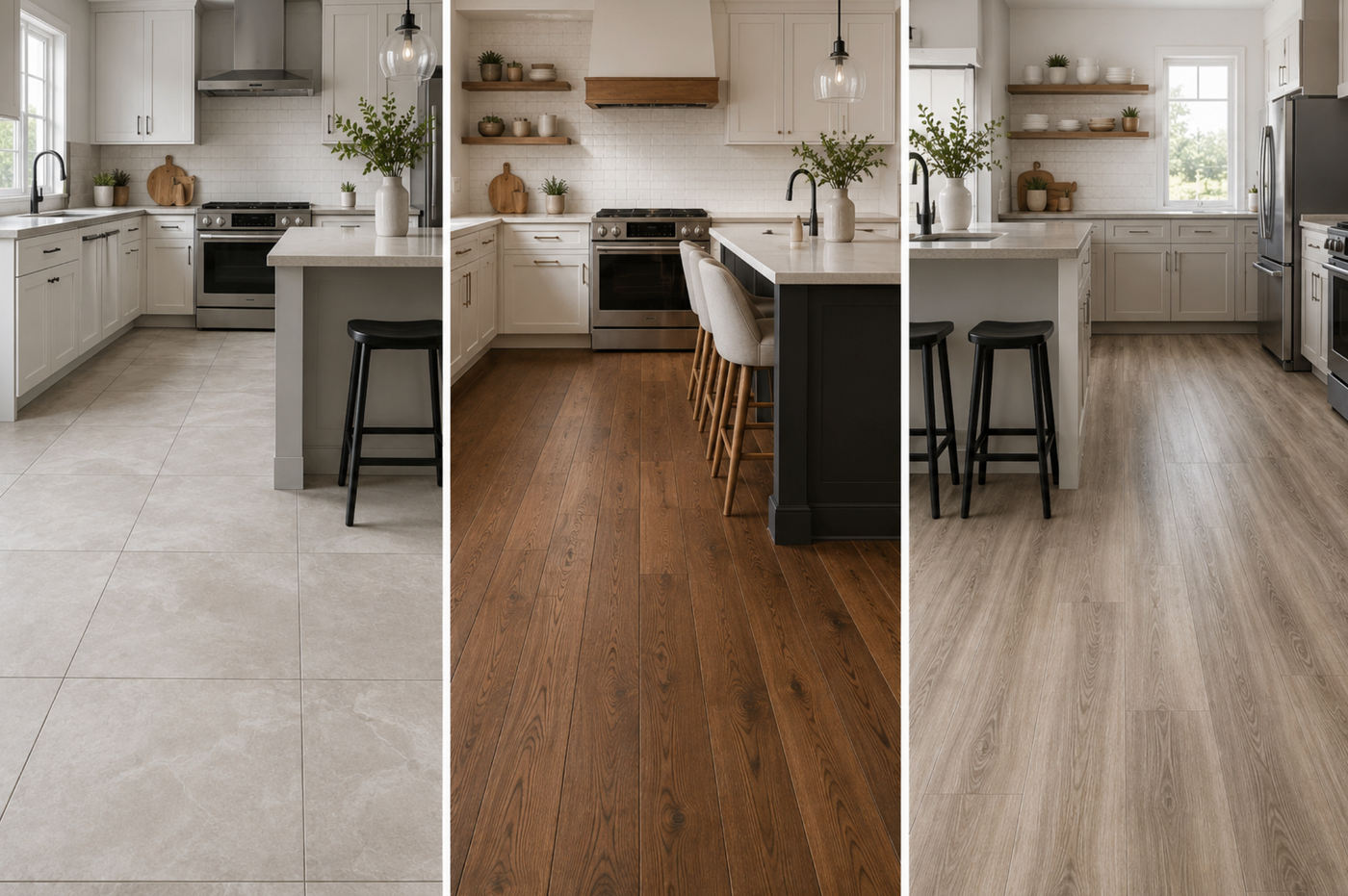
Kitchen flooring in Canada has to work harder than almost any other floor in the home. A kitchen floor has to handle spills, cooking mess, dropped dishes, pets, kids, winter grit, wet shoes, daily cleaning, and heavy foot traffic. It also has to look right beside cabinets, counters, stairs, dining areas, and living rooms.
For most Canadian homeowners, the main kitchen flooring choices are tile, engineered hardwood, and vinyl flooring. Each option can be right in the right home. Tile is tough and water-resistant. Engineered hardwood gives the most natural, premium look. Vinyl flooring is often the most forgiving option for real family life. The best kitchen floor is not the product with the longest feature list: it is the one that fits how the home actually works.
What Is the Best Kitchen Flooring in Canada?
The best kitchen flooring in Canada depends on the home. Tile is best when water resistance and surface durability are the top priorities. Engineered hardwood is best when the homeowner wants a warm, natural, high-end look. Vinyl flooring is best when comfort, waterproof performance, and easy maintenance matter most.
The mistake many homeowners make is choosing kitchen flooring as if the kitchen is an isolated room. In many Canadian homes, the kitchen is part of the main living space. The floor has to perform in the kitchen, but it also has to make sense across the whole main floor. A closed kitchen in an older home may handle tile well. An open-concept kitchen connected to a living room may look better with engineered hardwood or vinyl running through the full space. A basement kitchen, rental suite, condo, or busy family home may need waterproof flooring more than a formal design statement. The right answer starts with the home, not the product.

How Should Canadian Homeowners Choose Kitchen Flooring?
Canadian homeowners should choose kitchen flooring by weighing five things: moisture, comfort, durability, appearance, and visual flow. A floor that wins in one category may lose in another. Tile performs well around water, but tile can feel cold and hard. Engineered hardwood looks natural and premium, but it is still real wood and needs care around moisture. Vinyl flooring is practical and forgiving, but quality varies widely between basic products and thicker, more premium floors.
Canadian conditions also matter. Wet shoes, snow, salt, pets, and dry winter air all affect flooring. A kitchen in Vancouver may deal with damp conditions and constant rain-season traffic. A kitchen in Alberta or the Prairies may deal with very dry indoor air during winter. A condo may have sound requirements. A basement may have slab moisture concerns. A good flooring decision accounts for how the floor will be lived on every day.
Is Tile a Good Choice for Kitchen Flooring?
Tile is a good kitchen flooring choice when the homeowner wants a hard, durable, water-resistant surface. Ceramic and porcelain tile can handle spills, cleaning, and heavy traffic well when installed correctly. Tile makes sense in kitchens where water resistance is the main concern, or where the design supports a separate hard-surface kitchen floor. Tile is also a natural fit for bathrooms, laundry rooms, mudrooms, and entries.
The downside is comfort. Tile is hard underfoot, cold in many Canadian homes, and unforgiving when dishes, glasses, phones, or heavy pans are dropped. Grout also needs cleaning, and the final result depends heavily on subfloor preparation and installation quality. Tile can last a long time, but in an open-concept main floor, tile can create a hard visual break between the kitchen and living space. Sometimes that break looks intentional. Sometimes it makes the main floor feel smaller and more divided. Tile is a strong material: the real question is whether tile fits the way the kitchen connects to the rest of the home.
Is Engineered Hardwood a Good Choice for Kitchens?
Engineered hardwood can be a good kitchen flooring choice when the homeowner wants real wood beauty and understands the need for moisture care. Engineered hardwood is not waterproof, but many homeowners choose it in kitchens because it creates a warm, natural, premium look. The biggest reason is visual flow: in an open-concept home, engineered hardwood can run from the kitchen into the dining area, living room, hallway, and stairs, making the home feel more cohesive and intentional.
Product quality matters here. A premium engineered hardwood floor with a thicker 4mm veneer gives the floor a more substantial real wood surface. The trade-off is water: spills should be wiped quickly, pet bowls should sit on mats, and appliance leaks should be treated as urgent. Engineered hardwood is not the lowest-maintenance kitchen floor. It is the choice for homeowners who value natural wood appearance enough to accept reasonable care.
Is Vinyl Flooring a Good Choice for Kitchens?
Vinyl flooring is one of the most practical kitchen flooring choices in Canada. Many vinyl floors are waterproof, easier to clean than tile grout, warmer underfoot than tile, and more forgiving than wood in busy homes. Vinyl works especially well in family kitchens, condos, basements, rental suites, townhomes, and open-concept homes where the floor needs to continue beyond the kitchen.
Vinyl flooring is not one product: it is a category that includes sheet vinyl, glue-down vinyl plank, SPC click flooring, WPC vinyl flooring, loose lay vinyl, and other click-lock products. Some vinyl floors are thin and basic. Others are thicker, more comfortable, and more realistic. Wear layer, core construction, locking system, plank size, texture, and visual repeat all affect the result. A low-end vinyl floor can look flat and feel cheap. A better vinyl floor can be a very smart kitchen choice. Vinyl's strength is that it solves everyday kitchen problems very well.

What Is the Difference Between SPC and WPC Vinyl Flooring in Kitchens?
SPC and WPC are both types of rigid vinyl flooring, but they do not feel the same in a kitchen. SPC (stone plastic composite) is usually denser and harder: it can be durable, stable, and practical, and often performs well in homes where a thinner rigid floor is needed. The trade-off is that SPC can feel harder and colder, especially compared with thicker vinyl products.
WPC vinyl flooring is usually thicker, warmer, and more comfortable underfoot. In kitchens, that comfort matters: people stand at counters, cook, clean, unload groceries, and move between the sink, fridge, island, and stove for long stretches. WPC is not automatically better than SPC in every situation, but for kitchens the better vinyl floor is usually the one that balances waterproof performance, comfort, realistic visuals, and installation quality.
Which Kitchen Floor Is Best for Open-Concept Homes?
For open-concept homes, the best kitchen floor is often the one that creates the best flow across the entire main level. A kitchen floor should not be chosen only for the kitchen if the kitchen is visually connected to the dining room and living room. This is where engineered hardwood and vinyl flooring often become strong choices: engineered hardwood gives a continuous natural wood look, and vinyl gives a continuous waterproof option that can run through kitchens, dining areas, living rooms, hallways, and entries.
Tile can still work in an open-concept kitchen, but the transition has to be planned carefully. A tile kitchen beside a wood or vinyl living room can look good when the layout has a clear architectural break, but it may look awkward when it cuts across an open space without a natural stopping point. A simple test helps: stand where guests enter the main floor and look across the kitchen, dining area, and living room. If all those spaces are seen together, the flooring should feel connected. In open-concept homes, flooring is not just a surface: it is part of the architecture of the room.
Which Kitchen Flooring Is Best for Families With Pets and Kids?
Vinyl flooring is often the easiest kitchen flooring for families with pets and kids. Vinyl handles common spills, food mess, pet water bowls, and daily traffic with less stress than engineered hardwood. Tile is also durable, but tile is hard: a child falling on tile, a dropped glass, or long cooking sessions on a cold tile floor can make tile less comfortable in daily life, and grout maintenance can become annoying in a busy household.
Engineered hardwood can work in family kitchens, but the family has to live with more care. Pet water bowls should sit on mats. Spills should be wiped quickly. Chairs and stools should have proper floor protection. The floor should be treated as a premium wood surface. For many homes, the practical question is not just "what can survive?" but "what can we live on without being stressed every day?" For most busy households, that answer points toward vinyl. For households that care most about real wood and are willing to maintain it, engineered hardwood can still be worth it.

Which Kitchen Flooring Looks the Most Premium?
Engineered hardwood usually looks the most premium because it is real wood. Natural wood grain, long boards, clean grading, and a quality finish can create a look that is difficult for other materials to fully match. Premium engineered hardwood looks especially strong in open-concept kitchens where the floor continues into the living area: the kitchen stops feeling like a separate utility room and becomes part of a larger designed space.
Tile can also look premium, especially large-format porcelain tile in the right home. Vinyl flooring can look very good, but the quality range is wide. Better vinyl products provide realistic wood visuals, stronger texture, and a more substantial feel. Lower-end vinyl can show pattern repetition, flat visuals, or a thin feel underfoot. The most premium kitchen floor is not always the most expensive: it is the floor that looks intentional in the home.
Kitchen Flooring Comparison
| Flooring type | Best fit | Strengths | Trade-offs |
|---|---|---|---|
| Tile | Wet areas, closed kitchens, mudrooms, laundry rooms | Durable, water-resistant, long-lasting when installed well | Cold, hard, grout maintenance, installation quality matters |
| Engineered hardwood | Open-concept homes, premium interiors, real wood buyers | Natural beauty, warmth, strong visual flow, high-end appearance | Not waterproof, needs care around spills and leaks |
| Vinyl flooring | Busy kitchens, families, condos, basements, rentals | Waterproof options, easy maintenance, comfortable, practical | Quality varies widely, not real wood or tile |
| SPC vinyl | Durable rigid vinyl applications | Dense, stable, practical, often thinner | Can feel harder and colder |
| WPC vinyl flooring | Whole-home waterproof flooring with comfort | Thicker feel, warmer underfoot, comfortable, practical | Not real wood, product quality still matters |
What Are the Biggest Kitchen Flooring Mistakes?
The biggest kitchen flooring mistake is choosing a floor for one feature and ignoring the rest of the home. One mistake is choosing tile only because tile has always been common in kitchens: tradition is not a design plan. Another is choosing engineered hardwood without accepting that wood needs care around water. A third is choosing vinyl only by price, when cheap vinyl can create problems with appearance, feel, and long-term satisfaction.
A fourth mistake is ignoring transitions: a flooring transition should land where the home naturally changes, not cut randomly across open spaces. A fifth mistake is choosing from a small sample without thinking about the full room, since cabinets, counters, wall colour, light exposure, stairs, and furniture all change how a floor looks. Good kitchen flooring decisions come from thinking about the whole home, not just the square footage of the kitchen.
How Can Homeowners Judge Kitchen Flooring Quality Before Buying?
Homeowners should judge kitchen flooring quality by looking beyond sample colour. For engineered hardwood, ask about veneer thickness, grade, construction, finish, approved installation methods, and board lengths: a thicker veneer and cleaner grade can be signs of a more premium product. For vinyl flooring, ask about total thickness, wear layer, core type, locking system, attached pad, texture, plank size, and whether the floor feels substantial underfoot. For tile, look at tile type, size, slip resistance, grout choice, subfloor preparation, and installation quality. The best flooring decisions usually happen when homeowners compare full product quality, not just colour and price.
Should Kitchen Flooring Match the Living Room?
Kitchen flooring should usually match the living room when the kitchen and living room are part of one open-concept space. Matching flooring can make the main floor feel larger, cleaner, and more cohesive. This does not mean every home needs one floor everywhere: bathrooms, laundry rooms, mudrooms, and bedrooms may need different flooring. But when the kitchen, dining room, and living room are viewed together, one continuous floor often looks better than multiple flooring changes. The question is not whether matching is always right. The question is whether the flooring change improves the home or interrupts it.
Is Waterproof Flooring Necessary in a Kitchen?
Waterproof flooring is not mandatory in every kitchen, but it gives homeowners more forgiveness. Kitchens are spill-prone rooms, and vinyl flooring is often chosen because many vinyl products handle surface moisture better than wood. Waterproof vinyl can be a smart choice in homes with pets, kids, frequent cooking, rental use, or open-concept layouts where the floor continues into other rooms.
Waterproof flooring is not magic: a dishwasher leak or standing water can still create problems if water gets under the floor or into the subfloor. Even waterproof flooring requires responsible maintenance. Engineered hardwood can work in kitchens but needs faster cleanup and more caution. Tile handles surface water well, but grout, substrate, and installation quality still matter. Waterproof flooring helps. It does not replace common sense.
What Is the Best Kitchen Flooring for Condos?
The best kitchen flooring for condos is usually a product that balances durability, sound control, comfort, and building requirements. Vinyl flooring is often practical in condos because many products are waterproof, relatively comfortable, and available with attached pads or sound-rated systems. Condo owners should always check strata or building requirements before choosing flooring: some buildings require specific acoustic ratings or approved underlayment. Engineered hardwood can work in condos when the building allows it and the installation method meets requirements. In condos, the best floor satisfies both the homeowner's taste and the building's rules.
Best Kitchen Flooring by Situation
| Situation | Strong option | Why it works |
|---|---|---|
| Open-concept main floor | Engineered hardwood or vinyl flooring | Both can create better flow from kitchen to living areas |
| Busy family kitchen | Vinyl flooring | Waterproof options and easy cleaning reduce daily stress |
| Premium natural design | Engineered hardwood | Real wood gives the most natural high-end appearance |
| Wet-zone priority | Tile or waterproof vinyl flooring | Both can handle surface moisture well when installed properly |
| Condo kitchen | Vinyl flooring or approved engineered hardwood | Sound requirements and installation rules matter |
| Rental suite or basement kitchen | Vinyl flooring | Practical, water-resistant options are easier to maintain |
| Separate closed kitchen | Tile, vinyl, or engineered hardwood | The kitchen can have its own material without disrupting flow |
FAQ: Kitchen Flooring in Canada
Is tile better than vinyl for kitchen flooring?
Tile is better when the homeowner wants a hard, highly durable surface with strong water resistance. Vinyl is often better when comfort, warmth, easier maintenance, and whole-home flow matter more.
Is engineered hardwood too risky for kitchens?
Engineered hardwood is not automatically too risky for kitchens, but it is not waterproof. It can work well when homeowners wipe spills quickly, manage appliance leaks, and accept normal wood-floor care.
Is vinyl flooring good enough for a high-end kitchen?
Vinyl flooring can be good enough for a high-end kitchen when the product has strong visuals, a quality core, a good locking system, and a substantial feel. Low-end vinyl may not create the same impression.
What is the easiest kitchen flooring to maintain?
Vinyl flooring is usually the easiest kitchen flooring to maintain. Vinyl handles normal spills well, cleans easily, and avoids grout maintenance.
Should I use the same flooring in my kitchen and living room?
Using the same flooring in the kitchen and living room often works well in open-concept homes. A continuous floor can make the home feel larger and more refined.
What flooring should I avoid in a kitchen?
Avoid any kitchen flooring that does not match how the home is used. Avoid wood if the household expects a truly waterproof floor. Avoid cheap vinyl if long-term appearance matters. Avoid tile if comfort and warmth are major priorities.
Final Verdict
Tile, engineered hardwood, and vinyl flooring can all be good kitchen flooring choices in Canada: the right choice depends on the home, the household, and the design goal. Tile is the practical choice when the homeowner wants a hard, water-resistant surface and accepts coldness, hardness, and grout maintenance. Engineered hardwood is the premium natural choice for real wood beauty, warmth, and strong open-concept flow, though it needs care around moisture. Vinyl flooring is the practical everyday choice when waterproof performance, comfort, easy cleaning, and whole-home flow are the priorities. Within vinyl, higher-quality options such as WPC vinyl flooring can offer a thicker, warmer, more comfortable feel.
The best kitchen floor is not the floor that wins every category: no floor does that. The best kitchen floor is the one that fits the way the home is actually lived in. Contact us for help choosing a floor, or find a dealer near you to talk through the right option for your kitchen and lifestyle.
Related Reading
These articles go deeper on topics covered in this guide: