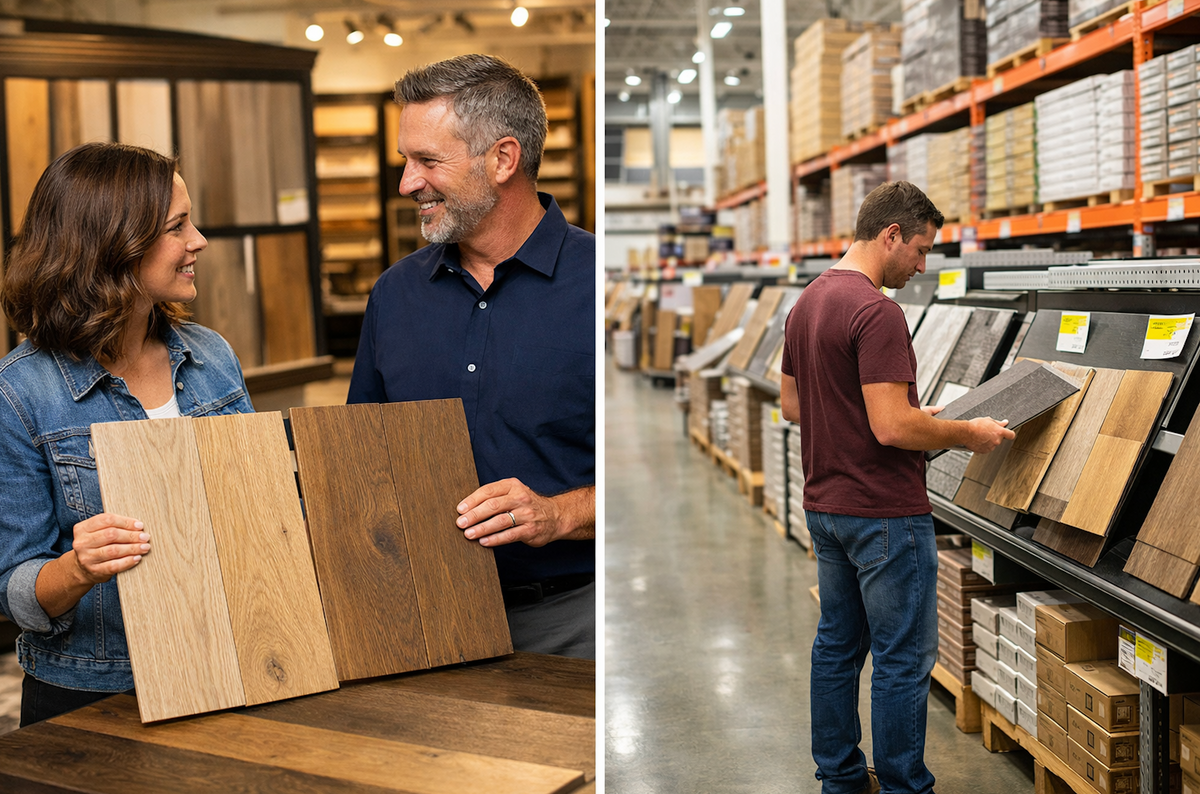
If you are shopping for flooring in Canada, there is a good chance you will end up weighing two very different paths. One is to buy from a large retailer like Home Depot. The other is to work with a specialty flooring dealer. Both options have a place , and that is the most important place to start this conversation.
Home Depot is an impressive company. They have built a retail model around convenience, accessibility, clear pricing, and the ability to help homeowners move quickly on a wide range of home improvement projects. For many flooring purchases, that works well. A buyer with a simple project, a tight budget, or a need for speed may find exactly what they need there.
But flooring is not always a simple purchase. In many homes, it is one of the largest visual surfaces in the entire space. You see it every day. You walk on it every day. You live with the colour, the texture, the sound, the comfort, and the overall feel long after the purchase is forgotten. That is where the conversation changes. Once flooring becomes a serious buying decision instead of a quick transaction, a specialty dealer usually offers the better experience.

Why Both Options Have a Place in Canada
For the right project, Home Depot can be a smart choice. If the job is straightforward, the budget is tight, or the priority is simply getting something practical installed without overcomplicating the process, big-box retail has real strengths. Clear price points matter. Convenience matters. Immediate access matters. Many homeowners are renovating a rental property, finishing a basement room, or refreshing a space they do not expect to live in forever. In those situations, a big-box environment can make perfect sense.
The problem is that flooring buyers often assume every flooring purchase should be approached that way. It should not. There is a meaningful difference between buying flooring for a short-term or lower-stakes project and buying flooring for the main areas of a home where quality, comfort, and long-term satisfaction matter. Once the decision becomes more permanent, more design-driven, or more personal, the buying environment starts to matter much more.
A specialty flooring dealer is built around one category. Flooring is not one department among many ; it is the entire business. That focus changes the staff, the displays, the product mix, and the overall quality of the buying conversation. For a serious flooring buyer, those differences are not small. They are often the difference between choosing a floor that is merely acceptable and choosing one that actually feels right once it is installed.

Where Flooring Dealers Offer a Better Experience
The clearest advantage a flooring dealer has is focus. The staff are not moving between paint, appliances, tools, and seasonal product , they are dealing with flooring every day. They compare constructions, explain product differences, answer installation questions, and help people narrow choices based on how the floor will actually perform in a real home. That kind of repetition builds genuine category depth that a generalist retail environment simply cannot replicate.
A serious flooring buyer usually has questions that go beyond price and colour. They want to know how the floor will feel underfoot. They want to understand whether one construction is quieter than another. They want to compare a thicker WPC vinyl floor to a thinner one. They want to know whether the product suits their home, their family, their subfloor, and their long-term expectations. Those questions determine whether the buyer is happy a year later , and a specialty dealer is far better equipped to answer them.
There is also a psychological difference in the buying experience. In a specialty flooring store, the customer is usually encouraged to slow down and compare properly. In a big-box store, the environment is naturally built for efficiency. Neither is wrong. But they lead to different outcomes. If the goal is speed, efficiency is a benefit. If the goal is making the best flooring decision, slowing down is often the smarter move.
Why Product Selection, Displays, and Comparison Matter
Many homeowners think selection is simply about how many products are available. In flooring, that misses the point. The better question is whether the buyer has enough meaningful choice to compare options properly.
Specialty flooring dealers often have more developed displays, larger sample boards, fuller plank presentations, and a more curated selection within the category. Flooring is one of the hardest products to judge from a small sample. A floor that looks attractive on a little board can feel completely different once it covers an entire room. Undertones show up differently at scale. Width matters more. Surface texture and sheen become more noticeable. Pattern repeat becomes more obvious. Larger displays allow buyers to touch, feel, compare, and visualise the product in a more realistic way before committing.

That matters even more for design-conscious buyers. There is a reason interior designers and serious renovators typically work through flooring dealers rather than big-box retail for major flooring decisions. They want to compare full displays, see how colours sit beside one another, and understand finish, scale, and overall visual effect before committing to a product.
This also connects directly to product choice. In categories like WPC and SPC vinyl flooring and engineered hardwood, there are meaningful differences between products that look similar at first glance. Thickness, construction, locking system, finish detail, and plank size all influence the end result. Those differences are easy to miss in a quick shopping trip and much easier to understand when the product is displayed properly and the staff know what the buyer is actually comparing.
Price, Value, and the Type of Buyer You Are
Price always matters, and it should. One of Home Depot’s real strengths is that they can hit price points clearly and consistently, and they have the scale to offer promotions and clear-out opportunities. For buyers focused primarily on upfront cost, that can be very compelling , and in the right situation, it is completely rational.
But flooring is one of those purchases where lower upfront cost does not always mean better value. A buyer who wants a floor that feels right, looks right, and suits the home more precisely is usually making a different calculation. They are not only asking, “What does this cost today?” They are asking, “Will I still be happy with this after it is installed? Did I compare enough to know I made the right decision?”
That is where dealers tend to win : not because they are always cheaper, but because they often offer a better decision process for a buyer who cares about the result. More product depth, more category-specific guidance, more meaningful comparison, better displays, and better context. In many cases, that leads to better long-term satisfaction, which is its own kind of value.
The real dividing line is not dealer versus Home Depot in some absolute sense. It is about the kind of buyer you are.
If your project is simple, your priorities are speed and budget, and you are comfortable making a relatively quick decision, a big-box retailer may be the right answer. If your flooring purchase feels important, if you want to compare carefully, and if you care about getting the product truly right for your home, a flooring dealer is usually the better choice in Canada.
Final Verdict
Home Depot deserves respect. They are excellent at convenience, value, and serving a broad home improvement market, and they absolutely have a place in flooring. For many projects they are a very practical option.
But for a serious flooring buyer, a specialty dealer usually offers the better experience. That comes down to three things: more focused staff, more developed product comparison, and a buying environment built specifically around flooring rather than general home improvement. When the project matters, those advantages matter too.
In simple terms, Home Depot is built for efficient buying. A flooring dealer is built for making a better flooring decision. Contact us for help choosing a floor , or find a dealer near you to get advice based on your actual home.
Related Reading
These articles go deeper on topics covered in this guide: