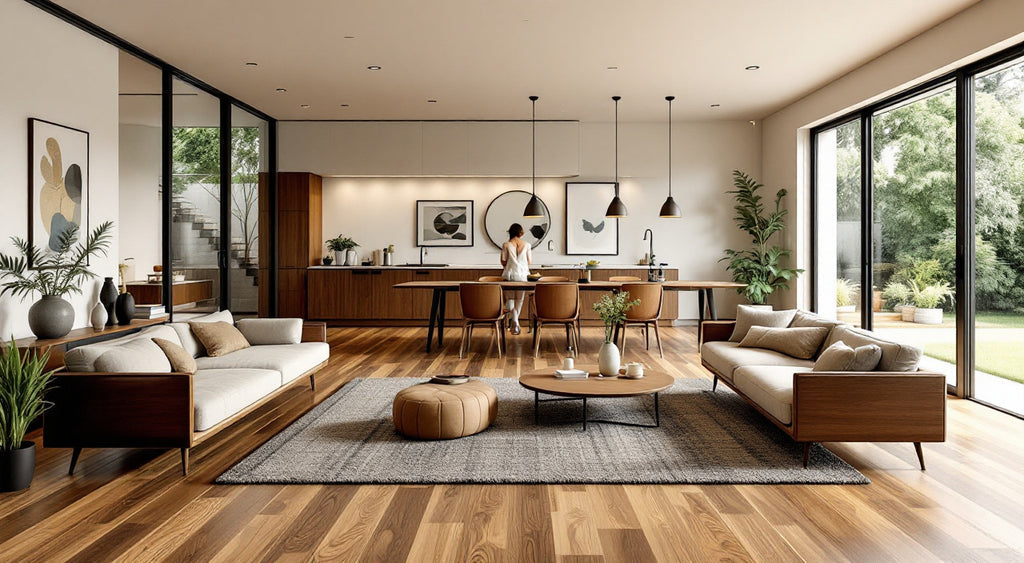
Mid-century modern design leans on flooring more than most people expect, because the style's entire look depends on warm, natural material meeting clean, uncluttered lines. A cool grey or heavily whitewashed floor fights that balance immediately. A warm-toned wood floor, in the right format and finish, is what lets the furniture's tapered legs and open sightlines read as inviting instead of stark.
What Actually Defines Mid-Century Modern Design?
Mid-century modern design rests on three working ideas: organic, gently curved forms paired with clean geometric lines, function over ornament, and a strong visual connection between indoor and outdoor space. Nothing in the style is fussy or heavily decorated.
The organic-meets-geometric balance shows up as tapered furniture legs, low-slung silhouettes, and rounded forms set against straight architectural lines and large expanses of glass. Function over ornament means a piece or a material earns its place by being genuinely useful and well made, not by being decorative. The indoor-outdoor connection, often built around large windows and sliding glass doors, means the materials inside are chosen partly to feel continuous with the natural world just outside them.
A fourth thread ties the first three together: warmth. The style emerged in the years following the Second World War, when new construction techniques allowed for open floor plans and walls of glass, and warm natural materials, wood most of all, were what kept those bright, minimally decorated rooms from feeling cold or clinical.

Why Do Warm Wood Tones Matter So Much to This Style?
Warm wood tones matter because they are doing the emotional work that ornament does in more traditional styles. Mid-century modern rooms are deliberately spare: clean lines, few decorative flourishes, and a lot of exposed floor and wall. Without a warm material somewhere in that mix, the room can read as cold rather than calm.
The floor is the largest continuous surface most rooms have, so its tone carries an outsized share of that warmth. A cool-toned or heavily bleached floor pulls a mid-century modern room toward the pale, minimal look of a different style entirely, closer to Scandinavian-inspired design than to the warmer, wood-forward look mid-century modern is known for. For a closer look at how tone and undertone get chosen in the first place, see How to Choose the Best Engineered Hardwood Colour for Your Home.
What Wood Tones Read as Mid-Century Modern?
Warm, medium-to-deep tones read as mid-century modern: honey and amber oak, warm walnut, and teak-inspired finishes with visible grain and a rich, saturated colour. These tones were the defining wood colours of the era's original furniture and cabinetry, and a floor in a related family ties the room together.
Cool, pale, or heavily grey-washed tones generally work against the style. They are not wrong in an absolute sense, but they pull a room toward a different, more minimal design language. A tone with too much red or pink undertone can also clash with walnut's naturally brown-purple cast, so the safest approach is to pick a floor tone in the same warm family as the furniture wood rather than matching it exactly. Wood species itself also shapes how warm or cool a floor reads; Oak, Hickory, or Maple? How Wood Species Shape the Look of Engineered Hardwood covers that in more detail.
Was Parquet or Herringbone a Signature Mid-Century Flooring Choice?
Yes. Parquet, individual wood blocks or strips arranged into a repeating geometric pattern, was one of the most recognizable flooring choices in mid-century homes, along with herringbone laid in a single warm tone. Both patterns gave a floor visual texture and craft without introducing colour or clutter, which fits the era's function-first, uncluttered instinct.
A single-tone herringbone or parquet layout is one of the most period-authentic choices available today for a room aiming at this look, because the pattern reads as structure and craftsmanship rather than decoration. Beyond Herringbone: A Guide to Flooring Layout Patterns goes deeper on how these patterns are built and where they fit best in a home.

Does Plank Width Change the Look?
It does, though the honest answer is less absolute than for some other styles. Original mid-century homes were typically floored with narrow strip hardwood, commonly around two to two and a quarter inches wide, because that was the standard residential flooring format of the era. A narrow strip floor, in a warm tone, is the most historically accurate choice for a true period recreation.
That said, a wider plank in the right warm tone can still read as mid-century modern, because tone and finish carry more of the visual identity than exact board width does. The trade-off is authenticity versus practicality: a narrow strip floor is the more period-correct choice, while a moderate-width plank is easier to source today and installs with fewer total seams. Very wide, oversized plank formats tend to feel more contemporary than mid-century, so a moderate width is generally the safer middle ground for this style specifically.
Matte or Glossy: Which Finish Fits Mid-Century Modern?
A satin or low-sheen finish generally suits mid-century modern better than a high-gloss one. The style favours materials that look genuine and lived-in rather than showroom-polished, and a lower-sheen finish lets the wood's natural grain and colour carry the visual interest instead of competing with it through reflection.
A very matte, chalky finish can undersell the warmth of a rich walnut or teak-inspired tone, so a satin finish, with enough sheen to bring out the grain and colour depth without reading as glossy, is usually the closer match. High-gloss finishes tend to read as more formal or contemporary, which pulls against the relaxed, function-first character the style is built on.
What Flooring Materials Can Actually Achieve This Look?
Several flooring materials can deliver the warm tone, moderate width, and satin finish this style calls for, and the honest answer depends on where in the home the floor is going rather than on any single category being the automatic choice. Engineered hardwood offers a genuine wood face with the grain depth and colour variation that reads most authentically as walnut or teak-toned, which is a real advantage for a style this closely tied to wood character.
In areas with real water exposure, a kitchen, entryway, or a lower-level room near grade, waterproof flooring is the more practical starting point. A fully waterproof core, the kind used in WPC vinyl flooring, holds up to spills and standing water without the moisture concerns a real wood veneer carries, and it can still be produced in warm, mid-century-appropriate tones and a matching plank format. Neither material is the default right answer everywhere in a home; the room's actual exposure to moisture and traffic should decide the material, while tone, width, and finish are what actually make a floor read as mid-century modern regardless of which material is chosen.
Two materials genuinely associated with the original era are worth naming honestly, even though they sit outside this comparison: terrazzo, a poured aggregate floor popular in mid-century entryways and sunrooms, and cork, valued at the time for its warmth underfoot and quiet, organic texture. Both can still suit the style well; they are simply a different flooring category from wood-look products and involve their own separate sourcing and installation considerations.
How Do Design Choices Map to Mid-Century Modern Principles?
The table below summarizes which flooring choices support which core idea behind the style, as a qualitative reference rather than a ranked list.
| Design principle | Flooring choice that supports it | Why it works |
|---|---|---|
| Warmth against clean lines | Warm-toned wood, from honey oak to deep walnut | Grounds a spare, minimally decorated room in natural warmth |
| Period-authentic texture | Single-tone parquet or herringbone | Reads as structure and craft rather than decoration |
| Function over ornament | Satin or low-sheen finish | Shows genuine wood grain without a showroom-polished look |
| Indoor-outdoor continuity | One consistent tone run through connected principal rooms | Keeps sightlines uninterrupted toward walls of glass |
| Historical accuracy | Narrow-to-moderate plank width | Matches the strip flooring standard of the original era |

FAQ: Flooring and Mid-Century Modern Design
A few practical questions come up once tone, pattern, and finish choices meet the realities of an actual home.
Does mid-century modern design require narrow strip flooring?
No. Narrow strip flooring is the historically accurate choice, but tone and finish carry more of the style's visual identity than exact board width. A moderate-width plank in a warm tone can still read as mid-century modern; very wide, oversized formats are the width range that tends to feel more contemporary than mid-century.
Can wide-plank flooring still work in a mid-century modern room?
It can, particularly in a moderate width paired with a warm tone and satin finish. The further a plank moves toward today's oversized giant-plank formats, the more the room starts to read as a contemporary update on the style rather than a period-accurate one, which is a legitimate design choice as long as it is a deliberate one.
Is mid-century modern the same as Scandinavian or modern farmhouse design?
No, though all three share a function-first instinct. Scandinavian-inspired design favours pale, cool-toned wood and visual minimalism; modern farmhouse leans on rustic texture and wider, more varied wood tones; mid-century modern sits apart from both with its warm walnut and teak-inspired tones, organic-meets-geometric furniture forms, and strong indoor-outdoor connection. See Flooring's Role in Scandinavian-Inspired Interior Design and Flooring's Role in Modern Farmhouse Design for a closer comparison.
Does a mid-century modern floor have to be engineered hardwood?
No. The look is defined by tone, pattern, and finish, not by one material category. Engineered hardwood offers the most authentic wood grain and colour depth for this style, while waterproof flooring, such as WPC vinyl flooring, is the more practical choice in a kitchen, entryway, or other area with real water exposure, and it can still be produced in the same warm, mid-century-appropriate tones.
Did mid-century modern homes actually use wall-to-wall carpet?
Some did, but the more enduring and widely referenced look is a warm hardwood or parquet floor left partly exposed, with a low-pile area rug defining a seating or dining zone rather than carpet covering the whole room. That approach also lets the floor's warm tone and pattern stay visible, which is a real part of the style's identity. Area Rugs and Hard Floors: An Easy Way to Add Warmth, Colour, and Comfort covers how to use a rug this way without covering up the floor entirely.
Choosing flooring for a mid-century modern room comes down to a small set of decisions made consistently: a warm wood tone, a period-appropriate pattern or width, and a satin finish that lets the grain do the work. Get those three right and the floor becomes the quiet, warm foundation the rest of the style is built on.
To see the full Caledon Floors range, click here.
To find a Caledon Floors dealer near you, click here.