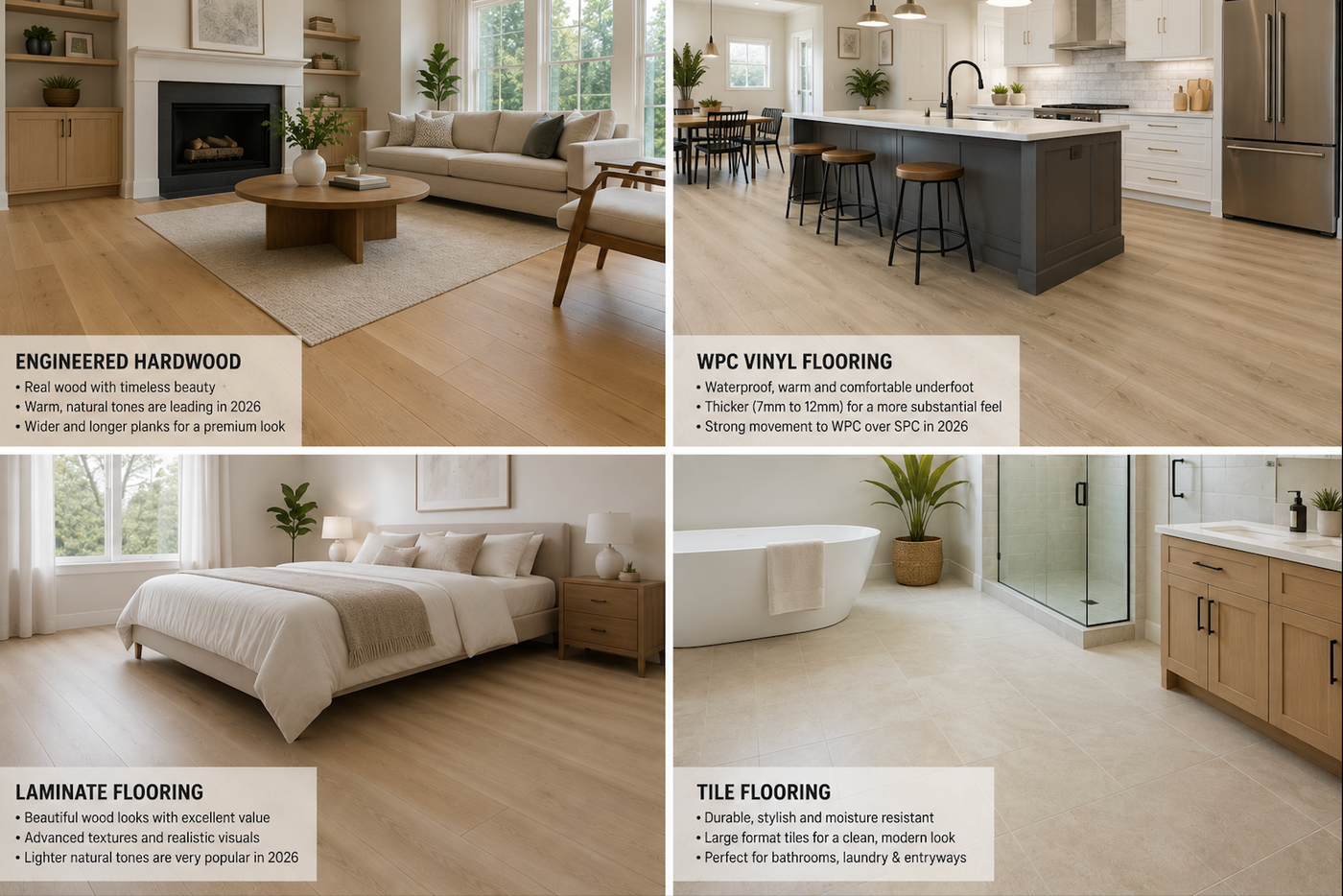
Canada flooring trends in 2026 are moving in a clear direction: warmer, calmer, more natural, more comfortable, and more practical.
The strongest trend is not one colour or one product. The real trend is a shift away from cold grey flooring, flat artificial visuals, short-board-heavy layouts, overly busy colour variation, and floors chosen one room at a time. Homeowners still want durability, waterproof performance, and easy maintenance, but they also want floors that feel more timeless, more comfortable, and more connected to the rest of the home.
Across major flooring brands, design publications, and homeowner conversations, the same themes keep showing up: warm natural wood tones, wider and longer planks, matte and textured finishes, better whole-home flow, thicker vinyl products, renewed interest in WPC vinyl flooring, and flooring that looks beautiful without feeling fragile.
For Canadian homes, the best flooring trend in 2026 is simple: choose floors that feel natural, current, comfortable, and built for real life.

Quick summary: what is trending in flooring for 2026?
The biggest flooring trends for 2026 are warm natural colours, wide and long planks, low colour variation, matte finishes, realistic wood textures, premium engineered hardwood, and thicker waterproof vinyl flooring. The trends fading fastest are cold grey plank flooring, overly busy variation, glossy finishes, thin-feeling vinyl, obvious pattern repeat, and awkward flooring transitions.
| 2026 flooring trend | What it means | What is fading |
|---|---|---|
| Warm natural wood tones | Softer oak, beige, honey, natural brown, warm greige | Cold grey plank flooring |
| Wider and longer planks | More premium scale and fewer visual breaks | Narrow, short-board-heavy layouts |
| Low colour variation | Cleaner, calmer full-room appearance | Busy high-variation floors |
| Matte and textured finishes | More natural and realistic surface feel | Glossy or plastic-looking finishes |
| Premium engineered hardwood | Real wood, cleaner grades, stronger long-term story | Thin, low-grade hardwood sold only by colour |
| Thicker vinyl flooring | More comfort, warmth, and perceived quality | Thin, hard, cold-feeling vinyl |
| WPC vinyl flooring | Waterproof performance with a more comfortable feel | Over-reliance on hard SPC as the only vinyl story |
| Better whole-home flow | Fewer awkward transitions and better sightlines | Choosing floors room by room |
What is the biggest flooring trend in Canada for 2026?
The biggest flooring trend in Canada for 2026 is the move toward warm natural tones and more timeless wood visuals. Cool grey flooring is fading. Soft oak, warm beige, muted honey, natural brown, mid-tone wood, and calm white oak looks are becoming stronger. The market is not going back to orange floors or shiny red-brown hardwood. The better direction is warm but controlled.
Natural, not loud. Warm, not yellow. Current, not trendy. Clean, not sterile.
This direction is showing up across major design sources, including Houzz, Better Homes & Gardens, and The Spruce, all pointing toward warm neutrals, natural wood tones, wide planks, matte finishes, and flooring that balances style with everyday function.
That matters in Canada because flooring is a long-term decision. Most homeowners are not replacing floors every few years. They want something that looks current now but still feels right five or ten years from now. The best 2026 flooring choices are not extreme. They are thoughtful.
Are grey floors out in 2026?
Cold grey floors are no longer the safe design choice they were a decade ago. Grey is not completely gone, but the flat, cool, grey plank look is starting to feel dated in many homes.
The problem is not every grey tone. A warm greige or soft neutral grey can still work in the right space. The issue is the older cool-grey plank look: blue-grey, flat grey, washed-out grey, or grey-brown flooring that feels disconnected from warmer interiors.
Canadian homes are moving toward warmer cabinets, creamier walls, natural stone, softer furniture, black accents, and organic textures. Cold grey flooring often fights that direction. The safer 2026 choice is warmer and more natural. That does not mean homeowners should chase honey oak blindly; it means the floor should feel balanced. A warm natural oak tone, soft beige-brown, warm greige, or muted natural wood visual will usually feel more current than a cold grey plank. Grey had its moment. Warm natural flooring is the stronger long-term direction now.

What flooring colours are trending in Canada in 2026?
The strongest flooring colours in 2026 are warm neutrals, natural oak tones, soft beige-browns, muted honey, mid-tone browns, warm greige, and calm white oak visuals. These colours work because they feel current without being extreme. They also work with a wider range of interiors: white kitchens, wood cabinets, black hardware, cream walls, stone counters, natural fabrics, and modern furniture.
| 2026 colour direction | Why it works |
|---|---|
| Natural oak | Warm, timeless, and easy to design around |
| Soft beige wood tones | Light without feeling cold |
| Muted honey tones | Warm and inviting without becoming orange |
| Mid-tone brown | Richer and more grounded |
| Warm greige | A softer alternative to cool grey |
| Low-variation white oak visuals | Clean, calm, and premium-looking |
The key is restraint. A floor can be warm without being orange. A floor can be light without feeling cold. A floor can be natural without feeling rustic. That is the difference between a short-lived trend and a good long-term flooring choice.
Are wide plank floors still popular in 2026?
Wide plank floors are still very popular in 2026, especially in engineered hardwood, luxury vinyl, and WPC vinyl flooring. Wider planks continue to signal a more modern, substantial, and architectural look.
In Canadian homes, wider planks work especially well in open-concept main floors, living rooms, kitchens connected to dining areas, primary bedrooms, hallways, and larger renovations.
But width alone does not make a floor look premium. A wide plank with poor colour, obvious pattern repeat, too many short boards, or the wrong undertone can still miss the mark. The best wide plank floors combine good proportions with natural colour, low variation, realistic texture, and proper installation. The real trend is not just wider planks; it is better-proportioned floors. Width helps create the look. Length, colour, texture, grade, and layout finish the story.

Why plank length matters as much as plank width
Plank length is one of the most overlooked flooring trends in 2026. Homeowners often notice width first, but length can have just as much impact on how expensive and calm a floor looks.
Longer planks create fewer visual breaks. They reduce the busy feeling that comes from too many short pieces. In larger rooms and open-concept homes, longer boards can make the floor feel more intentional. A short-board-heavy floor can look active even when the colour is beautiful; more seams mean more interruption, and more interruption means less calm.
Longer plank formats matter most in open-concept main floors, living rooms, dining rooms, hallways, primary bedrooms, larger renovation projects, and homes with long sightlines. This is why premium engineered hardwood collections often emphasize plank length. Board length is not just a technical detail; it changes the rhythm of the room. A homeowner may not notice plank length on a sample board. They will notice it when the floor is installed.
Is engineered hardwood trending in 2026?
Engineered hardwood remains one of the strongest premium flooring choices in 2026 because homeowners want real wood, natural warmth, and a more elevated full-home look. The trend is not simply "wood is back." Wood never really left. What has changed is the type of wood look homeowners want.
In 2026, the stronger engineered hardwood direction is toward cleaner grades, wider planks, longer boards, natural oak tones, matte or low-sheen finishes, better veneer stories, and controlled colour variation.
| Engineered hardwood trend | Why it matters |
|---|---|
| Cleaner grades | Less visual noise and a more refined appearance |
| Wider planks | More modern scale |
| Longer boards | Calmer, more premium room feel |
| Natural oak tones | Timeless and easier to design around |
| Matte or low-sheen finishes | More natural, less glossy |
| Better veneer stories | Stronger long-term value |
| Controlled colour variation | Cleaner full-home visual |
This is a strong fit for premium engineered hardwood lines such as Caledon's Origins Collection, where the story is built around a 4mm veneer, Select & Better grade, long planks, and low colour variation. That is where the premium hardwood conversation is going: not louder floors, but better floors, cleaner, longer, warmer, and more substantial.

What hardwood looks dated in 2026?
The hardwood looks that feel dated in 2026 are usually the ones that feel too cold, too glossy, too red, too orange, too grey, or too busy for the home. Some older hardwood colours can still look beautiful when they match the architecture, but in many renovations, homeowners are moving away from extreme undertones and heavy visual activity.
| Dated hardwood direction | Why it feels tired |
|---|---|
| Cold grey stain | Often feels disconnected from warmer interiors |
| Heavy orange tones | Can feel dated unless the home supports it |
| Red-heavy hardwood | Harder to pair with current neutral interiors |
| Glossy finishes | Less natural and more likely to show wear |
| Heavy rustic character in modern homes | Can make clean spaces feel visually busy |
| Many short boards | Creates too many seams and interruptions |
The strongest hardwood direction is warmer, calmer, more natural, and more controlled. That does not mean character is bad; it means character needs to fit the home.
Is vinyl flooring still trending in 2026?
Vinyl flooring is still trending in 2026, but the better trend is not basic vinyl. The stronger trend is realistic, thicker, more comfortable waterproof flooring that looks natural and performs well in real homes.
For years, much of the vinyl market was dominated by SPC because SPC was rigid, dense, waterproof, and easy to sell as a durable product. SPC still has a place and can be practical in many homes. But the premium residential market is moving toward a more complete question: how does the floor feel?
Homeowners are becoming more selective. They still want waterproof flooring, but they also want comfort, warmth, sound control, better visuals, and a more substantial underfoot experience. That is why thicker vinyl products are gaining attention, especially in the 7mm to 12mm range. The vinyl trend in 2026 is not simply "waterproof"; the better vinyl trend is waterproof flooring that feels good enough for the whole home.

Is WPC vinyl flooring part of the 2026 trend?
WPC vinyl flooring is absolutely part of the 2026 flooring trend because homeowners are becoming more selective about how vinyl feels, not just how it performs.
SPC vinyl flooring is usually dense and hard. That can be useful, but it can also feel colder and less forgiving underfoot. In a full home, those details matter. People stand in kitchens, walk barefoot in living rooms, hear the floor underfoot, and notice whether the floor feels substantial or thin.
WPC vinyl flooring usually has a stronger comfort story. It is often thicker, warmer, quieter, and more comfortable underfoot than many thinner SPC products, and it can feel more substantial in a full room.
| Vinyl trend in 2026 | Why it matters |
|---|---|
| Thicker vinyl products | More substantial feel underfoot |
| 7mm to 12mm constructions | Stronger comfort and perceived quality |
| Renewed interest in WPC | Warmer, more comfortable alternative to many hard SPC floors |
| Wider and longer planks | More premium visual scale |
| EIR texture | More realistic wood feel |
| Natural wood visuals | Less artificial, more current |
| Waterproof performance | Still essential for kitchens, basements, pets, and families |
SPC is not disappearing, and it should not be dismissed. But in the premium residential market, many homeowners are realizing that hardness, thinness, and cold underfoot feel are not small details; those details affect how the floor feels every day. WPC vinyl flooring fits the 2026 trend because it combines waterproof performance with comfort, warmth, and a more premium underfoot experience. That is why thicker WPC products are becoming more relevant again in homes where people want practical flooring without giving up the feeling of quality.
What flooring finishes are trending in 2026?
Matte, low-sheen, brushed, textured, and natural-looking finishes are stronger than glossy or artificial-looking surfaces in 2026. The reason is simple: homeowners want flooring that feels natural.
Glossy finishes can show scratches, dust, and imperfections more easily. Highly artificial surfaces can make a home feel less current. In contrast, matte and textured finishes feel softer, more realistic, and easier to live with. For wood-look vinyl, EIR texture matters because the surface texture should match the printed wood visual. For engineered hardwood, a quality finish should support the natural appearance of the wood without making the floor look plastic. The trend is toward floors that look like they belong in the home, not floors that look overproduced.
Are patterned floors trending in 2026?
Patterned floors, especially herringbone and chevron, are still part of the 2026 trend conversation, but they are not the right answer for every home.
Patterned floors can look beautiful in the right space. They can add craftsmanship, structure, and personality, working especially well in formal entries, dining rooms, feature areas, and homes where the architecture supports the detail. But patterned floors should be used carefully. In many Canadian family homes, the safest long-term direction is still a cleaner plank floor with strong proportions. The better 2026 rule is simple: use pattern when the home can support it, not just because pattern is trending.
What flooring trends already feel dated?
The flooring trends that already feel dated are the ones that feel cold, artificial, overly busy, thin, or disconnected from the rest of the home.
| Trend fading | Why it feels dated |
|---|---|
| Cold grey plank flooring | Often feels flat, cool, and disconnected from warmer interiors |
| High-variation floors in modern homes | Can make spaces feel busy |
| Too many short boards | Creates visual interruption |
| Glossy finishes | Can feel less natural and show wear more easily |
| Artificial-looking wood visuals | Lacks depth and authenticity |
| Thin, hard vinyl sold only as "waterproof" | Misses comfort, warmth, and whole-home feel |
| Random flooring transitions | Makes the home feel chopped up |
| Choosing floors room by room | Weakens whole-home flow |
Grey is the biggest one, but thin-feeling vinyl is another important one. A floor can be waterproof and still feel uninspiring. A floor can be technically durable and still feel cold, hard, or artificial. In 2026, homeowners are looking beyond basic claims; they want the floor to feel good in the home. That is the real shift.
What are major flooring brands doing in 2026?
Major flooring brands are all pointing toward the same bigger idea: floors have to combine style and performance. COREtec is framing flooring around design confidence, lifestyle, and comfort. Shaw continues to push waterproof and pet-friendly luxury vinyl performance. Mohawk's trend language highlights warm tones, comfort, and refinement. TORLYS emphasizes durable floors made for everyday living. Fuzion's 2026 trend content highlights warm natural wood tones and realistic textures.
The message is consistent: the market is not choosing between beauty and practicality. It wants both. That is also where Caledon Floors is focused: premium-looking products with strong real-world value. Origins supports the engineered hardwood trend. Goliath and Artimis support the high-quality WPC vinyl flooring trend. The common thread is better-looking flooring that still makes sense for real Canadian homes.

What do homeowners really want in 2026?
Homeowners do not just want a trendy floor. They want a floor they will not regret. That is the deeper trend.
People are more cautious now. They have seen grey floors date quickly. They have seen thin-feeling vinyl. They have seen floors that looked good in a sample but felt busy across a full home. They have seen renovations where the kitchen, living room, hallway, and stairs all feel disconnected.
In 2026, homeowners want flooring that feels warm, current, natural, durable, comfortable, easy to maintain, premium without being impractical, and suitable for the full home. That is why warm wood tones, cleaner grades, long planks, thicker vinyl, WPC construction, matte finishes, and whole-home flow are all part of the same story. The trend is not only visual; it is emotional. People want floors that make the home feel better.
What should Canadian homeowners choose in 2026?
Canadian homeowners should choose flooring that feels current without being overly trendy. The best 2026 flooring choices are warm, natural, practical, and connected to the rest of the home.
| Homeowner priority | Strong 2026 flooring choice |
|---|---|
| Most premium natural look | Engineered hardwood |
| Best waterproof whole-home practicality | WPC vinyl flooring |
| Bright modern interiors | Light natural oak tones |
| Warmer, richer interiors | Mid-tone natural wood |
| Busy family homes | Waterproof vinyl flooring |
| Condos | Sound-aware vinyl or approved engineered hardwood |
| Open-concept homes | Fewer transitions and calmer colour variation |
| Resale appeal | Neutral, warm, current wood visuals |
A premium engineered hardwood floor may be the right choice for homeowners who want real wood, cleaner grade, long planks, and long-term value. A high-quality WPC vinyl floor may be the better choice for homeowners who want waterproof performance, comfort, and lower-stress maintenance. The important point is to choose flooring based on the full home, not just one room.
How Caledon Floors fits the 2026 flooring trend
Caledon Floors is aligned with where the market is going. The 2026 flooring trend is warm, natural, premium-looking, practical, and value-conscious, and that is exactly where Caledon's product direction sits.
Origins engineered hardwood fits the premium natural wood trend with a 4mm veneer, Select & Better grade, long 74" plank format, and low colour variation. Origins gives homeowners the clean, elevated hardwood look that is becoming more important in modern interiors.
Goliath and Artimis WPC vinyl flooring fit the movement toward thicker, more comfortable waterproof flooring. They support the shift away from thin, hard, basic vinyl and toward a warmer, more substantial whole-home floor. The goal is not to chase every trend; it is to offer floors that look current, feel premium, and still make sense years from now.
Final thoughts: what flooring looks current in 2026?
The flooring that looks current in 2026 is warm, natural, calm, comfortable, and practical.
Cool grey plank flooring is fading. Warm wood tones are rising. Wide and long planks remain strong. Low colour variation feels more refined. Matte and textured finishes look more natural. Engineered hardwood continues to lead for premium natural design, while WPC vinyl flooring continues to grow where waterproof performance, comfort, and warmth matter.
The best floors in 2026 are not extreme; they are thoughtful. They make the home feel warmer, make rooms feel more connected, avoid the cold artificial look many homeowners are moving away from, and balance beauty with everyday performance. That is where Canadian flooring is going. Contact us for help choosing a floor, or find a dealer near you.
Related reading
- What Flooring Makes a Home Look More Expensive?
- How to Choose the Best Engineered Hardwood Colour for Your Home
- SPC vs WPC Vinyl Flooring: What Is the Difference and Which Is Better?
- How to Choose the Right Wear Layer for Vinyl Flooring: 12 Mil vs 20 Mil in Canada
- GreenGuard Gold Certified Flooring in Canada: What Low-VOC and Non-Toxic Actually Means
- How Engineered Hardwood Grade Changes the Look of a Floor