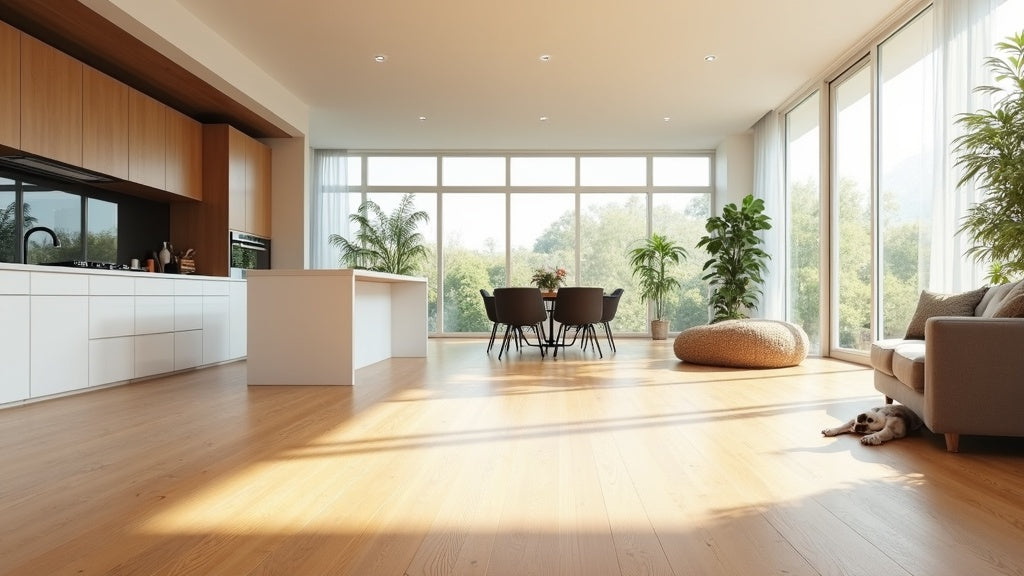
Humidity changes the moisture content of a floor's core material, and different hard flooring materials respond to that shift in very different ways. Wood-based products, including solid hardwood, engineered hardwood, and laminate, absorb and release moisture from the surrounding air, so they physically expand and contract as humidity rises and falls through the year. Composite-core products, including WPC vinyl flooring and stone-composite vinyl, use a core that is largely or entirely mineral and plastic rather than organic, so they stay dimensionally stable no matter what the air around them is doing. Understanding this one difference explains most of what separates a floor that stays quiet and flat year after year from one that visibly moves with the seasons.
This is not a checklist of installation steps or a guide to fixing a floor that has already moved. It is the underlying material science that should inform a flooring decision before a single plank is purchased, for any climate, in any home.

What Actually Causes a Floor to Respond to Humidity?
Wood is hygroscopic, meaning it constantly absorbs and releases moisture from the surrounding air until it reaches equilibrium with the humidity in the room. As that internal moisture content rises, wood fibres swell; as it drops, they shrink. Because the swelling and shrinking happen mostly across the width of a board rather than along its length, the visible effect is a floor that appears to grow slightly wider in humid conditions and narrower in dry conditions.
Composite materials do not work this way. A core made from limestone powder and plastic, or from a foamed polymer blend, has essentially no capacity to absorb water vapour from the air. Without moisture absorption, there is no swelling and shrinking cycle to begin with. This is the entire mechanism behind why some hard flooring categories are humidity-sensitive and others simply are not.
How Do Humidity Patterns Actually Change Through a Year?
Most homes see two humidity extremes rather than one steady level. Summer humidity tends to climb, especially in warm, humid, or coastal climates where the air itself holds more moisture. Winter brings the opposite problem in colder climates: heating systems dry out already-cold outdoor air as they bring it up to room temperature, so indoor relative humidity can drop sharply during the heating season even in a home that felt humid a few months earlier.
Climate also sets the baseline before seasonal swings are even factored in. Coastal and humid regions generally sit at a higher year-round ambient humidity than arid, high-elevation, or continental interior regions, which tend to run drier overall and see wider day-to-night humidity swings. Neither pattern is inherently a problem for hard flooring. The question is simply how much a given material's dimensions will move in response, and whether that movement is a variable the material was designed to absorb.
Which Hard Flooring Materials Are Most Sensitive to Humidity?
Any material built around real wood or wood fibre carries some hygroscopic behaviour, though construction changes how much that behaviour shows up in the finished floor.
Solid hardwood
Solid hardwood is a single piece of wood from surface to subfloor, so it carries the full hygroscopic behaviour of the species it is milled from. It is the most humidity-responsive hard flooring material on the market, which is exactly why real wood flooring has such a long, well-documented history of being paired with climate control and stable indoor conditions.
Engineered hardwood
Engineered hardwood pairs a real wood veneer surface with a cross-layered core, typically plywood or high-density fibreboard, where each layer runs in a different grain direction. That cross-graining meaningfully improves dimensional stability compared to solid wood, because the layers resist each other's movement rather than all swelling and shrinking in the same direction at once. For a deeper look at how the two compare, see Engineered Hardwood vs Solid Hardwood: Which Is Better for Your Home?.
Engineered construction reduces humidity sensitivity; it does not eliminate it. The surface is still a real wood veneer, and real wood still exchanges moisture with the air. That is a separate question from whether engineered hardwood tolerates standing water or heavy moisture exposure, which it genuinely does not, covered in more depth in Is Engineered Hardwood Waterproof? What It Can and Cannot Handle.
Laminate
Laminate's core is high-density fibreboard, which is compressed wood fibre and resin. Even though many laminate wear layers carry strong topical water resistance ratings that protect against surface spills, that surface protection is a separate property from the core's underlying material. Because the core itself is wood-based, laminate still responds to sustained ambient humidity over time the same way other wood-fibre products do, even on a floor whose surface shrugs off a spilled glass of water without a mark.

Which Hard Flooring Materials Stay Stable Regardless of Humidity?
The materials below share one trait: a core with little or no organic wood content, which is what removes the hygroscopic response entirely.
WPC vinyl flooring
WPC vinyl flooring uses a foamed composite core built from plastic and mineral fillers. A composite core like this is not hygroscopic and will not move with ambient humidity, so it stays dimensionally stable through the seasonal swings that make wood-based floors expand and contract.
SPC vinyl flooring
Stone plastic composite vinyl uses a core built primarily from limestone powder bound with plastic resin. That mineral-heavy composition is chemically inert to moisture, so SPC stays dimensionally stable across the full range of humidity a home can experience. The trade-off against WPC is comfort underfoot and sound, not humidity performance; see SPC vs WPC Vinyl Flooring: What is the Difference and Which Is Better? for the full comparison.
A waterproof composite core is also what allows these products to be sold as genuinely waterproof flooring, since a core with no organic material has nothing in it for moisture to damage from below, the same underlying property that delivers humidity stability from above.
Tile and natural stone
Fired ceramic, porcelain, and quarried stone are mineral materials with no hygroscopic behaviour at all. Ambient humidity has essentially no effect on their dimensions. Their real limitation is elsewhere, in impact resistance and installation complexity, not in how they respond to a humid summer or a dry winter.
Comparing Humidity Sensitivity Across Hard Flooring Materials
| Material | Core composition | Response to ambient humidity |
|---|---|---|
| Solid hardwood | Single-species solid wood | Most sensitive; expands and contracts with seasonal moisture content |
| Engineered hardwood | Real wood veneer over a cross-layered plywood or fibreboard core | Meaningfully more stable than solid wood; the wood veneer surface still responds somewhat |
| Laminate | High-density fibreboard (wood fibre and resin) | Core is wood-based and moisture-reactive over time, separate from its topical spill resistance |
| WPC vinyl flooring | Foamed composite core of plastic and mineral fillers | Dimensionally stable regardless of humidity |
| SPC vinyl flooring | Limestone powder and plastic resin | Dimensionally stable regardless of humidity |
| Tile and natural stone | Fired ceramic or quarried mineral | Essentially unaffected by ambient humidity |
Does Humidity Sensitivity Mean a Wood Floor Is a Bad Choice?
No. Humidity sensitivity is a trade-off, not a disqualifier. Solid and engineered hardwood offer a real wood surface, a warmth and depth that manufactured surfaces still work to replicate, and, for engineered products, genuine refinishing potential over the life of the floor. Those qualities are worth something on their own terms, and a wood-based floor performs well in a home where indoor conditions stay reasonably consistent, which describes most centrally heated and cooled homes for most of the year.
Neither direction is automatically correct. The honest starting point is the home's actual humidity pattern, not a blanket rule that one category of material always wins.
How Should Climate Factor Into a Hard Flooring Decision?
Look at how much ambient humidity actually swings in the specific space, not just the region overall. A below-grade space, a room with a lot of glazing, a consistently humid coastal climate, or a consistently dry arid or high-elevation climate all sit at a different baseline than a temperate, centrally conditioned main floor. Ambient air humidity is also a distinct question from ground or subfloor moisture, which is a separate risk covered in Moisture and Vapor Barriers: What Canadian Homeowners Actually Need; a floor can sit above a dry, well-sealed subfloor and still respond to a humid room, and the reverse is also true.
In a space with wide or extreme humidity swings, or inconsistent indoor climate control, a dimensionally stable composite or mineral floor removes humidity from the list of variables entirely. In a more typical, consistently conditioned space, weigh how much the aesthetic of a real wood surface matters against how much dimensional predictability matters. A dimensionally stable material takes humidity off the table as a factor to plan around; a wood-based material simply asks the room's indoor climate to stay within a reasonable, ordinary range.

Frequently Asked Questions
A few quick answers to the questions people ask most about humidity and hard flooring.
Does ambient humidity affect vinyl flooring?
It depends on the core. A composite or stone-based vinyl core, including a WPC core, is dimensionally stable regardless of humidity.
Is engineered hardwood more humidity-stable than solid hardwood?
Yes, meaningfully. The cross-layered core construction resists movement better than a single solid board, but the real wood veneer surface still exchanges moisture with the air, so engineered hardwood is more stable than solid wood, not immune to humidity.
Does a dry climate matter as much as a humid one?
Yes. Wood-based materials contract in dry conditions the same way they expand in humid ones. A consistently dry, arid, or high-elevation climate puts the same kind of demand on a wood-based floor as a consistently humid one, just in the opposite direction.
Are tile and stone a good choice in a humid climate?
Yes, from a purely humidity standpoint. Fired ceramic, porcelain, and quarried stone have no hygroscopic behaviour, so ambient humidity has essentially no effect on them. Their other trade-offs, such as installation complexity and a harder, colder surface underfoot, are separate considerations from moisture.
Contact us with any questions about choosing the right hard flooring for your home.
To find waterproof vinyl flooring, click here for a Caledon Floors dealer near you.