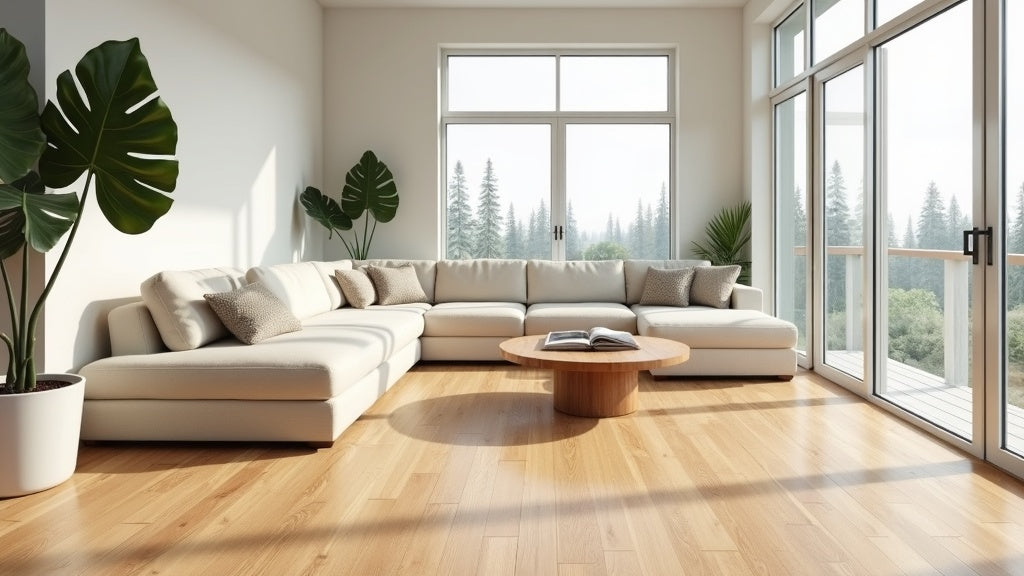
A quality vinyl plank floor is built to serve a home for decades. The honest answer to "how long?" has everything to do with how the floor is made and very little to do with the category label on the box. Wear layer thickness, the stability of the core, and a few simple care habits determine whether a floor stays beautiful for a generation or starts to show its age well before its time.
This guide covers what actually drives longevity in vinyl plank flooring, why WPC vinyl flooring holds up especially well in Canadian homes, and what basic care keeps a floor looking its best for years to come.

What Determines How Long a Vinyl Plank Floor Lasts?
Three layers of construction do most of the work, and they function as a system.
The wear layer sits on top. It is the clear, hardened protective coating that stands between the decorative surface of the plank and the daily friction of foot traffic, furniture, pets, and everything else a lived-in home can throw at a floor. The thicker the wear layer, the longer the surface holds up before showing wear.
Below the wear layer, the core determines how stable the floor stays through the seasonal humidity and temperature swings that define Canadian climate. A core that shifts, swells, or warps stresses the locking joints between planks and, over time, shows up as gapping, creaking, or an uneven surface. A stable core keeps the whole floor locked and level through years of seasonal cycling.
Below the core, an attached comfort pad softens the underfoot feel and absorbs minor subfloor irregularities that would otherwise concentrate stress at the locking joints. It is a quiet contributor to long-term performance: the less mechanical stress the joints absorb from below, the longer the floor holds together.
When all three are engineered well, the result is a floor that performs reliably year after year without demanding attention.
Why Does Wear Layer Thickness Matter So Much?
The wear layer is the specification most worth understanding when choosing a vinyl plank floor.
Wear layers are measured in mils, which are thousandths of an inch. A 20-mil wear layer, the standard on premium WPC vinyl, is a full half-millimetre of hardened protection over the print layer. That thickness is meaningful in daily use. Chair legs that travel back from a table several times a day, dog claws on a Saturday morning, salt-crusted boots dragged across a kitchen floor from November through April in most of Canada: a 20-mil layer absorbs all of this without the surface giving ground.
Thinner wear layers work well in lighter-duty applications. A bedroom, a guest room, a home office that sees minimal foot traffic: a thinner wear layer performs fine in those spaces. But for a main floor, a kitchen, a mudroom, or any room that sees concentrated daily use, the 20-mil tier is where long-term confidence comes from. The wear layer is the single most direct predictor of how the surface holds up over time, and it is the first number worth looking at when evaluating any vinyl plank floor.
For a deeper look at how to evaluate wear layer options against room use, How to Choose the Right Wear Layer for Vinyl Flooring in Canada walks through the full decision.
What Makes WPC Vinyl Flooring Built for the Long Haul?
WPC vinyl earns its reputation for durability primarily through the core, not the surface alone.
Premium WPC floors use a stable waterproof composite core, and that has real consequences for longevity in Canada. Cores that absorb moisture move with the seasons, and in a country where indoor humidity can swing from the bone-dry air of a Prairie January to the damp, mild stretch of a BC November, that absorption shows up as dimensional change: planks that expand in humid seasons and contract in dry ones. The joints between planks bear the brunt of those cycles.
A composite WPC core stays dimensionally stable through that full range. The planks hold their shape; the joints stay tight; the surface stays level. Over many years in a Canadian home, that stability is what keeps a floor looking and performing as it did on day one.
That same composite core is also what makes WPC a genuinely waterproof flooring option, not simply water-resistant. The waterproof construction runs through the full thickness of the plank, so a spill that sits for an hour, a slow dishwasher leak discovered too late, or a confident damp mopping does not compromise the structure of the floor. The water has nowhere to go and nothing to damage.
For more on how waterproof construction works across flooring categories, Waterproof Flooring: What Canadian Homeowners Need to Know covers the practical distinctions clearly.

How Does Everyday Care Extend the Life of a Vinyl Floor?
A premium WPC floor is not fragile. It is built to handle real life. But there is a straightforward set of habits that separates a floor that looks as good at year fifteen as it did at year one from one that ages noticeably before its time.
Regular sweeping or vacuuming is the most important single habit. Fine grit, the kind that tracks in on shoes, especially in salt season, acts as a mild abrasive on the wear layer surface over time. Removing it consistently means the wear layer is only fighting foot traffic, not foot traffic plus sandpaper.
Damp mopping with a pH-neutral cleaner handles everything else. Vinyl plank does not need much: a light pass with a well-wrung mop and a gentle cleaner keeps the surface clean without stressing the protective finish. Harsh chemical cleaners and abrasive pads are the main care mistakes: they degrade the wear layer's finish gradually, which is exactly the opposite of what you want to be doing to the most important durability layer in the floor. The guide at How to Clean Vinyl Plank Flooring covers what works and what to skip.
Entry mats at every exterior door capture the grit before it reaches the floor. In a Canadian household, this is a meaningful contribution. Salt crystals and sand tracked in during the winter months are coarser and more damaging than ordinary dust. A good mat at the front door and the back door eliminates the majority of that abrasive load before it ever contacts the floor.
Felt pads under furniture legs round out the basics. Concentrated load scuffing, from chairs pushed back from tables or furniture shifted during a room refresh, accumulates across years of use. Felt pads spread the load and prevent it from building up.
Is WPC Vinyl Durable Enough for Canadian Families?
Canadian homes put floors through a wider seasonal range than most climates, and they put floors through heavy daily use on top of that.
Open-concept main floors that take traffic from the front door, through the kitchen, and into the living room. Mudrooms that see wet boots and tracked-in sand from October through April. Family kitchens where the floor is the busiest surface in the house. These are the conditions a floor needs to handle not just today but for many years.
The combination of a 20-mil wear layer and a waterproof composite core is well-suited to exactly this kind of use. Families with kids and pets find the durability especially reassuring. Pets, Claws, and Accidents: What to Really Expect from Pet-Friendly Floors covers how vinyl holds up against the specific challenges pets bring, from claws to the occasional accident.
WPC vinyl also competes well across flooring categories when durability over the long term is the deciding factor. SPC vs WPC Vinyl Flooring: What Is the Difference and Which Is Better? explains how the two constructions compare in real-world use.
What Separates a Long-Lasting Vinyl Floor from a Short-Lived One: A Quick Comparison
| Durability Factor | Entry-Level Vinyl | Premium WPC Vinyl |
|---|---|---|
| Wear layer thickness | Typically 6 to 12 mil | 20 mil (.5mm) |
| Core stability | Can shift with humidity changes | Composite core; dimensionally stable through Canadian seasons |
| Waterproof construction | Surface-resistant; core may absorb moisture | Full-depth waterproof throughout the plank |
| Comfort underlay | Often requires a separate purchase | Attached pad included |
| Acoustic performance | Minimal | STC and IIC rated on premium collections |
| Best suited for | Low-traffic spaces, secondary rooms | Main floors, kitchens, mudrooms, high-traffic family use |
This is a qualitative overview. Specifications vary by product; always review the specs for any floor you are considering.

Frequently Asked Questions
A vinyl plank floor is one of the more considered purchases most homeowners make. These are the questions that come up most often.
Does wear layer thickness really make that much difference?
Yes, in high-traffic spaces. The wear layer is the surface's primary defence against the friction of daily use. In a low-traffic room, the difference between a 12-mil and a 20-mil layer may not be visible for a long time. In a main floor kitchen or a busy entryway, the gap becomes apparent much sooner.
Does a thicker plank last longer?
Total plank thickness contributes to rigidity and underfoot feel, but the wear layer is the more direct longevity factor at the surface. A 12mm WPC plank has a more substantial, quieter feel than a thinner plank and holds up better over subfloor imperfections, but the wear layer is what determines how long the surface stays looking new under daily use.
Does vinyl plank hold up to Canadian winters?
WPC vinyl is particularly well-suited to Canadian conditions. The composite core does not respond to seasonal humidity swings the way wood-based materials do, which means the floor stays stable through the full range from dry Prairie winter air to damp BC fall weather. Salt and sand tracked in during winter are the main surface stress; entry mats handle the bulk of that.
Is vinyl plank flooring good for high-traffic homes with kids and pets?
A premium WPC floor with a 20-mil wear layer is among the most practical choices for busy family households. The waterproof construction handles spills and accidents; the thick wear layer handles claws, dropped things, and the concentrated foot traffic of a lively home.
How does care affect how long the floor lasts?
Consistent basic care, sweeping to remove grit, damp mopping with a gentle cleaner, entry mats at exterior doors, and felt pads under furniture, makes a meaningful difference over the years. None of it is demanding. The floors that age best are almost always the ones that received simple, consistent care rather than occasional intensive cleaning.
At Caledon Floors, a Canadian hard-surface flooring distributor based in Vancouver, BC, our WPC vinyl collections are built to handle the demands of real Canadian homes. If you have questions about which floor fits your space, contact us here.
To find waterproof vinyl flooring in Canada, click here for a Caledon Floors dealer near you.