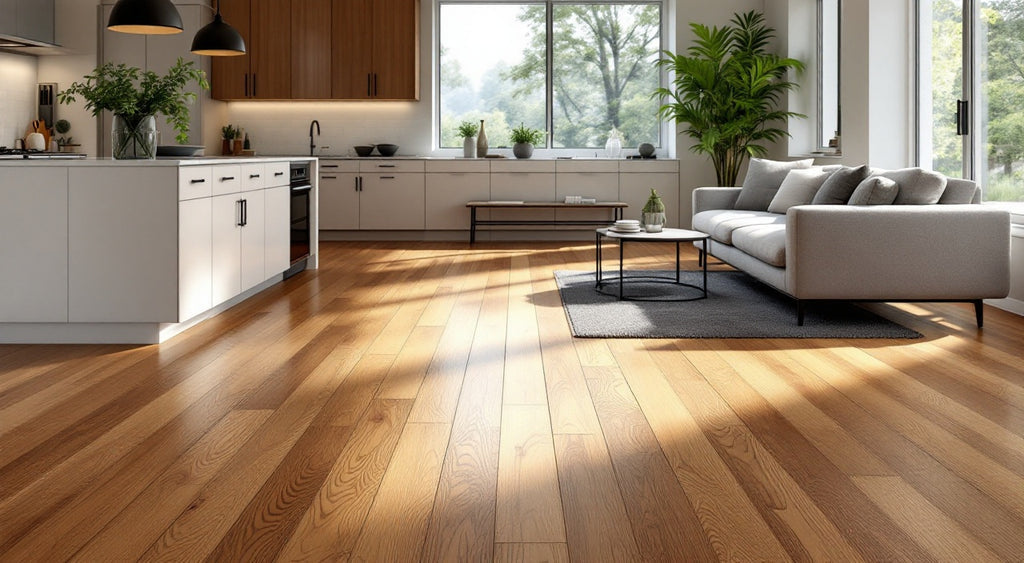
Engineered hardwood needs a full deep clean about once a month, on top of daily dusting or sweeping and a weekly vacuum. That cadence comes from the National Wood Flooring Association's homeowner maintenance guidance, and it holds whether the floor is three months old or fifteen years old. The real variable is not the calendar. It is how much foot traffic, grit, and moisture the floor sees between cleanings.
This guide breaks down what actually counts as routine maintenance versus a deep clean, what products are safe to use, how humidity changes the picture, and when a floor needs more than cleaning, specifically a recoat or a full refinish.
How Often Should You Deep Clean Engineered Hardwood Floors?
Monthly is the baseline for a full wood floor cleaner pass. Daily dusting or sweeping and weekly vacuuming handle the grit that causes most of the actual wear, so the monthly deep clean is really about lifting the oily film, footprints, and fine dust that routine dry cleaning leaves behind.
Homes with kids, pets, or heavier foot traffic often need that deep clean every two to three weeks instead of monthly. A rarely used formal room can sometimes stretch past a month between cleans. The schedule below is a starting point, not a rule that overrides how the floor actually looks and feels underfoot.
| Task | Frequency | Purpose |
|---|---|---|
| Dust, sweep, or dry-vacuum | Daily to a few times a week | Removes grit before it scratches the finish |
| Vacuum, bare-floor setting, no beater bar | Weekly | Pulls fine dust and debris out of the seams |
| Full deep clean with a wood floor cleaner | Monthly | Lifts oily residue and embedded dirt that dry cleaning misses |
| Recoat, new finish layer, no sanding | When the finish looks dull, often every few years | Restores shine and wear protection without removing wood |
| Full refinish, sand and refinish | Roughly every 3 to 5 years, sooner with heavy traffic | Removes deep scratches and worn finish down to bare wood |

What Counts as a Deep Clean, Versus Everyday Maintenance?
Everyday maintenance is dry: a broom, a dust mop, or a vacuum on the bare-floor setting. None of that involves liquid touching the floor, so it carries essentially no risk to the finish.
A deep clean adds a cleaning solution and a damp, not wet, application. That is the step that actually needs a schedule, because it is the one that can damage the finish if done too often with the wrong product, or too rarely to keep oily buildup from dulling the surface.

What Should You Use for a Deep Clean?
A pH-neutral cleaner made specifically for finished wood floors, applied with a well-wrung microfibre mop pad, is the safe standard. The floor should end up looking damp, never wet, and should dry within a minute or two of the mop passing over it.
Skip anything acidic or alkaline enough to strip a finish over time. That includes vinegar and water, ammonia-based cleaners, and bleach. Vinegar is a common home remedy that actually works against the finish with repeated use, not for it. Also skip oil soaps and general-purpose sprays not formulated for wood floors, since both can leave a residue that dulls the surface or makes it feel slippery.
Wet mops and steam mops are the two tools to avoid entirely. Steam pushes both heat and moisture through the finish and into the seams between boards, and a standard string mop puts down far more water than a wood floor's finish is designed to shed. Either one, used repeatedly, works moisture into the wood itself.
How Do You Deep Clean Without Damaging the Finish?
Vacuum or dry-mop first, every time, before any liquid touches the floor. Skipping this step means grinding grit into the finish once the mop passes over it, which causes the fine scratching that dulls a floor faster than normal wear.
Apply the cleaner to the mop pad, not directly to the floor, and work in small sections so nothing sits wet for more than a minute or two. Wipe up any pooling immediately with a dry cloth. Let the floor air dry fully before walking on it or setting furniture back down.
Blot spills the same way, the moment they happen, rather than waiting for the next scheduled clean. A spill left overnight does more damage than a year of properly timed monthly cleaning.
Does Humidity Change How Often a Floor Needs Attention?
Indirectly, yes. The National Wood Flooring Association recommends keeping indoor relative humidity between 30 and 50 percent and temperature between 60 and 80 degrees Fahrenheit for wood flooring generally. Outside that range, the wood itself starts reacting before a mop ever touches it.
Too much humidity and the boards can cup, meaning the edges sit slightly higher than the centres. Too little and they can gap or split as the wood loses moisture. Neither problem is fixed by cleaning more or less often. It is fixed by a humidifier or dehumidifier keeping the home in range year-round, which also protects whatever finish is already on the floor.
How Is Cleaning Engineered Hardwood Different From Cleaning WPC Vinyl Flooring?
The cadence is similar. What changes is how much margin for error the floor gives you. Engineered hardwood's wear layer is a real wood veneer, so it reacts to standing moisture the way any wood does: it can absorb it, swell, and eventually damage the finish or the wood underneath. WPC vinyl flooring is built around a fully waterproof composite core, so a damp mop pass carries essentially none of that same risk.
That is not a reason to treat engineered hardwood as fragile. It is a reason to be more deliberate about how much liquid touches it and how quickly it dries. Waterproof flooring like WPC vinyl tolerates a wetter mop and a faster pace; engineered hardwood rewards the slower, damp-only approach described above.
| Engineered hardwood | WPC vinyl flooring | |
|---|---|---|
| Surface material | Real wood veneer | Waterproof composite core |
| Deep clean cadence | About monthly | About monthly |
| Standing moisture tolerance | Low, dries fast, damp cloth only | High, fully waterproof core |
| Steam mop recommended | No | Not typically, check the manufacturer's care guidance |
What Are the Signs a Floor Needs More Than a Deep Clean?
A dull, hazy look that a clean does not fix is usually a worn finish, not a dirty floor. That typically calls for a recoat: a new layer of finish applied over the existing surface, with light abrasion first but no sanding down to bare wood. It is faster and less invasive than a full refinish.
Deeper scratches, discolouration in high-traffic paths, or a finish worn through in spots point to a full refinish instead. That means sanding the existing finish off and reapplying it, which only works if enough wear layer remains. The National Wood Flooring Association sets a flat sanding-safety threshold: a floor should not be sanded if less than 3/32 inch (2.5 millimetres) of wear layer remains. A typical refinishing pass removes roughly 1/32 inch (0.8 millimetres), and a heavier correction for deep scratches or unevenness can remove up to about 1/16 inch (1.6 millimetres).
NWFA guidance points to a refinish roughly every 3 to 5 years for an actively used wood floor, though that is a rough average, not a fixed clock. A well-maintained floor in a lower-traffic room can go well past that; a heavily used one can need it sooner. The wear layer remaining, not the calendar, is the number that actually decides whether refinishing is still an option.

Frequently Asked Questions
These are the specific questions that come up most often once the basic monthly-cleaning cadence is clear. Each answer below assumes a factory-finished engineered hardwood floor in normal residential use.
Can I use a steam mop on engineered hardwood?
No. Steam forces both heat and moisture into the finish and the seams between boards, and the National Wood Flooring Association specifically flags steam mops as more damaging over time than almost any other common cleaning mistake. Stick to a damp, well-wrung microfibre mop instead.
How do I remove sticky residue without damaging the finish?
Use a small amount of pH-neutral wood floor cleaner on a soft cloth and blot rather than scrub. Scrubbing at a sticky spot with pressure can dull or scratch the finish before the residue actually lifts. If it does not release easily, a second light pass usually works better than more pressure on the first.
Do all engineered hardwood floors need the same cleaning cadence?
The monthly baseline holds across most factory-finished floors, but higher-traffic homes with kids or pets often need a deep clean every two to three weeks rather than monthly. A rarely used room can sometimes go longer between cleans. Watch how the floor actually looks rather than following the calendar rigidly.
Can I use vinegar and water to clean engineered hardwood?
It is not recommended. Vinegar is acidic, and while a heavily diluted mix will not damage a floor overnight, repeated use gradually dulls and degrades most wood floor finishes. A cleaner formulated specifically for finished wood floors avoids that risk entirely and is not meaningfully more expensive or harder to find.
Understanding the right cleaning cadence is only part of protecting a wood floor long term. For more on choosing the wear layer thickness that gives a floor the most refinishing life, see How Thick Should an Engineered Hardwood Wear Layer Be?. For the fuller picture on when refinishing is worth it and what it involves, read Can Engineered Hardwood Be Refinished?. If moisture exposure is a bigger concern in your home, Is Engineered Hardwood Waterproof? covers what the material can and cannot handle. For the habits that protect any hard floor day to day, see Everyday Habits That Protect Any Hard Floor, and for the complete buying picture, start with Best Engineered Hardwood Flooring: The 2026 Buyer's Guide. If you are weighing engineered hardwood against a lower-maintenance option, How to Clean Vinyl Plank Flooring walks through the equivalent routine for that material.
Have more questions about keeping a floor in shape long term? Contact us any time.
To find waterproof vinyl flooring, click here for a Caledon Floors dealer near you.