By Caledon Floors. Caledon Floors sources and distributes engineered hardwood, WPC vinyl, and other hard-surface flooring, which means evaluating spec sheets from multiple manufacturers against the same primary-source standards before a product ever reaches a showroom floor. This guide applies that same discipline. Last verified: July 2026.
The best engineered hardwood flooring is not the one with the best photo online. It is the one whose veneer thickness, grade, core construction, and finish line up honestly with what a specific room actually needs to do every day. This guide, produced by Caledon Floors, walks through engineered hardwood flooring in the order a careful buyer should actually weigh it: veneer and refinishing, grade and species, core construction, plank size, finish, moisture reality, certifications, and the honest state of the market. Every technical claim below is checked against the organization that actually defines it, the National Wood Flooring Association (NWFA) for sanding and refinishing, the National Hardwood Lumber Association (NHLA) for grading terminology, and CARB2 / EPA TSCA Title VI for formaldehyde emissions, not a paraphrase, a marketing sheet, or an AI-generated summary. Where a number could not be confirmed against its primary source, it was left out rather than guessed at.
What Is Engineered Hardwood Flooring, Exactly?
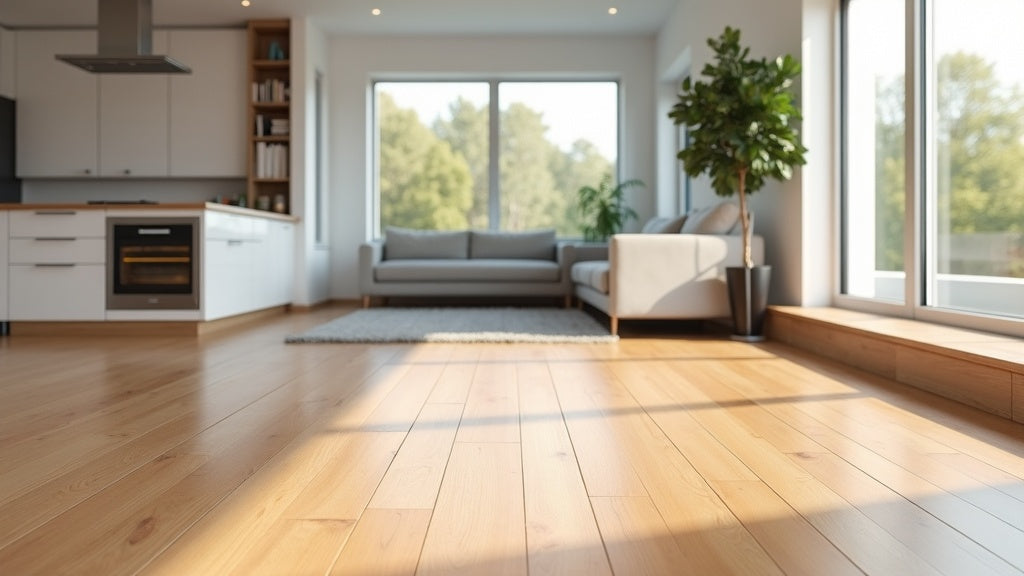
Engineered hardwood flooring is a real hardwood wear layer, called a veneer, bonded to a plywood or high-density fibreboard (HDF) core. The top surface is genuine wood: the same species, grain, and colour variation you would get from solid hardwood. The core underneath is what makes it "engineered," layers of wood or wood fibre cross-oriented for stability, rather than one solid piece of lumber running top to bottom.
That single distinction explains almost everything else in this guide. Because only the top layer is solid wood, veneer thickness becomes the number that governs refinishing life. Because the core is engineered rather than solid, dimensional stability, subfloor compatibility, and install locations all open up compared with solid hardwood. It is a different product from laminate, which has no real wood anywhere, just a printed image layer over a fibreboard core, and different again from WPC vinyl flooring, which pairs a printed wood-look layer with a waterproof composite core.
How Thick Does the Veneer Need to Be to Refinish an Engineered Floor?
Thick enough to clear 2.5mm (3/32") of remaining wear layer after sanding, according to the NWFA's Wood Flooring Sand and Finish Guidelines: "if the wear thickness is less than 3/32" (2.5 mm), the floor should not be sanded." That is a flat threshold, not a sliding scale. A floor either clears it or it does not.
The NWFA's Engineered Wood Flooring Refinishable Program sets its own minimum wear-layer thresholds for a floor to qualify at all: 3.2mm (4/32") for unfinished smooth flooring, 2.5mm (3/32") for factory-finished smooth flooring, and 2.5mm at the lowest point for sculpted or distressed flooring.
A typical full refinishing pass removes about 0.8mm (1/32") of wood, rising to roughly 1.6mm (1/16") for a heavier correction job, such as deep scratches, cupping, or an uneven factory finish. Use 0.8mm as the best case and up to 1.6mm as the realistic range for a harder job.
Do the math yourself before buying: a veneer around 4mm clears the 2.5mm threshold with roughly 1.5mm to spare, enough margin to absorb one typical-to-heavy refinish and plausibly still qualify afterward. A veneer at 2mm starts below the threshold the NWFA itself says warrants sanding in the first place, regardless of what any spec sheet claims. This is buyer math about the category, not a claim about any specific product's outcome. When we vet an engineered hardwood product before agreeing to bring it into our line, veneer thickness against this exact threshold is the first number we check, ahead of grade, ahead of finish, ahead of anything printed on a box.
One real-world nuance worth knowing: factory-applied aluminum oxide finishes are hard to abrade, which is good for everyday wear but makes them difficult to sand through cleanly. Professional finishers typically use diamond-head sanding equipment for this reason, and even experienced finishers occasionally sand through a thin veneer by misjudging it. Thickness on the spec sheet only protects you if the person doing the sanding respects it.
For the full mechanics of what refinishing an engineered floor actually involves, see can engineered hardwood be refinished. For the full mm-by-mm breakdown of what 2mm, 3mm, and 4mm+ wear layers actually buy you, see how thick should an engineered hardwood wear layer be.

What Does "Select & Better" Actually Mean?
"Select & Better" is a real, published grading term, not a marketing invention, but it means something narrower on an engineered floor than most buyers assume.
The term originates with the NHLA, the National Hardwood Lumber Association, which defines grading rules for solid lumber. Its top two hardwood grades are FAS (First and Seconds), which requires a minimum of 83⅓ percent of each board face to be clear, defect-free wood, and Select, a very similar clear-wood standard applied to smaller board sizes. In the trade, FAS and Select combined are called "Select & Better." Critically, NHLA grades apply to both faces of a solid board, because a raw board of lumber can be milled or used from either side.
Engineered hardwood only has one visible wood face: the veneer bonded to the plywood or HDF core underneath. There is no second wood face to grade. So when "Select & Better" appears on an engineered hardwood spec sheet, it is borrowing the name from the lumber standard, not its two-face mechanics. On an engineered floor, it functions as a single-face appearance grade, a description of how clean and uniform that one visible surface looks: fewer knots, less mineral streaking, less sapwood, more consistent colour, versus a more rustic, character-graded look with visible natural markings.
That distinction matters because there is no single regulated veneer-appearance standard the way there is for solid lumber grading. "Select & Better" as applied to an engineered veneer is an industry convention that varies somewhat by manufacturer. It is real and meaningful as a description of appearance, but it is not a durability rating, and a lower, more character-driven grade is a different look, not a worse floor. What we tell buyers who ask us about this term directly: ask to see the actual face grade in person, since the same "Select & Better" label can look meaningfully different from one manufacturer's veneer to another's.
For how grade actually changes the way a room reads, see how engineered hardwood grade changes the look of a floor.
Which Wood Species Should You Choose?
Species mostly decides colour range, grain pattern, and how forgiving the floor is of dents, not whether the floor is a good engineered product. Oak, both red and white, remains the most common choice for engineered hardwood because it takes stain evenly and its natural grain hides everyday wear well. Hickory is harder and more dramatic, with strong grain and colour variation, which suits a rustic or high-character look but is less forgiving to match if you ever need to extend the floor later. Maple has a tight, subtle grain and a clean, contemporary look, but it can stain unevenly, so it usually appears in natural or lightly-tinted finishes rather than deep stains. Walnut offers rich, warm colour but is a softer wood, so it shows dents and wear sooner than oak or hickory.
Because the wear layer is thin relative to solid lumber, the factory finish, not the species itself, does most of the work protecting the surface day to day. Species is primarily a design decision. Choose it for colour and grain, not for a durability outcome the finish is actually responsible for.

What's Under the Veneer? Core Construction and Dimensional Stability
The core is what makes engineered hardwood "engineered," and it is the reason engineered hardwood can go places solid hardwood generally cannot. A plywood or cross-laminated core is built from layers oriented in alternating directions, which resists the expansion and contraction that solid wood experiences as humidity changes through the year. Solid hardwood is one piece of wood top to bottom, so it moves more as a whole board, which is why it typically needs a wood subfloor, a longer acclimation period, and is not usually recommended over concrete.
Engineered hardwood's layered core gives it meaningfully better dimensional stability, which is why it is commonly installed over concrete slabs (subject to the specific product's rating and proper subfloor prep) and in basements and other spaces where solid hardwood would be a poor fit. This does not make engineered hardwood immune to humidity, only more stable than solid wood under the same conditions.
For how this plays out over a specific subfloor type, see can engineered hardwood go over concrete, for the fuller solid-versus-engineered trade-off, see engineered hardwood vs solid hardwood, and for what ply count and core material actually mean, spec sheet to spec sheet, see how engineered hardwood is built: core layers and ply count.
Does Plank Size Change How the Floor Performs?
Yes, in both looks and installation forgiveness. Wider, longer planks read as more contemporary and show fewer seams across a room, which is why long-format planks are a popular premium choice. The trade-off is that longer boards amplify any unevenness in the subfloor and are less forgiving of small acclimation-driven movement, so subfloor flatness matters more as plank length and width increase. Narrower, shorter planks are more traditional in appearance and more forgiving during installation, since minor subfloor imperfections are easier to hide across shorter runs.
Neither size is objectively better. It is a genuine trade-off between a specific aesthetic and installation tolerance, and the right call depends on how flat and well-prepared the actual subfloor is before installation starts.
See how engineered hardwood width and length change the look of a floor and subfloor preparation mistakes before committing to a long-plank format.
How Much Does the Finish Matter?
The factory finish does more day-to-day protective work than most buyers expect, and its sheen changes how the room actually looks and lives. Most engineered hardwood today ships with a factory-applied, UV-cured aluminum oxide finish, which is hard-wearing and consistent because it is applied and cured under controlled conditions rather than on site. Sheen level, matte, satin, or gloss, is a separate decision from finish durability: matte and low-sheen finishes hide dust, footprints, and light surface scuffing better, while higher-gloss finishes show more of both but read as more formal and reflective.
Finish quality changes how a floor wears over time; it does not exempt a floor from physical protection. A rolling desk chair, a heavy stationary appliance, or any sustained concentrated point load will mark any floor, regardless of finish hardness or wear-layer thickness, without a proper chair mat, rug, or furniture pad underneath. Treat finish and sheen as a wear-visibility and style decision, not a substitute for protecting the floor where it needs protecting.
For a full breakdown of sheen options, see matte, satin, or glossy.
Is Engineered Hardwood the Right Choice for a Humid or Wet Space?
No, not for genuinely wet rooms, and this is the honest answer most buying guides avoid. Because the wear layer is real wood, engineered hardwood reacts to sustained moisture and humidity swings, swelling, cupping, or discolouring, more than a synthetic-surfaced floor does. Engineered hardwood is not a moisture-resistant category. It is a real-wood category with better dimensional stability than solid hardwood, which is a different claim.
Compared honestly against the alternatives: many current laminate lines carry topical water-resistance ratings of up to 72 hours, often with wax-sealed edges that reduce edge swelling, giving laminate a real moisture advantage over engineered hardwood in a direct comparison, even though laminate has no real wood surface at all. For genuinely wet, high-risk rooms, kitchens with dishwashers, bathrooms, laundry rooms, entries, and basements, the more reliable category is WPC vinyl flooring, whose composite core is fully waterproof, because it does not contain a wood surface that can react to standing or absorbed moisture the way engineered hardwood's veneer does.
None of this makes engineered hardwood a poor choice. It makes it the wrong choice for the wettest, highest-risk rooms in a home, and a strong choice everywhere else: living rooms, bedrooms, dining rooms, and any space with reasonably stable indoor humidity, where its authentic wood beauty and refinishing potential are real, lasting advantages that waterproof flooring categories cannot match. What we tell dealers to ask a buyer before recommending engineered hardwood is simple: what happens in this room when something spills and nobody notices for a day. If the honest answer is a wet room, we point them elsewhere, regardless of what is easier to sell.
See is engineered hardwood waterproof for the full room-by-room breakdown, and engineered hardwood vs laminate for how the two compare beyond moisture.
What Certifications Actually Matter?
For engineered hardwood specifically, the certification to look for is CARB2, the California Air Resources Board's Phase 2 formaldehyde standard for composite-wood products, or its federal equivalent, EPA TSCA Title VI. Since 2019, products have certified to TSCA Title VI at the federal level, and its emission limits match CARB2's, so "CARB2 compliant" and "TSCA Title VI compliant" describe the same standard today: 0.05 ppm for hardwood plywood, 0.09 ppm for particleboard, 0.11 ppm for medium-density fibreboard, and 0.13 ppm for thin medium-density fibreboard, measured as formaldehyde emissions from the composite-wood component itself.
That last detail is the one buyers most often miss: CARB2 / TSCA Title VI tests the composite-wood core only, for formaldehyde specifically. It is narrower in scope than FloorScore, an SCS Global Services certification that tests a wider range of VOCs across the whole finished product, or UL GreenGuard Gold, which tests over 360 chemicals across the entire finished product and is commonly referenced for sensitive environments such as schools and healthcare facilities. An engineered hardwood floor being CARB2 or TSCA Title VI certified does not automatically mean it is FloorScore or GreenGuard Gold certified too, since those measure different things. If whole-product, low-VOC air quality matters to your household, for allergies, sensitivities, or a nursery, check specifically for FloorScore or GreenGuard Gold rather than assuming a formaldehyde certification covers it.
We do not agree to bring in an engineered hardwood product without a stated CARB2 or TSCA Title VI certification at minimum, and we tell dealers which additional certification to ask for when a household's air quality needs go beyond that baseline.
See low-VOC and non-toxic flooring: what GreenGuard Gold actually means for the fuller certification landscape.

What Drives the Price?
Veneer thickness, grade cleanliness, species, plank length, finish quality, and certification level all add cost, roughly in that order of impact. A thicker veneer costs more because it uses more of the valuable top layer of wood and supports more future refinishing life. A cleaner, more uniform grade costs more because more of the harvested wood gets rejected to achieve that consistency. Longer, wider planks cost more because they require larger, more uniform sections of veneer with fewer usable defects allowed. None of these are marketing add-ons; each one maps to a real material or manufacturing cost.
Two floors that look nearly identical in a photo can differ meaningfully in veneer thickness, core ply count, and finish process, which is exactly why price varies as much as it does within the category. Sourcing engineered hardwood from multiple manufacturers means seeing this gap directly: two products can land at very different costs for reasons that never show up in a listing photo. See engineered hardwood cost for installed cost ranges and what drives them, and why some engineered hardwood costs twice as much as other engineered hardwood for how to compare two similar-looking floors on paper.
Engineered Hardwood vs. the Alternatives: An Honest Comparison
No single flooring category wins every category. The table below states each material's real trade-offs, without a rigged outcome favouring any one of them.
| Material | Water / Moisture Resistance | Refinishing Potential | Real-Wood Look | Best Fit |
|---|---|---|---|---|
| Solid hardwood | Weakest of the four; reacts most to humidity swings | Highest; can typically be sanded and refinished many times over decades | Full-depth real wood, top to bottom | Stable, climate-controlled homes; long-term owners who value maximum refinish life |
| Engineered hardwood | Weaker than laminate or WPC vinyl; a real wood surface still reacts to sustained moisture | Good, if the veneer clears the NWFA's 2.5mm threshold with real margin; fewer total refinishes than solid wood | Authentic wood veneer surface | Living spaces with stable humidity; buyers who want real wood with better dimensional stability than solid hardwood |
| Laminate | Better than engineered hardwood in most modern lines; up to 72-hour topical ratings with wax-sealed edges | None; the surface is a printed image layer, not real wood | Photographic likeness only | Budget-conscious buyers and moderate-moisture rooms; not a refinishing option |
| WPC vinyl flooring | Strongest of the four; a fully waterproof composite core | None; there is no wood surface to sand | Realistic printed and textured likeness, not real wood | Kitchens, bathrooms, basements, entries, and any room where moisture is the primary risk |
Read this table as a decision tool, not a ranking. The "best" material is whichever row matches the room's actual moisture exposure and how much you value real, refinishable wood over synthetic durability.
For the deeper version of each comparison, see engineered hardwood vs solid hardwood, engineered hardwood vs laminate, and engineered hardwood vs vinyl.
Where Does Engineered Hardwood Work Best in a Home?
Living rooms, dining rooms, bedrooms, and hallways are the strongest fit, since these spaces rarely see standing water and benefit most from real wood's warmth and long-term look. Kitchens are a genuine judgment call: engineered hardwood can work there, but only with real planning around dishwasher and sink leak risk, since a slow undetected leak is a wood floor's actual failure mode, not everyday cooking splashes. Whole-home consistency is a separate, valid reason to choose engineered hardwood broadly, but it should not override the honest moisture guidance above for the rooms that genuinely need a waterproof category instead.
See engineered hardwood in kitchens: is it a good idea, kitchen flooring: tile, engineered hardwood, or vinyl, and should you use the same flooring throughout the house for the room-by-room detail.
How Much Should You Buy?
Order more than the bare square footage, because engineered hardwood is sold by the box and needs allowance for waste, cuts, and colour matching. Ten percent extra is the safe general rule for a straightforward room. Complex spaces with angles, diagonals, or island cutouts justify 10 to 15 percent. Engineered hardwood tends to run toward the higher end of that range compared with vinyl or laminate, since it is a natural material with random-length pieces and real colour variation, and cherry-picking longer boards for the centre of a room (where the eye lands) uses up more of the extra material than a fixed-length product would. Order everything from one batch or dye lot at once, since reordering later risks a visible colour mismatch, and keep a spare box on hand for future repairs.
Getting the subfloor right before installation matters as much as the material choice itself; see subfloor preparation mistakes and use how much flooring do I need to work through the actual math for your room.
The Honest Brand Landscape
Engineered hardwood spec sheets vary more than buyers expect, and the honest way to evaluate any manufacturer's product, not just one brand's, is to check the same handful of facts every time rather than trust the marketing description. What follows is the same checklist our own sourcing team runs on a product before we decide whether to bring it in at all, applied here to any manufacturer, not only the ones we work with.
Ask for the veneer thickness in millimetres, not a vague "premium" or "thick" descriptor, and check it against the NWFA's 2.5mm sanding threshold with real margin to spare. Ask whether the grade description ("Select & Better," "Character," "Rustic") is backed by an actual physical sample you can see, since appearance grading is a manufacturer convention, not a regulated standard. Ask what the core is made of, plywood or HDF, and how many plies, since that detail governs dimensional stability more than the species on top. Ask which certification is stated, CARB2 / TSCA Title VI, FloorScore, or GreenGuard Gold, and whether it matches what actually matters to your household, whole-product VOCs versus core-only formaldehyde. And ask what finish process was used and whether the sheen shown in a photo matches a sample you can hold.
No manufacturer, including us, should be taken at their word on any of these five points without a sample and a straight answer. That discipline is the actual differentiator in a category where two floors can look identical in a photo and differ substantially in what they are made of. We deliberately have not ranked or named any manufacturer in this guide, including our own collections, because the checklist above works regardless of which brand's spec sheet you are holding, and a ranked list would only be as honest as the criteria and conflicts of interest behind it, which most published rankings in this category do not disclose.
For the full six-question version of this checklist, including warranty and sourcing transparency, see How to Choose an Engineered Hardwood Brand: An Honest Evaluation Checklist.
About Caledon Floors and How We Verify This Guide
Caledon Floors is a hard-surface flooring distributor. We source engineered hardwood, WPC vinyl, and other flooring internationally, evaluate it against the same primary-source standards cited throughout this guide before deciding whether to carry it, and distribute it through a dealer network. That sourcing role is exactly why this guide exists in this form: evaluating spec sheets from many manufacturers against the same fixed standard, rather than taking any one manufacturer's claims at face value, is the daily discipline behind it.
This guide is maintained and periodically reviewed by Caledon Floors. Every technical claim in it is checked against the organization that actually defines it, not paraphrased from another website, a generic search result, or an AI-generated summary. Sanding and refinishing figures are sourced to the NWFA's published Wood Flooring Sand and Finish Guidelines and its Engineered Wood Flooring Refinishable Program documentation. Grading terminology is sourced to the NHLA's published lumber grading rules. Formaldehyde emission limits are sourced to EPA TSCA Title VI, which mirrors California's CARB2 standard at the federal level. Where a specific figure could not be confirmed against its primary source at the time of writing, it was left out of this guide rather than estimated or approximated.
This guide does not rank or recommend any specific manufacturer, including Caledon's own products, and it does not name a specific Caledon collection anywhere above. It is written to help a buyer evaluate any engineered hardwood floor on its actual merits, using the same criteria we apply ourselves before a product earns a place in our line.

Frequently Asked Questions
These are the specific questions buyers ask most often once they have already worked through the sections above. Each answer below is short enough to stand alone, and consistent with the standards cited throughout this guide.
Is engineered hardwood waterproof?
No. Engineered hardwood has a real wood veneer, which reacts to sustained moisture in a way that fully waterproof categories, like WPC vinyl flooring, do not. It can perform well in stable, moderate-humidity rooms, but it is not the right choice for a genuinely wet space. See the moisture section above for the full comparison against laminate and WPC vinyl.
Can engineered hardwood be refinished more than once?
It depends on how much veneer margin the floor has above the NWFA's 2.5mm sanding threshold, and how much wood each refinish actually removes, typically about 0.8mm, up to 1.6mm for a heavier correction. A veneer with real margin above 2.5mm can usually support at least one full refinish, and sometimes more, depending on the finisher's technique and how hard the original factory finish is to sand through.
What does "Select & Better" mean on an engineered hardwood spec sheet?
It is an NHLA-derived term describing how clean and uniform the single visible veneer face looks, borrowed from a solid-lumber grading standard but applied here as a single-face appearance grade, not the original two-face lumber standard. It describes appearance, not durability. See the grading section above for the full distinction.
Is engineered hardwood better than laminate?
Neither wins outright; it depends on the room. Laminate usually wins on moisture resistance and price, since its surface is a printed image layer with no real wood to react to water. Engineered hardwood usually wins on authentic wood beauty and refinishing or repair potential, since laminate cannot be sanded or refinished at all. Choose based on which trade-off matters more for the specific room.
How long does an engineered hardwood floor typically last?
There is no single honest number that applies to every home. What can be said honestly is that refinishing potential is what separates engineered hardwood's lifespan story from a synthetic category that cannot be refinished at all: a floor with real veneer margin above the NWFA's 2.5mm threshold can be sanded and refinished, which extends its useful life well beyond the original factory finish. Foot traffic, climate stability, and how much veneer thickness the floor started with all affect the actual timeline more than any single "years of life" number on a spec sheet.
What certification should I look for on an engineered hardwood floor?
At minimum, CARB2 or EPA TSCA Title VI, which covers formaldehyde emissions from the composite-wood core. If whole-product, low-VOC air quality matters to your household, for allergies, sensitivities, or a nursery, also check specifically for FloorScore or GreenGuard Gold, since a CARB2 or TSCA Title VI certification alone does not test the finished product's full VOC profile.
Contact a flooring specialist with your room's specific humidity, subfloor, and traffic details before you buy.
To find waterproof vinyl flooring, click here for a Caledon Floors dealer near you.