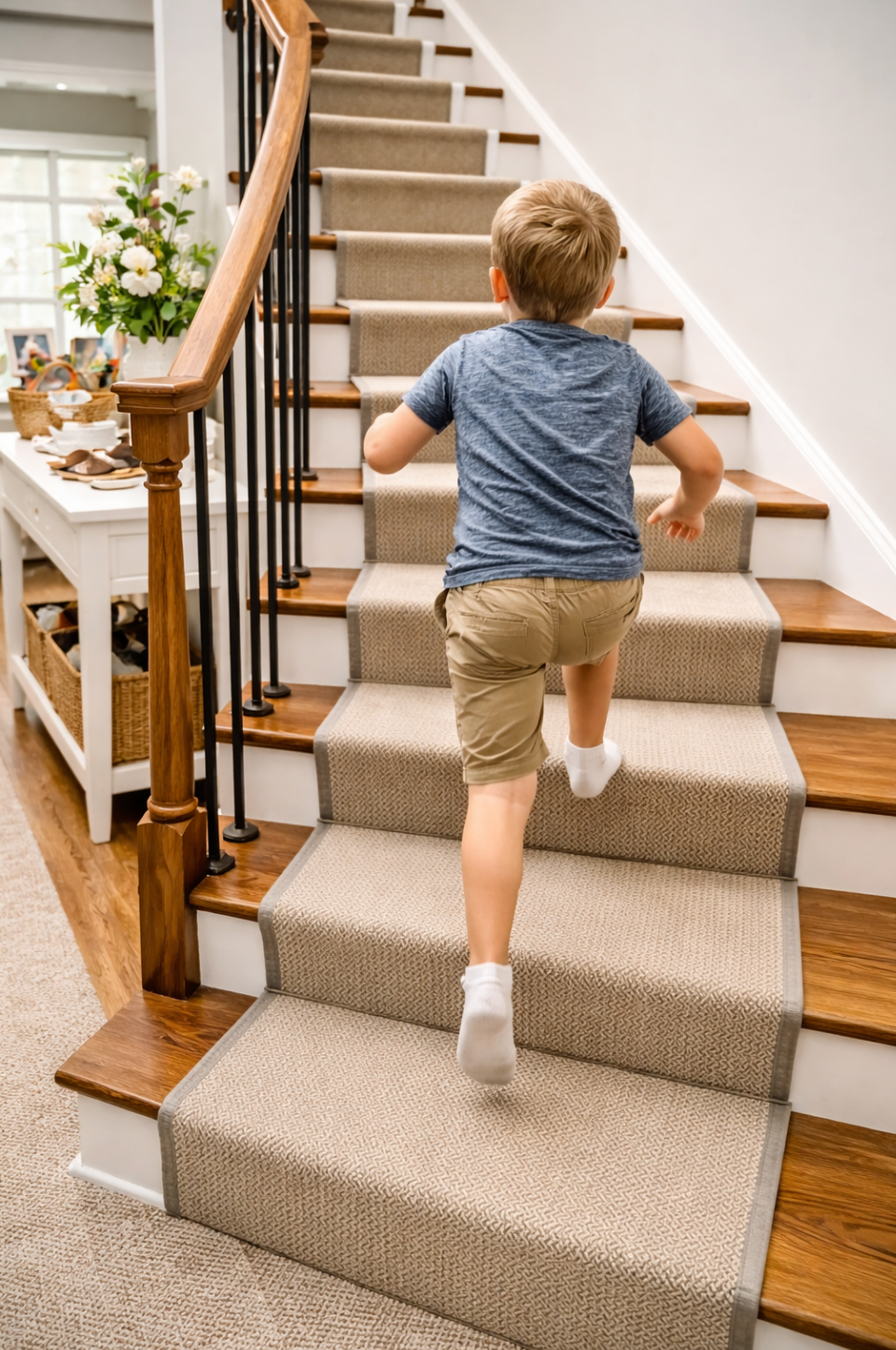
If you are trying to choose the best stair flooring for your home, the right answer is usually not the cheapest option and it is rarely the easiest installation. Stairs are different from the rest of the home. They take concentrated foot traffic, they need proper edge treatment, and small mistakes show up fast. That is why flooring for stairs is not just a style decision. It is a safety decision, a durability decision, and a labour decision.
For most Canadian homes, the best flooring for stairs is usually a durable product installed with the correct stair nosing and proper attention to slip resistance, edge detail, and long-term wear. In many homes, that means practical choices like vinyl flooring on stairs, quality laminate on stairs, or carpet when softness and grip matter most. What matters most is not just how the flooring looks on the staircase. It is how safe it feels, how well the stair nosing is finished, and whether the installer treated the stairs like detailed finish work instead of just another floor.
Many homeowners are surprised when stair pricing comes in much higher than the rest of the flooring quote. They assume stairs are just a smaller version of the floor below. They are not. Stair installations usually involve slower labour, more cutting, more detail work, more waste, more safety considerations, and more finish pieces such as stair nosings. That is why stairs often cost more per square foot, and why this is one area where cutting corners becomes obvious very quickly.

Why Stairs Need a Different Flooring Conversation
A hallway floor and a staircase may use the same product family, but they do not ask the same things from that product. On a regular floor, the installation usually moves across open space and slight visual inconsistencies may never get noticed. On stairs, every tread, every riser, and every front edge sits right in front of the eye. Every line matters. Every cut matters. Every transition matters. A staircase is not just flooring. It is visible finish work.
Stairs also wear differently. Most of the abuse happens on the front of the tread, right where the eye lands and the foot lands. That means the staircase often shows wear sooner than the floor around it. A product that looks great in a living room may be much less convincing once it has been wrapped around a staircase with poor edge detail or a weak nosing solution.
That is also why the best stair flooring is not always the exact same answer as the best flooring for the main level. Homeowners understandably want continuity, but stairs still have to work as stairs first. Safety, grip, edge durability, and long-term appearance all matter more here than they do on most flat-floor installations.

Best Stair Flooring Options: Carpet, Vinyl, Laminate, and More
There is no perfect flooring type for every staircase. The best choice depends on the home, the people using the stairs, and what the owner is actually trying to optimize for.
Carpet remains one of the strongest options for stairs when safety, softness, and noise reduction matter most. It is forgiving, quieter underfoot, and usually feels secure on a staircase. It may not create the same modern hard-surface look that many homeowners want today, but from a practical daily-use standpoint it still solves a lot of stair problems very well.
Vinyl flooring on stairs can be an excellent option when the product is durable enough and the full stair system is handled properly. It gives the homeowner a cleaner, more modern hard-surface look and tends to be easier to maintain than carpet. But this is also where stair detail becomes critical. A good vinyl floor on a flat surface does not automatically guarantee a good stair result. The finished staircase depends heavily on the nosing, the edge treatment, and the overall quality of the installation.
Laminate on stairs can work very well too, especially for homeowners who want strong wood-look value without stretching into a more expensive hardwood look. A quality laminate can create a very attractive staircase when the product line has good accessories and the installer takes the stair detail seriously. But laminate on stairs is not a casual decision. The stair finish needs to be planned, not improvised.
Engineered hardwood can look beautiful on stairs, especially in higher-end homes where the staircase is a major visual feature. But stairs are hard on floors, and real wood edges show wear in a very honest way. Homeowners choosing engineered hardwood on stairs should understand they are usually prioritizing a premium look, not the most forgiving long-term answer.
Tile is usually more limited for interior staircases in everyday Canadian homes. It can suit some specific design styles, but for many households it is simply too hard, too cold, and potentially too unforgiving to be the best everyday stair solution.
Best Stair Flooring Options and How They Perform
| Flooring type | How it performs on stairs | Main strengths | Honest trade-offs |
|---|---|---|---|
| Carpet | Very common and often very safe | Soft underfoot, quieter, good grip, forgiving on stairs | Harder to clean, shows traffic wear, less hard-surface appeal |
| Vinyl flooring on stairs | Strong option in many homes | Durable, practical, easier cleaning than carpet, broad style range | Stair nosing matters a lot, not every product line has a great stair solution |
| Laminate on stairs | Can work very well in the right product and staircase | Good wood-look value, attractive finish, practical durability | Needs strong stair accessories and careful detailing |
| Engineered hardwood | Beautiful when done well | Richer look, real wood surface, premium appearance | Higher cost, more sensitive, stair wear often shows faster |
| Tile | Limited use for most interior staircases | Durable surface, suits some specific designs | Hard, colder, less forgiving, can be a safety concern in some homes |
Stair Nosing for Vinyl Flooring, Laminate, and Other Installations
If you are shopping for stair flooring, stair nosings deserve far more attention than most homeowners give them. A stair nosing is the edge profile at the front of the stair tread, not just a trim piece, but one of the most important parts of the whole installation. It protects a high-wear area, helps create a finished look, and plays a major role in how safe and complete the staircase feels underfoot.
A bad nosing choice can make an expensive floor look cheap. A weak nosing detail can make the stairs feel less secure. A poorly matched nosing can break the visual flow of the entire staircase. That is why this is never just an accessory conversation. It is part of the flooring decision itself.
Stair nosing for vinyl flooring is one of the most important details in the whole job. A good vinyl floor can look excellent on stairs, but the finished result depends heavily on the nosing. If it looks clumsy, weak, or poorly matched, the staircase immediately feels cheaper and less secure. That is why homeowners should never choose vinyl flooring on stairs without first understanding what the full stair-edge solution will look like.
The same principle applies to laminate on stairs. Some product lines simply offer a better stair solution than others, which is one reason stairs should be discussed early in the buying process, not treated like a minor detail after the main floor has already been chosen.

Safety Comes Before Style on Stairs
A staircase can photograph beautifully and still be the wrong choice for everyday life. That is why safety has to lead the conversation. On a flat floor, a slightly slippery surface may just be annoying. On stairs, it can become a real problem. The two biggest issues are usually traction and edge confidence. People need to feel stable stepping onto the front of each tread, especially in socks, in busy households, or in homes with children, older adults, or pets.
This does not mean every staircase should be carpeted. It does mean the homeowner should be honest about how the stairs are used. A dramatic stair look seen on social media is one thing. A real staircase used every day in a Canadian home is another.
Good stair design balances appearance with grip, visibility, and a secure edge. One of the most common homeowner regrets is choosing a staircase that looked impressive during the project but felt too slippery, too hard, or too visually awkward once real life resumed. Stairs are not the place to chase the wrong kind of drama.

Why Stairs Cost More Than Homeowners Expect
This is the question behind a lot of stair conversations: why is the price so high? The answer is that stair work is slower, more detailed, and much less forgiving than open-area floor installation. An open room may allow for long, efficient runs. A staircase does not. Every tread and every riser needs individual attention. Every edge is visible. Every nosing has to be fitted properly. The work slows down because the standard has to go up.
That is why stair pricing often feels disproportionate to the actual square footage involved. Homeowners are usually thinking about the size of the area. Installers are thinking about the detail.
A staircase also tends to create more waste. There are more cuts, more offcuts, more layout decisions, and more opportunities for a piece to be unusable if the cut is not right. And unlike open-floor work, mistakes on stairs are hard to hide. A weak cut or rushed finish often stares back at you every time you use the stairs.
Why Stair Quotes Come in Higher
| Reason | Why it adds cost |
|---|---|
| More labour per step | Each tread, riser, and edge takes separate work |
| Stair nosings and accessory pieces | Specialized materials increase cost |
| More detailed cuts | Stair work is visible finish work, not basic open-run installation |
| Higher waste | More cuts means less efficient material usage |
| Slower installation pace | Stairs cannot be installed nearly as quickly as open areas |
| Higher finish expectations | Errors stand out immediately on a staircase |
Another reason stairs cost more is that not every product is naturally stair-friendly. Some materials require more custom handling, more planning, or more finishing creativity to produce a staircase that actually looks complete. Homeowners often notice the finished staircase more than the finished hallway, and that is exactly why the labour matters more here.
What Homeowners Get Wrong About Flooring for Stairs
The first mistake is assuming stairs are just a small add-on to the main floor. They are not. They are their own decision inside the larger flooring project. The second mistake is choosing the floor first and only later asking how it works on stairs. If the home includes a visible staircase, the stair solution should be part of the flooring conversation from the beginning.
The third mistake is using a product with a weak stair-detail package because the flat-floor sample looked great. A beautiful floor can become a disappointing stair installation very quickly if the nosing looks awkward or the edge feels underwhelming. The fourth mistake is prioritizing style too heavily over safety. Stairs are one of the few places in the home where a visually sharp decision can become a physically problematic one if it is not thought through properly.
The fifth mistake is underestimating how much craftsmanship matters. A staircase reveals the installer's quality very quickly. If the person doing the job treats the stairs like simple flooring instead of detailed finish work, the homeowner usually sees it in the result.

How to Choose the Best Stair Flooring for Your Home
The best starting point is a few practical questions. Who uses the stairs every day: a busy family home has different priorities from a quieter adult household. What matters most: safety, ease of cleaning, visual continuity, premium appearance, or long-term value? Those priorities do not always point to the same flooring type. How important is the staircase visually: in some homes it is a background feature, in others it is central to the entire design. And finally, how strong is the stair nosing solution for the product you are considering? That one question alone can save a homeowner from a very expensive wrong turn.
Best Stair Flooring by Priority
| If your priority is… | Best direction |
|---|---|
| Maximum safety and softness | Carpet |
| Easier cleaning and practical hard-surface look | Vinyl flooring on stairs |
| Best wood-look value | Laminate on stairs |
| Premium appearance | Engineered hardwood |
| Lowest regret over time | A durable product with a strong stair nosing and realistic safety profile |
FAQ: Best Stair Flooring
Here are the questions Canadian homeowners ask most often when choosing flooring for stairs.
What is the best stair flooring?
The best stair flooring depends on the home, but the strongest options are usually carpet for safety and softness, or durable hard-surface options like vinyl flooring on stairs or laminate on stairs when the correct stair nosing is used.
Is vinyl flooring on stairs a good idea?
Yes, vinyl flooring on stairs can be an excellent choice when the product is durable enough and the stair nosing for vinyl flooring is handled properly. The full stair-edge detail matters as much as the floor itself.
Is laminate on stairs a good option?
Laminate on stairs can work very well when the product is good quality and the stair accessories are strong. The visual value can be excellent, but the stair nosing and finish detail need to be right.
Why does stair nosing matter so much?
Stair nosing matters because it affects safety, edge durability, and the overall finished look of the staircase. A weak stair nosing detail can make even a good floor feel cheaper or less secure.
Why do stairs cost more than regular flooring?
Stairs cost more because the work is slower, more detailed, more visible, and usually requires specialized nosings and more cutting. Stair installations are much more labour-intensive than open-area flooring.
Final Verdict
The best stair flooring is the one that balances safety, durability, clean edge detail, and a realistic fit for the household. Stair nosings matter. Slip resistance matters. Visual finish matters. And cost matters, because stairs are one of the most detailed parts of any flooring project.
That is also why stairs cost more. They are not just smaller floors. They are higher-scrutiny, higher-detail, higher-labour surfaces that need to perform safely and look right at the same time. Do not treat the staircase like an afterthought. Get the product, the nosing, and the safety side right from the beginning. That is how you avoid paying for a staircase that looks good for a month but feels wrong for years.
Contact us for help choosing a floor, or find a dealer near you for advice on the right stair solution for your home.
Related Reading
These articles go deeper on topics covered in this guide:
- Vinyl Flooring in Canada: The Complete Guide to Types, Costs, Waterproofing, and Best Uses
- Click Lock Vinyl Flooring: Pros, Cons and Installation Guide
- Engineered Hardwood vs Vinyl Flooring in Canada: What Actually Works in Real Homes
- Condo Flooring Sound and Underlayments in Canada: Rules, Ratings, and Best Flooring Choices