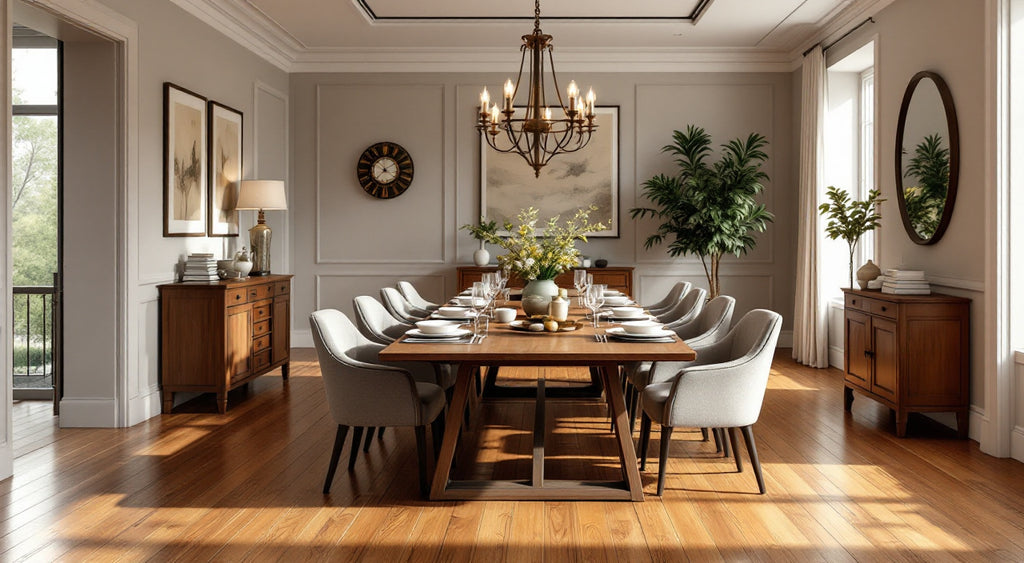
The best flooring for a formal dining room comes down to two things more than any other: how well it reads as a "special room" surface rather than a hallway extension, and how it handles a heavy table, buffet, or china cabinet sitting in the same spot for years. That is a narrower test than most buyers expect. A formal dining room rarely gets the daily foot traffic of a kitchen or entryway, and it is not a wet room, so those two questions matter more than the general durability specs buyers often start with. Dining chairs scooting in and out at every meal come up in almost every conversation about this room, and the honest answer up front is that a quality rigid-core product like WPC vinyl flooring handles that everyday contact without issue; it is heavy stationary furniture and the room's formal look that actually deserve the planning attention.

What Does a Formal Dining Room Actually Demand From a Floor?
A formal dining room's real physical demands are chair-scoot point loads and heavy, mostly stationary furniture, not water exposure or heavy foot traffic. Every time a dining chair is pulled back and pushed in, its legs (or casters, on some chair styles) concentrate a person's full weight onto a few small contact points. A household that eats dinner together most nights puts a chair through that motion well over a thousand times a year, and a home that entertains adds more on top.
The room's furniture load is also unusually static for a living space. A dining table, a buffet or sideboard, and a china cabinet or hutch often sit in the exact same spot for a decade or more, which is a different kind of stress than furniture that gets rearranged. Spills happen, but less often and less severely than in a kitchen: wine, gravy, and the occasional dropped plate, not standing water or daily splashing. That changes what actually matters most when choosing a floor here.
Do Dining Chairs Dent WPC Vinyl, Engineered Hardwood, or Rigid-Core Flooring?
A chair leg has far less surface area than a foot, so the same body weight that spreads harmlessly across a shoe sole becomes a more concentrated load at each leg tip. For a natural material like engineered hardwood's real wood veneer, that repeated concentrated contact over years can eventually show as a faint compression mark or a fine scratch directly under where the chairs sit. A rigid composite core, the kind used in WPC vinyl and in SPC vinyl or a quality AC4/AC5 laminate, is a different story: normal dining chair use, meaning chairs sat in for the length of a meal and then pushed back in, is well within what a rigid core is built to handle without denting.
WPC vinyl flooring is a rigid-core product, and it is durable. Its core is only softer relative to SPC vinyl specifically, and that difference is a comfort benefit, not a weakness: SPC is denser and harder, which also makes it colder and heavier underfoot, closer to walking on concrete. In everyday use, including a formal dining room, WPC's surface performance is very much like SPC's. Engineered hardwood's real wood veneer is the material here that carries a genuine, if modest, vulnerability to concentrated point-load marking, because it is a natural material rather than a manufactured composite or stone-polymer core.
That means dent resistance is not actually the deciding factor in a dining room; WPC vinyl and SPC are both durable rigid cores that handle it equally well. The real trade-off is authentic wood grain and refinishing potential (engineered hardwood) versus a fully waterproof, equally durable core with a warmer, more comfortable underfoot feel (WPC vinyl or SPC). Sustained, aggressive point loads like a piano or a daily-use rolling desk chair are the scenario where a denser core earns its keep, and a formal dining room does not put that kind of load on a floor.
Engineered Hardwood vs WPC Vinyl vs Rigid-Core Options for a Formal Dining Room
| Engineered Hardwood | WPC Vinyl Flooring | SPC Vinyl / Rigid-Core Laminate | |
|---|---|---|---|
| Formal, elegant look | Real wood grain and depth; the traditional formal-dining choice | Wide-plank wood-look designs read elegant at a glance | Wood-look designs available, but reads slightly less premium up close |
| Dent resistance under chair legs | Natural veneer can show a faint mark under sustained concentrated pressure | Durable; rigid composite core handles everyday dining chair use without denting | Also durable; dense core performs similarly to WPC here, with an edge only under sustained heavy point loads not typical in a dining room |
| Furniture and floating-floor fit | Can be glued or floated; heavy furniture planning still needed | Floating click-lock; heavy furniture planning needed | Floating click-lock; heavy furniture planning needed |
| Spill and moisture tolerance | Weakest; real wood surface reacts to standing liquid | Waterproof core; wipes clean without lasting damage | Generally strong; some laminate lines rated for extended surface exposure |
| Refinishing and repair potential | Strongest; a quality veneer can typically be sanded at least once | Not refinishable; damaged planks are replaced | Not refinishable; damaged planks are replaced |
Dent resistance is simply not a deciding factor between WPC vinyl and a rigid-core SPC or laminate product in a formal dining room; both handle normal dining chair use without issue. The real decision is about look and material trade-offs: engineered hardwood gives the most authentic wood grain and can be sanded and refinished, at the cost of a genuine, if modest, vulnerability to marking under concentrated pressure and a real wood surface that reacts to standing moisture. WPC vinyl and SPC both deliver a fully waterproof, durable core with a wide-plank wood-look design that reads elegant in a formal room, and WPC adds a warmer, more comfortable underfoot feel than SPC's denser, cooler surface.

Can a Floating Floor Handle a Dining Table, Buffet, or China Cabinet?
A floating floor needs specific planning around heavy, stationary furniture like a buffet or china cabinet, not just the standard perimeter expansion gap. A floating click-lock floor works because the entire connected surface expands and contracts together across the room as humidity and temperature shift through the year. A heavy piece of furniture that stays in one spot for years anchors that section of the floor in place, so it stops moving with the rest of the room, and the room's normal expansion has to be accounted for somewhere else.
This matters more the larger the furniture's footprint is relative to the room. A slim console against a wall is a minor factor; a full-length buffet or a china cabinet loaded with dishware is not. Do not assume a standard expansion gap automatically resolves this. Discuss the furniture layout with the installer or dealer before the floor goes down, since the right approach depends on the specific product, room size, and furniture placement.
Do You Need Felt Pads or a Rug Under Dining Chairs?
Felt floor protectors under every dining chair leg are one of the simplest, least expensive ways to keep chairs gliding smoothly and to protect against scuff marks and fine scratches over years of use. They are smart, low-cost insurance regardless of which material is chosen, and they matter most under engineered hardwood, where the natural wood veneer is the material genuinely susceptible to marking from repeated concentrated contact. A WPC vinyl or SPC floor is not at real risk of denting from normal dining chair use, but felt pads still help chairs glide instead of dragging and keep any floor looking newer for longer.
An area rug under the dining table adds a second layer of protection and softens the formal look many buyers want. If a rug is used, size it generously enough that all four chair legs stay on the rug even when pulled fully out from the table; a rug that only covers the table itself does nothing to protect the floor where the chairs actually move. Neither a rug nor felt pads is a substitute for the other. Together, they are the standard, low-cost way to protect a formal dining floor regardless of which material is chosen.
Does a Formal Dining Room Need Waterproof Flooring?
Waterproof flooring is a secondary consideration in a formal dining room, real but smaller than in a kitchen or entryway. Wine, sauce, and the occasional dropped dish happen at a dining table, and a fully waterproof core means a spill wipes up without soaking in or leaving a lasting mark, which matters more the more often the room hosts. Engineered hardwood does not offer that same protection: its real wood surface reacts to standing moisture more readily than a sealed vinyl or laminate surface, so a spill needs to be caught quickly rather than left to sit.
This is not reason enough on its own to rule out engineered hardwood in a dining room. It is a trade-off to weigh against the room's actual spill frequency and how quickly the household typically catches a mess. A household that entertains often and worries about wine on light-coloured wood may lean toward WPC vinyl flooring or a rigid-core option for that reason alone; a household that rarely worries about spills may not weigh it heavily at all.
A Formal Dining Room Is Also Where a Pattern or Premium Board Selection Pays Off
Because a formal dining room is a showcase space rather than a high-traffic thoroughfare, it is one of the better rooms in the house to invest in a detail most buyers skip elsewhere. With engineered hardwood, extra material budgeted beyond the minimum lets an installer run the longest boards down the centre of the room, where the eye lands first, and save the shorter, cut pieces for the edges near the walls. That single choice makes a real difference in how seamless a formal room looks.
A herringbone or chevron pattern is also worth considering here specifically, since it reads as an intentionally elevated choice and a formal dining room is small enough that the extra material cost stays manageable. Budget 15 to 20 percent extra material for a herringbone or chevron layout, well above the 7 to 10 percent that covers a straightforward plank installation, since the directional angle cuts waste more material than a simple run. Order the full room's material from a single batch or dye lot, since a formal dining room is exactly the kind of visible, all-at-once space where a colour mismatch from a reorder would stand out.

Frequently Asked Questions About Formal Dining Room Flooring
These are the practical questions that come up most often once a household has settled on the general direction and starts comparing specific products.
Is hardwood or vinyl better for a formal dining room?
Neither is universally better; it depends on what matters more for that specific room. Engineered hardwood gives the most authentic formal look and can typically be sanded and refinished at least once if it gets worn or scratched over the years, though its real wood veneer is the one material here with a genuine, if modest, vulnerability to marking under concentrated pressure. WPC vinyl flooring gives up some of that wood authenticity for a fully waterproof, durable rigid core and slightly easier long-term maintenance, and it handles normal dining chair use without any denting concern. Felt pads under the chairs are still a smart, low-cost habit either way.
Do I need a rug under my dining table?
It is not mandatory, but it is a smart, low-cost layer of protection and a common formal-dining design choice. If used, size the rug so all chairs stay on it even fully pulled out from the table, and pair it with felt pads on every chair leg regardless of whether a rug is used.
Should dining room flooring match the rest of the main floor?
Many households prefer visual continuity between a dining room and adjoining living or kitchen spaces, but it is a design preference, not a durability requirement. A dining room's chair-scoot point loads are a different physical demand than a kitchen's daily foot traffic and spill exposure, so matching materials across rooms means planning for the more demanding room's needs, not assuming the calmer room's needs apply everywhere.
What if my dining room is open to the kitchen?
An open floor plan usually means one continuous flooring choice across both spaces, which means the kitchen's higher spill and traffic demands should generally drive the material decision, even though the dining side of that same floor sees lighter, different-shaped wear from chair legs rather than daily foot traffic.
A formal dining room rewards getting two decisions right: choosing a material that honestly matches how much chair-leg denting resistance matters against how much the authentic look matters, and committing to felt pads or a properly sized rug regardless of which material wins that trade-off. Get both right and a formal dining floor holds its finish and its looks for years in a room built to be seen.
For more on comparing engineered hardwood against other materials, see this honest engineered hardwood vs laminate comparison and the complete engineered hardwood buyer's guide. Chair-leg point loads are not unique to dining rooms; the same protection principles apply in a home office with a rolling desk chair. For how a dining room fits into a broader renovation, see flooring for a main floor renovation and whether to use the same flooring throughout the house. For a closer look at how vinyl actually holds up to everyday scuffs, see is vinyl flooring really scratch resistant.
Contact a flooring specialist with questions about the right product for a specific dining room. To find waterproof vinyl flooring, click here for a Caledon Floors dealer near you.