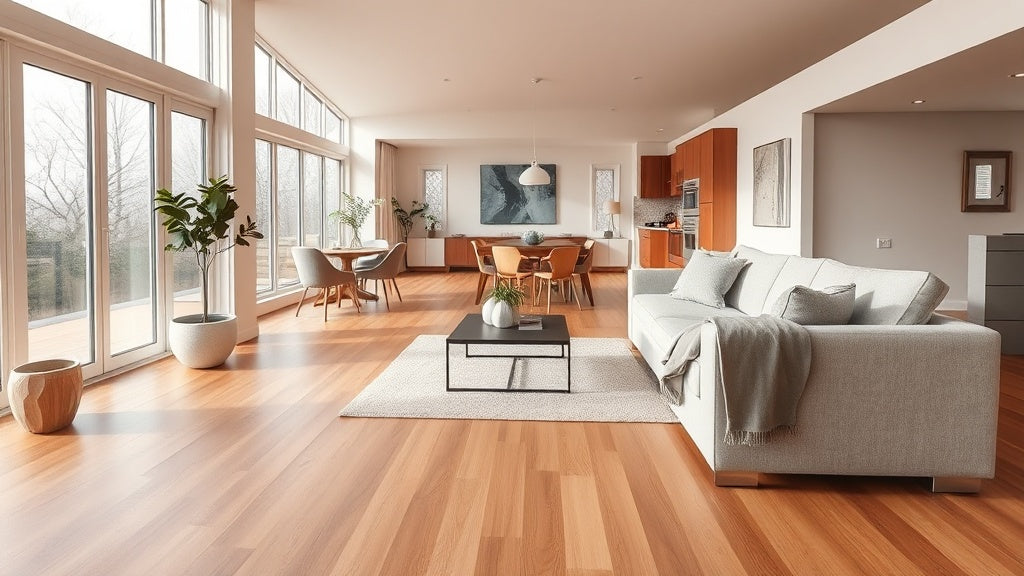
Engineered hardwood and laminate are two of the most popular choices when real solid hardwood is not on the table, and they are genuinely different products that suit different homes. One is a real wood floor. The other is an image floor. That distinction runs through every comparison point: how each looks up close, how each handles moisture, whether it can be refreshed, and how long it realistically lasts.
Both floors have real strengths. Neither is universally better. The right choice depends on how the space is used, what you want the floor to feel like, and how long you expect it to stay.

What Are Engineered Hardwood and Laminate Actually Made Of?
Engineered hardwood is a real wood product. A veneer of genuine hardwood sits on top of a stable, cross-laminated core (typically birch plywood, eucalyptus or a similar engineered base). The top layer is real hardwood, with natural grain variation, real texture, and the depth of character that comes from a living material. Veneer thickness matters considerably here: thinner veneers (0.6mm to 2mm) offer fewer options over the floor's life, while a 4mm veneer provides meaningful structural depth.
Laminate is built differently. Its surface is a photographic film, printed to look like wood (or stone, or tile), protected by a clear wear layer, and bonded to a high-density fibreboard (HDF) core. Laminate does not contain real wood in its surface; what you see is a precisely rendered photograph of wood grain, which today's manufacturing makes very convincing. The floor's visual character is fixed from the moment it is made.
Understanding this construction difference makes every other comparison in this article easier to read.
How Do They Compare on Look and Feel?
Both floors read well in a finished room, and the visual gap between them has closed considerably over the years.
Modern laminate is impressively realistic. High-resolution printing paired with embossed-in-register (EIR) texturing, where the physical surface texture aligns with the printed grain pattern, makes good laminate difficult to distinguish at a glance. For buyers who want a wood-look floor in practical applications, today's laminate is a legitimate option.
Engineered hardwood retains a quality that printing cannot replicate: natural variation. No two planks are identical. Grain shifts across a dye lot, colour ranges from plank to plank, and the floor reads as a living surface rather than a pattern. In a large open-concept room, this variation is what gives an engineered hardwood floor its visual depth. The floor looks subtly different in morning light than it does under evening lamps.
Underfoot, real wood has a density and warmth that synthetic surfaces approximate but do not fully match. Good laminate, especially thicker formats with an attached pad, comes close. But a floor made of actual wood has a solidity and resonance that many homeowners describe as clearly different. Both products benefit from quality underlayment beneath them, which improves both comfort and sound performance.
How Do They Handle Moisture?
Moisture behaviour is where the construction difference matters most practically.
Engineered hardwood manages everyday spills well. Its layered core is more dimensionally stable than solid hardwood, and prompt cleanup is sufficient for most household situations. Extended standing water is a different matter: the real wood veneer and the engineered core both respond to sustained moisture, so spaces with ongoing water exposure call for careful material selection. Kitchens, bathrooms, and above-grade living areas with managed moisture are all reasonable applications for engineered hardwood.
Traditional laminate's HDF core is moisture-sensitive by nature. The category's well-known limitation is seam vulnerability: moisture that reaches the joint over time is a concern, and this is a factor to weigh when choosing a floor for spaces that see regular water. Newer laminate formats have improved meaningfully, with tighter locking systems and more resistant cores, but laminate is not a waterproof floor category in the way that WPC vinyl flooring is.
For spaces where moisture is a genuine ongoing factor (basements, bathrooms, entryways with wet boots through a Canadian winter), a waterproof flooring product built on a composite, non-fibreboard core offers a structural advantage that neither engineered hardwood nor laminate can match by design. Collections like Goliath, Artimis, and Monolith are built specifically for those applications. For a deeper look at engineered hardwood and moisture, see Is Engineered Hardwood Waterproof? What It Can and Cannot Handle.

Can Either Floor Be Refinished?
This is the category where engineered hardwood holds a structural advantage that has no laminate equivalent.
Because the surface layer is real wood, engineered hardwood with adequate veneer thickness can be sanded and recoated. This resets the floor's appearance, removes surface wear, and can change the stain colour entirely. A floor with a 4mm veneer can typically be refinished more than once across its life, which means the floor's lifespan can be extended rather than simply ended when the surface shows its age.
For a complete picture of what refinishing involves and what veneer thickness makes it possible, see Can Engineered Hardwood Be Refinished? What Homeowners Need to Know.
Laminate cannot be refinished. The photographic surface, once worn through or scratched at depth, is permanent. Individual planks can sometimes be replaced if spares from the original purchase were kept, but the floor as a system cannot be sanded, restained, or recoated. When laminate has reached the end of its life, replacement is the path forward.
Which Lasts Longer?
Engineered hardwood's longevity depends significantly on veneer thickness, finish quality, and care. A floor with substantial veneer, maintained well and refinished when the time comes, can remain in service for 30 to 50 years or more. The material does not have a built-in expiry.
Laminate performs well for a defined period, typically 15 to 25 years in residential use depending on traffic and product quality. Commercial-grade laminate, in lighter-traffic applications, can approach the higher end of that range. Laminate holds up respectably, but its lifespan is finite and does not extend through refinishing the way engineered hardwood's does.
Neither product is indestructible. Both perform better with furniture pads, area rugs in high-traffic areas, and consistent care.
Where Does Each Floor Fit Best?
Engineered hardwood tends to be the stronger choice for:
- Main living areas (living rooms, dining rooms, bedrooms) where natural beauty and long-term longevity are the priority
- Homes where the floor is expected to stay for 20 to 30 years or more
- Renovations where future refinishing is part of the plan
- Above-grade spaces with manageable moisture levels
For a broader look at how engineered hardwood compares against solid hardwood, see Engineered Hardwood vs Solid Hardwood: Which Is Better for Your Home?.
Laminate tends to work well for:
- Secondary spaces (home offices, finished basements rated for laminate, guest rooms) where durability and a clean wood look matter more than longevity
- Rental properties or renovation projects where eventual replacement is acceptable
- Practical high-traffic spaces where the floor is a surface first and a design statement second
There is meaningful overlap. Many homeowners choose engineered hardwood for primary spaces and match it with laminate or a waterproof vinyl plank in secondary areas where moisture management or heavy use is the priority. See Best Flooring for a Main Floor Renovation in Canada for guidance on matching flooring to specific rooms and use cases.
Qualitative Comparison at a Glance
| Feature | Engineered Hardwood | Laminate |
|---|---|---|
| Surface material | Real wood veneer | Photographic print layer |
| Natural variation | Yes, inherent to the material | No; uniform printed pattern |
| Refinishable | Yes, with adequate veneer thickness | No |
| Moisture tolerance | Moderate; prompt cleanup handles everyday spills | Sensitive at seams; not a waterproof category |
| Feel underfoot | Natural, solid, warm | Can feel different from real wood; improves with quality pad |
| Typical lifespan | 30 to 50+ years with care and refinishing | 15 to 25 years |
| Scratch resistance | Moderate; finish-dependent | Generally good across the category |
| Best suited for | Main living areas, long-term renovations | Secondary spaces, practical applications |

Frequently Asked Questions
Choosing between engineered hardwood and laminate comes down to a few key considerations. Here are the questions that come up most often.
Is engineered hardwood always the better choice?
Not always. For spaces where longevity, refinishability, and the feel of real wood matter, engineered hardwood is the stronger floor. For secondary spaces, rental properties, high scratch resistance needed, or situations where a practical wood-look floor is needed without the long-term investment, laminate is a capable and legitimate option. The right choice is the one that matches the space and the home's needs.
How realistic does modern laminate actually look?
Today's premium laminate is convincingly realistic, especially with embossed-in-register texturing. In everyday lighting conditions in a finished room, good laminate reads very well. The difference from real wood becomes more apparent under close inspection and over years of use, but modern laminate has closed the gap meaningfully compared to older generations of the product.
Does engineered hardwood feel warmer underfoot?
Most people who have lived with both describe a difference. Real wood has a natural density and warmth that synthetic surfaces replicate to varying degrees. Premium laminate with a quality attached pad comes closer, but a floor made of actual wood tends to feel different underfoot in a way many homeowners find meaningful. Personal experience in a showroom is a worthwhile step before committing.
Is either floor a good choice for a wet area?
Neither engineered hardwood nor laminate is designed for spaces with ongoing water exposure. For bathrooms, laundry rooms, or basement floors where moisture is a consistent factor, a fully waterproof flooring option is a more practical starting point. Vinyl Flooring vs Laminate in Canada: What Actually Works explores how laminate compares to waterproof vinyl in more detail.
How important is veneer thickness in engineered hardwood?
Very important. Veneer thickness determines whether the floor can be refinished and how many times. A 3mm veneer will allow one careful refinish. A 4mm veneer gives considerably more latitude. If refinishability is part of why you are choosing engineered hardwood, confirm the veneer thickness before purchasing.
Have questions about which floor suits your home? Contact Caledon Floors and a flooring specialist can help you work through the options.
To find waterproof vinyl flooring in Canada, click here for a Caledon Floors dealer near you.