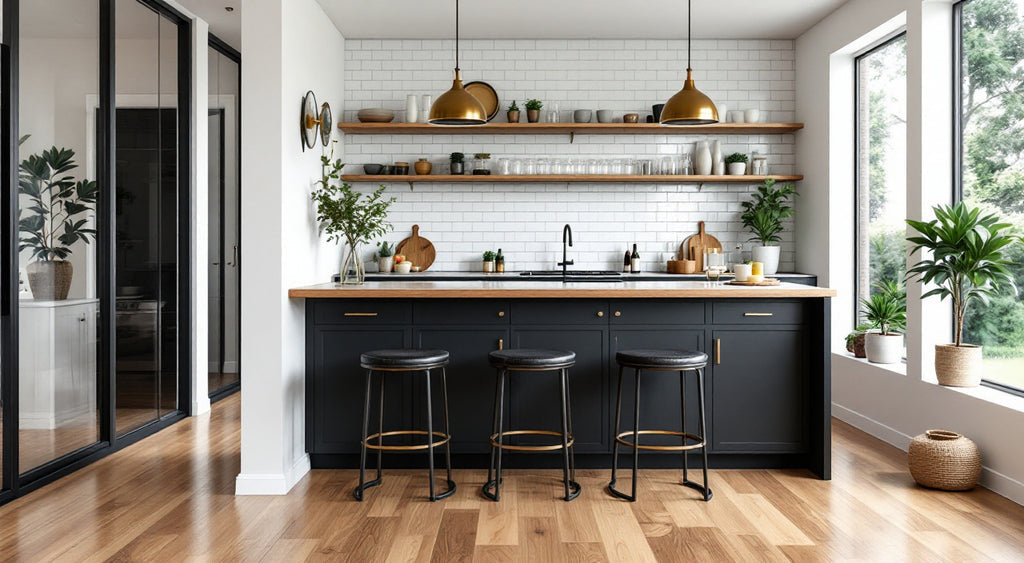
The best flooring for a home bar or wet bar is a fully waterproof surface that shrugs off spills, ice melt, and constant stool traffic without needing babying. That single requirement, waterproof flooring that can also take repeated point contact from bar stools, rules out more materials than people expect and points toward a short list of honest choices.

What Does a Home Bar Floor Actually Need to Handle?
A home bar floor deals with three things most other rooms do not: standing liquid, repeated stool movement, and cabinetry or appliances packed into a small footprint. Spilled drinks, melting ice cubes, and condensation from glassware land on the floor more often than in almost any other room in the house except the kitchen and bathroom. Stools get pulled out, spun, and dragged back in dozens of times a night, which concentrates wear on a few small contact points instead of spreading it evenly like foot traffic does. And because a bar is usually built into a corner, an island, or a finished basement wall, the floor often has to work around a sink, a beverage fridge, or an ice maker rather than sit in an open room.
None of that means a home bar needs the same flooring as a bathroom. It is a splash-and-spill environment, not a standing-water one, closer in practice to the demands covered in flooring for entryways and mudrooms than to a full wet room. The right answer is a floor built for occasional liquid contact and repeated point pressure, not a floor engineered for a shower pan.
Is Waterproof Flooring Necessary for a Wet Bar?
Yes, if the bar has a sink, an ice maker, or a beverage fridge that can leak or overflow. A wet bar by definition includes plumbing, and plumbing eventually drips, seeps, or overflows even when it is installed correctly. A floor with a genuinely waterproof core, not just a water-resistant surface coating, is the only category that removes water damage as a long-term risk in that zone.
A dry bar, meaning a bar cart or cabinet setup with no plumbing, carries much lower stakes. Spilled drinks and ice melt still happen, but there is no sink or fridge line that can fail while nobody is home. For a dry bar, the flooring decision comes down more to comfort, look, and stool durability than to water risk. The same waterproof-core logic that applies to a wet bar's sink zone is covered in more depth in waterproof flooring for kitchens and bathrooms, two other rooms built around the same plumbing-adjacent risk.
How Do Vinyl, Tile, Laminate, and Engineered Hardwood Compare for a Home Bar?
Each of the four common hard-surface categories handles a wet bar's demands differently, and the honest comparison runs in more than one direction. No single material wins every column.
| Material | Water and spill resistance | Comfort underfoot | Stool point-load resistance | Best fit for a home bar |
|---|---|---|---|---|
| WPC vinyl flooring | Fully waterproof core | Warm, cushioned, quietest underfoot | Durable; rigid composite core handles regular stool use without a denting concern | Most home bars, where comfort and warmth matter alongside water protection |
| SPC vinyl | Fully waterproof core | Firmer, cooler than WPC | Also durable; performs similarly to WPC for typical stool use, with an edge only under genuinely heavy, constant, commercial-style traffic | Bars wanting a firmer, cooler underfoot feel than WPC's warmth |
| Tile | Fully waterproof, including grout lines when properly sealed | Hard and cold underfoot | Excellent; resists point load | The immediate zone right around a sink or ice bin, especially in a commercial-style wet bar |
| Laminate | Topical water resistance only, commonly rated for spills left standing up to about 72 hours before core swelling begins; not waterproof at the seams | Firm, moderate warmth | Good on a quality AC4 or AC5 rated product over a dense core | A dry bar with no plumbing, not the wet zone around a sink |
| Engineered hardwood | Real wood surface is vulnerable to standing liquid and swelling; not recommended near standing water | Warm, natural | Vulnerable to point-load denting like any natural wood veneer | Not recommended directly around a wet bar's sink or ice zone |
The rigid-core vinyl categories, WPC and SPC, are usually the practical answer for the bulk of a home bar floor because they combine full waterproofing with genuine day-to-day durability. For a closer look at how the two constructions actually differ, see SPC vs WPC vinyl flooring. Tile earns its place specifically in the small footprint right around a sink or ice bin, where hard, fully sealed protection against standing liquid matters more than comfort. Laminate's topical water-resistance rating, now common across several manufacturers, protects against a spill that gets wiped up promptly, but it is not built for a standing puddle at the seams the way a fully waterproof core is, so it belongs on a dry bar rather than the wet zone. Engineered hardwood's real wood surface carries the same moisture vulnerability it carries anywhere else in the house, and a wet bar's higher spill frequency is exactly the wrong place to test that limit.

What About Bar Stools and Point-Load Damage?
For the typical home bar, used mainly for entertaining on weekends and the occasional weeknight, WPC vinyl flooring's durable rigid core handles stool traffic without a real denting concern. Denting only becomes a genuine consideration when a bar sees stools used for hours at a time, night after night, the way a genuinely constant, heavily used bar does; that kind of repeated, sustained weight on the same few small contact points is where any floor benefits from physical protection.
Felt furniture protector pads under every stool leg are a smart, low-cost habit for any home bar, and they matter most for a bar that sees that kind of constant, nightly use. For stools that swivel or get moved often, a hard plastic mat under the barstool footprint does the same job a chair mat does at a desk. This is general good practice, not a sign that WPC vinyl needs protecting from typical, regular home entertaining use. For more on how vinyl actually holds up day to day, see a realistic look at vinyl's scratch resistance.
If stool traffic is genuinely heavy and constant, closer to a commercial bar than a typical home entertaining space, a denser, more rigid core such as SPC vinyl or a quality laminate over a dense HDF core has an edge over WPC's rigid core under that specific sustained load. Engineered hardwood's natural wood veneer is a different, more real concern in that same scenario, since it is a natural material rather than a manufactured composite core. For the vast majority of home bars, this distinction does not change the decision: WPC's comfort and warmth come without giving up durability for normal stool use.
Does a Home Bar Need Special Flooring Planning Around a Beverage Fridge or Kegerator?
Yes, if the floor is a floating click-lock product. A floating floor works because the entire connected surface expands and contracts together across the room. A heavy, stationary appliance like a beverage fridge, wine cooler, or kegerator anchors that section of the floor in place, so the room's normal expansion has to be accounted for somewhere else instead of resolving itself at a standard perimeter gap.
This is a real planning question, not a minor detail, and it becomes more important the more floor area the appliance covers relative to the bar's footprint. Do not assume a standard expansion gap automatically covers a fixed beverage fridge or built-in ice maker. Discuss the appliance layout with the installer or dealer before the floor goes down, since the correct fix depends on the specific product and room.
What Flooring Works Best for a Bar in a Basement?
Most home bars end up in a finished basement, which adds a moisture source most other rooms do not have: the ground itself. Basement humidity, minor slab moisture, and the risk of a below-grade leak all sit underneath the floor rather than spilling on top of it, which is a different problem from the sink and ice bucket splashes happening above.
A fully waterproof core still matters here, but so does what happens underneath it. A proper vapour barrier between the concrete slab and the flooring, along with basic subfloor moisture testing before installation, protects the investment from below the same way a waterproof wear layer protects it from above. For the wider set of decisions a below-grade room adds on top of the bar itself, see flooring for basements. Skipping the vapour barrier step is one of the more common and avoidable ways a basement bar floor fails years later, long after the party spills stopped being the concern.

Frequently Asked Questions
These are the questions that come up most often once someone has settled on a general direction and starts planning the actual installation.
Is vinyl flooring good for a home bar?
Yes. Both WPC and SPC vinyl offer a genuinely waterproof core, which is the single most important property for a floor that sits under a sink, an ice bucket, and regular drink spills. WPC adds more comfort and warmth underfoot, and its durable rigid core handles typical stool use without a denting concern. SPC adds a further edge in resistance to concentrated stool point loads, but only under genuinely heavy, constant, commercial-style use. For a typical home bar, comfort and warmth are the real trade-off to weigh, not durability.
Can tile go behind a wet bar sink?
Yes, and it is a strong choice specifically for that small zone. Properly sealed tile is inherently non-porous, which is why it shows up so often directly behind commercial and high-use residential bar sinks. Its downside, a cold, hard, unforgiving surface, matters less in a few square feet right at the sink than it would across an entire bar floor.
Does a wet bar need a floor drain?
Most residential wet bars do not include a floor drain; that is more common in commercial bar setups built to code for constant heavy water use. A residential wet bar's water exposure is intermittent spills and splashes, not standing water that needs active drainage, so a fully waterproof floor covering the area is generally the more relevant investment than plumbing in a drain.
Is engineered hardwood ever okay near a home bar?
It can work farther away from the actual sink and ice zone, where spill exposure is occasional rather than routine, the same way it can work in a dining room or living room. Directly around the sink, ice bin, or beverage fridge is where the risk stops being worth it, since real wood's surface reacts to standing moisture in a way a fully waterproof core simply does not.
A home bar or wet bar earns its keep through use, and the floor underneath it takes more concentrated abuse than almost any other room in the house. Getting the water protection and the stool-traffic durability right the first time avoids a costly redo a few years in.
Contact a flooring specialist with questions about the right product for a specific bar layout. To find waterproof vinyl flooring, click here for a Caledon Floors dealer near you.