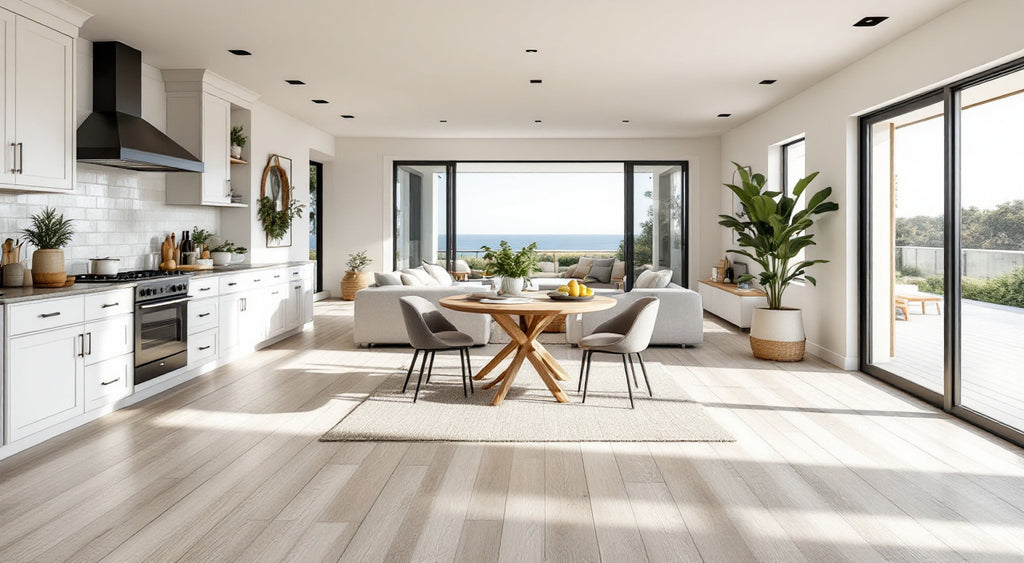
Coastal-inspired interior design leans on flooring more than most homeowners expect, because the floor sets the light, airy foundation the whole look is built on. Sun-bleached, driftwood-toned wood with visible grain and a soft, low-sheen surface is what makes a room read as relaxed and breezy rather than staged. Get the tone or the finish wrong and the rest of the room, however carefully styled, will not carry the look on its own.
What Actually Defines Coastal-Inspired Interior Design?
Coastal-inspired design rests on three working ideas: a light, sun-washed material palette, a deliberate sense of natural, slightly imperfect texture, and a strong visual connection between indoor and outdoor space. Nothing about the style is meant to look polished or formal.
The palette leans on driftwood greys, sandy honey tones, and whitewashed woods, layered with natural fibre textiles, white or off-white walls, and the occasional muted blue or green accent kept mostly to soft furnishings rather than hard surfaces. The texture instinct favours visible wood grain, knots, and colour variation over a flawless, uniform surface, because a floor that looks touched by sun and salt air reads as authentic rather than manufactured. The indoor-outdoor connection means the flooring tone often runs, or at least visually echoes, from the main living space toward glass doors and the outdoor view beyond them.
A fourth idea usually rides along with the first three: comfort underfoot, since coastal-inspired rooms are meant to be lived in barefoot, sand and all, not admired from a distance. That practical instinct is what separates coastal-inspired design from a purely decorative beach theme.

Why Does Texture Matter More Than Tone Alone in This Style?
Texture carries more of the coastal-inspired look than exact colour, because the style is built around the feeling of naturally weathered wood rather than a single specific shade. A wire-brushed or hand-scraped surface, with grain and knots left visible, reads as coastal-inspired even in a tone that would look plain and ordinary with a smooth, uniform finish.
This is a genuine departure from a strictly minimalist floor, where a flawless, low-contrast surface is the goal. Coastal-inspired flooring is allowed, even expected, to show natural variation from board to board, since that variation is part of what makes it read as sun-bleached and lived-in rather than freshly machined.
What Wood Tones Read as Coastal-Inspired?
Driftwood grey, sandy honey, and whitewashed or limed oak tones read as coastal-inspired. These sit warmer and more varied than a strict cool-grey Scandinavian palette, but stay well short of the deep, saturated browns associated with traditional or rustic interiors.
Undertone matters as much as depth of shade. A pale tone with a strong orange or red cast will still fight a coastal-inspired room's airy, sun-washed feel, while a driftwood grey or a soft honey tone with natural colour variation across boards reads as genuinely coastal-inspired as long as it stays muted rather than saturated. For a closer look at how undertone gets chosen deliberately rather than by accident, see How to Choose the Best Engineered Hardwood Colour for Your Home.
Does Plank Format and Surface Texture Change the Look?
Yes, on both counts. Wide, long-format planks generally read as more coastal-inspired than a narrow strip floor, for the same reason they work in most open, casual styles: fewer seams and repeats keep the visual field calm rather than busy. Where coastal-inspired design departs from a strictly minimalist wide-plank look is surface texture. A wire-brushed or lightly hand-scraped surface, rather than a smooth, glass-flat one, is what gives the floor its weathered, sun-bleached character.
A matte or low-sheen finish suits the style better than a high-gloss one, for a practical reason as much as an aesthetic one. Coastal-inspired rooms tend to sit near large windows or glass doors that flood the space with direct light, and a glossy floor amplifies that glare into a hot spot rather than a soft glow. A matte finish also disguises everyday sand, dust, and bare footprints far better than a glossy surface, which matters in a style built around barefoot, indoor-outdoor living.

How Does Sun Exposure Affect Coastal-Inspired Flooring?
Meaningfully, because coastal-inspired rooms are usually designed around large windows or glass doors to maximize the indoor-outdoor connection, which also means the floor receives more direct, sustained sunlight than a typical room. Prolonged direct sun changes the colour of almost every hard flooring material over time, wood through a genuine chemical reaction in the surface layer, vinyl more slowly through gradual wear on its protective top layer.
This is a normal material property, not a defect, and it is worth planning around rather than being surprised by later. A rug placed near a sun-drenched patio door, or furniture left in one spot for years, can leave a visible tone difference once it is finally moved, and a lighter, more reflective floor tone also changes how that light-filled room feels day to day. Does Floor Colour Really Change How Warm or Cozy a Room Feels? covers how a floor's tone interacts with the light a room actually receives.
How Does Humidity Near Water Affect Material Choice?
Coastal and other humid climates generally sit at a higher year-round ambient humidity than dry, continental interiors, and that baseline matters for any material that absorbs moisture from the air. Real wood, including the veneer face of engineered hardwood, is hygroscopic: it expands and contracts as humidity rises and falls through the year. A composite core, the kind used in waterproof flooring, has essentially no capacity to absorb moisture from the air, so it stays dimensionally stable regardless of the season or the climate.
This does not mean engineered hardwood is off the table in a humid or coastal setting. It means the room's real humidity pattern, not just its aesthetic, should inform the choice. How Humidity Affects Any Hard Flooring Choice covers this in full. Entryways and mudroom-style spaces that see wet feet, sand, or sustained splashing from an outdoor shower or pool are a different question again, and the honest answer there usually leans toward a fully waterproof core rather than a real wood surface, regardless of how the rest of the home is finished.
What Flooring Materials Can Actually Achieve a Coastal-Inspired Look?
Several flooring materials can meet the driftwood-toned, wide-plank, textured specification coastal-inspired design calls for, and the honest answer depends on where in the home the floor is going rather than on any single category being the default. Engineered hardwood offers a genuine wood face, real grain, and the natural colour variation the style leans on. WPC vinyl flooring can be produced in the same driftwood and sandy tones with a textured, low-sheen surface, and its fully waterproof core is the more practical starting point for an entryway, mudroom, sunroom, or any space with real, sustained exposure to sand, water, or humidity.
Neither category is automatically the right answer everywhere in a coastal-inspired home. A main living space with filtered light and normal foot traffic can work well in either material, while a space with genuine daily water and sand exposure points more clearly toward a waterproof core. The room's actual exposure, not the room's style alone, should decide the material. Waterproof Flooring: The Complete Guide to What Actually Keeps Water Out goes deeper on what a waterproof core actually protects against.
| Design principle | Flooring choice that supports it | Why it works |
|---|---|---|
| Light-filled, airy feel | Driftwood grey, sandy honey, or whitewashed wood tones | Reflects available light while still reading as warmer and more varied than a strict minimalist palette |
| Naturally weathered texture | Wire-brushed or hand-scraped surface with visible grain and board-to-board variation | Mimics genuinely sun-bleached, salt-worn wood instead of a uniform machined look |
| Indoor-outdoor connection | Consistent tone running toward the main glass doors or window wall | Keeps the transition to the outdoor view visually uninterrupted |
| Barefoot, sand-and-salt practicality | Matte or low-sheen finish | Disguises everyday sand, dust, and footprints, and cuts glare from strong direct sun |
| Casual, layered warmth | Natural fibre rugs, such as jute or sisal, layered over the floor | Adds texture and softness without introducing colour that fights the coastal palette |

FAQ: Flooring and Coastal-Inspired Design
A few practical questions come up once tone, texture, and material choices meet the realities of a real home near sun, sand, or open water.
Does coastal-inspired design require white or bleached floors?
No. White and heavily bleached floors are one common expression of the style, but the underlying principle is a light, sun-washed, naturally varied tone, not one mandated colour. A driftwood grey or a soft sandy honey tone reads just as coastal-inspired, as long as it stays muted rather than saturated and keeps some natural grain variation visible.
Is coastal-inspired design the same as Scandinavian design?
Related, but distinct. Scandinavian-inspired design favours a cool, low-contrast, uniform palette built around visual minimalism, while coastal-inspired design allows warmer, more varied tones and deliberately visible texture to read as naturally weathered rather than flawless. See Flooring's Role in Scandinavian-Inspired Interior Design for a closer comparison of the two.
Does a coastal-inspired home actually need waterproof flooring everywhere?
No. The honest answer depends on exposure, not on the style itself. A main living space with normal foot traffic and filtered light can work well in engineered hardwood or waterproof flooring alike. An entryway, mudroom, sunroom, or any space with genuine daily exposure to sand, water, or humidity is where a fully waterproof core earns its place, rather than being assumed as a blanket requirement across the whole home.
Can dark flooring work in a coastal-inspired room?
Occasionally, and usually as a deliberate accent rather than the main floor. A deeper driftwood or weathered walnut tone can work in a smaller, well-lit space or as a contrast in one zone, but it works against the light, airy feel the style depends on if it is used across an entire open floor plan.
Does a coastal-inspired room need engineered hardwood specifically?
No. The look is defined by tone, texture, and finish, not by one material category. Engineered hardwood delivers the most authentic grain and colour variation, while WPC vinyl flooring is the more practical choice anywhere real water, sand, or sustained humidity is part of daily life, and it can still be produced in the same driftwood and sandy tones the style calls for.
Choosing flooring for a coastal-inspired room comes down to a small, consistent set of decisions: a light, naturally varied tone, a textured rather than glass-flat surface, a matte finish that handles sun and sand, and an honest read on how much real water exposure the space actually sees. Get those right and the floor does the quiet, sun-washed work the rest of the style is built on.
To see the full Caledon Floors range, click here.
To find a Caledon Floors dealer near you, click here.