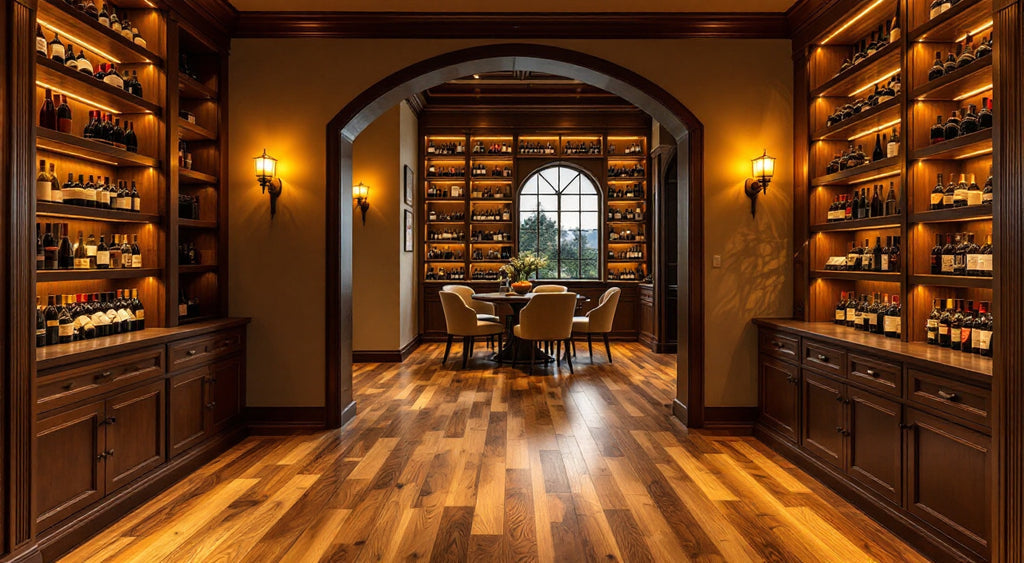
The best flooring for a wine cellar or cold room is a material that will not react to sustained humidity or a cool, damp, often below-grade concrete slab: waterproof vinyl or tile, in most cases, rather than anything built on a wood veneer. These rooms hold humidity levels and temperature conditions that most other rooms in a house never see, and that changes which materials genuinely make sense.
What Makes a Wine Cellar or Cold Room Different From Any Other Room in the House?
Most rooms are built to stay dry and swing with the seasons. A wine cellar or cold room is built to do the opposite: stay cool and hold humidity on purpose, day after day, for years.
A proper wine cellar is typically held at 55 to 59 degrees Fahrenheit (12 to 15 degrees Celsius) with relative humidity in the 50 to 70 percent range. Consistency matters more than hitting an exact number. A room that swings between 50 and 68 degrees does more damage to stored wine than a steady 58 degrees ever would. A cold room, the older-home cousin of the cellar, is usually less deliberately engineered but shares the same basic conditions: cool, damp, and often set against an unheated foundation wall.
That combination, sustained elevated humidity plus a cool, often below-grade concrete slab, is the single biggest factor in choosing a floor for either space.

Is a Wine Cellar the Same Thing as a Cold Room?
Not quite, though they solve a similar problem. A wine cellar is usually a deliberately built, insulated, and mechanically cooled room designed around wine storage conditions. A cold room is more often an existing, unheated nook near a home's foundation, historically used for root vegetables and preserves, that runs cool and slightly damp simply because it sits closer to the ground and the outside wall than the rest of the house.
The practical difference for flooring is how tightly controlled and how dry the space actually is. A mechanically cooled cellar with a vapor barrier and finished walls behaves differently than an older cold room with a bare concrete slab and no vapor control. Both still share the same core challenge underfoot: sustained humidity against a floor. For a broader look at how this plays out across more rooms, see how humidity affects any hard flooring choice.
Why Does Sustained Humidity Change Which Flooring Materials Make Sense?
Because not every flooring material responds to humidity the same way. Materials built from an inert composite core or fired clay do not absorb ambient moisture, so a stable 60 percent relative humidity is a non-event for them. Materials with a real wood face do absorb and release moisture from the air around them, and a wine cellar's whole job is to hold humidity higher and more constantly than a typical living space ever does.
That is not a knock on wood. It is a mismatch between what a wine cellar is built to do and what a hygroscopic material handles well.
Is Engineered Hardwood a Good Choice for a Wine Cellar or Cold Room?
Generally, no, and this is one of the few cases where the honest answer is a clear caution. Engineered hardwood's layered core gives it real dimensional stability compared to solid wood, but its wear layer is still a genuine wood veneer, and wood reacts to moisture in the air around it, not just to standing water.
A wine cellar's target humidity, 50 to 70 percent, held constantly rather than seasonally, is exactly the kind of sustained exposure that puts a wood veneer at the most risk of cupping, swelling, or surface changes over time. It also matters that most wine cellars and cold rooms sit on a below-grade concrete slab, which raises its own moisture questions before flooring choice even comes into play (see the slab-testing section below, and our full piece on whether engineered hardwood can go over concrete). If real wood underfoot matters enough to accept the humidity risk, it needs a fully sealed, mechanically controlled room with a verified, protected slab and close ongoing monitoring, not a typical below-grade space.
Are Waterproof Vinyl Floors a Good Fit for a Wine Cellar or Cold Room?
Yes, with one caveat about the subfloor. WPC vinyl flooring uses a composite core rather than real wood, so it does not absorb ambient humidity the way a veneer does, and its waterproof construction is not compromised by the kind of sustained dampness a wine cellar or cold room holds. That makes waterproof flooring one of the more practical choices for either space.
The caveat is the concrete slab underneath, not the vinyl itself. A floating vinyl floor sits on an attached comfort pad, and if a below-grade slab is releasing more moisture than it should, that moisture has nowhere to go but against the underside of the floor. The fix is not a different vinyl product. It is testing the slab first (see below) and adding a vapor barrier if the results call for one, the same discipline covered in our guide to moisture and vapor barriers.
SPC vinyl, a denser, more rigid composite than WPC, shares the same moisture-inert core and is worth knowing about even though it is a different category. Either composite core handles a wine cellar's humidity without issue. The choice between the two usually comes down to underfoot feel and budget rather than moisture performance, which is covered in more depth in our SPC vs WPC comparison.

Is Tile the Safest Choice for a Below-Grade Cold Room?
For pure moisture resistance, yes. Tile is fired clay or stone, so it does not react to humidity, temperature, or a damp slab at all. In a genuinely damp, older cold room with no vapor barrier and no realistic way to add one, tile is often the most conservative choice available.
The trade-off is comfort. Tile is cold and hard underfoot, which is a downside in most rooms but barely registers in a space that is meant to stay cool anyway. It is also a more involved, more expensive install than a floating floor, and it will not forgive an uneven or cracked slab the way a floating product can.
Does Cork Flooring Work in a Wine Cellar or Cold Room?
It can, with real caveats. Cork's cellular structure gives it natural insulating value and a warmer feel underfoot than tile or vinyl, which some wine cellar owners specifically want.
That comfort advantage depends heavily on the finish, not the raw material. Cork flooring relies on a factory-sealed finish and properly sealed joints to keep sustained ambient moisture from reaching the cork itself, and it is less forgiving of a genuinely damp, unsealed slab than tile or waterproof vinyl. Cork is a reasonable choice in a mechanically controlled, vapor-barriered cellar with a verified dry slab. It is a riskier one in an older, uncontrolled cold room.
Do You Need to Test the Concrete Slab Before Installing Any Flooring in a Cold Room?
Yes, and this matters more here than in almost any other room. Below-grade slabs are more likely to carry elevated moisture than an above-grade slab simply because they sit closer to the surrounding soil, a mistake covered in more general terms in our piece on subfloor preparation mistakes.
The two recognized tests are a calcium chloride test (ASTM F1869), which measures moisture vapor coming off the slab surface, and an in-situ relative humidity probe (ASTM F2170), which measures moisture deeper in the slab. The National Wood Flooring Association's own installation guidelines call for a Class I impermeable vapor retarder whenever calcium chloride readings exceed 3 pounds per 1,000 square feet per 24 hours, relative humidity readings exceed 80 percent, or calcium carbide readings exceed 2.5 percent. For on- and below-grade slabs specifically, the guidelines go further: because below-grade moisture is variable and sub-slab barriers can degrade over time, a vapor retarder is always recommended there, regardless of what the test numbers say. Since a wine cellar or cold room is almost always below grade, that guidance applies directly. This single step does more to protect the floor than the choice of material itself, and the same logic behind it is why below-grade rooms generally, like the ones covered in our guide to basement flooring, call for slab testing before anything else gets decided.

Comparing Flooring Options for a Wine Cellar or Cold Room
None of these materials is wrong in every situation. The right one depends on how controlled the space is and how the slab tests.
| Material | Moisture tolerance | Underfoot comfort | Below-grade suitability | Honest trade-off |
|---|---|---|---|---|
| Waterproof vinyl (WPC or SPC) | Excellent, inert composite core | Warm to neutral, comfortable | Very good, once the slab is tested | The vinyl will not fail from humidity, but the slab still needs testing |
| Tile | Excellent, fully inert | Cold and hard | Excellent, even on a damp slab | Least forgiving install, coldest underfoot |
| Cork | Good, if properly sealed | Warmest, natural insulation | Fair, depends on slab condition and seal quality | Needs a controlled, dry, tested slab to perform well |
| Engineered hardwood | Poor for sustained humidity | Warm, authentic wood feel | Weak, real risk over time | The wood veneer reacts to ambient humidity, not just spills |
Frequently Asked Questions
These are the questions that come up most often once someone starts actually planning a wine cellar or cold room floor, beyond the basic material choice above.
What temperature and humidity should a wine cellar actually hold?
Most wine storage guidance targets 55 to 59 degrees Fahrenheit and 50 to 70 percent relative humidity, with consistency mattering more than hitting an exact number. A steady 58 degrees protects wine better than a room that swings between 50 and 68.
Can laminate flooring work in a cold room or wine cellar?
It is not a strong fit, for a similar reason to engineered hardwood. Modern laminate often carries a strong topical water-resistance rating for spills, but its core is still a wood-fibre board, and sustained ambient humidity is a different kind of exposure than a wiped-up spill. A cold room's constant dampness is closer to the exposure laminate is not built to handle.
Does a wine cellar floor need a vapor barrier?
Often, especially below grade. Whether one is required depends on how the concrete slab tests, as covered in the slab-testing section above, not on which flooring material is chosen. Test first, then decide.
Is mold a real risk in a wine cellar or cold room?
It can be, wherever sustained humidity meets an organic material and poor airflow. Inert materials like tile and waterproof vinyl remove one variable from that equation because there is no organic substrate for mold to take hold in the flooring itself. Ventilation and a tested, properly sealed slab still matter regardless of material.
Can you install flooring directly over a concrete cold room floor?
Only after the slab has been tested and, if needed, treated with a vapor retarder. Skipping that step and assuming any flooring will simply handle a damp below-grade slab is the most common and most avoidable mistake in this kind of project.
To see the full Caledon Floors range, click here.
To find a Caledon Floors dealer near you, click here.