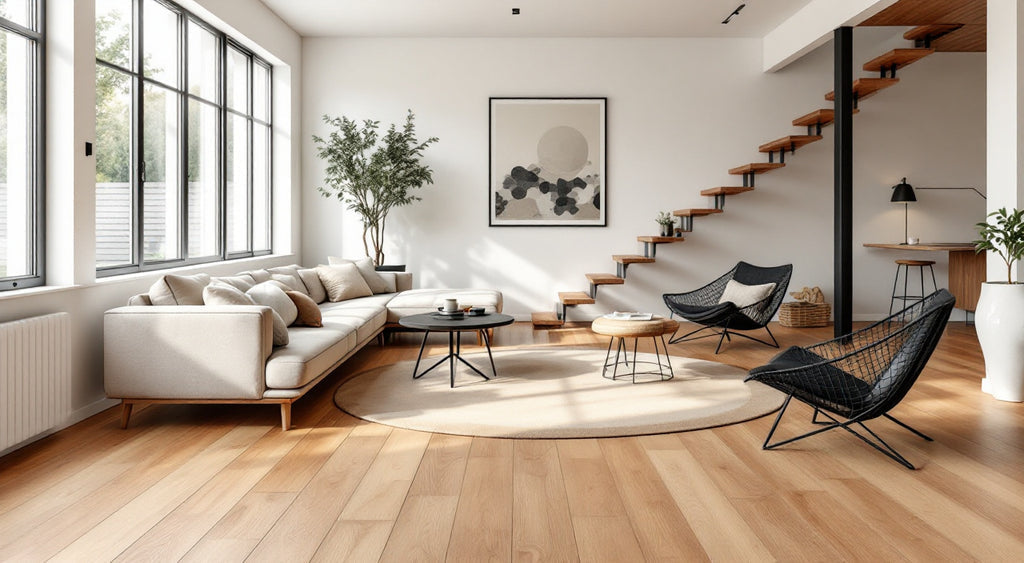
Japandi flooring works when the floor reads as warm, honest, and slightly imperfect rather than pale and pristine. The style blends Japanese wabi-sabi, which values natural imperfection and visible material honesty, with Scandinavian minimalism, so the floor needs to carry warmth and quiet texture at the same time. A wide-plank, matte-finish wood-look floor in a warm mid tone, with real or realistic grain variation left visible rather than sanded away, is what makes a room read as Japandi instead of a colder, paler Scandinavian space.
What Makes a Floor Read as Japandi Rather Than Just Scandinavian?
A Japandi floor leans warmer, more asymmetrical, and more texturally honest than a Scandinavian-inspired one. Classic Scandinavian flooring stays pale and cool in undertone, aiming for maximum light reflection and visual calm. Japandi keeps the same wide-plank, matte-finish instinct but shifts the tone warmer and welcomes more visible grain, more asymmetry in layout and furniture placement, and the occasional darker accent for contrast.
That difference comes directly from wabi-sabi, the Japanese half of the style. Wabi-sabi treats a knot, a mineral streak, or an uneven grain pattern as honest character, not a defect to hide. A floor sanded and finished to look perfectly uniform works against that idea. Flooring's Role in Scandinavian-Inspired Interior Design covers the cooler, more symmetrical version of this minimalist family; Japandi is its warmer, more textured relative, not a rebrand of the same look.
What Wood Tones Actually Fit a Japandi Room?
Warm, mid-range neutrals fit Japandi best: honey oak, sandy blond, soft caramel, and light-to-medium walnut tones. Stark white-washed or ash grey reads as Scandinavian rather than Japandi, and a very dark, glossy espresso tone reads as traditional or formal rather than calm.
The warmth is the point. Hygge, the Scandinavian half of Japandi, is about comfort and cosiness, and a cooler grey floor works against that feeling even in an otherwise minimalist room. A honey or caramel undertone keeps the space feeling lived-in and calm rather than sterile.
Japandi rooms also use tonal contrast more freely than a Scandinavian room does. A warm mid-tone floor paired with darker walnut furniture legs, a black steel shelving frame, or a deep-toned accent wall is a common Japandi pairing, where a purely Scandinavian room would keep that contrast much quieter. The floor tone itself should still stay warm and singular; the contrast comes from what sits on top of it.

Does Wood Grain and Imperfection Actually Matter for a Japandi Floor?
Yes, more than in almost any other design style. Wabi-sabi treats visible wood grain, knots, and natural colour variation as the point of the material, not something to disguise. A floor with heavy grain uniformity and almost no visible character can look "too clean" for a genuinely wabi-sabi room, even if the tone and plank width are otherwise correct.
Engineered hardwood veneers are typically sold in appearance grades, most commonly Select & Better, Character, and Rustic, describing how clean or how marked the single visible wood face looks. Select & Better is the cleanest, most uniform appearance grade, with minimal knots or streaks. Character and Rustic grades show more visible grain movement, mineral streaks, and small knots. A Japandi room genuinely built around wabi-sabi authenticity often suits a Character or Rustic-leaning appearance more than the cleanest available grade, which is the opposite instinct from most other premium flooring buying decisions. How Engineered Hardwood Grade Changes the Look of a Floor walks through what each grade actually looks like underfoot.
A wood-look vinyl floor can also read as authentically Japandi if the embossing is done well. Embossed-in-register texturing aligns the surface texture to the printed grain pattern, so knots and grain lines feel physically present under the foot instead of only visible to the eye. What Embossed-in-Register Texture Means explains how that alignment is what keeps a printed floor from feeling flat or fake. Oak, Hickory, or Maple? is a useful reference for how different species carry grain and knot character differently, whether the floor is real wood or a wood-look printed surface.
Why Does Plank Width and Layout Matter in Japandi Spaces?
Wide, long planks matter for the same reason they matter in Scandinavian rooms: fewer seams create a calmer, less broken-up visual field. Giant Plank vs Standard Format covers how format size changes a room's proportions in more detail, and the same logic applies here.
Where Japandi diverges is layout discipline. A Scandinavian room typically keeps a single run direction and reserves any patterned zone, like a single-tone herringbone entry, as a quiet, contained exception. Japandi tolerates more asymmetry: a rug placed off-centre, furniture arranged in an intentionally uneven grouping, or a single accent zone in a contrasting plank layout, like a chevron threshold, standing out more deliberately against the plainer field around it. The floor itself stays calm and consistent; the asymmetry lives in how the room is furnished on top of it, not in a busy multi-directional floor.
Should Japandi Floors Be Matte or Satin?
Matte or low-sheen finishes fit Japandi best, for the same reason they fit Scandinavian rooms: gloss reflects light and competes for attention in a way that undercuts a calm, uncluttered read. Matte, Satin, or Glossy explains how sheen level changes a room's character in more depth.
Wabi-sabi adds a second reason beyond aesthetics. A high-gloss surface reads as engineered and polished, the opposite of the "honest, unadorned material" idea at the centre of the style. A matte or slightly satin finish lets light sit into the wood grain rather than bounce off the surface, which is part of what makes a textured, characterful floor look intentional instead of unfinished.
Should You Choose Hardwood or WPC Vinyl for a Japandi Home?
Both engineered hardwood and WPC vinyl flooring can genuinely achieve the warm, matte, wide-plank Japandi look, and the honest answer depends on where the floor is going and how much the household values real-wood authenticity versus everyday practicality, not on either material being the automatic right choice.
Engineered hardwood offers a real wood face, so grain, knots, and colour variation are the material itself rather than a printed pattern, which fits wabi-sabi's emphasis on honest materials directly. It can also be refinished within the limits of its wear layer over time, letting the floor age and develop patina rather than needing replacement, which suits the style's comfort with visible age. It does not carry the same moisture tolerance as a manufactured product, so it needs sensible care around spills and humidity.
WPC vinyl flooring uses a fully waterproof core, which makes it the more practical choice for the wetter parts of an open-concept Japandi great room, a kitchen or entry that flows directly into the main living space without a material break. Waterproof flooring keeps the visual continuity a Japandi open floor plan depends on without asking a real wood veneer to handle standing water or spills it was never built for. Good embossed-in-register texturing narrows the visual gap between a printed and a real wood-look floor considerably, though a close look still shows the difference in how grain and knot placement repeat.
Neither material should be treated as the default simply because it is easier to source or more familiar. A household that wants the floor to visibly age and show wear as part of the design should lean toward real wood where moisture exposure allows it. A household prioritizing consistency and low maintenance across an open plan, especially through a kitchen or entry, is generally better served by a waterproof, wood-look material instead.
| What matters for the look | Engineered hardwood | WPC vinyl flooring |
|---|---|---|
| Grain and knot authenticity | Real wood face; genuine variation | Printed pattern; embossed-in-register narrows the gap |
| Warm, wide-plank tones | Widely available | Widely available |
| Matte or low-sheen finish | Standard option | Standard option |
| Ages and develops patina | Yes, within refinishing limits | No; surface stays consistent over time |
| Water tolerance in open-concept kitchens | Needs care around spills and humidity | Fully waterproof core |

How Does Flooring Work with Japandi Furniture and Textiles?
Japandi rooms typically use low-profile furniture, so more of the floor stays visible than in a room full of tall case pieces, which makes the floor's tone and texture carry more visual weight than usual. A floor with real character earns its place in a room built this way; a flat, low-variation floor can end up looking underdressed once the furniture sits low and the floor becomes the room's main textural layer.
Natural fibre rugs, like jute, wool, or a low-pile wool blend, layer texture onto the floor without adding colour contrast, which keeps the room calm while still feeling grounded and warm underfoot. Area Rugs and Hard Floors covers how to add that layer without breaking the floor's visual continuity. For wall, trim, and cabinet colour, the same warm-undertone discipline that governs the floor should extend upward; How to Match Your Floor Tone with Cabinets, Trim, and Walls walks through how to keep a warm floor from clashing with cooler-toned millwork or cabinetry above it.

Frequently Asked Questions
A few practical questions come up once the tone, grain, and finish decisions above meet a real room and a real budget.
Is Japandi just Scandinavian design with a different name?
No. Both styles share a minimalist, function-first instinct and a matte, wide-plank flooring approach, but Japandi runs warmer in tone, more asymmetrical in layout, and more comfortable with visible grain and imperfection because of its wabi-sabi half. Scandinavian design generally stays paler, cooler in undertone, and more symmetrical.
Can I get a genuine Japandi look with vinyl plank flooring instead of real wood?
Yes, provided the embossing is embossed-in-register so the surface texture lines up with the printed grain, and the tone, plank width, and finish sheen follow the same warm, wide, matte guidance that applies to real wood. A fully waterproof WPC vinyl floor is also the more practical choice for a kitchen or entry inside an open-concept Japandi space.
Does Japandi flooring have to be a warm tone, or can a pale grey floor still work?
A warm tone is the more defining choice, since it is one of the clearest ways Japandi separates itself from a cooler Scandinavian palette. A pale, slightly warm greige can still work if the rest of the room's materials, textiles, and wood furniture lean warm enough to keep the overall feeling grounded rather than cold.
Should a Japandi floor be a clean, uniform grade or show more natural grain variation?
Leaning toward more visible grain and character generally suits the style better than the cleanest, most uniform appearance grade available. A near-perfectly uniform floor can end up reading as closer to a formal or Scandinavian aesthetic than a genuinely wabi-sabi one, where natural markings are treated as the material's honest character rather than a flaw.
To find high quality flooring, click here for a Caledon Floors dealer near you.
Contact us with any questions about choosing the right flooring for your space.