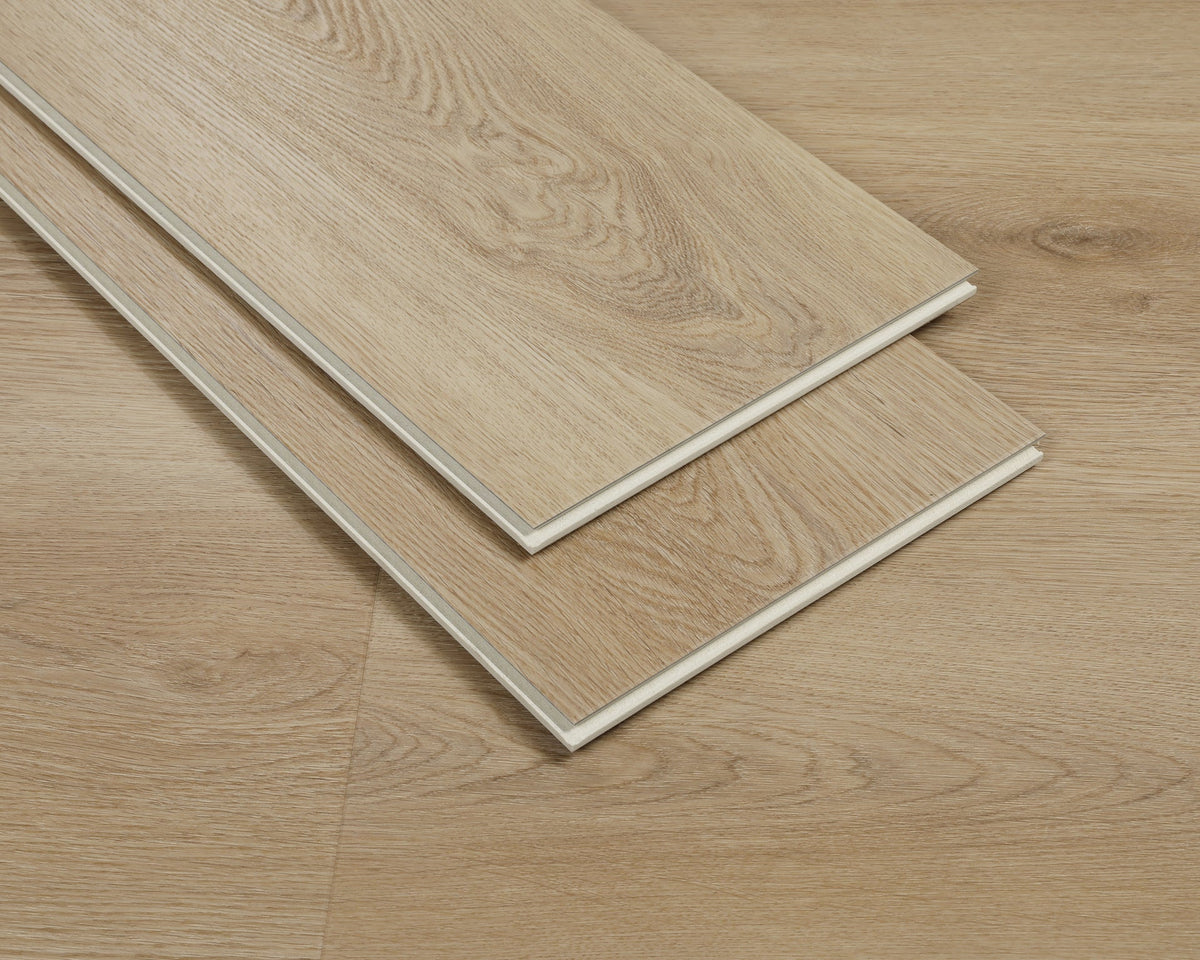
Vinyl plank flooring cost per square foot is driven mainly by five things: the core construction, the wear layer thickness, the plank format, the surface texture precision, and any independent certifications the product carries. Two planks can look nearly identical on a showroom wall and still sit at opposite ends of the price range, because most of what separates them is invisible until you know what to look for.
This matters because vinyl plank is sold in a wider price band than almost any other flooring category. Buyers who understand what they are actually paying for make a better decision than buyers who just compare a price tag against a photo. For a broader look at how vinyl plank compares across types and use cases, see this complete guide to vinyl flooring types, waterproofing, and best uses.

What Price Tier Should You Actually Expect?
Vinyl plank flooring generally falls into three broad tiers: entry, mid, and premium. The gap between them is significant, and premium-tier product commonly costs two to three times more per square foot than entry-tier product with the same core type.
Entry-tier planks use thinner cores, lighter wear layers, and basic printed patterns. Mid-tier planks add a thicker wear layer and better texture matching. Premium-tier planks combine a dense or reinforced core, a heavier wear layer, and manufacturing precision that shows up in how closely the surface texture lines up with the printed wood grain. None of these tiers is inherently the "right" choice. The right tier depends on the room, not the showroom.
Does the Core Type, WPC or SPC, Change the Price?
Core type affects price, but usually by a modest amount rather than a dramatic one. The bigger price swings come from wear layer thickness and manufacturing quality within a core type, not from choosing WPC over SPC or the reverse.
WPC vinyl flooring uses a composite core built for comfort and warmth underfoot, with a cushioned pad already attached in most floating floor products. This construction tends to run slightly thicker overall, which adds material cost. SPC (stone plastic composite) uses a denser, more rigid core, which trades some of that underfoot comfort for a slimmer profile and strong dimensional stability against temperature swings. Pricing between the two core types overlaps heavily in practice. A well-made SPC plank from a reputable line can cost more than a mediocre WPC plank, and the reverse is just as true. Core chemistry alone is a poor predictor of price; the manufacturer's actual build quality within that core type matters more. For the fuller performance comparison beyond price, see this breakdown of the difference between SPC and WPC vinyl flooring.
Does a Thicker Wear Layer Really Cost More, and Is It Worth It?
Yes. Wear layer thickness, measured in mils, is one of the most direct cost levers in vinyl plank flooring, and it is worth paying for in higher-traffic spaces. Light residential product often uses a wear layer in the 6 to 12 mil range, while heavier-duty and commercial-grade product runs 20 mils or more.
The wear layer is the clear protective coating over the printed design layer. It is what actually gets walked on, and it is what determines how long the printed pattern stays visible before it wears through. A thicker wear layer costs more to manufacture and typically carries a longer wear warranty, but it is not equally valuable everywhere. A guest bedroom used a few nights a month does not need the same wear layer as a busy kitchen or a rental property with constant turnover. For a deeper look at matching mil rating to a room, see this guide to choosing the right wear layer, and for how long a well-matched wear layer should realistically last, see how long vinyl plank flooring lasts.
How Much Does Plank Thickness and Format Affect the Price?
Overall plank thickness and plank size both add cost as they increase, largely because they demand tighter manufacturing tolerances. A thin 4 to 5 millimetre plank uses less raw material and is easier to produce consistently. Thicker planks, often 8 millimetres and up, use more core material and generally feel more substantial and quieter underfoot, which is part of why they cost more.
Giant-format planks, meaning longer and wider than a standard plank, cost more again. A larger single piece has to stay dimensionally stable across a bigger surface area without warping or curling at the edges, which requires more precise core engineering and tighter factory quality control. A short, standard-width plank has much less room to go wrong. See this comparison of giant-format and standard-format vinyl plank for how the format choice changes both price and the feel of a room.

Why Do Two Similar-Looking Planks Cost Differently?
Surface texture precision is one of the least visible cost drivers and one of the most expensive to get right. A basic printed plank uses a flat or randomly textured surface that does not line up with the printed wood grain underneath. An embossed-in-register plank aligns the physical texture directly with the printed grain pattern, so a knot or grain line you can see is also a knot or grain line you can feel.
That alignment requires precise tooling and calibration between the printing step and the embossing step, and it is genuinely harder to manufacture consistently at scale. It is also one of the biggest reasons a plank can look convincingly like real wood rather than an obvious print. Buyers comparing two visually similar planks side by side are often comparing a registered-texture product against a flat-textured one without realizing it, which explains a price gap that otherwise looks unexplainable. See this explainer on what embossed-in-register texture actually means for more on why it makes such a visible difference.
Do Certifications Like GreenGuard Gold Add to the Cost?
Yes, modestly, and the added cost reflects real testing overhead rather than a marketing markup. Independent certifications such as GreenGuard Gold and FloorScore require third-party laboratory testing of chemical emissions, ongoing compliance audits, and manufacturing controls to maintain the certification over time.
That process costs the manufacturer money, and it typically shows up in the retail price. What it buys the buyer is independently verified low-VOC performance rather than a manufacturer's own unverified claim. For homes with young children, allergy sensitivities, or simply a preference for verified air-quality data, that cost is easy to justify. For a low-use secondary space, it may matter less. See this explainer on what GreenGuard Gold and low-VOC certification actually verify for the full picture.
Does Waterproof Construction Cost More Than Water-Resistant Vinyl?
Yes. A genuinely waterproof product, meaning a fully sealed composite core that will not swell or delaminate if water sits on it, costs more to build than an older-generation water-resistant product that only resists moisture at the surface. Waterproof flooring needs engineering all the way through the plank, not just a coated top layer, and that thoroughness costs more to manufacture.
This is worth confirming directly rather than assuming from marketing language, since "water-resistant" and "waterproof" describe genuinely different levels of protection. A kitchen, bathroom, basement, or entryway is worth the added cost of a truly waterproof core. A formal living room with no meaningful water exposure generally is not.
Vinyl Plank Cost Drivers at a Glance
| Cost driver | What raises the price | What it actually buys you |
|---|---|---|
| Wear layer thickness | Heavier mil rating (20 mil and up) | Longer visible-wear life, better fit for high traffic |
| Core type and density | Denser or reinforced core construction | Marginal, brand and build quality matter more |
| Plank thickness and format | Thicker planks, giant-format sizes | Sturdier feel underfoot, harder to manufacture without warping |
| Texture precision | Embossed-in-register surface matching | A more convincing, realistic wood look and feel |
| Certification | Independent lab testing and audits (GreenGuard Gold, FloorScore) | Verified low-VOC performance, not a manufacturer's own claim |
| Waterproof core engineering | Fully sealed construction through the whole plank | Genuine water protection, not just surface resistance |
Does Installation Method Change the Total Project Cost?
Material cost per square foot is only part of the total project cost, and installation method can shift the total meaningfully. Click-lock vinyl plank is a floating floor system that connects plank to plank without adhesive, which generally makes it faster and less labour-intensive to install than a glue-down product. See this pros, cons, and installation guide for click-lock vinyl flooring for the full mechanics.
Glue-down vinyl plank often uses a thinner, simpler core, which can make the material itself less expensive, but it requires adhesive and more installation time and skill, which adds labour cost. A homeowner comparing two total project quotes should separate the material price from the installation price before assuming one product is the cheaper overall choice.
How Can You Avoid Overpaying Without Sacrificing Quality?
The most common way buyers overpay is not choosing the wrong tier, it is ordering incorrectly. Flooring is sold by the box, and boxes must be purchased whole, so rounding up is unavoidable. A straightforward, rectangular room typically needs 7 to 10 percent extra material for cuts and waste, while a room with angles, diagonals, or heavy cabinetry needs closer to 10 to 15 percent.
Buying too little is more expensive than it sounds. A second order placed weeks or months later risks a different production batch, or dye lot, with a subtle but visible colour or shade difference from the first order. Ordering everything at once, in one batch, from the start avoids that risk entirely and is one of the simplest ways to protect the money already spent on the floor.
Is More Expensive Vinyl Plank Flooring Always the Better Choice?
No. Paying for a heavier wear layer, a certification, or a giant-format plank in a room that will never use that durability or scale is money spent on a feature the room does not need. A guest room, a formal dining room used a few times a year, or a low-traffic den does not require the same specification as an entryway, kitchen, or rental unit that sees daily wear.
The honest way to shop is to match the specification to the room's actual demands first, then let that decision set the budget, rather than picking a price point and working backward. A well-matched entry-tier product in a genuinely low-traffic room is a smarter purchase than an over-specified premium product the room will never test.

Frequently Asked Questions About Vinyl Plank Flooring Cost
These are the questions that come up most often once buyers understand what actually drives vinyl plank pricing.
Is vinyl plank flooring cheaper than engineered hardwood per square foot?
Generally yes, particularly at the entry and mid tiers, though the gap narrows at the premium end. A premium, giant-format, heavily certified vinyl plank can land close to an entry-tier engineered hardwood product. The categories are not interchangeable on performance, so cost should not be the only factor in that comparison.
Does a longer wear warranty always mean the floor costs more?
In most cases, yes, because a longer wear warranty is usually backed by a thicker wear layer and more rigorous manufacturing controls, both of which add cost. Warranty terms and what they actually cover vary by manufacturer, so it is worth reading the specific warranty language rather than assuming all warranties of similar length mean the same thing.
Why do two vinyl planks that look almost identical cost so differently?
The differences are usually invisible on a showroom sample: wear layer thickness, core density, whether the texture is embossed-in-register or simply flat-printed, and whether the product carries independent certification testing. Two planks can share a similar colour and pattern while differing substantially in all four.
Is the cheapest vinyl plank flooring a false economy?
Not necessarily. In a genuinely low-traffic room, a lower mil, thinner-core product can be a sound and honest choice rather than a compromise. The false economy is buying the cheapest option for a high-traffic or high-moisture space where it will wear through or fail well before a better-matched product would.
To find waterproof vinyl flooring, click here for a Caledon Floors dealer near you.
Contact us with any questions about choosing the right flooring for your space.