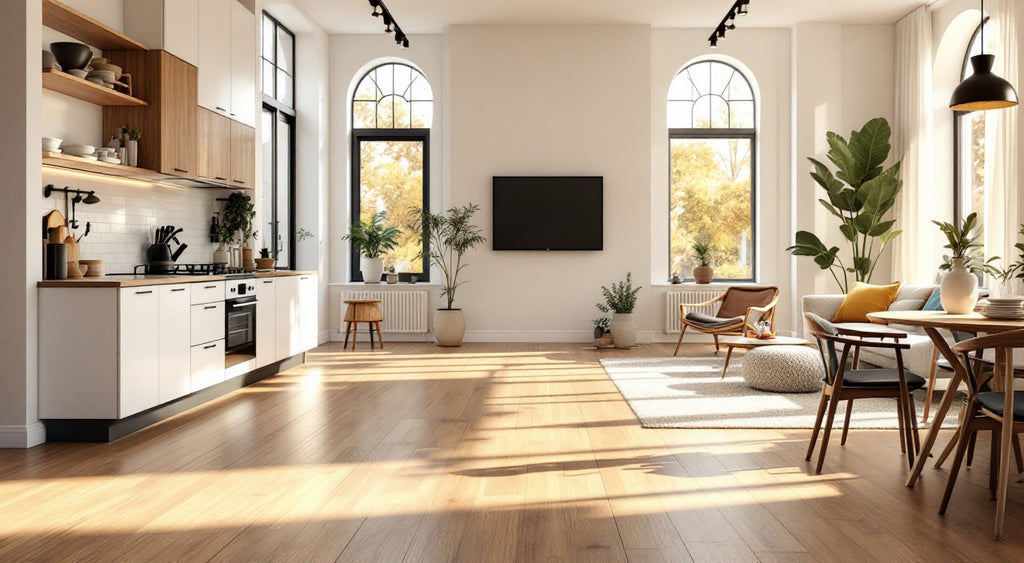
Engineered hardwood carries more misconceptions than almost any other flooring category, and most of them trace back to one confusion: mixing up engineered construction with a printed laminate imitation, or assuming "engineered" means "not real." Neither is true. Engineered hardwood myths tend to survive because the category sits in an awkward middle ground, built differently than solid wood but still genuinely wood, and that middle ground invites guesswork. This is the direct engineered hardwood counterpart to the common myths about vinyl flooring already worth debunking. Here is what actually holds up, and for a fuller buying framework, the engineered hardwood buyer's guide covers the category end to end.

Is Engineered Hardwood Not Real Wood?
Engineered hardwood is real wood. The confusion usually comes from the word "engineered," which describes the construction method, not a substitute material.
A genuine engineered board is a face veneer of solid wood, typically somewhere between 0.6mm and 6mm thick depending on the manufacturer, bonded under heat and pressure to a core of cross-laminated plywood, high-density fiberboard (HDF), or solid-strip lumber. The surface you walk on, sand, and refinish is the same wood species you would get in a solid plank. What changes is what sits underneath it.
That core is the actual engineering, covered in more depth in how engineered hardwood is built layer by layer. Cross-ply plywood alternates the wood grain direction of each layer at 90 degrees, which resists the natural expansion and contraction that causes a solid board to cup, gap, or buckle as humidity shifts through the year. The result is a real wood surface with a more dimensionally stable foundation, not a fake wood surface with a wood-look print, which is the product this myth is actually thinking of.
Can Engineered Hardwood Never Be Refinished?
Some engineered hardwood can be refinished multiple times. Whether a specific floor can depends entirely on how thick its veneer is, not on whether it is engineered at all.
The National Wood Flooring Association's published sanding guidance sets a single flat threshold: once a wear layer has less than 3/32 inch (2.5mm) of wood remaining, the floor should not be sanded again. A typical refinishing pass removes about 1/32 inch (0.8mm) of material, rising to roughly 1/16 inch (1.6mm) for a heavier correction on deep scratches or cupping. A veneer that starts at 4mm clears that 2.5mm threshold with real margin, enough to plausibly absorb a full refinish and still remain refinishable afterward. A veneer at 2mm or thinner starts below the line NWFA says warrants sanding at all, and may not tolerate even one pass.
So the honest answer is not "yes" or "no," it is "check the veneer thickness before you buy if refinishing potential matters to you." This is also why aluminum oxide factory finishes, which are genuinely hard to abrade, do not change the sanding math. They protect the surface from everyday wear; they do not add sandable wood back once the veneer is used up. The full mechanics, including how much material a typical pass removes, are broken down in can engineered hardwood be refinished.
Is Engineered Hardwood Basically the Same Product as Laminate?
No. Laminate's surface is a printed decorative layer sealed under a clear wear layer, sitting on an HDF or particleboard core. There is no wood on a laminate floor's walking surface at all. Engineered hardwood's surface is genuine wood veneer, full stop.
That distinction cuts in laminate's favour on one honest point worth stating plainly: modern quality laminate typically has better water and moisture resistance than engineered hardwood. Many current laminate lines carry a topical water-resistance rating up to 72 hours with wax-sealed edges and a low swell rate, because a printed, sealed surface simply does not react to standing moisture the way real wood does. Engineered hardwood's plywood or HDF core gives it good dimensional stability against humidity swings, but the wood veneer surface itself carries a real risk of swelling, cupping, or discolouring with sustained water exposure, a risk laminate's sealed surface does not share.
Where engineered hardwood wins, and wins clearly, is authentic wood grain and grain variation that no print can fully replicate, plus the refinishing and repair potential covered above. Choosing between them is a real trade-off, not a case of one being a cheaper knockoff of the other, and the full side by side is worth reading in engineered hardwood vs laminate: an honest comparison.
Does a Select & Better Grade Mean a More Durable Floor?
No. Select & Better is an appearance grade, describing how clean and uniform the wood face looks. It says nothing about strength, wear resistance, or durability.
The name comes from the National Hardwood Lumber Association's solid-lumber grading system, where FAS and Select grades describe both faces of a raw board, since a sawmill can cut and use either side. Engineered hardwood only has one real wood face, the veneer bonded to the core, so the two-face lumber mechanics do not apply. When "Select & Better" appears on an engineered spec sheet, it has borrowed the name to describe that single visible face: fewer knots, less mineral streaking, less sapwood, more consistent colour, versus a more rustic, character-graded look with visible natural markings. A higher appearance grade means a cleaner, more uniform look. It does not mean the board resists dents, scratches, or moisture any better than a lower, more character-graded veneer of the same thickness and finish.
Because this is an industry convention rather than a single regulated standard, the exact line between grades can vary from one manufacturer to the next, which is another reason to treat it as a look decision, not a performance spec. What Select & Better actually means covers how to compare it across manufacturers.
Is Engineered Hardwood Off Limits Over Radiant Heat?
Not necessarily, and engineered hardwood is actually the wood flooring category radiant heat installers tend to prefer over solid hardwood, specifically because of its more stable core.
The requirement is that the specific product be manufactured and rated for radiant heat installation, not that wood flooring in general is banned from it. Surface temperatures generally need to stay at or below about 27C (80F) for engineered products, and any temperature change should ramp gradually, no more than a few degrees per day, to avoid thermal shock. Manufacturer guidance typically calls for running the radiant system for at least two weeks before installation so residual construction moisture in the subfloor evaporates, and for using a floor-temperature-limiting thermostat alongside the standard air sensor.
Solid hardwood is generally not recommended over radiant heat at all, because a single solid board reacts to temperature and humidity changes more dramatically than a cross-ply engineered core does. So the myth actually has the comparison backwards: engineered is usually the more radiant-compatible wood option, provided the product is rated for it and the installation follows the manufacturer's temperature and ramp-up guidance. The full breakdown across both vinyl and hardwood is in flooring over in-floor heating.

Is Engineered Construction a Cheaper Downgrade From Solid Hardwood?
No. Engineered construction is a different design choice, not a lesser one, and on dimensional stability specifically, it usually performs better than solid hardwood, not worse.
Solid hardwood is one continuous piece of wood through its full thickness, which means it reacts to humidity as a single mass of material. Wide solid planks are especially prone to seasonal gapping, cupping, and edge lift as moisture levels swing through the year. Engineered hardwood's cross-ply or HDF core resists that same movement because each layer's grain runs against the one below it, so the layers restrain each other. Large humidity swings or a genuinely wet event will still damage either product, but under normal seasonal humidity changes, an engineered floor is generally the more stable of the two.
Solid hardwood's real advantage is depth of material: because the entire board is wood, it can typically tolerate more total refinishing over its lifetime than even a thick engineered veneer can. That is a legitimate, honest point in solid's favour, explored fully in engineered hardwood vs solid hardwood. But "engineered means cheap" and "engineered means less real" are both wrong. It means a different set of trade-offs, matched to a different set of rooms and climates.
Is Engineered Hardwood Waterproof Because It Has a Real Wood Surface?
No, and this is worth stating plainly: engineered hardwood is not water-resistant or waterproof, regardless of veneer thickness, finish quality, or core type. A real wood surface reacts to sustained moisture, full stop.
This is a case where the honest answer points away from wood entirely. For a room with genuine, sustained water exposure, a fully waterproof flooring category is the correct answer, not a wood-based one dressed up with careful language. WPC vinyl flooring is built around a composite core specifically engineered to be waterproof, which is a fundamentally different property from a wood veneer's moisture tolerance. If the central question for a room is water, waterproof flooring built for that purpose is the honest recommendation, and engineered hardwood, however premium, is not that product. The nuanced, full picture, including where engineered hardwood can and cannot go, is in is engineered hardwood waterproof.
Myth vs Reality at a Glance
| Myth | Reality |
|---|---|
| Engineered hardwood is not real wood | It has a genuine wood veneer face, typically 0.6mm to 6mm, bonded to an engineered core |
| It can never be refinished | Refinishing potential depends on veneer thickness versus the NWFA's 2.5mm sanding threshold |
| It is basically the same as laminate | Laminate has a printed surface with no wood; engineered has a real wood face, though laminate usually resists water better |
| Select & Better means more durable | It is an appearance grade of the single wood face, not a strength or wear rating |
| It cannot go over radiant heat | A rated engineered product is often preferred over solid hardwood for radiant systems |
| Engineered means a cheaper downgrade | It is a different, often more dimensionally stable construction, not an inferior one |
| It is waterproof because it has real wood | It is not water-resistant or waterproof; genuinely wet rooms call for waterproof flooring instead |

Frequently Asked Questions About Engineered Hardwood Myths
These questions come up constantly once buyers start comparing engineered hardwood against solid wood, laminate, and vinyl side by side. The short answers below expand on the myths above with the specific numbers buyers usually ask for next.
How thick does the veneer need to be to refinish engineered hardwood?
The NWFA's threshold is a flat 2.5mm (3/32 inch) of remaining wood; below that, a floor should not be sanded. A veneer starting at 4mm or more generally leaves enough margin for at least one full refinish, sometimes more depending on wear. A veneer at 2mm or less starts close to or under the line and may not tolerate sanding at all.
Does engineered hardwood scratch more easily than solid hardwood?
Scratch resistance depends on the finish and wood species, not on whether the board is solid or engineered. Both share the same real wood surface, so a harder species and a well-applied factory finish resist surface scratching similarly whether the board underneath is solid or engineered.
Can engineered hardwood be installed over concrete?
Yes, engineered hardwood is generally a good fit over concrete, provided the slab is properly tested for moisture and acclimated before installation. Its cross-ply core is part of why it tolerates a concrete subfloor better than solid hardwood typically does. The moisture-testing steps that matter most are covered in can engineered hardwood go over concrete.
Is engineered hardwood a good long-term investment?
It can be, when the veneer thickness matches how long you expect to own the floor and humidity stays reasonably controlled. A thick veneer with real refinishing headroom, paired with steady indoor humidity, is a genuinely durable long-term choice; a thin veneer treated carelessly is not, regardless of how the floor is marketed.
Engineered hardwood does not need any of these myths to make its case. The real story, real wood on a more stable core, honest trade-offs against solid wood and laminate, and a genuine need for humidity control, is a good enough reason to consider it on its own.
To discuss your project, click here to contact us.
To find waterproof vinyl flooring, click here for a Caledon Floors dealer near you.